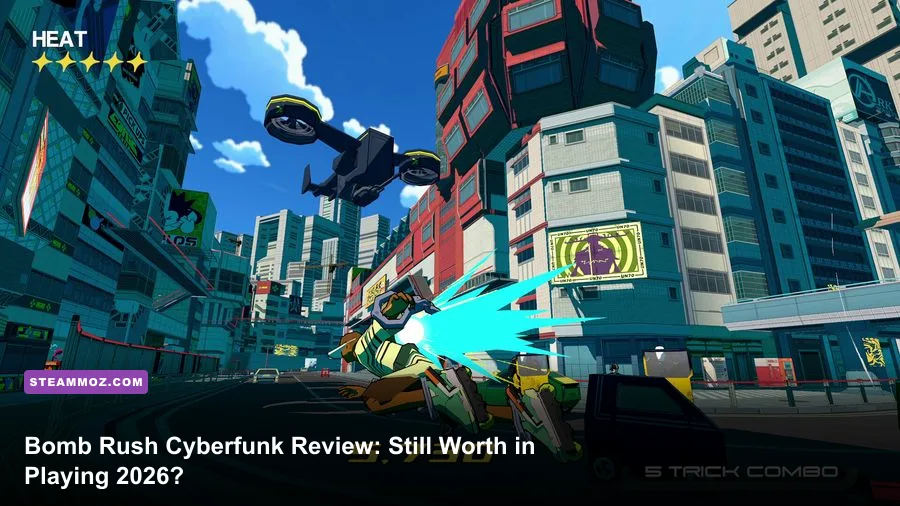
Yes, Bomb Rush Cyberfunk is still worth playing in 2026—especially if you miss movement-heavy arcade games with attitude. Team Reptile's neon graffiti adventure delivers a memorable soundtrack, expressive traversal, and a lovingly built successor to Jet Set Radio Future. Its weak combat, uneven mission pacing, and occasional technical roughness stop it from being a flawless classic, but the core feeling of chaining tricks across New Amsterdam remains unusually satisfying.
The important distinction is that this isn't a modern open-world blockbuster with endless systems. It's a focused arcade-style campaign built around movement, tagging, crew recruitment, and replaying routes until they click. If that sounds like your kind of game, the answer is an easy recommendation. If you need deep combat, realistic skating physics, or a huge amount of post-game content, Bomb Rush Cyberfunk is a much harder sell.

What Bomb Rush Cyberfunk actually does best
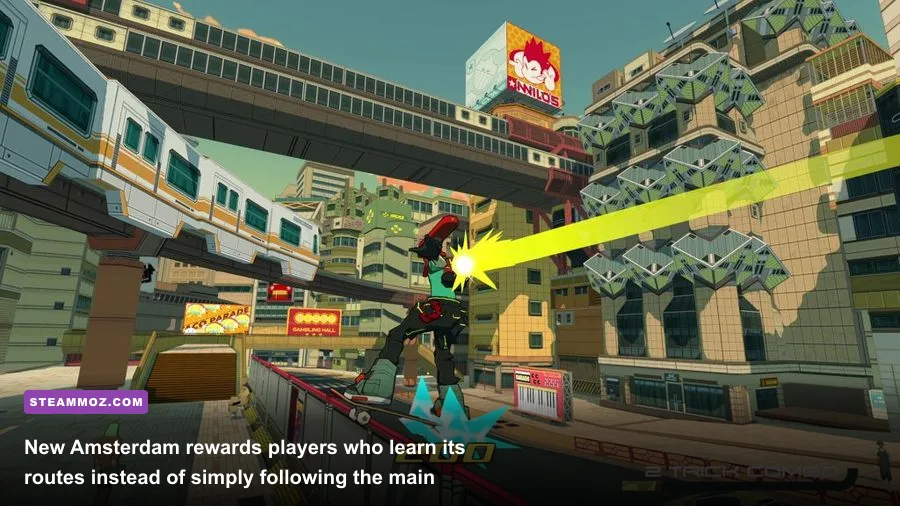
Bomb Rush Cyberfunk places you in New Amsterdam, a futuristic city split into districts controlled by graffiti crews and policed by the militarized R.O.B. faction. You begin as Red, a graffiti writer with a robotic head, before joining Tryce and Bel in the Bomb Rush Crew. From there, the campaign loops through a satisfying rhythm: explore a district, find its graffiti spots, complete challenges, defeat a rival crew, and recruit new members.
The movement is the star. Red can skate, ride a BMX bike, or use inline skates once those movement types become available through the story. Each option has a different feel, but all three support the same basic language: grind rails, wallride surfaces, launch from ramps, perform air tricks, land cleanly, and maintain momentum. The best routes aren't necessarily the fastest straight line. They are the lines that let you link a rail into a wallrun, jump into a manual, then boost toward the next rooftop.
That momentum system gives the game its personality. You aren't merely traveling between mission markers; you're reading the architecture like a skatepark. A traffic barrier becomes a launch point. A telephone wire becomes a grind opportunity. A long staircase becomes a downhill combo line. The controls are accessible within minutes, but mastery comes from learning each district's geometry and finding routes that preserve speed.
| Core Activity | What You Do | Why It Matters |
|---|---|---|
| Movement | Grind, wallrun, boost, manual, and chain tricks | Builds momentum and makes traversal faster |
| Graffiti | Complete small, medium, and large tagging pieces | Expands crew presence and opens progression goals |
| Recruitment | Locate playable crew members around New Amsterdam | Adds movement variety and extends exploration |
| Rival battles | Compete against opposing crews in set-piece encounters | Pushes the story into new districts |
The official Steam page lists the game as a single-player experience, and that's the right way to approach it. This is a compact, authored adventure rather than a live-service skate sandbox.
🎮 Bomb Rush Cyberfunk
Looking to experience this game? Grab your digital key directly on our store for $19.99.
View on Steammoz Store →Movement, graffiti, and the real progression loop
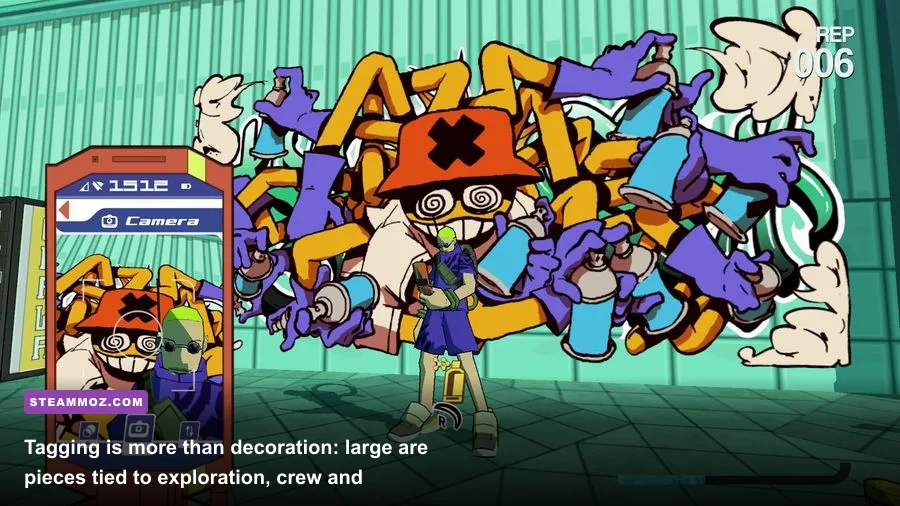
Bomb Rush Cyberfunk's progression is deliberately old-school. You don't spend points on a skill tree, equip stat-boosting shoes, or constantly replace gear. Instead, your options expand through story progression and crew recruitment. New characters often unlock different movement styles, while new areas introduce more complicated graffiti pieces and longer traversal lines.
Graffiti is the connective tissue. Small tags are quick interruptions during exploration, while larger pieces ask you to reach elevated surfaces, collect the necessary spray cans, and execute a short input sequence. The game doesn't turn tagging into a complicated drawing simulator; it treats it as a stylish challenge that keeps you looking upward and searching behind buildings.
That design works brilliantly early on, when every rooftop suggests a hidden route. Later, the repetition becomes more apparent. Districts can feel like checklists if you approach them with completionist tunnel vision. My advice is to treat optional tags as movement challenges rather than chores. Finish the ones that naturally sit along your route, then return for cleanup after the crew's movement options have expanded.
| Progression Stage | Primary Unlocks | Best Approach |
|---|---|---|
| Opening districts | Basic traversal, early tags, Bomb Rush Crew setup | Learn boosting, grinding, and safe landings before chasing collectibles |
| Mid-game | Additional crew members and movement styles | Revisit old districts to reach rooftops and hidden graffiti |
| Late campaign | Harder tags, longer routes, rival crew confrontations | Prioritize momentum and memorize escape routes during chases |
| Post-game cleanup | Remaining graffiti, secrets, and replay value | Use the fastest movement style for each route instead of forcing one character |
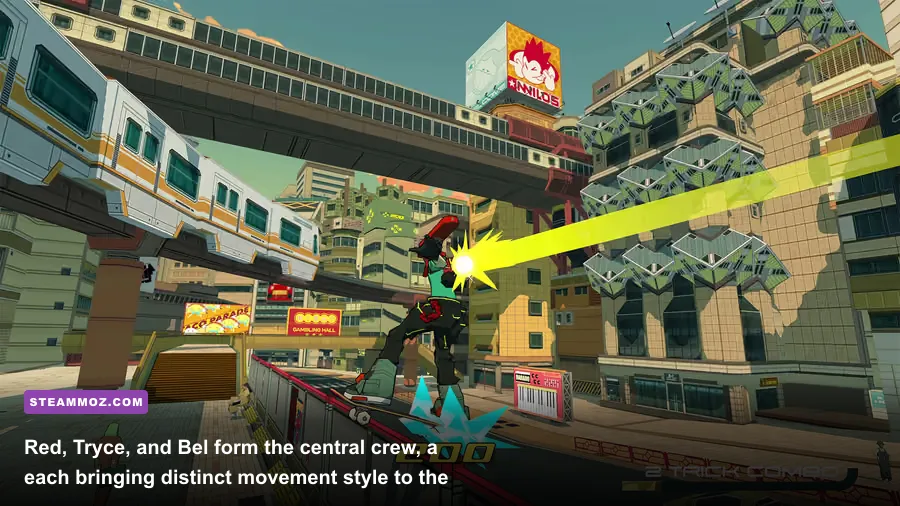
The campaign also understands the appeal of collecting a crew. Characters such as Red, Tryce, Bel, Vinyl, Coil, and Felix aren't radically different RPG classes, but their visual identities and movement options make swapping characters feel meaningful. The game wants you to develop favorites, then return to districts with a fresh set of tricks.
For more advice on games where route knowledge matters more than grinding, Steamoz's secret-location guide for Journey to the Savage Planet is a useful companion read. The games are very different, but both reward curiosity over blindly following objective markers.
Combat is the weak link, not the movement
Combat exists mainly to break up traversal. Red and the crew use close-range attacks, environmental opportunities, and special moves to deal with R.O.B. units and rival gang members. The encounters are readable enough, but they lack the precision and depth of the movement system. Attacks can feel light, enemy behavior is fairly predictable, and there isn't much reason to develop a dedicated combat style.
That imbalance matters because the campaign occasionally makes fights feel more important than they really are. You may enter an area expecting a demanding action sequence, only to discover that the fastest solution is to land a few hits and get back to skating. This isn't a deal-breaker; it simply means you should judge Bomb Rush Cyberfunk as a movement game with combat, not a hybrid that gives both systems equal attention.
Police encounters are more interesting when they become pursuits. The pressure comes from maintaining speed while avoiding getting boxed in, not from carefully parrying every strike. When the alert level rises, keep your route flexible. Use vertical space, break line of sight around buildings, and avoid stopping to admire a combo if a patrol is already closing in.
| Encounter Type | Main Danger | Reliable Counter | Best Tool |
|---|---|---|---|
| Basic R.O.B. patrol | Getting interrupted during a route | Use quick attacks, then immediately resume movement | Short combo into a launch or nearby rail |
| Rival crew fight | Multiple targets crowding a small arena | Keep enemies separated and use the arena's height | Movement-first attacks rather than standing exchanges |
| Police pursuit | Loss of momentum and repeated stun pressure | Change elevation, turn corners, and avoid dead ends | Boost chains, wallruns, and rooftop shortcuts |
| Late-game set piece | Long encounter with limited breathing room | Prioritize survival and positioning over stylish damage | Simple attacks followed by immediate repositioning |
If deep combat systems are your priority, you may have more fun with a dedicated action game. Steamoz's Hell Is Us beginner tips cover a much more combat-focused experience, while Guilty Gear Strive match tips are better suited to players looking for technical fighting mechanics.
Performance and the best way to play in 2026

Bomb Rush Cyberfunk is not a demanding PC game by modern standards. Its stylized visuals, cel-shaded characters, and clean environmental geometry scale well across hardware. The bigger concern is consistency during busy scenes, especially when several characters, effects, and large city vistas appear together. A stable frame rate helps movement feel more reliable than simply pushing every option to maximum.
On PC, start with a frame-rate target your system can hold without dips. The game benefits from responsive inputs because grinding and landing are timing-sensitive, even though it isn't a frame-perfect competitive title. On handheld hardware, accepting a lower resolution or occasional visual compromise is worthwhile if it keeps traversal smooth.
| Setting or Profile | Recommended Value | Performance Impact | Visual Result |
|---|---|---|---|
| Resolution | Native display resolution | Highest GPU cost | Sharper graffiti and cleaner distant geometry |
| Shadows | Medium or High | Moderate | High preserves depth around rails and rooftops |
| Effects | High unless frame rate dips | Moderate in busy scenes | Improves boost trails and colorful special effects |
| Anti-aliasing | High on desktop, lower on handheld | Low to moderate | Reduces jagged edges on wires and rooftop structures |
| Frame-rate target | Stable 60 fps when possible | Depends on hardware | More dependable landings and camera control |
The Steam listing's minimum requirements are modest: Windows 10, an Intel Core i5-2.5 GHz processor or equivalent, 4 GB of RAM, a GeForce GTX 460-class graphics card, and roughly 2 GB of storage. Those figures are old enough that most modern gaming PCs should clear them comfortably. Still, the minimum spec is not a promise of maximum settings or flawless performance on every integrated GPU.
For broader PC optimization context, compare this compact game with Steamoz's Hunt: Showdown 1896 system requirements guide. Bomb Rush Cyberfunk is dramatically easier to run, which is one reason it remains a strong recommendation for modest laptops and handheld PCs in 2026.
Soundtrack, style, and what has aged well
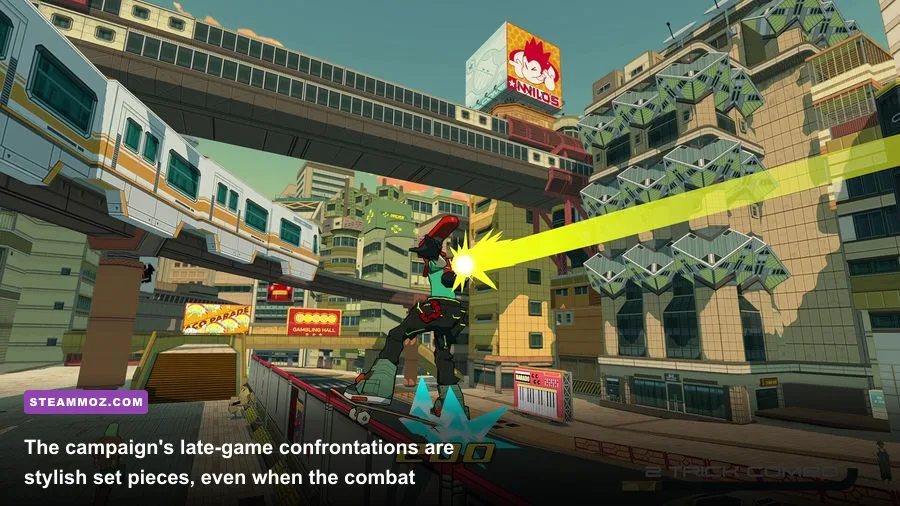
The soundtrack is a major reason Bomb Rush Cyberfunk still feels fresh. It captures the same broad cultural lane as Jet Set Radio without functioning as a simple imitation. The music leans into energetic electronic production, hip-hop, funk, and vocal tracks that make even a routine trip across a district feel like a music-video sequence. The sound design also understands rhythm: rails, boosts, landings, and tagging all contribute to the sense that you are performing rather than merely commuting.
The visual style has aged particularly well. New Amsterdam is colorful and deliberately artificial, packed with bold signage, chunky silhouettes, graffiti murals, and exaggerated faction designs. It doesn't chase photorealism, so the presentation remains distinctive rather than dated. The camera can occasionally fight you in tight spaces, but the overall readability is strong enough that you usually know where the next rail or wallrun should be.
Team Reptile's official Bomb Rush Cyberfunk website makes the game's identity clear, while the developer's official Team Reptile site provides background on the studio's catalog. The game wears its influences openly, yet its characters, setting, and music give it enough personality to stand on its own.
Final verdict: buy it if movement is your main event
Bomb Rush Cyberfunk is worth playing in 2026 because its best idea still works: moving through a city should feel like dancing with the environment. The campaign is long enough to establish its world without exhausting the concept, the crew is memorable, and the graffiti challenges give exploration a tangible purpose. It also runs on modest hardware and offers a rare kind of stylish, single-player arcade experience.
Its flaws are equally clear. Combat is serviceable rather than exciting. Some objectives repeat too often. The camera occasionally turns a clean route into an awkward correction, and players expecting a large online playground may find the post-campaign offering limited. None of those problems erase the central pleasure, but they do explain why this is a very good game rather than an untouchable masterpiece.
| Player Type | Verdict | Why |
|---|---|---|
| Jet Set Radio fan | Strong buy | It delivers graffiti crews, stylish districts, music, and movement with genuine affection |
| Movement-game enthusiast | Strong buy | Routes, trick chains, and vertical exploration carry the experience |
| Combat-focused action player | Wait for a sale | Fights are functional and rarely match the quality of traversal |
| Completionist | Recommended with caveats | There is satisfying cleanup, but some collectibles become repetitive |
| Casual story player | Recommended | The campaign is approachable, colorful, and easier to finish than a huge open-world game |
Steamoz verdict: 8/10. Bomb Rush Cyberfunk doesn't replace every modern skating or action game, and it doesn't need to. It succeeds by committing to speed, style, and the joy of finding one more line through the city. In 2026, that's still more than enough to make it worth playing.