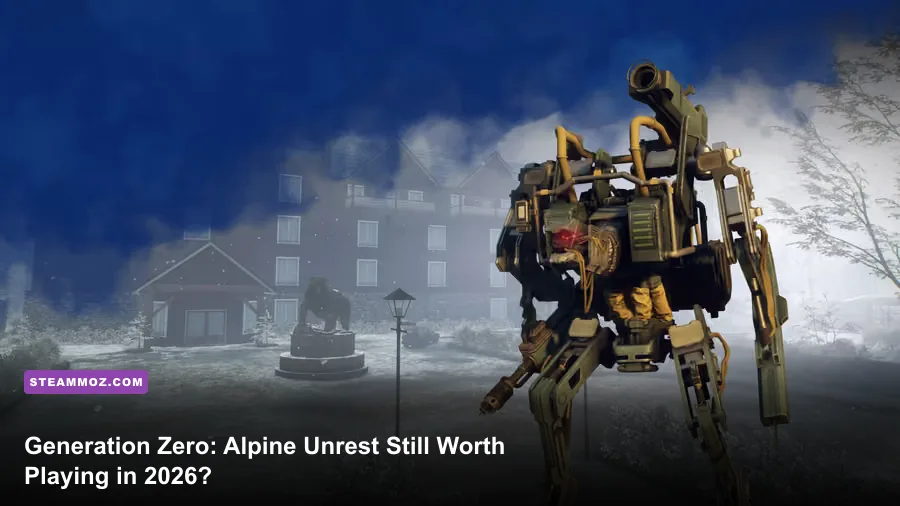
Yes, Generation Zero – Alpine Unrest is still worth playing in 2026 if you already enjoy methodical open-world shooting, scavenging, and co-op ambushes. It is not a standalone expansion, and its story is only a few hours long when rushed, but Himfjäll adds a striking island, tougher Apocalypse-class machines, useful weapons, and some of the game's best atmospheric encounters. The catch is that the DLC inherits Generation Zero's uneven mission design, sparse storytelling, and occasionally awkward AI. Buy it on sale for the best value; skip it if you want a tightly scripted shooter campaign.
This is an expansion for the 2019 base game, not a replacement for it. You need Generation Zero on Steam, and Alpine Unrest is designed for characters who already understand the game's ammunition economy, weak-point targeting, and retreat-heavy combat. New players can visit Himfjäll early, but the island's Apocalypse machines can punish an under-equipped survivor brutally.
What Alpine Unrest actually adds to Generation Zero
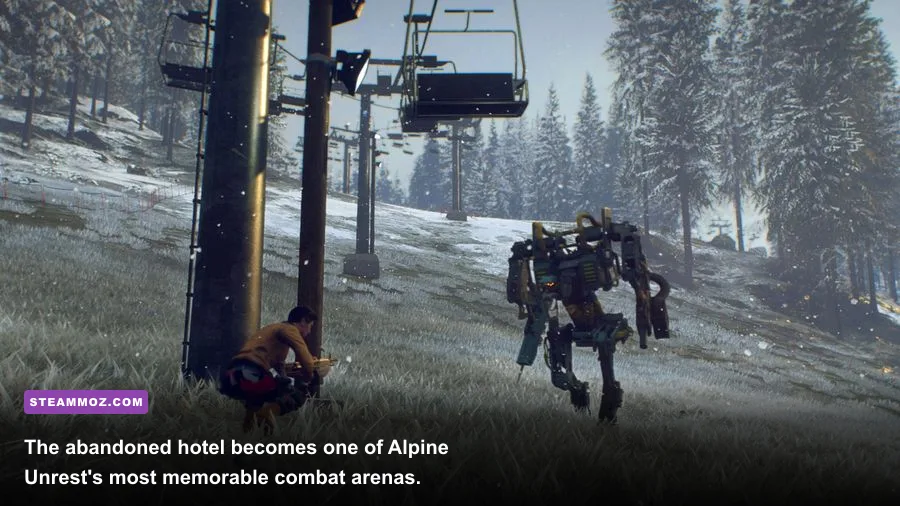
Alpine Unrest takes you to Himfjäll, a snow-covered island separated from Generation Zero's original Östertörn map. Its visual identity is immediately different: frozen roads, dense pine forests, military bunkers, coastal settlements, and the large hotel that dominates the island's early story. The scenery is more compact than Östertörn, which makes missions feel less like long drives between isolated objectives.
The expansion's central story follows the local resistance and digs further into the catastrophe's human cost. Don't expect cinematic character writing or a dramatic branching campaign. Most narrative information still arrives through collectible audio logs, notes, terminals, and brief mission conversations. The strength is mood rather than dialogue. Himfjäll feels abandoned in a way the mainland sometimes doesn't, and its snow, radio chatter, and distant machine noises create a properly tense survival-shooter rhythm.
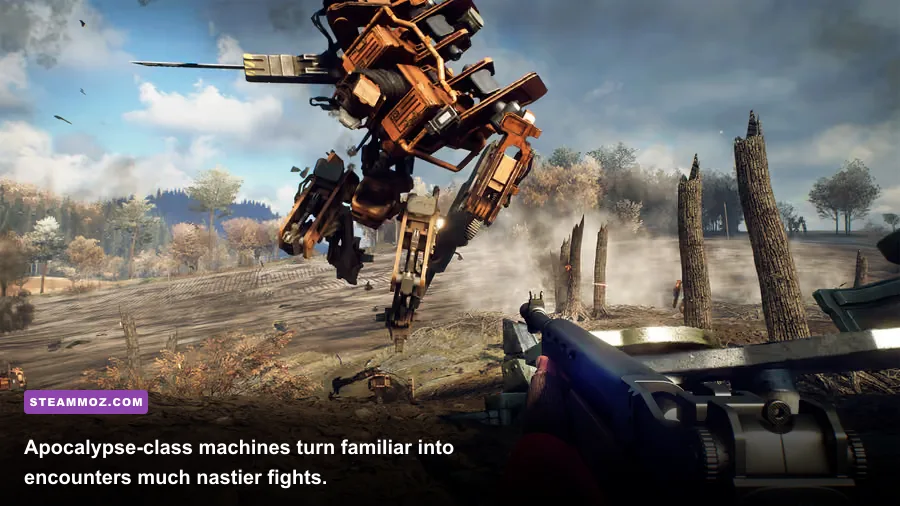
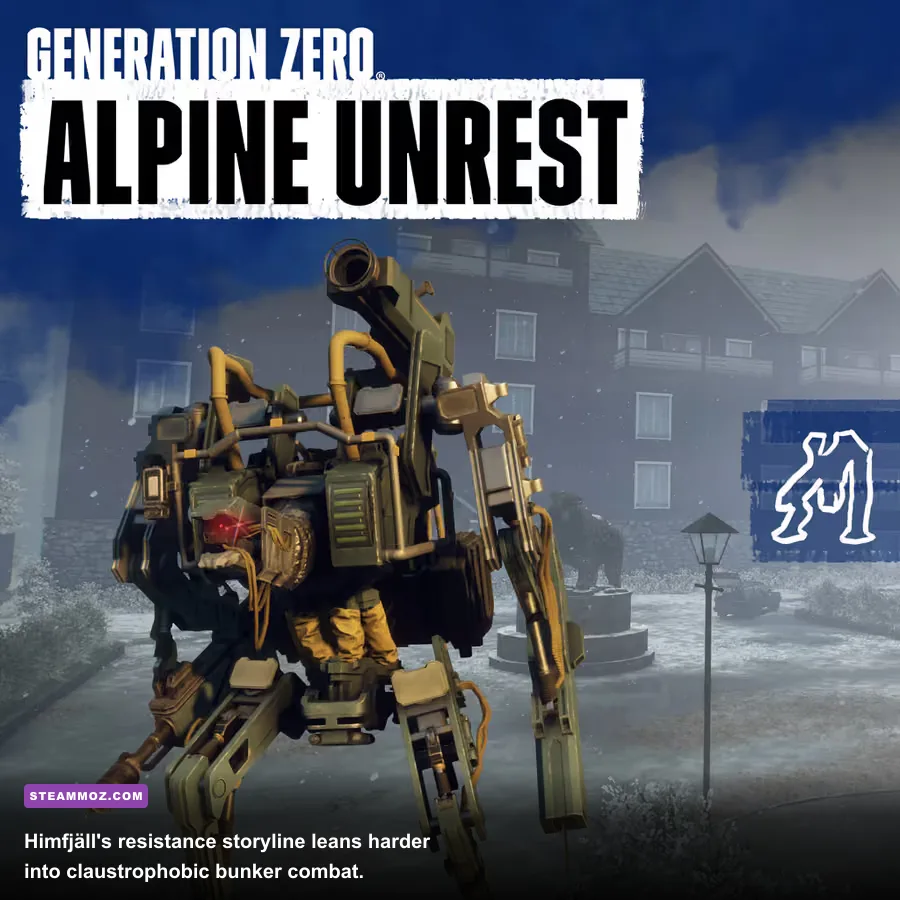
The major mechanical addition is the Apocalypse class of machines. These variants are not simply recoloured robots with larger health bars. They add more dangerous battlefield pressure, forcing you to identify the machine type before committing to a fight. An Apocalypse Hunter can make close-range movement risky, while an Apocalypse Tank turns open ground into a death sentence if you fail to destroy its weapons and armor modules quickly.
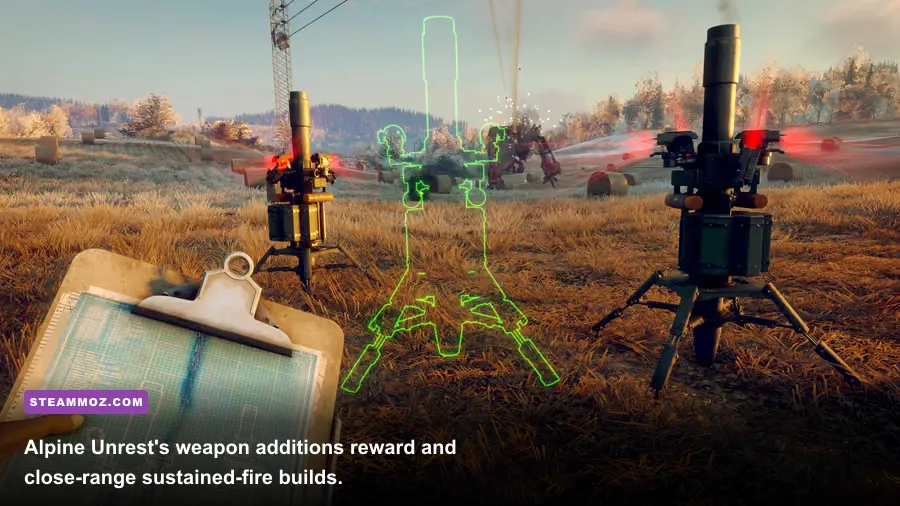
Alpine Unrest also adds new equipment, including the Kpist m/45, N60, and M9. The Kpist m/45 is a fast-firing submachine gun that excels when you are stripping components from Runners, Hunters, and exposed weapon systems at short range. The N60 gives players a heavier sustained-fire option, while the M9 is a practical sidearm for conserving primary ammunition. Weapon quality still depends heavily on rarity and attachments, so finding a five-crown version can matter more than simply unlocking the model.
| Addition | What it changes | Who benefits most | Value in 2026 |
|---|---|---|---|
| Himfjäll island | Compact snowy map with bunkers, settlements, and hotel interiors | Solo explorers and co-op squads | High |
| Apocalypse machines | More dangerous variants with harsher combat pressure | Mid- and late-game characters | High |
| Kpist m/45 | Fast close-range fire for component destruction | Aggressive SMG players | Good |
| N60 | Sustained automatic fire against groups and exposed components | Heavy-gun builds | Good |
| M9 | Reliable backup weapon with manageable ammunition use | Every build | Useful |
🎮 Generation Zero - Alpine Unrest
Looking to experience this game? Grab your digital key directly on our store for $3.19.
View on Steammoz Store →Himfjäll is the DLC's strongest reason to return
Himfjäll works because it compresses Generation Zero's best ideas. On the mainland, a mission can involve a long run across roads, a vehicle detour, two random encounters, and a final objective that feels disconnected from the journey. Himfjäll puts more meaningful landmarks within walking distance. You can loot a house, spot a machine patrol across the snow, enter a bunker, and emerge into a new fight without spending ten minutes driving.
The hotel is the obvious set piece, but it is not the only memorable location. Bunkers create tight sightlines where a Hunter's weapons become more threatening, while snowy forests make it easy to lose visual contact with a patrol. That works both ways: you can break line of sight behind trees, relocate, and attack a machine's fuel tanks from a better angle. The island rewards players who read terrain instead of treating every fight as a flat shooting gallery.
That compact design also improves co-op pacing. One player can scout with binoculars and use the Spotting Intel skill to reveal information, another can carry an EMP-related tool or deployable, and a third can handle ammunition and healing. The squad is rarely so far apart that someone misses the entire encounter. If your group enjoys the slow-burn tension of co-op progression and resource management, Alpine Unrest's island layout is much easier to appreciate than its headline story.
Still, the island is not perfectly dense. Some side activities feel like familiar fetch quests, and collectible hunting can become repetitive if you are trying to clear every icon. The map's best moments happen when you investigate a suspicious building or hear machines before you see them, not when the game sends you to another generic search objective.
How to fight Apocalypse machines without wasting supplies
The most important Alpine Unrest lesson is simple: damage the machine's ability to fight before chasing its health bar. Generation Zero's robots are component puzzles. Shoot armor plates, weapons, fuel tanks, sensors, and exposed internals rather than dumping ammunition into the center mass. A damaged component can change an encounter more dramatically than a few extra rounds of raw damage.
Start every engagement with reconnaissance
Use binoculars before firing. Identify whether you are facing a Runner pack, Hunter support, a Tank, or a Harvester, then look for nearby Seekers and additional patrols. Seekers can attract trouble and make a manageable duel snowball into a multi-machine fight. If your character has Spotting Intel, the extra information is especially valuable in fog, snow, and nighttime encounters.
Prioritize weapons, sensors, and mobility
Against a Hunter, target the weapon arm that threatens your current position, then the second weapon or fuel tank. Against a Tank, avoid standing in front of the machine's main gun and work from cover. A Tank's legs and weapon mounts are better targets than its heavily protected frontal body. Harvester fights become much safer when you remove its rocket pods or interrupt support behavior before dealing with the remaining armor.
EMP cells, EMP rounds, flares, and fire can all create openings, but they are not substitutes for positioning. Flares can redirect attention, while an EMP effect gives you a short window to hit components or revive a teammate. Carrying every tool is tempting, but weight and ammunition limits matter. A focused loadout usually beats a backpack full of gear you never deploy.
| Threat | Primary danger | First target | Best response |
|---|---|---|---|
| Apocalypse Runner | Fast pressure and pack attacks | Legs or exposed fuel area | Keep moving; use SMG fire and shotgun bursts |
| Apocalypse Hunter | Ranged pressure and close-range punishment | Weapon arm | Break line of sight, then flank with an assault rifle or Kpist m/45 |
| Apocalypse Tank | Heavy weapons and area denial | Main gun, legs, or fuel components | Fight from hard cover and rotate positions after volleys |
| Harvester | Rockets and reinforcement pressure | Rocket pods | Use cover, disable support tools, and avoid open fields |
| Seeker | Alerts nearby machines | Sensor body | Kill it quietly or eliminate it before starting the main fight |
For a practical build, put early skill points into Scavenger, Spotting Intel, and Salvage rather than spreading points across every weapon category. Scavenger helps stabilize ammunition supplies, Spotting Intel improves scouting, and Salvage supports the component-focused combat loop. Later, choose Reload Speed, Carry Capacity, or weapon-specific skills based on whether you play solo or in a squad. Players who like precise weak-point shots should lean toward Marksman-related upgrades, while aggressive teams can justify Machine Gunner or close-range weapon investment.
Weapons, progression, and the solo-versus-co-op test
Alpine Unrest is most enjoyable after the base game has taught you its economy. A fresh character can visit the island, but low-tier ammunition, weak armor, and limited skills make the DLC feel harder than intended. Bring at least one accurate mid-range weapon, one close-range option, a sidearm, healing items, and enough ammunition to survive a fight that attracts a second patrol.
The Kpist m/45 is the most immediately exciting addition. Its value comes from controllable aggression: it can chew through Runner packs and exposed Hunter parts quickly, but the short effective range and ammunition appetite punish panic spraying. Burst fire is usually better than holding the trigger until the magazine disappears. Pair it with a hunting rifle or assault rifle so you can open encounters from distance.
The N60 is more situational. It gives heavy-fire enthusiasts a way to maintain pressure, but its handling and ammunition demand make it less attractive for a lightweight solo scavenger. In co-op, it becomes much better because one player can suppress a machine while another circles toward a fuel tank or rear component. The M9 is not a reason to buy the DLC on its own, but it is a dependable backup when you need to finish a damaged component without wasting rifle rounds.
Loot quality remains tied to the wider Generation Zero progression system. The DLC does not suddenly replace your entire arsenal with perfect gear. Expect to inspect multiple versions of the same weapon and judge them by rarity, magazine size, recoil, ammunition type, and attachment slots. If you already have strong five-crown weapons, the expansion's new guns are sidegrades rather than mandatory upgrades.
| Playstyle | Recommended loadout | Skill priorities | Why it works on Himfjäll |
|---|---|---|---|
| Solo scout | Assault rifle, Kpist m/45, M9, binoculars | Spotting Intel, Scavenger, Carry Capacity | Flexible range and better resource control |
| Component sniper | Hunting rifle, assault rifle, M9 | Marksman skills, Spotting Intel, Reload Speed | Removes weapons and sensors before machines close in |
| Co-op suppressor | N60, shotgun, M9 | Machine Gunner, Salvage, Medic | Maintains pressure while teammates flank |
| Close-range brawler | Kpist m/45, shotgun, EMP tools | Close Combat, Reload Speed, Survivor | Strong in bunkers and interiors, risky in open snow |
Solo players should expect more downtime between fights because every revive, resupply, and flank is their responsibility. Co-op makes Apocalypse encounters more forgiving without making them trivial. A disciplined team can split roles; an uncoordinated one simply creates more noise and pulls more machines. If your group enjoyed the tactical scavenging in Earth Defense Force 5, the co-op chaos will probably click, though Generation Zero is slower and more deliberate.
PC performance and whether the 2026 value holds up
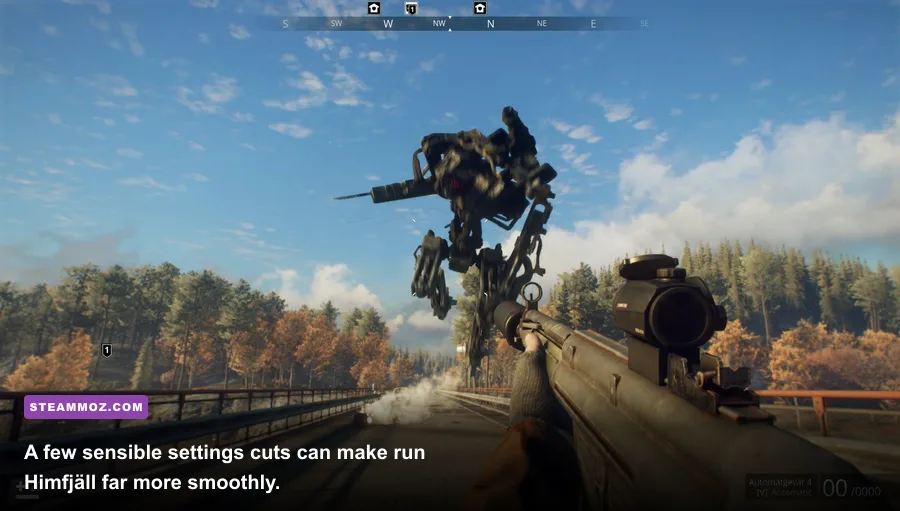
Generation Zero remains visually attractive on PC, especially on Himfjäll, but the open world can produce uneven frame pacing when several machines, effects, and long-distance terrain are visible. The right target is a stable frame rate rather than blindly pushing every setting to Ultra. Shadows, foliage distance, volumetric effects, and resolution scale tend to matter more than small texture adjustments.
At 1080p, a modern six-core gaming PC with 16GB of RAM and a GTX 1660-class or RX 5600 XT-class GPU should be able to target 60 frames per second with sensible settings. For 1440p Ultra, an RTX 3060 Ti, RX 6700 XT, or better is a more comfortable starting point, though CPU performance still matters in busy encounters. Install the game on an SSD if possible; it won't magically raise average FPS, but it can reduce the irritation of streaming stutter and loading pauses.
| Setting | Recommended value | Estimated FPS impact | Visual trade-off |
|---|---|---|---|
| Resolution | Native 1080p or 1440p | Very high | Best clarity; lower resolution is the fastest performance fix |
| Shadows | High | High | Ultra improves forest depth but costs frames |
| Foliage distance | High | Medium to high | Lowering it reduces distant vegetation density |
| Effects | High | Medium | Explosions and smoke lose some richness on Medium |
| Post-processing | Medium | Low to medium | Lower values can improve image cleanliness |
| Anti-aliasing | High or application default | Medium | Lowering it makes snow and foliage shimmer |
| Motion blur | Off | Negligible | Sharper aim and clearer machine movement |
For more PC troubleshooting habits, Steamoz's max-FPS settings guide and smooth-performance settings breakdown cover the same useful basics: cap the frame rate below unstable peaks, check GPU utilization, and test one setting at a time. Generation Zero also benefits from closing background overlays if you are chasing hitching rather than average FPS.
Final verdict: buy Alpine Unrest on sale, not by default
Generation Zero – Alpine Unrest earns a 7/10 in 2026. Himfjäll is a strong setting, the Apocalypse machines add meaningful combat tension, and the Kpist m/45, N60, and M9 give veterans new toys to fold into existing builds. The DLC is at its best when you and friends are quietly scouting a bunker, disabling a Hunter's weapons, and realizing a Tank has arrived behind you.
Its weaknesses are just as familiar. The story rarely rises above environmental intrigue, mission objectives can repeat, and the base game's inventory management and AI quirks remain intact. Alpine Unrest won't convert someone who dislikes Generation Zero's slow scavenger-shooter structure. It also isn't essential for a first playthrough if you're still learning Östertörn.
Buy it if you want more atmospheric co-op combat, tougher machine variants, and a compact map that makes exploration feel purposeful. Wait for a discount if you only want a few hours of story. And if you are returning after years away, check the official Generation Zero site and the official Alpine Unrest Steam listing for current pricing and update information before buying.
The short version: Alpine Unrest is not the expansion that fixes Generation Zero, but it is the expansion that best shows why the game still has a loyal audience. If the sound of rifle fire echoing through a frozen forest sounds like a good evening, Himfjäll remains worth visiting in 2026.