
Yes, Dino Crisis is worth playing in 2026—but only if you want a compact, old-school survival-horror game rather than a modern action blockbuster. Capcom’s 1999 dinosaur thriller still delivers superb tension, clever resource pressure, and one of the PlayStation era’s most memorable protagonists in Regina. Its fixed camera, muddy backgrounds, awkward controls, and dated puzzle logic are real friction points, yet the combination of velociraptors, limited ammunition, branching decisions, and a hostile research facility remains unusually effective. Play it for the atmosphere and survival systems, not for visual polish.
That distinction matters because Dino Crisis has never received the kind of official modern remake that Resident Evil 2 or Resident Evil 4 enjoyed. The original release remains a PlayStation game built around pre-rendered rooms, tank controls, loading transitions, and a roughly six-to-eight-hour first run. If you can accept those conventions, this is still a sharp, focused horror experience. If you expect unrestricted third-person movement, autosaves, modern checkpoints, or cinematic monster combat, it will feel primitive within minutes.

What Dino Crisis Still Does Better Than Most Horror Games

Dino Crisis is set on Ibis Island, where Regina, a member of the government strike team SORT, arrives with Gail, Rick, and Cooper after contact with a secret research facility collapses. The team discovers that Dr. Edward Kirk’s experiments with the Third Energy project have opened the door to something much worse than a conventional security breach. The dinosaurs are not supernatural, but the facility’s science-fiction disaster gives the game a distinct identity that zombie-focused horror often lacks.
The central strength is pressure. Velociraptors do not simply stand in doorways waiting for you to line up a headshot. They rush, flank, retreat, and punish slow recovery animations. A room that was safe thirty seconds ago can become dangerous after a scripted attack, an unlocked door, or a returning dinosaur. The result is a constant calculation: spend shotgun shells now, use a med pack to stop bleeding, or sprint through and risk taking damage?
That pressure is reinforced by the game’s Dynamic Item system. In certain areas, the exact supplies available can vary based on decisions and difficulty, so a player who burns every shell early can create a miserable later section. The game also uses Hemostat items to stop bleeding, while standard recovery items restore health. Bleeding is particularly nasty because it turns a single raptor hit into a slow drain that remains relevant after the fight ends.
Dino Crisis also asks you to make meaningful route choices. The three main endings are shaped by decisions involving characters such as Gail and Dr. Kirk, including whether you prioritize rescue objectives or pursue the scientist. These choices are not as elaborate as a modern branching narrative, but they give repeat runs a purpose beyond collecting a different cutscene. The game’s alternate endings also fit its action-game DNA: short campaigns, strong replayability, and a reason to try a different path.
The atmosphere is doing more work than the graphics
The original PlayStation visuals are undeniably rough. Character models have visible polygons, distant backgrounds are blurry, and dinosaur animations can look stiff. Still, the presentation has a practical advantage: fixed camera angles hide information. A bloodstained corridor, a flickering terminal, or a dark doorway can create suspense because you cannot immediately see what is waiting outside the frame.
The sound design carries the rest. Footsteps, distant roars, gunfire, and warning alarms establish danger before the camera confirms it. The best moments are often quiet ones, when Regina walks through an apparently empty corridor and you hear claws scrape somewhere off-screen. That restraint gives the facility a grim rhythm that still works through headphones.
🎮 Dino Crisis
Looking to experience this game? Grab your digital key directly on our store for $4.99.
View on Steammoz Store →Combat, Weapons, and the Cost of Pulling the Trigger
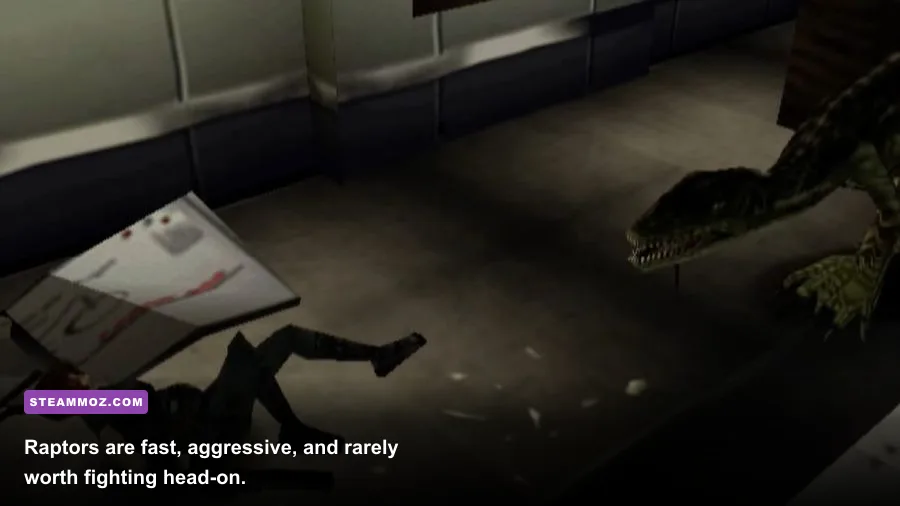
Combat is functional rather than elegant. Regina aims in the direction selected by the controls, waits for a target to enter range, and fires a weapon whose stopping power varies considerably. The game rewards distance, positioning, and knowing when to flee. Unlike many later survival-horror games, Dino Crisis does not make every enemy encounter feel like a mandatory shooting gallery. Running is often the correct tactical decision.
The Glock 34 is your dependable sidearm and the weapon you should treat as a tool for conserving stronger ammunition. It is useful against isolated compys and for creating space, but it is a poor answer to a charging raptor. The shotgun is the workhorse for close-range stopping power. Its spread makes it forgiving when a dinosaur is moving across the screen, though wasting shells on enemies you could dodge will hurt later.
The grenade gun gives you more specialized options through explosive and incendiary ammunition. Explosive rounds are valuable when several threats cluster, while flame ammunition is particularly useful when you need reliable damage over a short window. The dart gun is less immediately exciting but can support a conservative playstyle by using tranquilizer ammunition to neutralize threats without spending your best shells. The flame thrower and anti-tank rifle are situational weapons, saved for specific encounters and late-game emergencies rather than casual corridor cleaning.
| Weapon | Best Use | Ammo Discipline | 2026 Verdict |
|---|---|---|---|
| Glock 34 | Weak enemies and emergency spacing | Use freely, but do not challenge raptors at point-blank range | Reliable starter weapon |
| Shotgun | Stopping a close raptor or clearing a cramped room | Fire when the target commits to an attack | Most important general-purpose weapon |
| Grenade Gun | Groups, explosive hazards, and elemental damage | Reserve specialty rounds for forced encounters | Excellent with planning |
| Dart Gun | Tranquilizing threats and conserving lethal ammunition | Needs patience and safe positioning | Underrated survival tool |
| Flame Thrower | Specific late-game situations | Limited opportunity to replenish fuel | Powerful but highly situational |
One of the game’s smartest combat details is the way enemies react to damage without turning into health bars. A dinosaur may stagger, change direction, or collapse briefly, but that does not always mean the room is safe. You need to watch the animation and create an exit route. When a raptor falls, reload only if you have enough distance. Otherwise, move first and manage the weapon after the camera gives you breathing room.
How to survive raptors without wasting your inventory
Keep moving diagonally when space allows, avoid backing into doors or corners, and learn the shape of each room before you commit to a fight. If a raptor enters from the side of the screen, do not panic-fire the shotgun immediately. Let it close enough for the spread to connect, then use the stagger to pass or reposition. Against multiple dinosaurs, explosive rounds are more efficient than trying to land several separate shotgun blasts.
Always check whether an encounter is actually mandatory. Some rooms are designed to be crossed, not conquered. A sprint through a hostile hallway may cost one hit point and no ammunition, while a full clear can cost ten or more shells. That trade is especially important on Hard, where the smaller supply margin makes every unnecessary kill ripple through the rest of the campaign.
Puzzles, Inventory Pressure, and the Parts That Have Aged
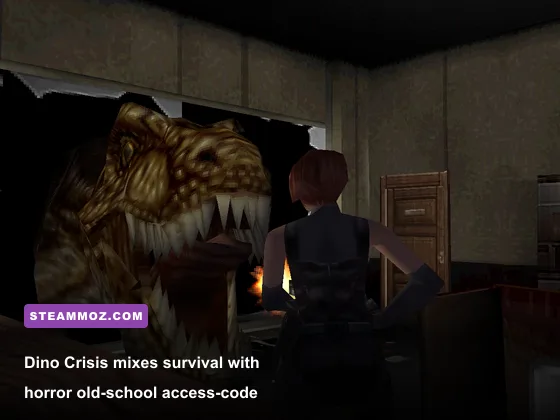
The facility’s puzzles are built around access cards, terminals, computer passwords, plugs, key items, and color-coded security systems. You will move between connected laboratories, storage areas, control rooms, and emergency routes while trying to remember which locked door belongs to which objective. The structure creates a satisfying sense of place, but it can also produce old-school backtracking that feels more tedious than mysterious in 2026.
The D.D.K. system is a good example of both sides. Digital Disc Keys and Code Discs require you to match letters, numbers, and security information to unlock doors or terminals. The logic is consistent once you understand the interface, but the game does not always communicate its rules clearly. Keep notes. Write down room names, card colors, and codes instead of relying on memory, because opening the wrong menu repeatedly is not a puzzle—it is friction.
Inventory management is similarly unforgiving. Regina has limited slots, and key items can occupy space for longer than you expect. Carrying every recovery item feels safe until you discover that you cannot pick up an important plug or disc. The best habit is to maintain a small emergency reserve, deposit duplicates when possible, and return to storage before a major objective rather than after your inventory is completely jammed.
| System | What It Adds | Where It Ages | Best Modern Approach |
|---|---|---|---|
| D.D.K. keys and discs | Layered security puzzles | Codes are easy to forget | Keep a written room-and-code log |
| Limited inventory | Meaningful resource decisions | Backtracking to storage | Carry one healing item and one emergency weapon reserve |
| Fixed cameras | Uncertainty and cinematic framing | Threats can enter off-screen | Turn corners slowly and pre-aim before crossing thresholds |
| Save system | Risk and route planning | Losses can erase long stretches | Save before major doors and after dangerous combat |
The biggest barrier is the control scheme. Regina moves with tank controls, meaning up moves her forward relative to her current facing while left and right rotate her. It feels awkward for the first hour, especially when a dinosaur attacks from behind. Do not fight the controls by constantly changing direction. Tap backward to create distance, rotate deliberately, then fire once the target is in front of you. That small adjustment makes the game far more manageable.
Boss Encounters and the Game’s Best Set Pieces
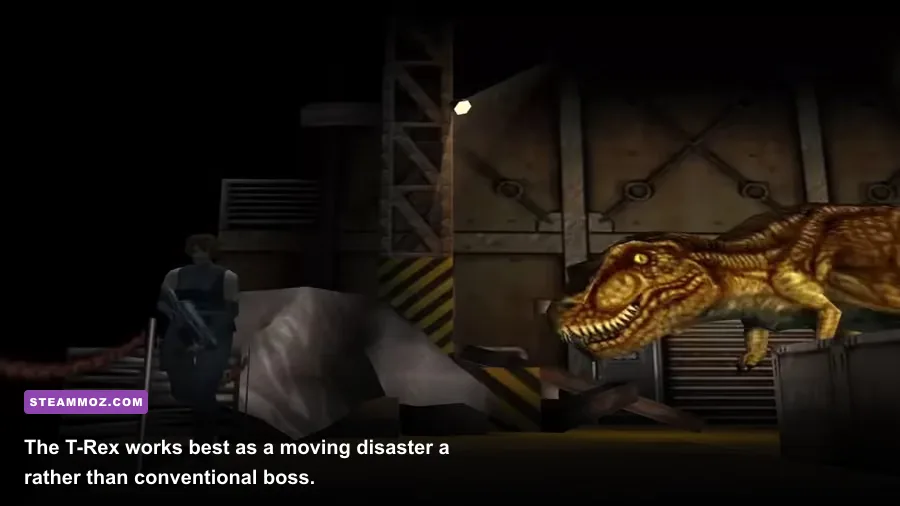
Dino Crisis handles its largest dinosaurs differently from a modern action game. The Tyrannosaurus Rex is usually a moving hazard, a wall of teeth that interrupts exploration and forces Regina to escape, activate machinery, or survive a brief combat sequence. That design is effective because the T-Rex feels too large to reduce to a conventional arena health bar. The game understands that terror often comes from being unable to control the situation.
The attack telegraphs are simple but readable. Roars and camera shifts signal that an encounter is about to change, while the T-Rex’s lunges create a narrow window to move or fire. Do not stand in the open trying to empty every weapon into it. Prioritize the environmental objective, watch the escape route, and save your strongest ammunition for sections where the game clearly expects sustained damage.
Other major encounters test resource management more directly. The game’s dinosaurs can force you into tight rooms where the camera hides approach angles, so entering with a full reload and at least one recovery item is more valuable than carrying another puzzle object. Heal bleeding immediately, because entering a scripted sequence with a ticking health drain can turn a manageable encounter into an unwinnable one.
The set pieces are short, which helps the pacing. Dino Crisis rarely overstays its welcome with a boss that repeats the same attack cycle for ten minutes. Its best moments are transitions: a laboratory evacuation, a sudden breach, a corridor that stops being safe, or a dinosaur appearing where the game trained you to expect only locked doors. These sequences remain memorable because they are tied to navigation and story rather than isolated combat arenas.
How Dino Crisis Runs in 2026
The original game has no official Windows version, so PC players should be careful about what they download. A legitimate route is to use hardware and software that you own and dump your own game disc or legally acquired copy, following the relevant laws in your country. Avoid random “remastered” executables and ROM sites; many bundle malware, broken patches, or unauthorized files. Check Capcom’s official games portal and the PlayStation games catalog for current availability rather than assuming every listing is official.
On original hardware, the experience is authentic but dependent on aging discs, cables, and display scaling. On a modern display, the low-resolution backgrounds can look harsh, particularly when stretched to fill a 16:9 panel. Integer scaling, a 4:3 aspect ratio, and a mild CRT-style filter usually produce a more natural image. Heavy smoothing can blur the pre-rendered rooms into an unpleasant wash, so keep filtering conservative.
An emulator can offer sharper output, save-state convenience, and controller remapping, but those options can also weaken the intended tension. Save states are useful for testing troublesome sections, yet relying on them after every doorway removes much of the original risk. I recommend regular in-game saves first, with emulator states reserved for troubleshooting or preserving a difficult experiment.
| Play Method | Visual Result | Comfort | Recommendation |
|---|---|---|---|
| Original PlayStation and CRT | Soft, authentic 240p presentation | Highest hardware friction | Best for preservation-minded players |
| Original PlayStation on modern TV | Often blurry or unevenly scaled | Simple setup, mixed image quality | Use 4:3 and disable excessive sharpening |
| Legal disc dump with emulator | Higher resolution and stable output | Best controller and display flexibility | Best practical option when done legally |
| Unofficial PC port or random download | Inconsistent and potentially altered | Security and compatibility risk | Avoid |
For broader retro-PC troubleshooting, our guides on stopping crashes and rescuing FPS and running older PC games on modern systems cover the same basic discipline: verify the source, avoid random fixes, and change one compatibility setting at a time. If you want an official technical reference for PlayStation products, PlayStation Support is safer than relying on an anonymous forum download.
The Verdict: A Classic With One Huge Condition
Dino Crisis is worth playing in 2026 if you enjoy survival horror’s older vocabulary: fixed cameras, deliberate controls, limited saves, backtracking, and the constant possibility that the smartest fight is the one you avoid. Regina remains a strong lead, the facility has a memorable layout, and the dinosaur threat gives every familiar horror system a different flavor. Raptors are faster and more spatially aggressive than the shambling enemies that defined many of the era’s competitors, and the result is a game that can still make a routine key hunt feel dangerous.
It is not an effortless recommendation. The graphics are dated, the controls demand patience, and some D.D.K. puzzles feel like paperwork rather than discovery. The game also lacks modern quality-of-life features such as an objective tracker, automatic checkpoints, widescreen support, or a polished digital PC release. Players who dislike backtracking will probably bounce off before reaching the strongest set pieces.
My final score is 8/10 for survival-horror fans and 6/10 for newcomers expecting a modern remake. Start on Normal, keep written notes, conserve shotgun shells, and treat the environment as part of every fight. Give the game one uninterrupted evening rather than judging it from a ten-minute emulator test. Once the controls click, Dino Crisis stops feeling like a museum piece and starts feeling like a lean, mean experiment that deserved a second life.
If Capcom ever revives the series, the ideal remake should preserve the pressure, D.D.K. puzzles, branching decisions, and dangerous raptors—not simply turn every dinosaur into a shooting-gallery target. Until then, the original remains the best way to understand why the concept still has teeth. For more retro-minded recommendations, Steamoz readers can also explore our hidden-location hunting guide and weapon-value breakdown. Dino Crisis is old, occasionally awkward, and absolutely still worth the trip to Ibis Island.