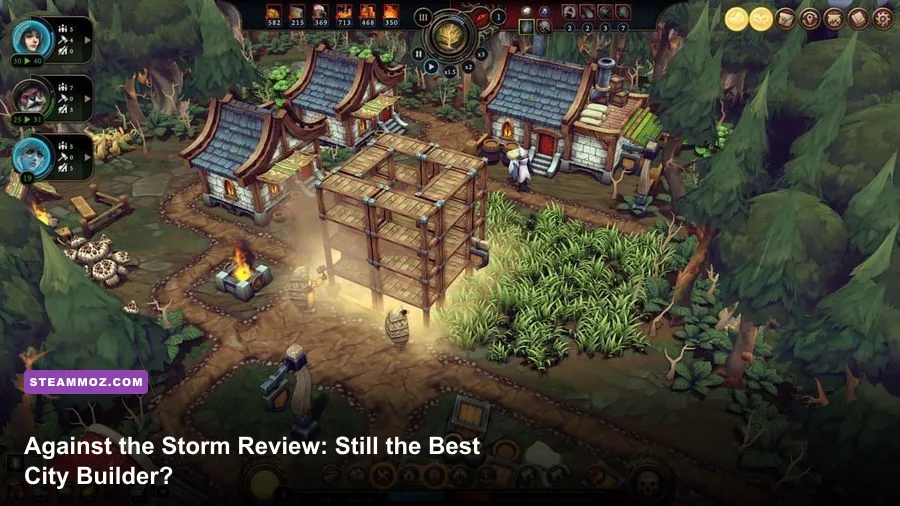
Yes, Against the Storm is absolutely worth playing in 2026—especially if you want a city builder that respects your time, keeps every run unpredictable, and makes failure feel like useful progress. Eremite Games' storm-battered settlement sim remains one of the smartest strategy games on Steam because it combines the satisfying production chains of a traditional builder with the pressure, randomness, and replayability of a roguelite. It isn't a relaxing town-painting game, though. Against the Storm constantly asks you to make ugly compromises, abandon perfect layouts, and win before your colony's morale collapses.
That tension is still the whole show. You lead humans, beavers, lizards, harpies, and foxes through hostile wilderness, answer orders from the Queen, open dangerous glades, and earn reputation before the Queen's Impatience fills the victory bar. The result is a game where a small decision—cutting one more patch of trees, delaying a shelter, or spending a cornerstone on production instead of resolve—can completely change a settlement.

Why Against the Storm Still Feels Special

Most city builders are about permanence. You build a city, optimize it, and slowly turn an empty map into a polished machine. Against the Storm flips that fantasy. Each settlement is temporary, and winning usually means reaching 14 reputation before the Queen's Impatience overtakes you. When the run ends, you return to the Smoldering City with resources, meta-progression, and a better understanding of the systems that just wrecked you.
That structure solves one of the genre's biggest problems: late-game boredom. In a conventional builder, you may spend an hour fixing road placement after the interesting decisions are over. Here, the map keeps pushing back. The biome changes available resources, the blueprint draft changes your production options, and forest hostility rises as you cut trees and open glades. You are rarely more than a few minutes away from a meaningful decision.
The opening is particularly strong. You begin with a small group of settlers, a crude camp, limited food, and a handful of random blueprints. You need shelter, fuel, food, and planks, but your first buildings cannot cover every need. A Rain Mill might unlock flour and trade goods, while a Kiln provides coal and jerky but competes for valuable builders and fuel. The game makes specialization powerful without making any single opening mandatory.
Compared with broader management games, Against the Storm is closer to a strategy puzzle. You don't ask, “What would make this town look nice?” You ask, “What can this particular map and blueprint hand support?” That difference gives it remarkable replay value. A settlement built around beavers and Crude Workstations plays differently from one built around harpies, Clothing, and a strong Weaver.
For a useful contrast, our Dungeons 2 winter leveling guide covers a much more direct campaign economy. Against the Storm is less about finding one dominant route and more about adapting when the game refuses to give you the building you wanted.
🎮 Against the Storm
Looking to experience this game? Grab your digital key directly on our store for $8.99.
View on Steammoz Store →The Core Loop Is Brilliant, But Deliberately Demanding
A normal settlement follows a rhythm: gather, process, satisfy needs, explore, and convert surplus into reputation. The clever part is that almost every action carries a cost. Opening a glade gives you new land and resources, but it can also reveal a dangerous event that consumes tools, time, or villagers. Cutting more trees gives you fuel and space, but increases Hostility. Building another production chain may improve resolve later while starving your early-game construction economy.
Glade management is the clearest example. Small glades are safer and often contain basic resources. Dangerous glades can contain high-value nodes and events such as Ancient Battlegrounds, Forbidden Glades, or storm-related hazards. The correct answer is not “open as many as possible.” It is to open one when you have enough workers, fuel, food, and a plan for the event. A dangerous glade discovered during the Storm season can turn an otherwise winning run into a collapse.
Resolve is equally nuanced. Each species has different needs and preferences. Humans care about items such as Ale, Clothing, and Religion; beavers value Education, Luxury, and Leisure; lizards respond strongly to Jerky, Skewers, and Warmth; harpies often become valuable through Clothing, Education, and luxury goods. Meeting needs raises resolve, while low resolve makes villagers leave and can eventually generate hostility through unhappy species.
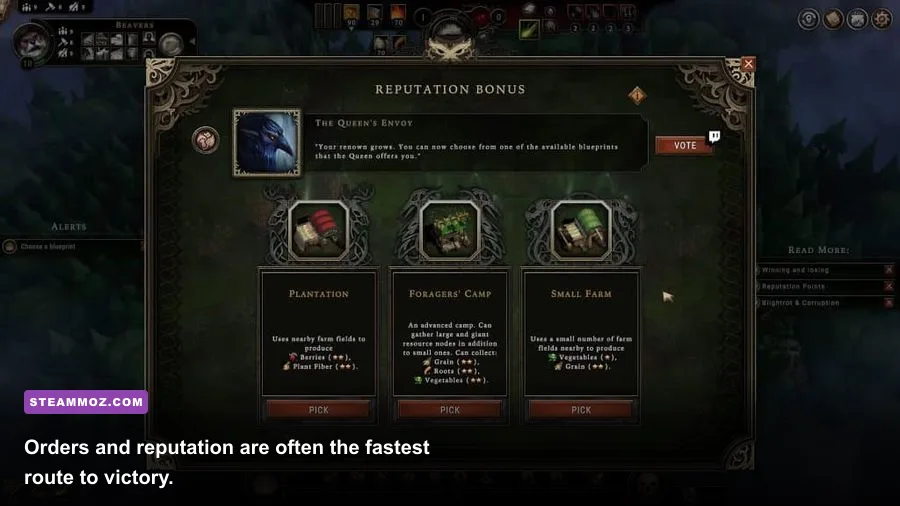
Reputation is earned in three main ways: completing Orders, surviving certain Glade Events, and pushing species resolve high enough for long enough. Orders are often the safest source because they give you a target and a reward. A good player doesn't blindly complete every order. You compare the reward against the time and materials required, then choose objectives that overlap with the settlement you already have.
The Queen's Impatience is not just a timer; it is a pressure valve. It rises as time passes, but it can also reduce the threat from Hostility. That creates a fascinating comeback mechanic. A struggling colony isn't always doomed, because a higher Impatience level may make the forest less immediately dangerous. You still need reputation, but the game gives you room to recover if you stop making panic decisions.
| System | What It Rewards | What It Punishes | Best Practical Approach |
|---|---|---|---|
| Reputation | Orders, resolve, glade events | Slow or unfocused settlements | Pick objectives that match existing production |
| Hostility | Careful forest expansion | Overcutting trees and opening too many glades | Pause woodcutters during dangerous seasons |
| Resolve | Species needs and comfort | Missing housing, food, and services | Push one species high instead of pleasing everyone |
| Impatience | Time-efficient reputation gains | Waiting without a victory plan | Use Orders and resolve bursts to finish quickly |
Species, Buildings, and the Best Production Decisions

The species system is where Against the Storm becomes more than a logistics game. Each race has a different resolve threshold and a different reason to be invited into your settlement. Humans are reliable generalists and improve with housing, religion, and luxury goods. Beavers are excellent workers and fit naturally into wood-heavy openings. Lizards are useful for food-related resolve and often become your first reliable reputation engine. Harpies are fragile but can produce enormous value when you unlock Clothing or Education.
Species bonuses also influence who should work where. A beaver assigned to a Woodcutter Camp is generally more efficient than a human, while a harpy can excel in certain production roles. This doesn't mean you should micromanage every worker every few seconds. It means you should notice when your best species are sitting in low-value jobs while a less suitable settler handles a key recipe.
Production buildings use star ratings to show efficiency. A two-star recipe is usually a major upgrade over a one-star recipe, while a three-star recipe can justify building an entire economy around it. But stars are not enough by themselves. A three-star recipe that consumes a rare resource may be worse than a two-star recipe using plentiful roots, berries, or clay. Always check the complete chain, including fuel and hauling time.
Some of the strongest early buildings are flexible rather than glamorous. A Supplier helps turn basic materials into tools, packs, or complex goods. A Kiln gives you coal, jerky, and crystallized goods depending on available recipes. A Rain Mill can unlock flour and packs, but only if you can sustain grain or roots. The best blueprint is the one that fixes your current bottleneck, not necessarily the one with the highest theoretical output.
Cornerstones can radically change your plan. A cornerstone that improves wood production may look ordinary until you realize the biome is rich in trees and your settlement has beavers. Another that increases production speed during the Storm may be stronger in a colony already equipped with rainpunk engines. Think in terms of compounding advantages: bonuses that improve several buildings are usually more valuable than a narrow reward you cannot activate immediately.
| Priority | Strong Choice | Why It Works | Main Risk |
|---|---|---|---|
| Early survival | Woodcutters, shelters, crude food | Stabilizes fuel, housing, and basic resolve | Hostility rises if you overcut |
| Mid-game economy | Kiln, Supplier, Rain Mill | Unlocks coal, packs, flour, and trade value | Consumes workers and multiple inputs |
| Resolve push | Weaver, Brewery, Forum | Converts goods into reputation | Needs reliable luxury supply |
| Late-game finish | Orders, services, rainpunk | Creates a fast final reputation burst | Can drain fuel or impatience time |
If you enjoy comparing multiple production routes, our Empires of the Undergrowth farming guide offers a useful counterpoint. That game rewards long-term colony growth; Against the Storm rewards identifying the shortest viable chain.
Rainpunk Is the Mechanic That Changes Everything
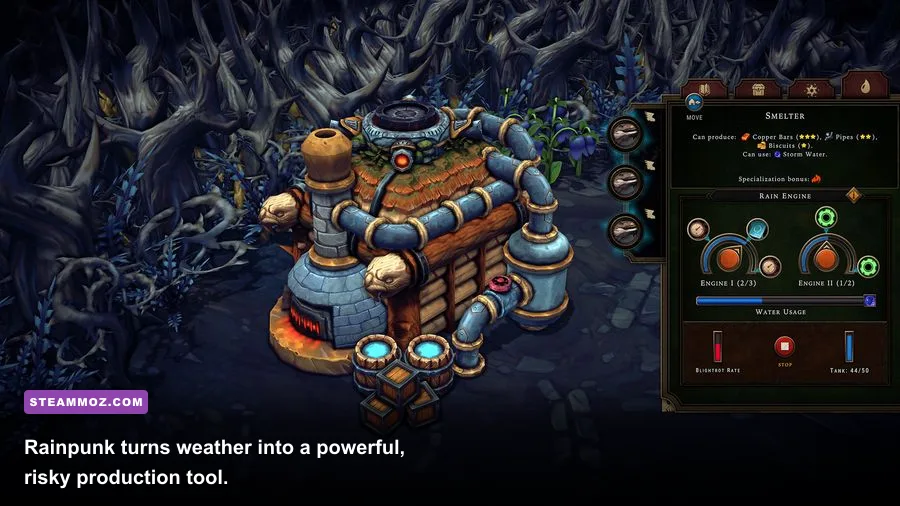
Rainpunk machinery is where the game moves from excellent to genuinely distinctive. You can use pipes, water, and engines to increase production speed or improve worker resolve, but the system generates blightrot. Ignore that blightrot and your settlement can suffer a devastating infection during the Storm.
There are three main rainwater types tied to the weather cycle: Drizzle, Clearance, and Stormwater. Buildings may accept specific water types, and water storage lets you prepare for the season ahead. Drizzle water is often useful for growth-oriented production, while Stormwater can create explosive output at a much higher risk. The exact value depends on the building and recipe, so don't connect every engine just because you can.
The best rainpunk use is targeted acceleration. Put water into a building that is blocking your entire economy—perhaps a Carpenter producing planks or a Rain Mill producing flour—rather than spreading a small bonus across six facilities. Watch the blightrot meter, keep Purging Fire available, and assign workers to the Blight Post before the Storm season arrives.
Rainpunk also changes resolve management. Some engines provide resolve bonuses or reduce the pressure of a difficult season, letting you turn a temporary production boost into reputation. Used correctly, rainpunk can end a settlement several minutes early. Used carelessly, it creates a fuel crisis while your best workers are stuck fighting blightrot.
Performance and Quality of Life in 2026

Against the Storm is not a cutting-edge graphics showcase, and that's good news. Its stylized presentation scales well across modern gaming laptops and desktop PCs. The real performance issue appears in large settlements when the simulation is processing many villagers, production buildings, pathfinding decisions, and rainpunk effects at once. Your average frame rate may look fine while the simulation itself slows during intense late-game activity.
For most systems, 60 fps at 1080p is a realistic target with medium-to-high settings. Shadows, vegetation density, and visual effects are the settings most likely to affect GPU load, while settlement size and simulation speed are more closely tied to CPU performance. If the game feels sluggish during a crowded Storm, lowering resolution won't necessarily solve it. Pausing briefly, reducing workers, and avoiding unnecessary production chains often helps more.
| Setting or Factor | Recommended Value | Performance Impact | Visual or Gameplay Note |
|---|---|---|---|
| Resolution | Native 1080p or 1440p | High GPU impact | Keep native resolution unless GPU-limited |
| Shadows | Medium | Medium GPU impact | Good compromise during dense settlements |
| Vegetation | Medium to High | Low to medium | High settings preserve the forest atmosphere |
| Effects | Medium | Medium during Storm season | Lower this first if rain and particles stutter |
| Simulation load | Reduce idle workers and chains | High CPU impact | More effective than lowering resolution in late game |
The interface remains one of the game's strongest features. Production recipes, species needs, building bonuses, and resource flows are readable without burying you in menus. There is still a learning curve, particularly around recipe odds and resolve timing, but the game usually tells you why a settlement is failing. If you want more PC troubleshooting context, our Elex crash and FPS fixes cover the broader Windows-side issues that can also affect simulation-heavy games.
What Has Improved—and What Still Gets in the Way
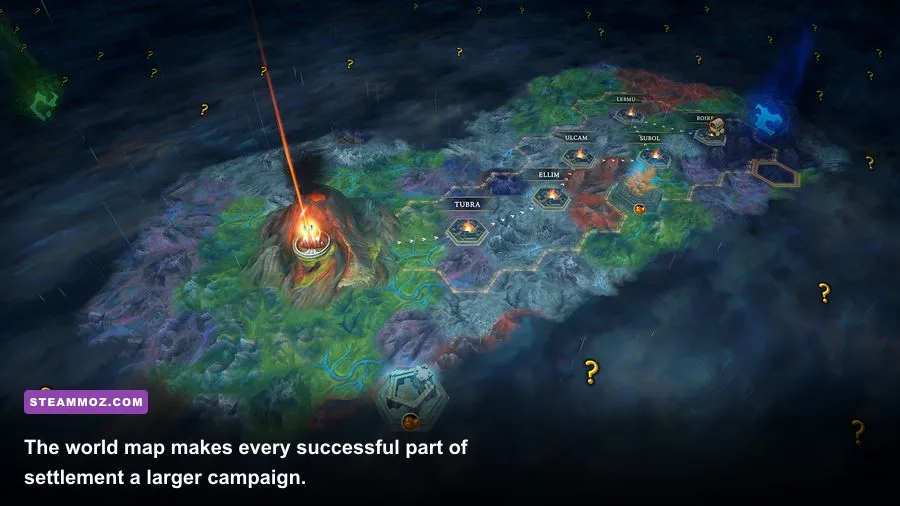
Against the Storm's biggest long-term strength is its campaign layer. The Smoldering City unlocks new species, buildings, embarkation bonuses, and metaprogression options without making early settlements irrelevant. You keep returning to the same core loop, but the available tools expand enough to create new strategies. Higher difficulties also push you to understand systems you could previously ignore, especially Hostility, resolve timing, and event preparation.
That said, the game can feel opaque during the first several hours. Blueprint choices are random, some recipes only become good when paired with specific resources, and the interface doesn't always explain why a seemingly positive action caused a chain reaction. New players may also mistake more buildings for more progress. In reality, every unneeded building can steal workers, fuel, and maintenance time from the chain that actually wins the settlement.
There is also a real emotional trade-off. If you want to nurture one town for dozens of hours, Against the Storm's temporary settlements may feel disposable. The game asks you to abandon a colony at its peak and start again elsewhere. For me, that's the point: the campaign turns each settlement into a solved experiment rather than a forever-home. But players seeking a pure sandbox should look toward a more traditional builder.
Updates and balance changes can alter the best cornerstones, species combinations, or blueprint priorities, so exact meta advice should always be checked against the current build. The official Steam page, Eremite Games website, and the game's community wiki are useful references when a patch changes a recipe or mechanic.
Final Verdict: Buy It If You Like Meaningful Pressure
Against the Storm is worth playing in 2026 because its design has aged in the right direction. It doesn't depend on enormous maps, photorealistic graphics, or a scripted story to stay compelling. Its replayability comes from the interaction between species, blueprints, biomes, glade events, Orders, Hostility, weather, and the ticking pressure of the Queen's Impatience. Few city builders make a settlement's final ten minutes feel as dramatic as its first ten.
Buy it if you enjoy strategy games where adaptation matters more than memorizing a single build order. Buy it if you like the idea of Frostpunk-style pressure mixed with production-chain planning and roguelite progression. Buy it if the thought of turning roots into flour, flour into biscuits, and biscuits into a last-second resolve victory sounds more satisfying than decorating a perfect boulevard.
Skip it if you need a relaxed sandbox, dislike random blueprint drafts, or want a permanent city that grows forever. Against the Storm is demanding, occasionally opaque, and willing to punish greed. But once its logic clicks, every failure teaches you something useful. In 2026, that makes it more than a good city builder—it remains one of the sharpest strategy games on PC.
For another take on demanding management systems, our Dungeons 4 hidden rewards guide explores a much more campaign-focused style of progression. Against the Storm is the better pick when you want every new map to force a fresh plan.