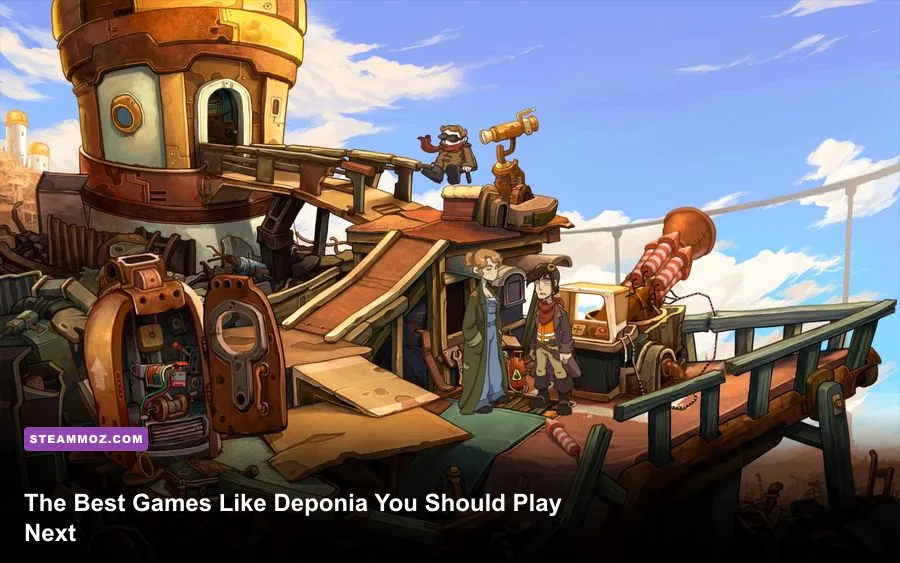
If Deponia: The Complete Journey left you craving more bizarre characters, inventory puzzles, terrible decisions, and animated worlds packed with personality, start with Grim Fandango Remastered, Thimbleweed Park, and Edna & Harvey: Harvey's New Eyes. They are the closest matches for Deponia's mix of comedy, eccentric storytelling, and classic point-and-click problem solving, while Broken Sword and Return to Monkey Island offer stronger detective writing and cleaner modern design.
That distinction matters in 2026. Deponia is not just a puzzle game; it's a very specific flavor of adventure game. Rufus is a selfish, unreliable disaster, the jokes are deliberately loud, and the world of floating scrap cities makes every object feel like it could become either a solution or a punchline. The recommendations below rank games by how well they recreate that combination rather than simply listing every famous point-and-click adventure.

The best Deponia alternatives ranked
There is no single replacement for Deponia because Daedalic combines several traditions at once. It borrows the visual timing of cartoons, the object-combination logic of classic LucasArts adventures, and the darker character humor associated with modern European adventure games. The table makes the differences clear before we dig into the individual recommendations.
| Game | Tier | Closest Deponia trait | Best reason to play |
|---|---|---|---|
| Grim Fandango Remastered | S-Tier | Distinctive world and absurd comedy | Best overall writing and atmosphere |
| Thimbleweed Park | S-Tier | Classic puzzle structure and weird ensemble | Most satisfying old-school investigation |
| Edna & Harvey: Harvey's New Eyes | S-Tier | Daedalic's dark cartoon humor | Closest tonal match |
| Return to Monkey Island | A-Tier | Ridiculous dialogue and item puzzles | Best modern interface and pacing |
| Broken Sword: Shadow of the Templars | A-Tier | Travel, conversation, and clue hunting | Best grounded mystery |
| Day of the Tentacle Remastered | A-Tier | Surreal comedy and inventory logic | Best interconnected puzzle design |
| The Dark Eye: Chains of Satinav | B-Tier | European fantasy adventure design | Best darker Daedalic-style alternative |
My S-Tier picks are the ones that understand why Deponia works. They don't merely contain puzzles. They give the puzzles a strong dramatic identity, then make the setting memorable enough that you want to poke at every suspicious object. A-Tier games are excellent but either less chaotic, less dark, or more traditional. B-Tier recommendations are worthwhile if you care more about Daedalic's production style than Rufus's particular brand of catastrophe.

🎮 Deponia: The Complete Journey
Looking to experience this game? Grab your digital key directly on our store for $2.99.
View on Steammoz Store →Grim Fandango is the best all-round replacement
Grim Fandango Remastered on Steam is the strongest recommendation for anyone who wants a complete adventure rather than a similar joke density. You play Manny Calavera, a travel agent for the Department of Death, guiding newly deceased souls through the afterlife. The four-year story moves through the Aztec-inspired Land of the Dead, from the Department of Death to the port city of Rubacava and beyond.
The overlap with Deponia is immediately obvious. Both games turn impossible architecture into comedy. Manny's art-deco underworld is as visually committed as Rufus's floating garbage civilization, and both protagonists spend much of the story manipulating people who are smarter, richer, or more competent than they are. The difference is maturity: Grim Fandango's jokes support a noir plot about corruption, loyalty, and class, while Deponia more often uses its plot as a runway for a gag.
Its puzzles also reward patient observation. The infamous mechanic involving a ticket printer, the betting-race sequence, and the tools used around Rubacava all demand that you understand how a location functions instead of randomly combining every item. The original interface can feel awkward, but the remaster adds direct character control, updated lighting, developer commentary, and a remastered score. Use direct control if you want less friction; switch to the classic tank-style movement only if you're chasing the original feel.
Why it ranks S-Tier: Manny has more emotional depth than Rufus, the four-chapter structure has excellent momentum, and Rubacava is one of the most atmospheric locations in the genre. If you only play one game from this list, play this.
For another Daedalic-adjacent recommendation, Steamoz's Harvey's New Eyes PC requirements guide covers the technical side of one of the publisher's most distinctive adventures.
Edna & Harvey delivers the closest dark-comedy tone
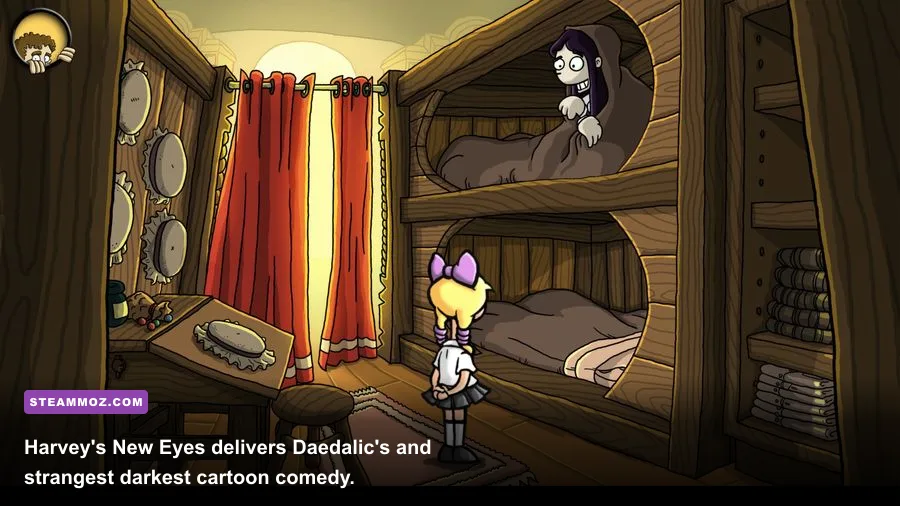
Edna & Harvey: Harvey's New Eyes is the obvious choice when the part you loved most about Deponia was Daedalic's willingness to make a joke uncomfortable. You play Lilli, a quiet girl living in a strict convent school. Her imaginary friend Harvey helps her suppress disobedience through a series of increasingly disturbing “lessons.”
This is not a relaxed comedy adventure. The game uses a cute hand-drawn presentation to frame cruelty, repression, and childhood trauma, and its narrator often describes horrible events with a cheerful detachment. That tonal collision is very close to Deponia's habit of placing slapstick beside genuine consequences. Lilli is also a useful contrast to Rufus: she is passive and anxious where he is loud and self-important, so the humor comes from watching her survive a world designed to erase her agency.
Mechanically, Harvey's New Eyes uses traditional inventory puzzles, dialogue choices, and screen-by-screen exploration. The key difference is that Lilli's actions are frequently interpreted by the narrator rather than explained through direct character banter. Look carefully for interactive hotspots, especially in the convent's classrooms, dormitories, and garden areas. Some solutions are deliberately grotesque, so don't assume an apparently absurd object is decorative.
The game is shorter and more focused than The Complete Journey, which is a strength. Deponia's middle chapters can sprawl across multiple locations and fill your inventory with objects whose purpose is impossible to predict. Harvey's New Eyes keeps its central emotional arc visible, making each puzzle feel connected to Lilli's situation instead of being a detached comedy sketch.
Why it ranks S-Tier: It has Daedalic's visual language, the same appetite for morbid jokes, and a wonderfully unreliable tone. It isn't as mechanically generous as modern adventure games, but that sharper edge is precisely why Deponia fans should try it.
Thimbleweed Park is the puzzle purist's pick
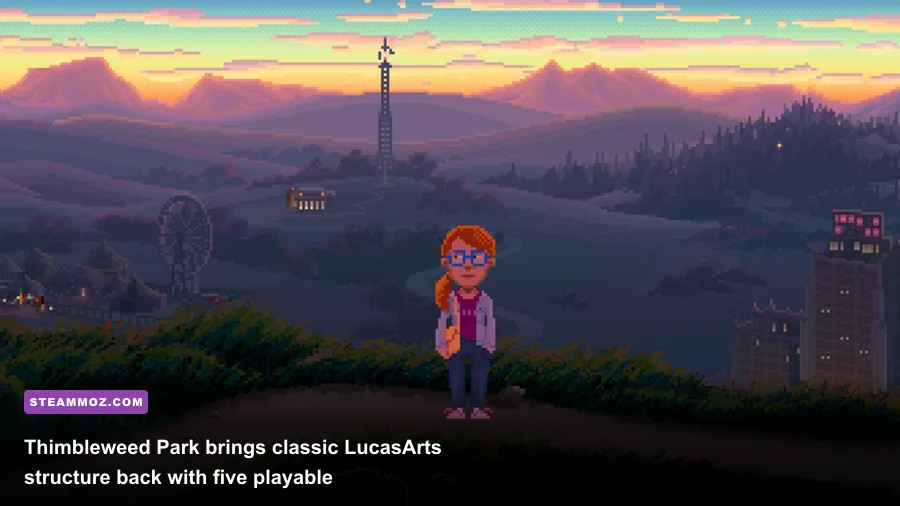
Thimbleweed Park comes from Ron Gilbert and Gary Winnick, two designers associated with the classic LucasArts adventure tradition. Its opening image is a dead body beneath a bridge, but the game quickly expands into a deliberately strange small-town mystery involving FBI agents Angela Ray and Antonio Reyes, local sheriff Franklin, aspiring game developer Delores, and clown Ransome.
Compared with Deponia, Thimbleweed Park is less dependent on a single comic lead. You switch between five playable characters, and each one can carry out actions, collect objects, and contribute dialogue to the investigation. That structure creates genuine puzzle design rather than simple fetch quests. A clue found by Reyes may unlock a conversation for Ray, while Delores's computer knowledge opens paths that the sheriff cannot access.
The setting is compact but dense. Thimbleweed Park, the hotel, the pillow factory, the circus grounds, and the abandoned sewer system all contain recurring characters and layered clues. The game also lets you choose Casual or Hard difficulty. Casual removes some of the more punishing puzzle steps, while Hard preserves the full challenge and adds extra solutions. Start with Casual if you're new to classic adventures; the harder mode is better once you understand how the game hides information in dialogue and visual repetition.
Thimbleweed Park does not offer Deponia's romantic melodrama or Rufus's constant physical comedy. What it does offer is cleaner puzzle logic. When you combine an item, it usually relates to a character's job, a location's function, or an established clue. That makes the eventual “aha” moments feel earned instead of lucky.
Why it ranks S-Tier: The five-character system, optional difficulty modes, pixel-art presentation, and surprisingly ambitious ending make it the best choice for players who value puzzle construction above everything else.
Broken Sword and Monkey Island cover the lighter side
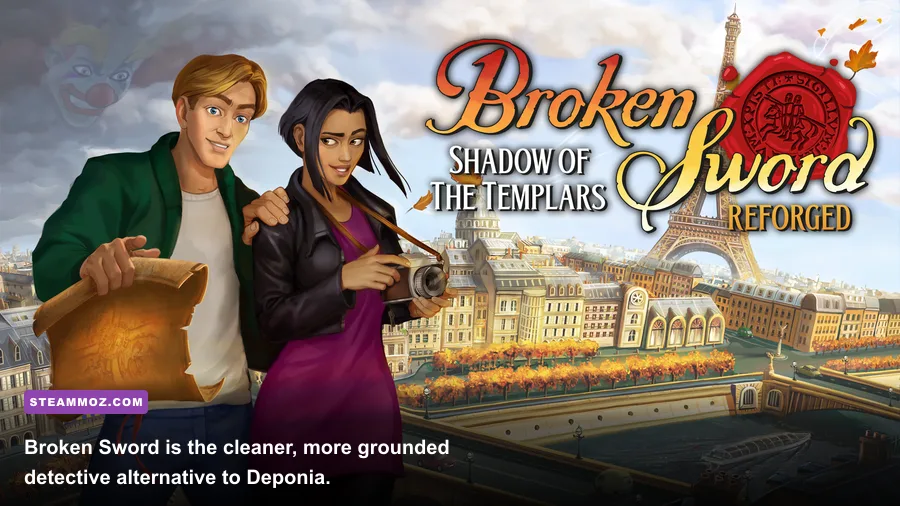
If Deponia's darker humor isn't essential, two classics deserve your time. Broken Sword: Shadow of the Templars follows American tourist George Stobbart after a bombing in Paris introduces him to journalist Nico Collard and a conspiracy tied to the Knights Templar. The Director's Cut adds new scenes and playable Nico sections, though some fans still prefer the original's pacing.
Broken Sword is the most approachable detective adventure here. George's dialogue is witty without being relentlessly obnoxious, Nico provides a strong investigative counterpoint, and the locations move from Paris to Ireland, Syria, Spain, and Scotland. Puzzles usually depend on conversations, disguises, documents, and contextual objects. The sheep sequence in Ireland is a classic example of the game's design: it is funny, memorable, and based on understanding how the environment can be manipulated.
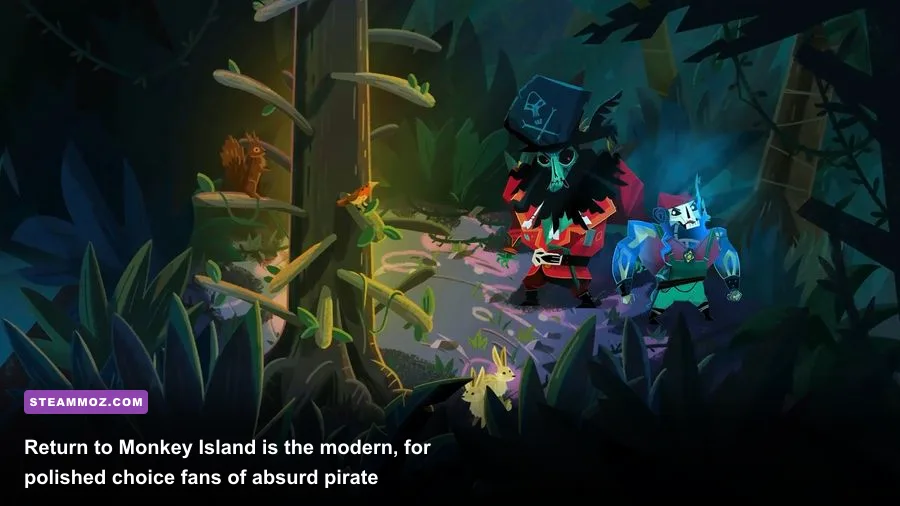
Return to Monkey Island is the better option if you want Deponia's anarchic dialogue and absurd item puzzles with a far more forgiving interface. Guybrush Threepwood returns to Mêlée Island and sets out to uncover the titular secret while dealing with LeChuck, rival pirates, and a new generation of swashbucklers.
The modern hint book is an important feature, not a crutch. It gives progressively clearer clues without immediately solving the puzzle, and the game includes Casual and Hard modes. Casual removes several steps; Hard restores more elaborate puzzle chains and optional tasks. The inventory is compact, item descriptions are readable, and double-click travel reduces the walking that slowed older adventures.
| Game | Difficulty feel | Comedy style | Best starting mode |
|---|---|---|---|
| Broken Sword | Moderate, clue-driven | Dry detective humor | Director's Cut for newcomers |
| Return to Monkey Island | Casual to demanding | Fast pirate banter | Casual first, Hard later |
| Deponia | Often opaque | Broad slapstick and dark gags | Use the hint system sparingly |
| Thimbleweed Park | Moderate to hard | Deadpan absurdism | Casual for a first run |
Choose Broken Sword if you want a coherent mystery. Choose Return to Monkey Island if you want the closest modern equivalent to a joke firing every few seconds. Neither has Deponia's deliberately abrasive hero, but both understand that adventure-game dialogue should keep you moving between puzzles.
Day of the Tentacle remains an essential bonus pick
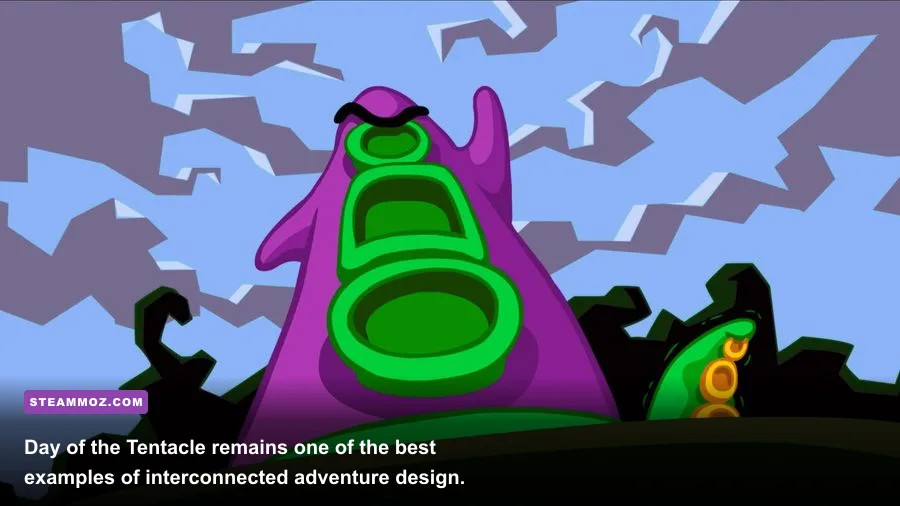
Day of the Tentacle Remastered is the oldest game on this list and still one of the smartest. Bernard, Hoagie, and Laverne must stop Purple Tentacle after a mutated tentacle gains world domination ambitions. The trick is that the three characters operate in different versions of the same mansion across the past, present, and future.
That time structure produces the kind of puzzle chains Deponia fans tend to enjoy: an object obtained in one era can be mailed or altered to help a character in another. Hoagie's colonial-era section and Laverne's future laboratory are packed with visual callbacks, while Bernard's present-day puzzles establish the game's central logic. The Remastered edition lets you switch between the original pixel art and updated artwork at any time, and the soundtrack and interface have been refreshed without changing the underlying design.
It is more tightly designed than Deponia and less interested in emotional drama. There are no combat systems, stats, or gear trees to distract from exploration, and every useful object belongs to a tightly controlled puzzle network. That makes it a perfect palate cleanser after the more sprawling Complete Journey trilogy. If you get stuck, inspect every character, not just every object; many solutions depend on using a person's personality as much as their inventory.
Why it ranks A-Tier: Its comedy has aged remarkably well, the three-era structure remains inventive, and the remaster is easy to recommend. It misses S-Tier only because it doesn't offer the same sweeping world or character arc that makes Deponia feel like a complete journey.
For more strange strategy and adventure recommendations from Steamoz, check out our guides to Dungeons 3: Clash of Gods tips, Dungeons 4's hidden rewards, and ELEX PC fixes. They aren't point-and-click adventures, but they share Deponia's love of unusual worlds and systems that reward experimentation.
What to play first in 2026
For the closest emotional and visual follow-up, play Edna & Harvey: Harvey's New Eyes. For the best complete package, choose Grim Fandango Remastered. For pure puzzle quality, Thimbleweed Park is the winner, while Return to Monkey Island is the easiest recommendation for anyone who wants modern controls and a forgiving hint system.
My personal 2026 play order is Grim Fandango, Thimbleweed Park, Harvey's New Eyes, Return to Monkey Island, then Broken Sword. That sequence moves from atmospheric storytelling to hard-edged puzzle design, then circles back to Daedalic's darker comedy before finishing with two accessible classics. You won't get another Rufus, and that's probably for the best. But these games understand the same essential rule: the strangest object in the room is often the key to everything.