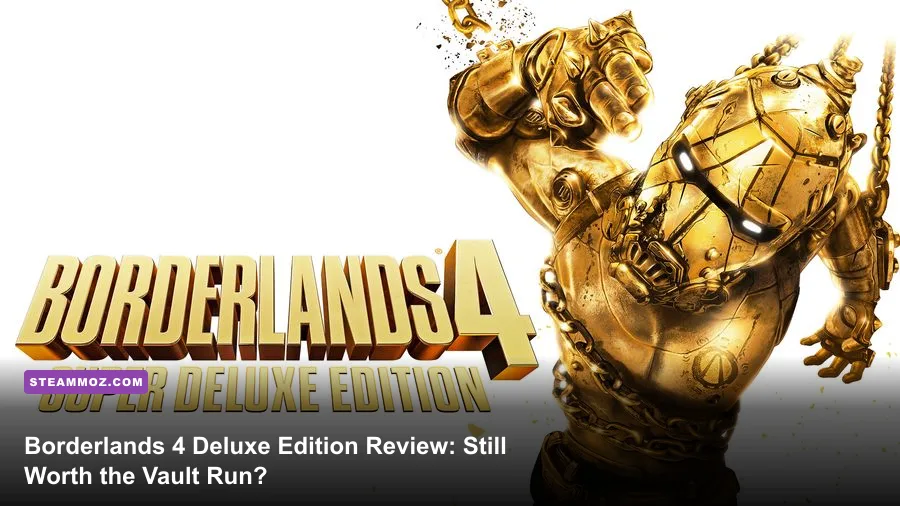
Yes, Borderlands 4 Deluxe Edition is worth playing in 2026—but only if you want a premium co-op looter-shooter and plan to spend serious time in its endgame. The base game contains the campaign, all four Vault Hunters, Kairos, and the core loot chase. The Deluxe Edition earns its price through extra post-launch content rather than an overwhelming pile of launch-day cosmetics. That makes it a sensible buy for committed players, but a poor value if you only want to finish the story once.

The short verdict on Borderlands 4 Deluxe Edition
Borderlands 4 is the series at its most ambitious. It keeps the familiar rhythm—shoot, grab loot, shoot harder things—while giving the campaign a more connected planet, denser traversal, and a less stop-start sense of momentum than Borderlands 3. Kairos is the star. Its regions feel like parts of one unstable world instead of disconnected theme-park arenas, and the open structure gives side missions, movement tools, and vehicle travel a real purpose.
The writing is still aggressively Borderlands. Expect rapid-fire jokes, loud personalities, grim violence, and the occasional genuinely affecting character beat fighting for space in the same cutscene. Some players will find that mix exhausting. Others will be delighted that Gearbox has not sanded off the series' weird edges.
My recommendation is straightforward: buy the base edition if you mostly play solo or want to sample the campaign; choose Deluxe if you have a regular co-op group, enjoy replaying characters, or know you'll chase seasonal and expansion content. The upgrade is not essential for understanding the story, and the bonus cosmetics don't transform the early game.
| Edition | Best For | What You Actually Get | 2026 Verdict |
|---|---|---|---|
| Standard | Solo players and first-time buyers | Full campaign, four Vault Hunters, core endgame | Best value for most players |
| Deluxe | Co-op groups and long-term players | Base game plus the announced Deluxe post-launch content and cosmetic bonuses | Worth it on sale or for dedicated players |
| Super Deluxe | Collectors and day-one loyalists | Broader future content bundle, premium cosmetics, and extras depending on platform listing | Only buy after checking the exact store contents |
One warning matters in 2026: publisher bundles can change after launch. Check the live contents on the official Steam listing before paying for an upgrade. The name “Deluxe” is less important than whether its included DLC has already released.

🎮 Borderlands 4 Deluxe Edition
Looking to experience this game? Grab your digital key directly on our store for $49.99.
View on Steammoz Store →What makes Kairos better than Borderlands 3's worlds
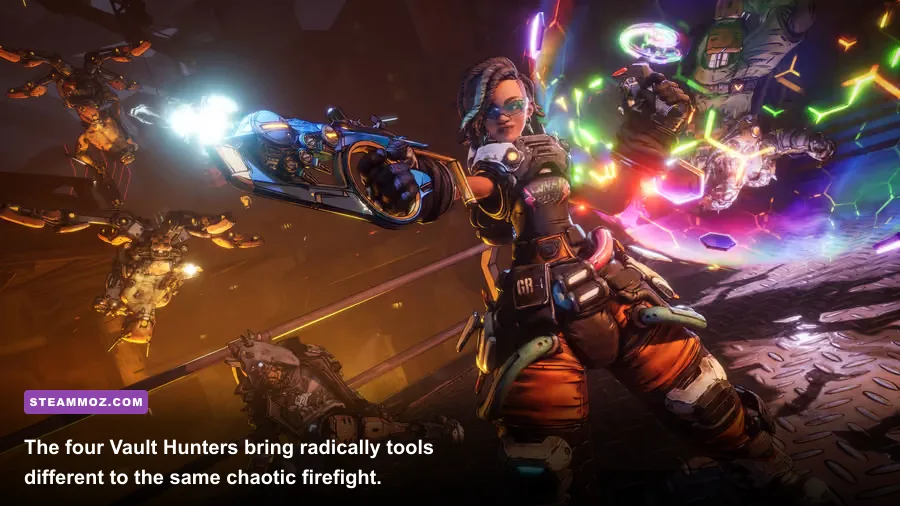
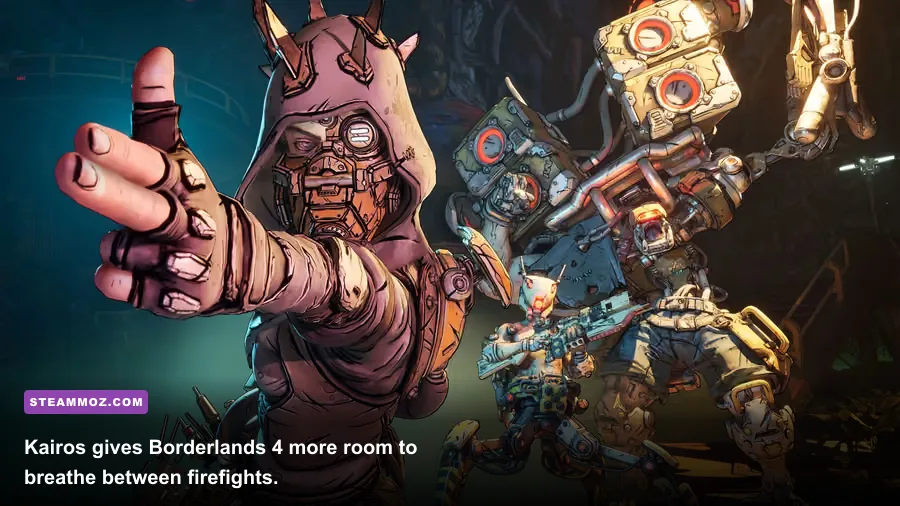
Borderlands 4's biggest structural improvement is how it handles space. Kairos is not a seamless simulation—you still enter missions through familiar checkpoints, fast travel, and loading transitions—but its connected zones make exploration feel less like selecting a new television set. The world has a stronger geographical identity, and objectives can pull you through combat spaces rather than repeatedly teleporting you back to a central hub.
That matters because movement is no longer just a way to cross dead ground. Traversal tools turn cliffs, gaps, and vertical combat arenas into route choices. You can often approach an encounter from above, flank a shielded target, or use the environment to break up a crowd before the shooting starts. The best side missions understand this and combine exploration with a clear combat gimmick instead of simply asking you to kill ten enemies in a new color of warehouse.
Kairos also gives the campaign a welcome sense of escalation. The Timekeeper's control is not merely background lore; it shapes the enemy presence, mission framing, and visual language of the planet. The story works best when it focuses on the four playable Vault Hunters—Vex, Rafa, Harlowe, and Amon—as professionals with different reasons for entering the conflict. Vex is the most immediately readable solo pick, Rafa makes aggressive close-range play feel deliberate, Harlowe rewards battlefield control, and Amon suits players who enjoy a heavier, more methodical rhythm.
That isn't to say the world is flawless. Borderlands 4 still repeats activities, and large maps can occasionally turn a funny mission into a long commute. Fast travel solves the worst cases, but the map can become busy with icons before the campaign has taught you which activities deserve attention. My advice is to ignore completionist pressure early. Follow story missions until your movement options expand, then clean up side content in a region with gear that matches your current level.
Players who enjoy reading environmental clues and poking into optional corners will get more from Kairos than players who sprint objective to objective. If you want a slower, more exploratory shooter with a strong sense of place, our games like Hunt: Showdown 1896 recommendations are also worth a look—but Borderlands 4 remains much more generous with power fantasy and loot.
Combat, Vault Hunters, and the loot chase
The gunplay remains excellent because Borderlands 4 understands that weapon variety only matters when weapons change how you make decisions. Manufacturers still push different combat identities: Jakobs rewards precision and critical hits, Maliwan asks you to manage elemental effects and charge behavior, Tediore turns reloads into active damage, Vladof favors volume of fire, and Hyperion leans into stability and defensive handling. A weapon's level is important, but its parts and manufacturer behavior can matter just as much.
Don't automatically replace a strong gun because the next drop has a higher item score. A well-matched weapon can carry you through several levels if its elemental type, magazine behavior, and secondary effect fit your Vault Hunter. Conversely, a higher-level gun with poor recoil or an awkward reload can feel weaker in actual combat. Test weapons against armored, shielded, and flesh targets before selling them.
The four Vault Hunters make replayability the game's strongest argument. Vex is built around supernatural pressure and companion-style support, making her flexible when enemies surround you. Rafa's exo-suit gives him an immediate answer to aggressive encounters and rewards players who understand when to commit rather than constantly backpedal. Harlowe's technology is about controlling space and stacking advantages, while Amon is the choice for players who want to dictate the frontline with durable tools and heavy impact.
Build decisions become meaningful once you stop treating action skills as emergency buttons. Use a Vault Hunter's active ability to create a window for weapon damage, then exploit the status or positioning advantage it produces. For example, a control-oriented Harlowe setup should not waste its field effect on a single weak enemy; use it to isolate a dangerous elite, group targets for elemental damage, or interrupt a push toward the objective. Rafa players should save defensive resources for the moment an arena closes in, not spend them during the opening seconds of every fight.
| Vault Hunter | Combat Identity | Best Weapon Pairing | Who Should Choose Them |
|---|---|---|---|
| Vex | Flexible damage and supernatural support | Elemental SMG plus accurate pistol | Solo players who want recovery options |
| Rafa | Mobile exo-suit aggression | Shotgun plus high-rate assault rifle | Players who like pushing enemy lines |
| Harlowe | Area control and battlefield setup | Elemental rifle plus launcher | Co-op players who coordinate target focus |
| Amon | Heavy frontline pressure and durability | Heavy weapon plus close-range backup | Players who prefer deliberate engagements |
Co-op is where these distinctions become clearest. A Harlowe who controls a choke point gives Rafa a safe lane to dive through, while Vex can keep pressure on enemies that would otherwise force Amon away from the objective. Level scaling makes mixed-level groups less punishing than in older entries, but equipment quality still matters. Keep a few spare weapons for a friend's level range instead of handing over every legendary you no longer use.
Endgame depth and Deluxe Edition value
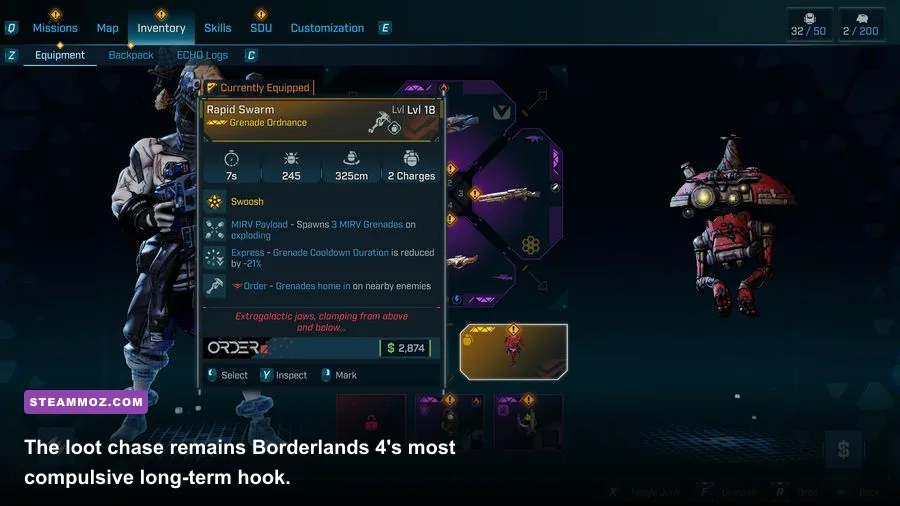
The endgame is the deciding factor for a 2026 purchase. Borderlands 4's campaign is substantial, but the Deluxe Edition only makes sense if you enjoy the loop after the credits: replaying missions with another Vault Hunter, refining a build, hunting better parts, and tackling harder encounters with stricter damage checks.
The strongest part of that loop is its immediacy. You can usually identify why a new drop matters. Maybe it lets your elemental setup apply effects faster, gives a close-range Rafa build more room to stay aggressive, or improves Amon's ability to hold a position. The weaker part is familiar to every looter-shooter veteran: once your build crosses a certain threshold, many drops become salvage before you have even inspected them. Inventory management is better when you make selling and marking junk part of your route rather than letting menus swallow an entire session.
Deluxe content has a practical advantage for long-term players because it protects you from buying each expansion separately, assuming the included bundle matches the current platform listing. It also gives Gearbox room to introduce new missions, gear pools, and challenges without fragmenting your friend group immediately. That convenience is valuable—but only if you will play the content. A cosmetic pack is not a reason to spend extra money on its own.
There is also a timing question. In 2026, the base game is more likely to receive discounts, while the Deluxe upgrade may remain expensive relative to the amount of content already available. If you are uncertain, buy Standard during a sale and upgrade once the first major expansion has earned your confidence. If you already know you will play every Vault Hunter and return for seasonal activities, Deluxe is easier to justify at launch pricing.
| Player Type | Recommended Edition | Why | Value Rating |
|---|---|---|---|
| One-and-done story player | Standard | The campaign and core characters are already included | Excellent |
| Solo build crafter | Standard, then upgrade on sale | You can judge the endgame before buying future content | Very good |
| Weekly co-op group | Deluxe | Shared access to post-launch content reduces purchase friction | Good to excellent |
| Borderlands completionist | Deluxe or higher bundle | Extra content and cosmetic bonuses have more lasting value | Good |
Before buying, compare the exact bundle on the official Borderlands 4 site and Gearbox's developer page. Store descriptions can change as expansions launch, and platform-specific cosmetic entitlements are easy to misread.
PC performance and the best settings for 2026
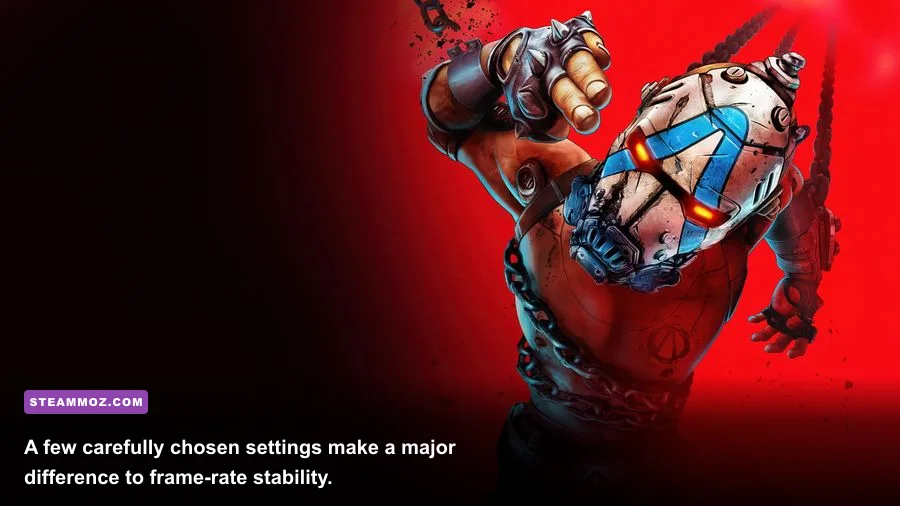
On PC, Borderlands 4 is at its best when you prioritize frame-time consistency over a handful of ultra presets. The cel-shaded art direction hides some reductions in shadow and foliage quality, while combat exposes every hitch. A stable 60 frames per second feels much better than a nominal 80 that collapses during elemental explosions, heavy enemy waves, or four-player co-op.
Use the game's built-in benchmark after changing several settings, then test a real combat arena. A quiet corridor tells you almost nothing about performance. Start with upscaling on Quality at 1440p, move to Balanced if your GPU struggles, and reserve Performance mode for lower-end hardware or high-refresh targets. Frame generation can improve the displayed number, but it doesn't remove input latency and should not be used to disguise a weak base frame rate.
| Setting | Recommended Value | FPS Impact | Visual Trade-Off |
|---|---|---|---|
| Resolution | Native 1080p or 1440p | Very high | Lower resolution is the fastest performance gain |
| Upscaling | Quality at 1440p; Balanced at 4K | High benefit | Balanced may soften distant detail |
| Shadows | High | Medium to high | Ultra adds cost during large fights |
| Volumetric Effects | Medium | Medium | Less dense fog and light shafts |
| Foliage and Effects | High | Medium | Lowering effects helps elemental-heavy battles |
| Ray Tracing | Off unless using a high-end GPU | Very high | Reflections and lighting lose some richness |
| Frame Generation | Optional above a real 60 FPS | Displayed FPS increase | Can add latency and artifacts |
For more PC troubleshooting habits, Steamoz's guides to PC fixes and performance-focused graphics settings cover the same useful basics: update the driver, disable overlays when diagnosing stutter, and avoid changing six variables at once.
Console players get the simpler trade-off. Use the quality mode if you value sharper environmental detail and play mostly solo; choose performance mode for co-op, fast movement, and competitive comfort. Borderlands 4's combat is forgiving enough that either mode works, but the performance option better matches the game's frantic rhythm.
Is Borderlands 4 worth playing in 2026?
Borderlands 4 is worth playing in 2026 because it finally makes the series' loot-heavy formula feel spacious again. Kairos gives exploration more purpose, the four Vault Hunters create genuinely different approaches to combat, and the campaign provides enough momentum to support multiple playthroughs. It isn't a clean reinvention, and it still carries the franchise's loud humor, repeated activities, and occasionally messy inventory habits. Those flaws are real, but they sit on top of exceptionally satisfying shooting.
The Deluxe Edition is a more conditional recommendation. Buy it if you have a co-op group, expect to play beyond the campaign, or find it discounted close to the price of the base game. Skip it if you are testing the franchise, playing one short solo campaign, or mainly want the cosmetic extras. Standard is not a stripped-down demo; it is the complete Borderlands 4 experience before the optional long tail begins.
My final score for the game is 8.5/10, with the Standard Edition earning the stronger value recommendation and Deluxe landing at 8/10 for committed players. If the loot loop has ever hooked you before, Borderlands 4 is an easy recommendation. If randomized gear usually feels like busywork, no edition will magically change your mind. Everyone else should start with Standard, bring a friend, and let Kairos prove whether the next legendary drop is worth one more run.
And if you're hunting for more games that reward mastery rather than button-mashing, check out Steamoz's Huntdown weapon tier list and Binary Domain review for two very different takes on satisfying shooter combat.