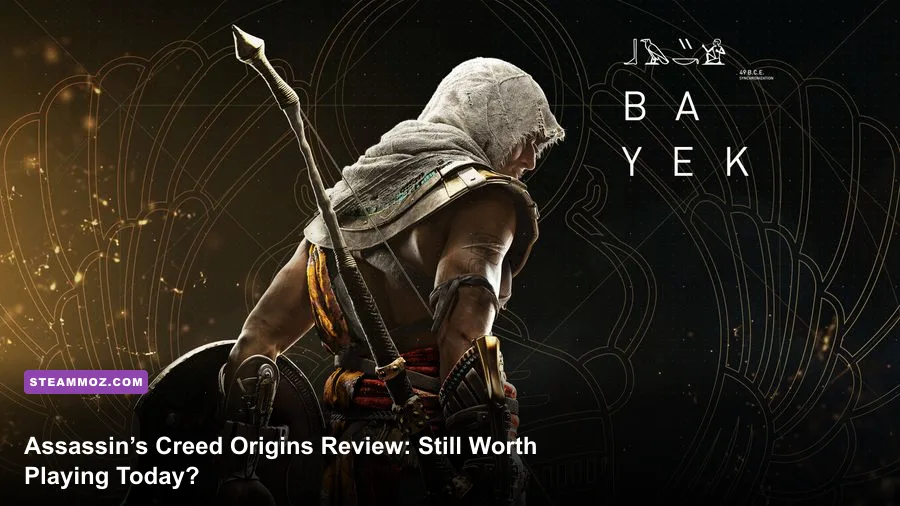
Yes, Assassin’s Creed Origins is still worth playing in 2026—especially if you want a gorgeous single-player RPG with a huge world, satisfying stealth, and one of Ubisoft’s most convincing historical settings. Its combat and quest design show their age, but Bayek’s journey through Ptolemaic Egypt remains compelling, and the PC version runs well on modern hardware after some sensible tuning.
Origins is the game that moved Assassin’s Creed from a stealth-action series toward a full action RPG. That shift won’t work for everyone. If you’re looking for compact assassinations, dense parkour routes, and the social stealth of the Ezio games, this can feel oversized and occasionally grindy. If you want exploration, gear, character progression, and a world packed with tombs and forts, it’s still a strong buy—particularly on sale.
Why Origins Still Holds Up in 2026
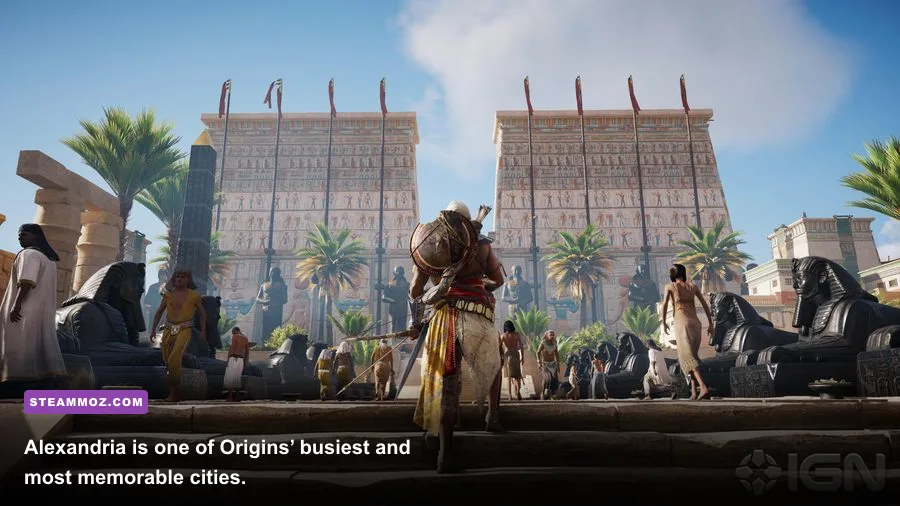
Released in 2017, Origins follows Bayek of Siwa, a Medjay whose personal revenge story gradually expands into the creation of the Hidden Ones. The setting is Egypt during the reign of Cleopatra and the political conflict involving Julius Caesar, Ptolemy XIII, and rival power brokers. That period gives the game an unusually rich backdrop: Roman occupation, Greek influence, Egyptian religion, desert trade routes, and cities that feel culturally distinct rather than copied and pasted.
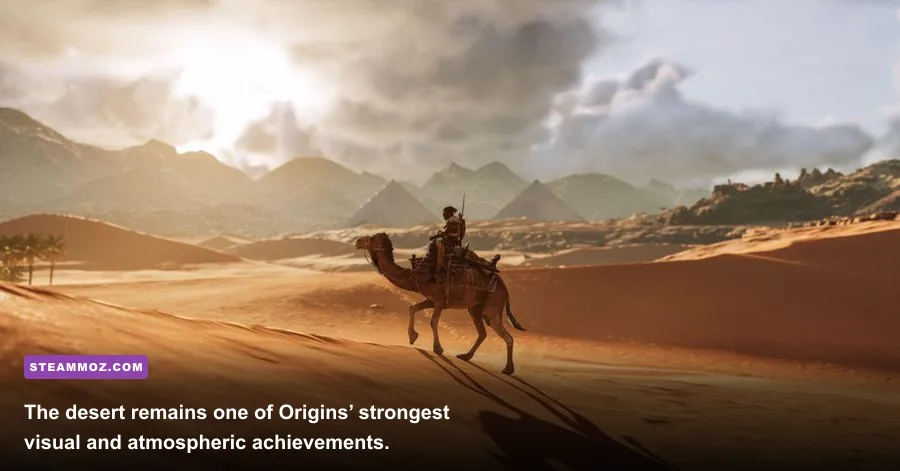
The standout achievement is scale with personality. Siwa is dry, isolated, and sun-blasted; Alexandria is a crowded Greek-influenced port; Memphis feels religious and ancient; Cyrene carries a different North African identity. Riding a camel from a village to the Giza plateau still delivers the kind of wide-screen adventure spectacle many newer open-world games struggle to match.
Ubisoft’s official Assassin’s Creed site remains useful for series background, while the Steam page for Origins lists the current PC edition and downloadable content. For another strong historical-action recommendation, compare its design with our Ace Combat 7 equipment breakdown; the games are wildly different, but both reward learning a deep equipment system rather than blindly chasing higher numbers.
| Area | What Works | What Feels Dated |
|---|---|---|
| World | Distinct regions, convincing history, excellent landmarks | Many camps use familiar layouts |
| Story | Bayek, Aya, Cleopatra, and the revenge arc | Some present-day material is underdeveloped |
| Exploration | Tombs, papyri, viewpoints, wildlife, hidden routes | Map icons can overwhelm the discovery |
| Presentation | Sunlight, sand, water, architecture, and music | Facial animation and NPC behavior show the game’s age |

🎮 Assassin's Creed Origins
Looking to experience this game? Grab your digital key directly on our store for $8.99.
View on Steammoz Store →Combat, Stealth, and Bayek’s Best Skills
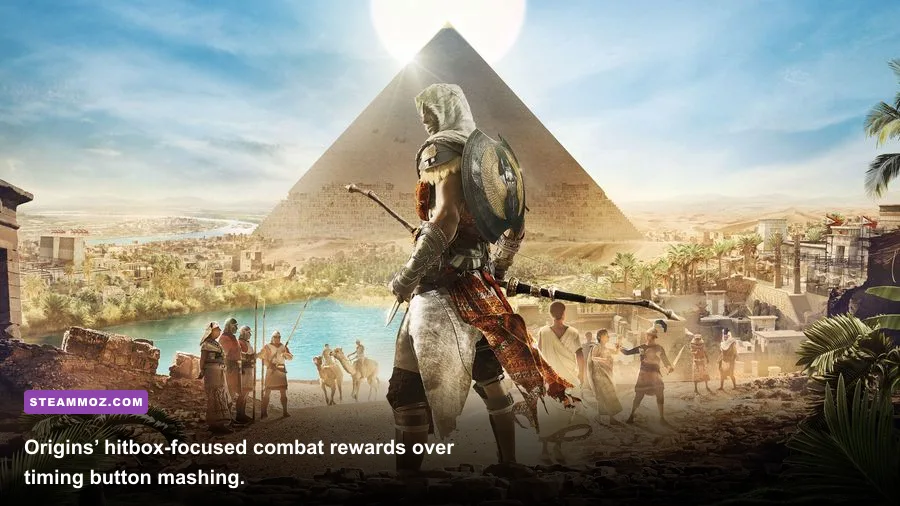
Origins replaces the old instant-counter loop with hitbox-based combat. Bayek has a light attack, heavy attack, dodge, shield parry, charged heavy strike, and adrenaline abilities. Enemy level matters: fighting guards several levels above Bayek can turn a clean ambush into a short, ugly funeral, even when your gear looks respectable.
The most important combat lesson is spacing. A shield-bearing soldier can block frontal light attacks, while brutes swing slowly but cover a surprising distance. Dodge toward the attacker when you need to slip behind a shield, then use a heavy attack or charged strike. The parry is excellent against readable human attacks, but it isn’t a universal answer against large animals, bosses, or attacks with unusual timing.
Weapons are divided into swords, sickle swords, heavy blades, heavy blunt weapons, spears, bows, and shields. Each weapon has a level, rarity, damage value, and perks. Don’t automatically dismantle lower-level legendary gear: a weapon with useful perks can remain valuable, and upgrading it at a blacksmith restores it to Bayek’s current level.
The strongest early skill route
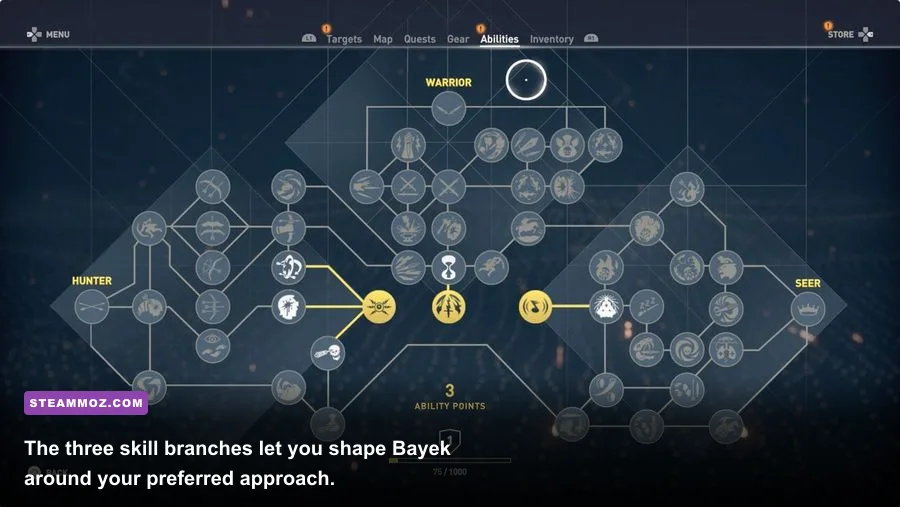
Start in the Warrior branch with Regeneration, which lets you recover health during combat, then take Shield Charge if you enjoy aggressive openings. In the Hunter branch, Enhanced Hunter Bow and Elite Ranger improve ranged damage and slow-time aiming. The Seer branch’s Sleep Darts, Smoke Screen, and Animal Taming support stealth and experimentation.
For a flexible level-40-plus setup, prioritize Overpower Combo, Overpower Chain Throw, Bow Bearer, Archer’s Speed, and Assassination Master. Overpower abilities consume a full adrenaline meter, so build adrenaline with regular hits, then spend it on a high-value target or a dangerous elite. A predator bow for close-range headshots and a warrior bow for rapid follow-up shots cover most situations.
| Playstyle | Core Skills | Recommended Gear | Best Situation |
|---|---|---|---|
| Stealth Assassin | Assassination Master, Smoke Screen, Chain Assassination | Predator Bow, hidden-blade damage perks | Fort infiltrations and officer takedowns |
| Shield Warrior | Regeneration, Shield Charge, Overpower Combo | Sword or sickle sword, shield with melee resistance | Open fights and elite guards |
| Ranged Hunter | Enhanced Hunter Bow, Archer’s Speed, Elite Ranger | Hunter Bow, predator bow, ranged-damage perks | Wildlife, towers, and camp softening |
Where the Quest Design Loses Its Way
Origins has excellent main-story moments, but its level-gated structure can interrupt the momentum. The central narrative regularly sends Bayek across Egypt, then asks you to gain several levels before the next mission. The solution is not to clear every question mark. Follow the main quest, complete side missions with character-driven stories, and use viewpoints to reveal nearby objectives without turning the whole map into a checklist.
Some side quests are genuinely memorable. Bayek helping ordinary people gives the story emotional weight that the political plot sometimes lacks. Others are straightforward errands: kill a captain, investigate a location, retrieve an item, repeat. The best approach is selective exploration. Tombs and papyri puzzles are worth your time for the atmosphere and XP; clearing every bandit camp becomes repetitive much sooner.
The main story takes roughly 30 to 40 hours for a focused playthrough, while a completionist run can pass 80 hours. The Hidden Ones expansion adds a new region, story content, and a level cap increase to 45. The Curse of the Pharaohs is the more ambitious DLC, raising the cap to 55 and adding supernatural afterlife zones inspired by Egyptian mythology. You can check Ubisoft’s Origins page for the current edition and expansion information.
There’s also a Discovery Tour mode, which removes combat and turns the world into an interactive historical exhibit. It’s slower and more educational than the campaign, but it’s one of the best ways to appreciate the architecture, clothing, religion, and daily life Ubisoft reconstructed.
PC Performance and the Settings Worth Changing
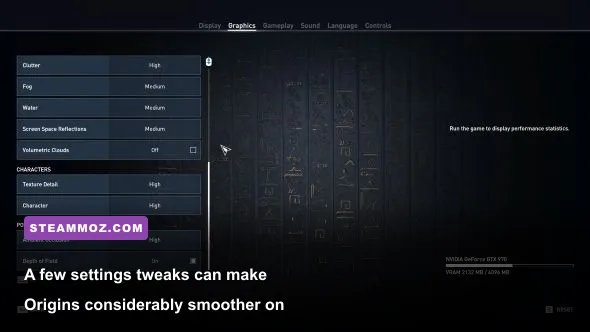
Origins is more demanding than its age suggests. Its AnvilNext 2.0 engine can push modern CPUs hard in crowded cities, and the built-in benchmark is useful because Alexandria and Memphis expose CPU limitations better than quiet desert areas. A stable 60 frames per second is much more valuable here than ultra-quality shadows that barely improve the view.
The original PC requirements listed an Intel Core i5-2400S or AMD FX-8120 with a GTX 660 or Radeon R9 285 for minimum settings, while the recommended target used an Intel Core i7-3770 or AMD FX-8350 alongside a GTX 760 or Radeon R9 280X. Those specifications are old now, but laptop GPUs and integrated graphics still benefit from a tuned profile.
| Setting | Recommended Value | FPS Impact | Visual Note |
|---|---|---|---|
| Resolution | Native; use 90% resolution scale if needed | Very high | Resolution scale is the fastest performance lever |
| World Details | High | High CPU impact | Controls distant geometry and scene density |
| Environment Details | High | Medium | Preserves landscape quality without Ultra cost |
| Shadows | High or Medium | Medium to high | Medium is a good choice on older GPUs |
| Volumetric Clouds | Medium | Medium | Ultra clouds cost frames for limited gameplay benefit |
| Anti-Aliasing | High | Low to medium | Keep it high unless chasing a strict frame target |
On a modern gaming PC, aim for 1080p or 1440p at 60 fps before experimenting with higher presets. Locking the frame rate can reduce uneven frame pacing in cities. If you’re troubleshooting another older PC release, our crashing and low-FPS fixes guide covers the same practical basics: update drivers, disable overlays, verify files, and test exclusive fullscreen before blaming the game.
The Verdict: Buy It, Skip It, or Wait for a Sale?
Buy Assassin’s Creed Origins in 2026 if you enjoy open-world RPGs, historical settings, stealth sandboxes, and long-form exploration. Its best qualities are unusually durable: Egypt is still spectacular, Bayek is a warm and believable protagonist, and the combat has enough weight to make enemy camps feel like tactical problems rather than animation galleries.
Skip it if you dislike level-gated missions, loot rarity, map clutter, or repeated outpost objectives. Origins is not the tightest Assassin’s Creed game, and its RPG structure occasionally buries the fantasy of being an elite assassin under gear checks and XP errands. It also lacks the smoother traversal and more refined stealth systems found in later entries.
| Player Type | Verdict | Reason |
|---|---|---|
| Assassin’s Creed newcomer | Strong buy | Accessible combat and a self-contained historical story |
| Stealth purist | Buy on sale | Stealth works, but RPG progression dominates the design |
| Open-world completionist | Strong buy | Huge map, tombs, wildlife, quests, and DLC |
| Action RPG veteran | Buy on sale | Fun combat, lighter build depth than modern RPGs |
| Low-end PC owner | Check performance first | CPU-heavy cities can undermine otherwise good settings |
My final recommendation is simple: play the base campaign, use side quests to stay near the recommended level, and don’t feel pressured to clear every icon. Add The Hidden Ones if you want more of Bayek’s story; choose The Curse of the Pharaohs if you want the strangest and most visually inventive content in the package. Origins isn’t a flawless Assassin’s Creed game, but in 2026 it remains one of the most inviting ways to get lost in a virtual historical world.
If you’re comparing older games before spending your backlog budget, Steamoz’s Beyond the Ice Palace 2 review and Borderlands 2 performance guide offer two very different takes on whether age matters. In Origins’ case, the answer is clear: the rough edges remain, but Egypt is still worth the trip.