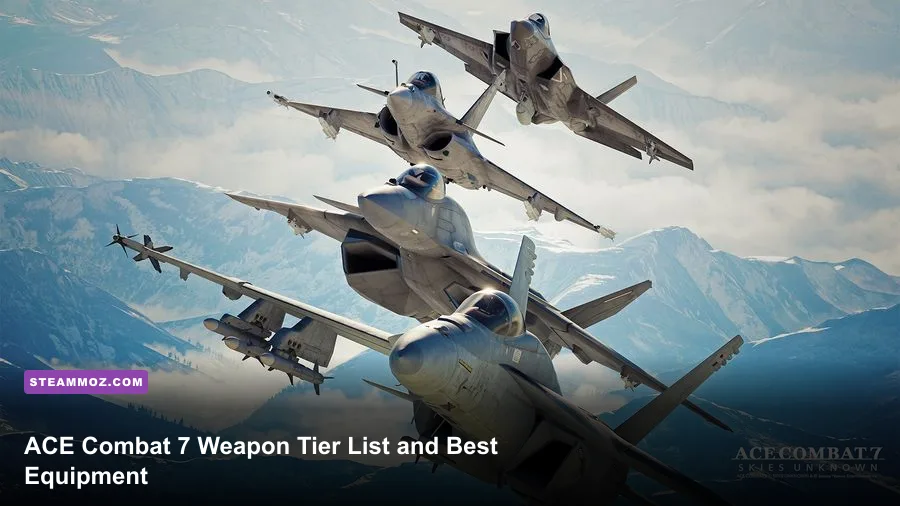
The best ACE COMBAT 7 weapons are QAAM, LAAM, 8AAM, 4AGM, LASM, EML, and PLSL, but the winner depends on the mission. QAAM dominates aggressive dogfights, LAAM controls long-range airspace, 4AGM and LASM delete ground targets, while EML and PLSL reward genuinely accurate pilots. For most of the campaign, prioritize High-Speed Data Link, Variable Cycle Engine, Superior Maneuverability, and the largest compatible weapon-ammo upgrades rather than blindly chasing the most expensive aircraft.
This ranking covers the campaign first, with multiplayer notes where the balance changes. Special weapons don't have a universal damage number that stays identical against every target: aircraft type, target armor, difficulty, hit location, and scripted boss behavior all matter. The useful comparison is therefore practical output—lock range, salvo size, reload pressure, targeting flexibility, and how often a weapon solves the mission's actual problem.
🎮 Get ACE COMBAT 7: SKIES UNKNOWN
Ready to dive in? Grab your copy today for just $9.59.
Check OfferACE COMBAT 7 weapon tier list at a glance
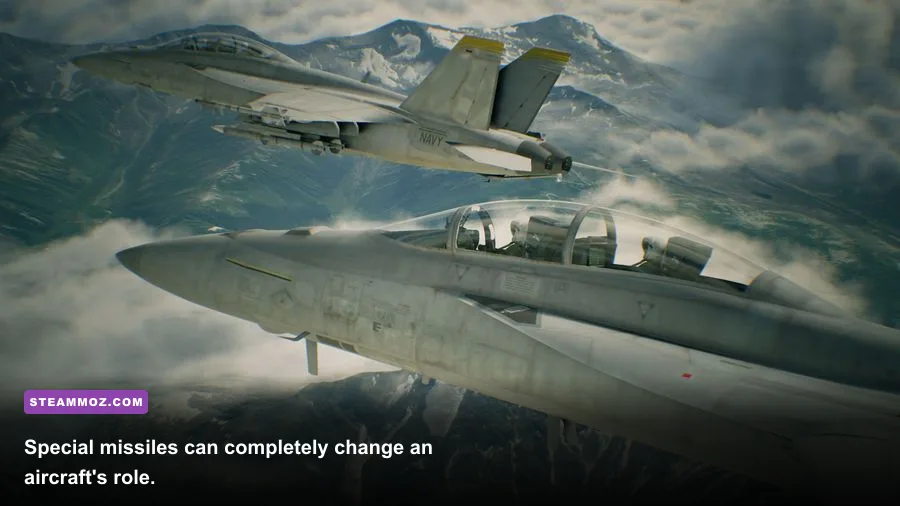
Here is the short version. S-Tier weapons either solve several mission types or produce such a large advantage in their niche that the trade-off is worth it. A-Tier choices are excellent but need a more deliberate build. B-Tier weapons can be outstanding on the right map, while C-Tier options are usually held back by narrow targeting, low flexibility, or demanding execution.
| Tier | Weapons | Best use | Main drawback |
|---|---|---|---|
| S | QAAM, LAAM, 4AGM, LASM, EML, PLSL | Dogfights, long-range interception, ground clearing, precision kills | Ammo limits or high skill ceiling |
| A | 8AAM, 6AAM, 4AAM, HPAA, UGB, XSDB, MGP | Air superiority, bomber interception, dense ground formations | Less universal than S-Tier picks |
| B | LAGM, GPB, SFFS, TLS, MSTM | Specific mission objectives and specialist aircraft | Awkward lock rules or inconsistent payoff |
| C | RKTL, RKT, UGBL, ADMM in restricted roles | Fun specialist runs and certain DLC aircraft | Weak flexibility or difficult aiming |

🎮 ACE COMBAT 7: SKIES UNKNOWN
Looking to experience this game? Grab your digital key directly on our store for $9.59.
View on Steammoz Store →S-Tier air-to-air weapons

QAAM
QAAM is the safest high-end answer for campaign dogfighting. Its stronger tracking and wider post-launch correction let it punish aircraft that defeat ordinary missiles with a hard break. It is particularly effective against high-mobility enemies in Missions 7, 15, and 19, where waiting for a perfect standard-missile angle can waste too much time. Fire after the target begins its turn rather than instantly at the edge of lock range; the missile needs enough energy to capitalize on its guidance.
QAAM is not magic. It carries fewer rounds than the standard missile pool on many aircraft, and a careless pilot can empty the rack into flares or tunnel-visioned targets. In multiplayer, its reputation is even more complicated because energy management, high-G turns, and countermeasures give experienced opponents ways to force misses.
LAAM and 8AAM
LAAM is the campaign's best long-range opener. It can threaten aircraft before they enter normal dogfight distance, making it excellent for thinning formations and starting encounters on your terms. Use it on aircraft such as the F-14D or F-15C when the mission rewards interception more than close-range turning. Don't spam LAAM at maneuvering targets; launch while the enemy is flying predictably, then switch to standard missiles once the fight collapses into a merge.
8AAM is a superb alternative for crowded air battles. Its eight-missile salvo can rapidly clear groups, but the weapon is more effective when targets are already separated and locked deliberately. Firing the entire volley at one agile ace is usually wasteful. The F-14D's 8AAM loadout becomes especially valuable when an objective presents multiple aircraft in quick succession.
EML and PLSL
EML is the best precision weapon in the game when your aim is reliable. It hits extremely hard, has no conventional missile-lock delay, and can remove valuable aircraft with a well-placed shot. The drawback is obvious: you must lead the target yourself, and the reticle's movement punishes frantic corrections. Practice on large bombers before taking EML into a time-sensitive ace encounter.
PLSL is more forgiving over time. Its rapid pulse stream can shred aircraft and ground targets without consuming missile ammunition, but it demands sustained tracking and exposes you to tunnel vision. The F-22A's PLSL loadout is a strong late-campaign choice because the aircraft supplies the speed and maneuverability needed to stay behind targets while the laser does the work.
S-Tier ground-attack and multirole weapons

4AGM and LASM
4AGM is the strongest general-purpose ground weapon. It locks multiple ground targets, releases a four-missile salvo, and lets a fast multirole fighter clear vehicle clusters without making a slow attack run. The F-15E is the obvious campaign workhorse, especially in missions with scattered radar vehicles, artillery, and ships. Fire in measured groups: locking every visible target before release is more efficient than dumping missiles at one structure.
LASM is better when ships and large surface targets dominate the objective. Its long-range anti-ship profile lets you attack from safer angles, and it remains useful against large ground targets when standard bombs would require a dangerous low pass. Missions 11 and 15 are natural showcases. LASM is less impressive against tiny, dispersed vehicles, so don't equip it merely because the weapon has excellent range.
UGB, XSDB, and SFFS
UGB is the reliable bomb choice. It has a generous blast radius and straightforward delivery, making it excellent for bases, airfields, and grouped ground units. The A-10C with UGB is slower than modern multirole fighters, but that extra payload and targeting simplicity can make ground-heavy missions feel dramatically cleaner.
XSDB offers a faster, more flexible ground-clearing rhythm. It works well when you need to hit several separated targets without repeatedly lining up a bomb run. SFFS can produce spectacular results over dense formations, but its spread and timing demand better release discipline. Against single buildings or isolated launchers, UGB or GPB is usually less frustrating.
| Weapon | Tier | Strong aircraft examples | Best target pattern |
|---|---|---|---|
| 4AGM | S | F-15E, Su-34 | Multiple vehicles spread across a combat zone |
| LASM | S | F/A-18F, Su-33 | Ships and large surface targets at range |
| UGB | A | A-10C, F-16C | Clusters of buildings, vehicles, and facilities |
| XSDB | A | F-35C | Several separated ground targets |
| SFFS | B | Su-34 | Dense formations with predictable placement |
| GPB | B | F-2A | Large individual structures or hardened targets |
Best aircraft equipment and parts ranking

Weapon choice gets the headlines, but parts decide whether an aircraft can deliver that weapon consistently. Campaign performance parts are not the same as multiplayer optimization: online restrictions and cost limits can prevent stacking every top upgrade. For a general campaign build, improve missile reliability and aircraft energy first, then add ammo or payload capacity.
| Rank | Part | Why it ranks here | Best pairing |
|---|---|---|---|
| S | High-Speed Data Link | Improves standard missile performance and lock utility | QAAM, LAAM, 8AAM |
| S | Variable Cycle Engine | Raises speed, helping approach, escape, and missile energy | Multirole or interceptor builds |
| S | Superior Maneuverability | Improves turning control in close engagements | QAAM, EML, PLSL |
| A | New Flap Actuators | Strengthens low-speed turning and high-G dogfights | QAAM and standard missiles |
| A | Bulletproof Fuel Tank | Extends sortie endurance in long missions | 4AGM, LASM, UGB |
| A | Special Missile Hardpoint Upgrade | Increases special-weapon capacity where compatible | QAAM, 4AGM, LASM |
| B | Directional Proximity Fuze | Improves near-miss potential for compatible missiles | Standard air-to-air missile builds |
| B | Automatic Fire Extinguisher | Provides a safety net after heavy damage | Blind campaign attempts |
High-Speed Data Link is the closest thing to a universal first pick because it supports the standard missile you use throughout every sortie. Variable Cycle Engine is more valuable than raw top-speed numbers suggest: speed controls how quickly you reach a target, how much energy you carry into a turn, and whether you can disengage before a scripted attack lands. New Flap Actuators are excellent for QAAM fighters, but they matter less on a long-range LAAM build that should avoid turning contests.
Don't overlook ammo parts. A weapon with a brilliant damage profile is useless if the mission has three target waves and your loadout runs dry after the first. The part tree opens gradually through campaign progression and aircraft purchases, so spending MRP on a compatible weapon-capacity upgrade can be a bigger practical gain than buying a flashy new airframe.
Best builds for campaign missions
All-round campaign build
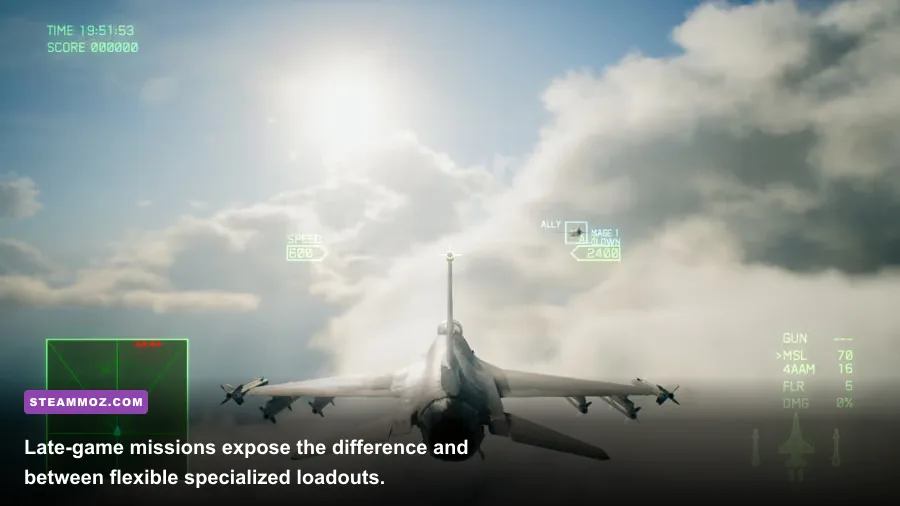
Use the F-22A with QAAM or PLSL, High-Speed Data Link, Variable Cycle Engine, Superior Maneuverability, and a special-ammo upgrade. QAAM gives you an answer to difficult aircraft; PLSL is better when you are comfortable holding a firing line. This build is excellent for late missions, but its weapon supply can feel tight if you waste special shots on ordinary enemies.
Ground-clearance build
Take the F-15E with 4AGM, Variable Cycle Engine, Bulletproof Fuel Tank, and special-ammo capacity. It is fast enough to relocate between target groups and flexible enough to defend itself after the ground objective ends. On naval missions, swap to an LASM-compatible aircraft and replace turning-focused parts with range and payload support.
Precision ace build
Choose an EML aircraft such as the MiG-31B or Su-57, then install Variable Cycle Engine and maneuverability parts that help you stabilize your firing angle. The MiG-31B is fast but less comfortable in prolonged turns; the Su-57 is more forgiving once unlocked. Use standard missiles to force predictable movement, then land EML shots when the target commits to a break.
| Build | Aircraft | Weapon | Parts priority | Mission profile |
|---|---|---|---|---|
| Dogfighter | F-22A | QAAM or PLSL | Data Link, Maneuverability, Flap Actuators | Air superiority and aces |
| Multirole cleaner | F-15E | 4AGM | Engine, special ammo, Fuel Tank | Mixed air and ground objectives |
| Ship hunter | F/A-18F or Su-33 | LASM | Engine, payload, missile capacity | Naval targets and surface fleets |
| Precision ace | MiG-31B or Su-57 | EML | Engine, maneuverability, weapon capacity | High-value aircraft and boss fights |
Weapons that look better than they perform
TLS is spectacular but rarely the efficient choice. Its beam requires sustained positioning, and a target that breaks line-of-sight wastes the entire attack window. MGP can melt aircraft at close range, yet the distance needed makes it risky against missiles and high-speed bosses. HPAA hits hard and is useful against durable aircraft, but its small margin for error makes QAAM or standard missiles easier for most players.
ADMM is powerful on the aircraft that carry it, especially for players who enjoy a screen full of missile trails, but its value depends heavily on target density and available ammo. In missions built around a few evasive high-value targets, a more focused weapon can produce better results. The same principle applies to RKTL and RKT: rockets are fun, but their unguided delivery makes them poor recommendations for a first clear.
How to spend MRP without crippling your arsenal
Unlock one capable fighter in each role before collecting every branch aircraft. The F-16C gives you an inexpensive early multirole platform, the F-15E provides a major 4AGM power spike, and the F-22A or Su-57 offers a late-game air-superiority endpoint. DLC aircraft can be excellent, but they shouldn't replace understanding the standard tree if you're learning the campaign's mission design.
Check the official Steam page for ACE COMBAT 7 for the current PC package and DLC lineup, then compare patch and platform details through the official Bandai Namco game page. The ACE COMBAT 7 community wiki is useful for checking aircraft trees and weapon availability, although mission strategy still comes down to your route and aim.
For PC players, don't let performance undermine precision. A steady frame rate makes EML timing, PLSL tracking, and high-G corrections noticeably easier. Steamoz's guides to smoother FPS settings and maximum-FPS configuration cover the same practical rule: reduce expensive visual effects before sacrificing input consistency. If crashes are the issue, the PC crash-fix guide is a useful troubleshooting reference.
The final verdict is straightforward: use QAAM for difficult air fights, 4AGM for mixed ground missions, LASM for ships, and EML or PLSL when your aim is strong. Build around High-Speed Data Link and Variable Cycle Engine, carry enough special ammunition for every objective wave, and choose the weapon that matches the map—not the one with the flashiest lock-on effect. That approach turns ACE COMBAT 7's sprawling aircraft tree into a much more manageable, brutally effective arsenal.