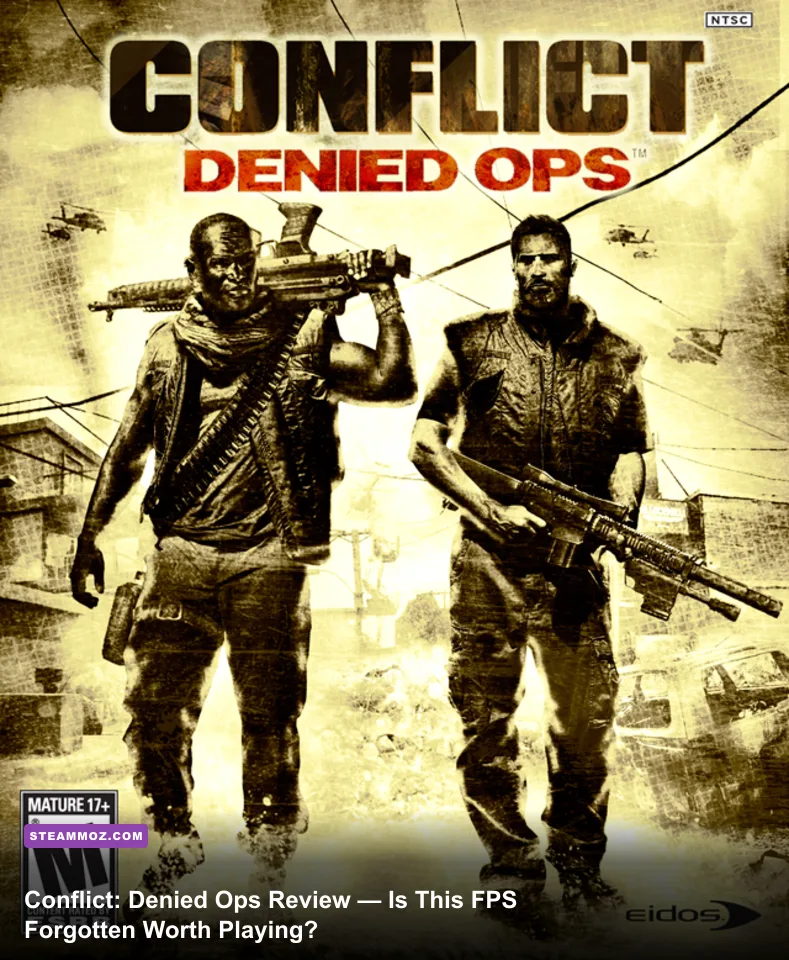
Conflict: Denied Ops is worth playing in 2026—but only as a short, rough-edged retro shooter, not as a lost tactical masterpiece. Its two-character combat system, destructible environments, and surprisingly punchy gunfights still have personality, especially in co-op. The catch is that the campaign is brief, the AI is unreliable, the PC presentation feels dated, and the game never reaches the tactical depth its premise promises. If you can grab it cheaply and tolerate some old-school friction, there’s fun here. If you want the precision of Ready or Not or the cinematic polish of Call of Duty, look elsewhere.
Released in 2008 by Pivotal Games and published by Eidos Interactive, Conflict: Denied Ops arrived during a crowded period for military shooters. It followed the earlier Conflict games but shifted toward a more accessible first-person format. You control two operatives from a covert CIA unit: Lincoln Graves, a heavy-weapons specialist, and Reggie Lang, a stealthier reconnaissance and sniper character. The central idea is simple: switch between them instantly, use their different tools, and tear through hostile environments together.
That formula is still the reason to revisit it. It’s also the reason the game can feel oddly unfinished. Graves and Lang are useful, but the missions rarely demand clever coordination. Most encounters boil down to shooting through rooms, ordering the other character to hold position, and reviving them when the AI does something spectacularly reckless.
The short verdict on Conflict: Denied Ops
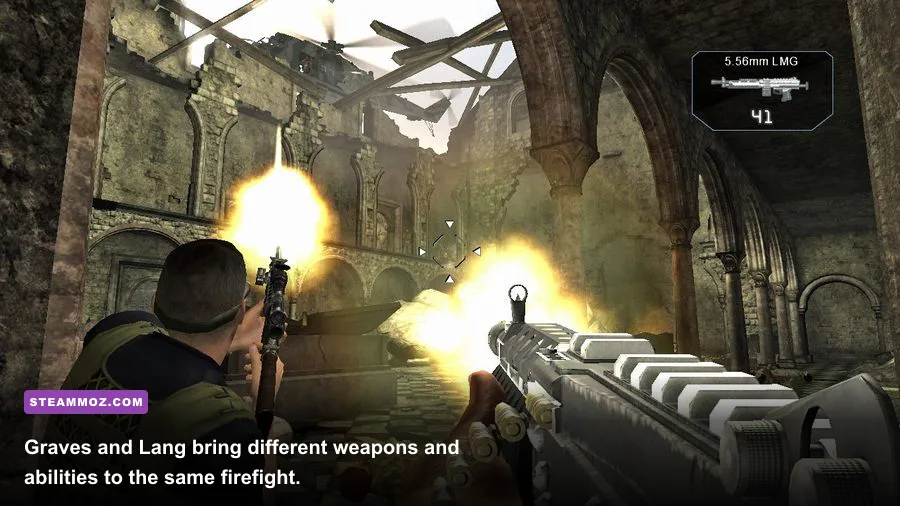
Conflict: Denied Ops earns a cautious recommendation in 2026. It’s a solid weekend shooter for players who enjoy mid-2000s design: linear missions, loud weapons, regenerating health, destructible scenery, and uncomplicated progression. Expect around six to eight hours for a first campaign run, depending on difficulty and how often you replay checkpoints. There is no sprawling skill tree, loot system, or live-service distraction. You pick an operative, complete the mission, and move on.
| Category | 2026 verdict | Why it matters |
|---|---|---|
| Gunplay | Good | Weapons feel immediate, loud, and responsive, though enemy reactions are basic. |
| Two-character system | Interesting | Instant switching creates useful tactical options but rarely becomes mandatory. |
| Campaign length | Below average | Expect roughly six to eight hours, with limited replay variety. |
| Enemy AI | Weak | Opponents can expose themselves, ignore destruction, or overwhelm the partner AI. |
| Presentation | Dated | Lighting, animation, textures, and interface show the game’s 2008 roots. |
| Co-op value | Strongest feature | A human partner makes character switching and flanking much more entertaining. |
The important distinction is price. At a low sale price, this is an easy recommendation for retro-FPS fans. At a premium, it becomes difficult to defend because newer games deliver better enemy behavior, stronger checkpoints, and more flexible difficulty options. Before buying, check the current official Steam listing for availability, controller support, and user reports about modern Windows compatibility.

🎮 Conflict: Denied Ops
Looking to experience this game? Grab your digital key directly on our store for $0.89.
View on Steammoz Store →Graves and Lang are the real reason to play
Graves and Lang are not classes in the modern RPG sense. You don’t build statistics, unlock a deep perk grid, or customize armor. Their identities come from weapons and abilities. Graves is the aggressive answer: he carries heavier firepower and is built for suppressing groups, smashing cover, and surviving direct engagements. Lang is the precision option, giving you a sniper’s perspective and a quieter way to remove priority targets.
Switching characters is performed during missions rather than between elaborate loadout screens. That makes the mechanic feel immediate. See a machine-gun position? Move to Graves. Spot a distant officer or explosive target? Shift to Lang. Need to revive the downed operative? Swap quickly, secure the room, and bring the partner back into the fight.
The problem is that the campaign doesn’t consistently force these decisions. Lang’s accuracy is useful, but many arenas can be cleared by simply pushing forward with automatic weapons. Graves’ heavier arsenal is fun, yet the destruction system often lets you solve the same encounter by shooting every wall until the cover disappears. The design hints at a tactical shooter, then repeatedly rewards the instincts of an arcade FPS.
Commanding the AI partner is functional rather than sophisticated. You can generally direct your partner to move or hold a position, but don’t expect the contextual orders found in later squad shooters. The computer-controlled operative can provide extra fire, but it won’t reliably flank, prioritize targets, or understand when a supposedly safe position has become a death trap.
| Operator | Best role | Useful strength | Main weakness |
|---|---|---|---|
| Lincoln Graves | Assault and suppression | Heavy weapons and stronger close-range pressure | Loud approach and less reliable precision at distance |
| Reggie Lang | Reconnaissance and precision fire | Sniping, careful target selection, and safer long-range kills | Less comfortable when surrounded or rushed |
| AI partner | Additional fire | Can distract enemies and help finish exposed targets | Weak positioning, inconsistent reactions, and poor tactical judgment |
That makes co-op especially valuable. A human controlling Graves can create pressure while the Lang player watches lanes, or the roles can reverse when a mission shifts from open combat to close-quarters clearing. If you like older cooperative shooters, our Brothers in Arms: Earned in Blood beginner guide covers a more demanding squad-based alternative.
Weapons feel better than the enemy AI deserves
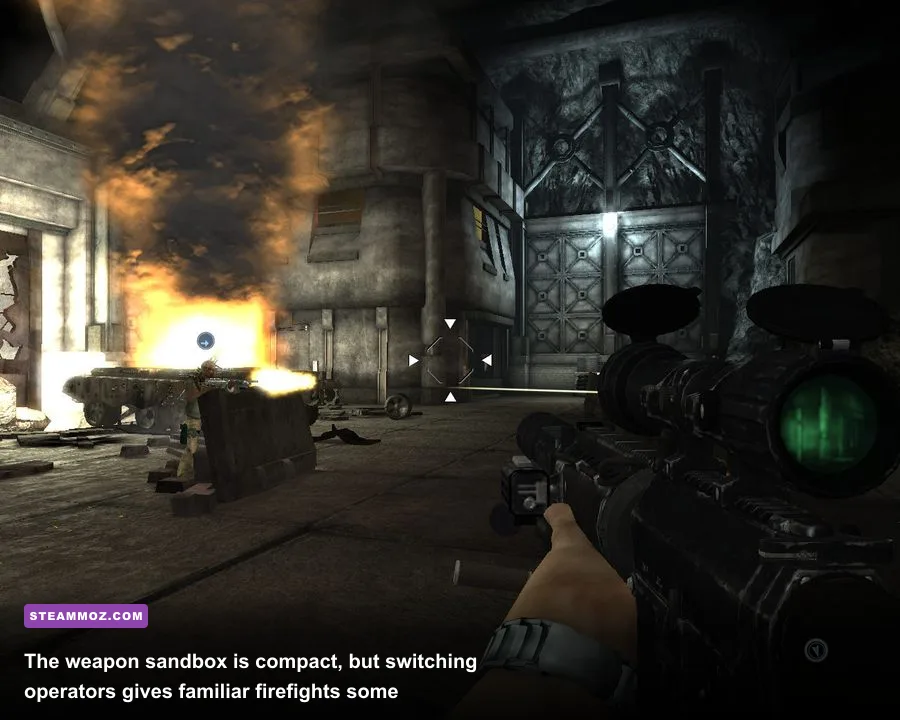
The shooting is the game’s safest success. Assault rifles have satisfying impact, automatic fire is easy to control, and heavier weapons make a convincing mess of cover. Sniper play is slower and more deliberate, letting Lang pick off exposed soldiers before Graves storms the position. Shotguns are at their best in cramped interiors, where a fast switch and a close-range blast can turn a bad push into a clean room.
There is no meaningful weapon-stat screen showing damage, recoil values, rate of fire, or reload timings. That matters because modern players are used to comparing exact numbers. In Denied Ops, weapon choice is communicated through feel and role rather than transparent statistics. The assault rifle is the dependable default, the sniper rifle rewards patience, and heavy weapons are situational tools rather than permanent upgrades.
Use Lang to remove enemies with obvious advantages: mounted gunners, distant guards, and soldiers carrying explosives. Then switch to Graves before entering the room. This two-step rhythm is more effective than trying to make one character do everything. Likewise, don’t waste heavy ammunition on isolated targets. Save it for clustered enemies, reinforced positions, and moments when environmental destruction opens a new route.
Explosives are particularly useful when enemies gather behind cover, but the game’s feedback can be inconsistent. A blast may remove the wall you wanted to use while leaving a nearby enemy strangely untouched. Watch the geometry, not just the reticle. If a surface looks thin, shoot it first and expose the room; if it looks reinforced, reposition rather than dumping an entire magazine into it.
| Combat situation | Preferred operator | Recommended approach | Common mistake |
|---|---|---|---|
| Distant mounted gunner | Lang | Peek from cover, land a precision shot, then advance. | Charging Graves across open ground. |
| Dense interior room | Graves | Break cover, use automatic fire, and clear corners aggressively. | Keeping Lang exposed after the first missed shot. |
| Enemy cluster behind cover | Graves | Use explosives or heavy fire to alter the arena. | Repeating the same exposed angle. |
| Long sightline with scattered targets | Lang | Remove priority enemies before the push. | Firing continuously and revealing your position. |
| Partner down | Either | Switch immediately, retreat behind hard cover, then revive. | Attempting a revive while the room is still active. |
Destruction is clever, but rarely truly tactical
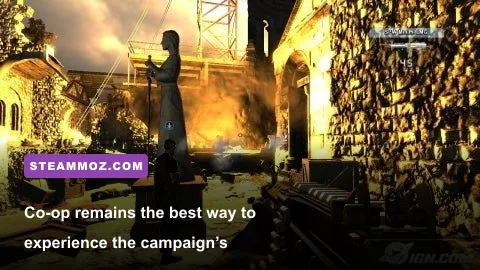
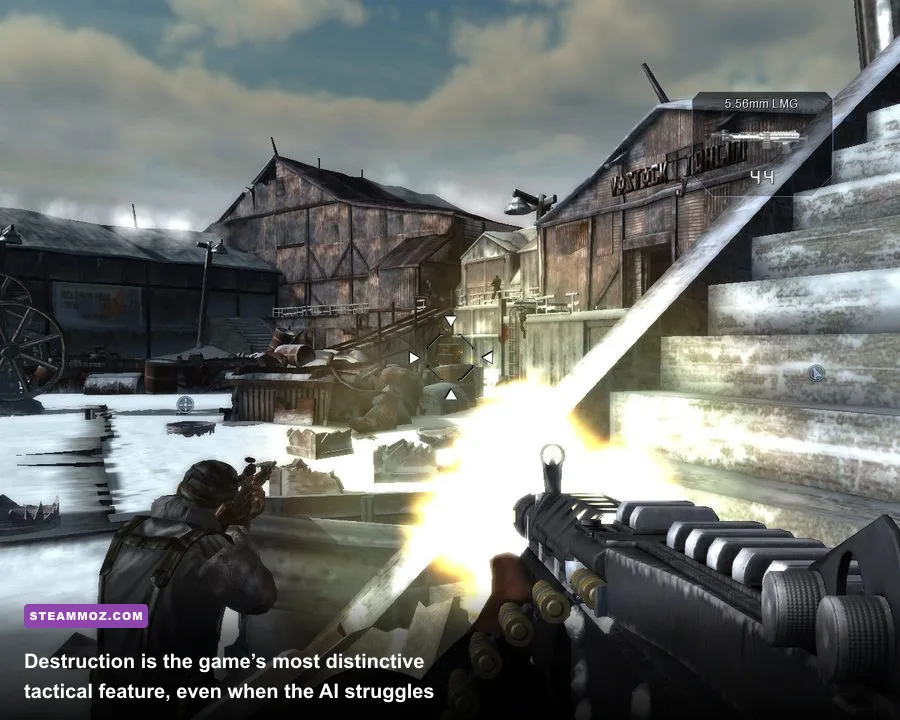
Destructible environments were a major selling point in 2008, and they remain visually satisfying. Walls fracture, cover breaks apart, and gunfire can change the shape of an encounter. The technology gives firefights a physical texture that many similarly aged shooters lack. You don’t always feel locked into a corridor because the environment can be damaged or opened.
Yet destruction is more spectacle than systemic strategy. The AI doesn’t consistently react to a breached wall, relocate intelligently, or punish you for removing your own cover. The best use is usually straightforward: destroy a barrier to expose a machine-gunner, clear a sightline for Lang, or remove a safe hiding place before pushing with Graves.
That limitation becomes obvious during repeated arenas. Once you understand that a certain wall can be removed, the encounter becomes a routine puzzle rather than an improvised battle. Still, the feature helps the game feel distinct. If you enjoy older shooters with physical environments, compare its approach with the more open-ended systems discussed in our Dungeons review, which examines a very different kind of space management.
The campaign is entertaining, uneven, and over quickly
The campaign moves through international conflict zones and military installations with the broad strokes you’d expect from a late-2000s action game. Missions typically combine infiltration, firefights, demolition, escort movement, and extraction. The pacing is brisk, and there’s little padding from collectibles or side activities. That focus is refreshing in 2026, although it also means the game has very little to offer after the credits.
Level design is strongest when it gives both characters room to work. Open compounds let Lang pick targets while Graves creates noise from a second angle. Urban sections can produce enjoyable cover-to-cover advances, especially when destruction opens alternate lines of attack. Narrow corridors are less successful because they minimize the difference between the operators and turn the experience into a conventional corridor shooter.
Difficulty changes how punishing mistakes feel, but it doesn’t fundamentally repair the AI or deepen the tactics. On lower settings, Graves can often brute-force encounters. Higher settings make positioning more important because incoming fire punishes exposure, but they can also magnify the partner AI’s mistakes. The best experience is usually a middle or high difficulty with a human co-op partner, not the hardest setting played solo for bragging rights.
| Campaign element | What works | What doesn’t | 2026 expectation |
|---|---|---|---|
| Mission variety | Mixes assault, stealth, demolition, and extraction. | Objectives often return to the same shooting loop. | Enjoyable in short sessions. |
| Level design | Some arenas support flanking and destructible routes. | Corridors reduce tactical choice. | More linear than modern tactical FPS games. |
| Difficulty | Higher settings make exposure dangerous. | Doesn’t solve AI or checkpoint issues. | Choose normal or hard for the best balance. |
| Replay value | Co-op and alternate operator approaches add some variety. | No major progression, challenge mode, or build system. | Limited after one or two runs. |
PC performance and modern compatibility
Conflict: Denied Ops is technically lightweight by 2026 standards. Its original PC requirements are modest, but that doesn’t guarantee a flawless modern experience. Old games can run into issues with widescreen scaling, controller detection, refresh-rate behavior, mouse sensitivity, or multiplayer connectivity. Check the developer’s official site where available, and read recent Steam community reports before assuming every setup behaves identically.
| Setting or issue | Recommended value | Performance impact | Visual or practical note |
|---|---|---|---|
| Resolution | Native monitor resolution | Low on modern GPUs | May require community fixes for clean widescreen presentation. |
| Texture quality | Highest available | Low | Textures are old, so there’s little reason to reduce them. |
| Shadows | High, then lower if stuttering appears | Moderate | One of the more noticeable older-engine performance settings. |
| Anti-aliasing | Highest stable option | Low to moderate | Helps jagged geometry but cannot fix dated assets. |
| V-sync | Test on and off | Variable | Disable it if input feels sluggish; use a driver-level frame cap if needed. |
| Frame rate | Stable 60 FPS target | Depends on compatibility | Consistency matters more than chasing an unusually high refresh rate. |
Don’t expect modern ultrawide support, HDR, ray tracing, or a polished remaster. The game’s low hardware demand is a benefit, but its age is visible in animation blending, lighting, facial models, and interface scaling. If your older PC games regularly stutter, our PC stutter troubleshooting guide has broadly useful steps for overlays, drivers, and frame pacing.
Co-op changes the entire recommendation
Solo play is serviceable; co-op is where Denied Ops starts to make sense. With two human players, Graves and Lang stop feeling like a gimmick and become a basic but enjoyable division of labor. One player can draw attention and destroy cover while the other watches a flank. You can also recover from mistakes without blaming a bot that wandered into a grenade.
The co-op design remains limited by the same campaign structure. There aren’t elaborate combined abilities, shared progression systems, or missions built around synchronized timing. The appeal is simply coordination inside familiar spaces. That’s enough for a relaxed evening with a friend, particularly if you both enjoy games that show their age instead of hiding it.
Before starting, agree on who prefers which operator. Graves players should expect to lead pushes and manage crowded rooms. Lang players need patience, strong target recognition, and the discipline to avoid sprinting into every fight. Swap roles between missions if you want the campaign to feel less repetitive.
Should you play Conflict: Denied Ops in 2026?
Play it if you want a compact, inexpensive military FPS with destructible cover, two playable operators, and a distinctly 2008 sense of scale. Play it in co-op if possible. The shooting is satisfying enough, the campaign keeps moving, and the Graves-Lang switch gives ordinary firefights a little personality. It’s also a useful time capsule from the period before every shooter needed an open world, battle pass, or hundred-hour progression track.
Skip it if you need smart squad AI, transparent weapon statistics, modern accessibility options, seamless online matchmaking, or deep tactical simulation. The game’s biggest weakness isn’t that it looks old; it’s that its best ideas are underused. Destruction doesn’t consistently reshape enemy behavior, operator differences rarely become essential, and the AI partner can turn a carefully planned assault into slapstick.
My final rating for 2026 is 6.5/10. That score reflects a game with a strong hook, enjoyable weapons, and a campaign worth one weekend, dragged down by shallow systems and aging technical design. Buy it during a sale, approach it as a retro action shooter rather than a serious tactical simulator, and keep expectations realistic. Under those conditions, Conflict: Denied Ops is still worth playing—not because it was secretly ahead of its time, but because its loud, destructible, two-man formula remains charmingly direct.
For more recommendations from the same era, see our reviews of Car Mechanic Simulator 2015 and Dustborn. They offer very different experiences, but both show why older and overlooked PC games can still earn a place in a modern backlog.