
The fastest Dragon Lapis leveling route is not a single secret map: push the story until the next dungeon opens, equip Lapis boards that raise damage before defense, and farm the strongest enemy group you can defeat in one or two turns. For gold, sell surplus drops only after buying the newest weapon and armor upgrades, then repeat a short dungeon loop instead of wandering the overworld.
That sounds simple, but Dragon Lapis punishes unfocused grinding. Experience is only useful when your party can convert it into faster clears, and gold disappears quickly if you upgrade every character at every town. The efficient approach is a rotating cycle: unlock a new area, test its enemies, upgrade your main damage dealers, and farm just long enough to remove the next progression wall.
This guide applies to the Steam and mobile versions of Dragon Lapis. Menus and balance can vary slightly between releases, so treat exact shop prices and drop tables as version-sensitive. The core Lapis system, job progression, encounter strategy, and gold logic remain the same.
Build the party for fast clears, not safe clears
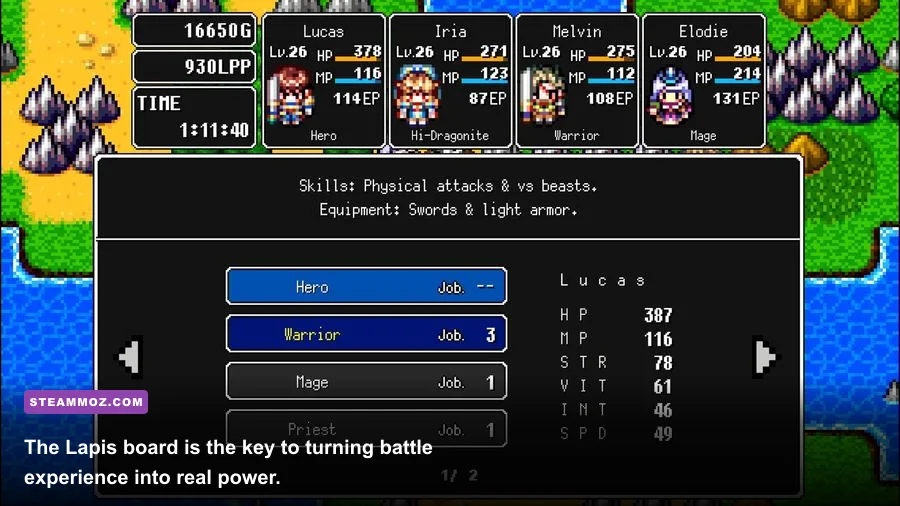
Dragon Lapis uses a job-and-board progression system rather than a conventional weapon-only RPG structure. Each character becomes stronger by activating nodes on Lapis boards, and the best farming setup is built around reducing turns. A defensive setup may survive longer, but it also consumes more healing items and produces less experience and gold per minute.
Give your primary physical attacker the board with the strongest available Strength and physical skill bonuses. A second attacker should focus on area damage or reliable multi-target skills. Your support character should prioritize MP, healing power, and speed. The fourth slot can become a flexible damage dealer, status specialist, or emergency healer depending on the dungeon.
Don't spread every new board across the entire party at once. Activate the highest-value nodes on two characters first. A useful early priority is roughly 60 percent offensive nodes, 25 percent HP or defensive nodes, and 15 percent MP or utility nodes. This isn't a permanent build; it's a farming profile that gets you through encounters before they have time to use their nastier skills.
| Party Role | Primary Priority | Secondary Priority | Farming Job |
|---|---|---|---|
| Main attacker | Strength and physical skill damage | Weapon attack and speed | Delete the toughest target |
| Area attacker | Multi-target skill power | MP and elemental damage | Clear groups in one turn |
| Support | MP, healing, and speed | HP and status resistance | Keep the loop moving |
| Flex slot | Damage or weakness coverage | Defensive utility | Finish survivors or recover runs |
How to spend Lapis points
Buy nodes that improve a skill you actually press. A small attack increase on a frequently used ability beats a large-looking bonus tied to a skill you never select. Check the board after every major story milestone, because a newly unlocked job can make old nodes much less attractive.
Save a few points for skill access rather than dumping everything into raw statistics. The biggest leveling gains come from unlocking a dependable group attack, then pairing it with enough MP to use that attack repeatedly between recovery points. If your party needs two or three turns to defeat ordinary enemies, your board choices are lagging behind the area.

🎮 Dragon Lapis
Looking to experience this game? Grab your digital key directly on our store for $7.49.
View on Steammoz Store →The fastest experience route follows the story curve
There is no reason to grind from the beginning of Dragon Lapis. Early monsters give low returns, while the game continually introduces stronger equipment, better boards, and more profitable enemies. Fight normally through each new region, then stop for a focused session only when one of three warning signs appears: ordinary battles take more than two turns, a boss defeats a character before your healer acts, or the newest shop gear is still unaffordable.
When you reach a new dungeon, clear its first loop and record three things: how many turns the average group takes, how much MP your area attacker spends, and whether the route contains a convenient recovery point. The best experience location is usually not the dungeon with the highest enemy levels. It's the strongest place where you can defeat groups quickly without returning to town after every few fights.
| Progression Check | What to Do | Target Clear Time | Why It Matters |
|---|---|---|---|
| New area unlocked | Test five to ten encounters | Under 30 seconds each | Measures whether your build fits the zone |
| Enemies survive your opener | Upgrade weapon or offensive board | One to two turns | Shorter fights improve EXP per minute |
| MP runs dry quickly | Add MP nodes or use cheaper attacks | Complete a full loop | Reduces downtime and item costs |
| Boss blocks progress | Farm the previous dungeon briefly | Two to four levels | Efficient preparation beats random grinding |
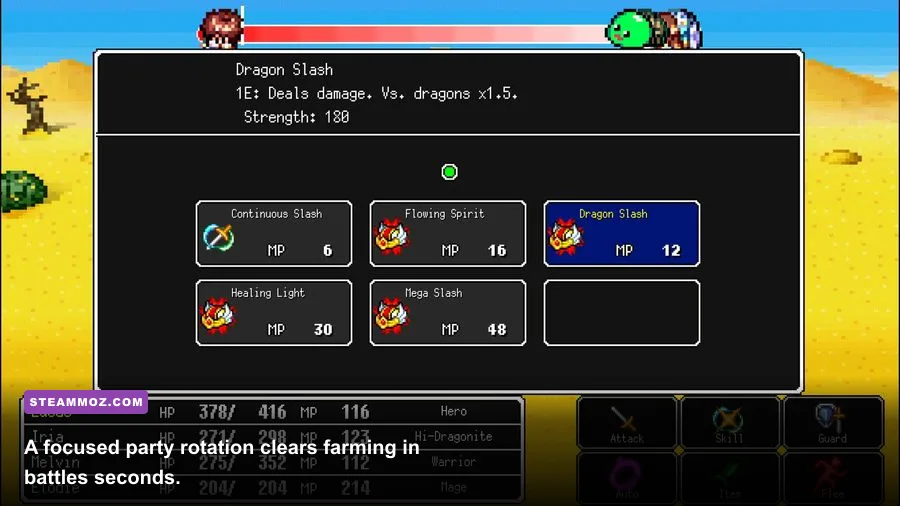
Use the strongest area skill against groups, then finish survivors with basic attacks whenever that saves MP. Random battles are not a race to press the most expensive button. They are a resource puzzle. If one enemy remains with a sliver of health, don't spend a high-cost spell unless that spell prevents the next enemy turn.
For a stalled boss, farm until your main attacker can survive one full attack cycle and your healer can restore the party without exhausting MP. That benchmark is more useful than chasing an arbitrary level. Dragon Lapis bosses often become manageable after a modest equipment upgrade because weapon attack and board bonuses compound across every round.
Our fastest leveling and credit route guide uses the same principle: measure rewards per minute, not rewards per encounter. The lesson transfers perfectly here.
Gold farming works best with controlled spending

Dragon Lapis gold farming is mostly an economy problem. Battle rewards, chest contents, and sellable drops all matter, but careless shopping is what creates the feeling that the game never gives you enough money. Buy the newest weapon for your main attacker first, then the newest armor for the character taking the most damage. Upgrade the rest only when the current equipment is clearly causing deaths or extra turns.
Don't purchase every accessory immediately. Accessories can be valuable against a specific status effect or boss mechanic, but they are usually a poor early farming investment compared with a weapon that improves every encounter. Keep one or two situational accessories in storage and sell duplicates when your inventory begins filling with low-tier equipment and common monster materials.
A practical gold loop
Start at the nearest town with a shop and healing point. Empty your inventory of genuinely useless drops, equip the best current gear, and enter the highest-level dungeon you can clear consistently. Follow the shortest route containing the densest enemy groups. Use area skills on the first round, recover at the dungeon's healing point if available, and repeat the loop until you can afford the next major weapon purchase.
Sell drops in batches rather than after every encounter. Constant shop trips destroy your gold-per-minute rate. A good stopping point is when your bag is close to full, your MP items are running low, or you have earned enough for a specific upgrade. Farming without a purchase target often leads to wasting the money on minor equipment that will be replaced after the next story segment.
| Gold Source | Best Use | Efficiency | Important Warning |
|---|---|---|---|
| Dungeon battles | Gold plus experience | Best combined return | Only farm where clears stay quick |
| Chest rewards | Early upgrade funding | Excellent but limited | Check side paths before leaving |
| Sell duplicate gear | Emergency shop money | Situational | Keep unique accessories and quest items |
| Common enemy drops | Routine income | Steady | Batch-sell to reduce downtime |
Use the gold-management lessons from Car Mechanic Simulator as a useful reminder: money earned is only valuable when it accelerates the next upgrade. In Dragon Lapis, that usually means one high-impact weapon, not four mediocre purchases.
Turn order and skill rotation make the grind faster

Speed is the hidden stat in every farming route. A character who acts before the enemy can remove a target, prevent damage, and save healing resources. Put speed-boosting nodes or equipment on the character responsible for opening combat. If that character consistently acts second, change the setup even if the displayed attack stat is slightly lower.
Your standard rotation should look like this: the area attacker opens with the cheapest reliable group skill, the main attacker targets the strongest survivor, and the support character uses a buff or basic attack unless healing is required. Against a single enemy, stop using group skills and switch to the strongest efficient single-target ability. Save full-MP attacks for elite enemies, dangerous formations, or boss phases.
Elemental weaknesses are worth exploiting, but don't build an entire farming plan around them unless the dungeon has a very consistent enemy type. A neutral attack that kills in one turn is better than a theoretically stronger elemental skill that costs too much MP or requires swapping boards. Consistency is what turns a decent route into a profitable one.
Before a boss, restore HP and MP, inspect every character's Lapis board, and replace farming accessories with resistance or recovery options if the encounter uses status effects. During the fight, watch the boss's opening pattern instead of burning all resources immediately. If it buffs itself or enters a stronger phase after losing health, hold your best burst for that transition and keep the healer ready to act.
When to stop farming
Stop when your next weapon or armor upgrade is affordable and your party clears the current route comfortably. Continuing past that point usually gives diminishing returns because the next story area will offer better experience, stronger drops, and more gold. Dragon Lapis rewards momentum: unlock the next region, update your boards, and move your farming loop forward.
If the game stutters or inputs feel delayed on PC, our PC stutter troubleshooting guide covers the general fixes worth trying. Dragon Lapis is lightweight, but stable performance still makes repeated encounters less tiring.
Common farming mistakes that waste hours
The biggest mistake is grinding enemies far below your party's level. Their battles feel safe, but the low reward and slow travel time make the route inefficient. The second is leveling every character evenly when only three are needed for the next story checkpoint. Focus your strongest core first, then bring reserves up later with the better experience from newly unlocked areas.
Another trap is ignoring the Lapis board after changing jobs. A character may look stronger on paper while losing access to the skill that made the previous setup efficient. Recheck active abilities, passive bonuses, and MP costs after each job change. The best farming build is the one that produces fast, repeatable clears, not the one with the highest theoretical endgame numbers.
Finally, don't hoard every consumable. Healing items exist to keep a profitable loop running, and using a few is cheaper than returning to town repeatedly. At the same time, don't burn rare recovery items on ordinary battles. Use basic attacks to finish weak enemies, reserve premium resources for bosses, and always leave town with a clear upgrade goal.
For more retro RPG progression advice, see Steamoz's hidden-reward guide for Cossacks 3 and the new-player tips for Freedom Wars Remastered. The games differ wildly, but both reward players who plan routes instead of grinding blindly.
For official release information and platform details, check the official KEMCO Dragon Lapis page, the KEMCO game catalog, and the game's official Steam listing.
The short version: use the newest dungeon you can clear in one or two turns, prioritize offensive Lapis nodes, buy one meaningful weapon upgrade at a time, and sell surplus drops in batches. That loop keeps experience, gold, and story progress moving together—the exact rhythm Dragon Lapis wants you to find.