
Yes, Alien: Isolation’s Safe Haven is still worth playing in 2026—but only if you want a compact, punishing survival-horror challenge rather than another story chapter. The DLC’s objective-driven map turns Sevastopol into a tense resource puzzle, and its strongest runs remain some of the best standalone Alien gameplay Creative Assembly ever made. It is less appealing as a first taste of the game, and its value depends heavily on whether you already own the Season Pass or can buy the DLC cheaply.
Safe Haven does not add a new campaign, major cutscenes, or a fresh narrative arc for Amanda Ripley. Instead, it asks you to complete a chain of tasks while managing health, crafting materials, access routes, and the unpredictable Xenomorph. That narrower format is exactly why it still works: there is almost no downtime, no tutorial padding, and no guarantee that the route you used five minutes ago will remain safe.
For the full context, the official Steam listing remains the best place to check the current package and DLC availability. My verdict is an 8/10 for returning players, 7/10 for newcomers, and a firm recommendation for anyone who enjoys stealth games built around pressure rather than combat power.
What Safe Haven actually adds

Safe Haven is a Survivor Mode expansion for Alien: Isolation. Its headline arena is the Safe Haven location, a section of Sevastopol that functions as a compact challenge map rather than a conventional campaign level. You begin with a limited loadout, move through connected rooms, and complete objectives that gradually open the path toward escape. The companion Basement map extends the same idea with a tighter, more claustrophobic layout.
The important distinction is that this is not a traditional mission with a scripted sequence of encounters. Survivor Mode tracks your performance through score, time, objectives, and survival. You can finish a run quickly, search for supplies, or take a riskier route for a better leaderboard result. That changes how you read the environment. A locker is not simply a hiding place; it is a potential checkpoint in a route. A save station is not just convenient; using it can cost time and reveal where you are making noise.
The map also makes Alien: Isolation’s existing systems feel more deliberate. Keycards, rewire panels, terminals, vents, doors, lockers, and crafting benches are no longer background dressing. You are constantly deciding whether a new objective is worth crossing an exposed room. The game’s 18-mission campaign can sometimes bury these systems beneath long exploration sequences. Safe Haven strips away that excess and leaves the core loop on the table.
There is no conventional skill tree or character build here. Amanda’s capabilities come from the campaign’s established tools: the motion tracker, flare, noisemaker, smoke bomb, flashbang, EMP mine, medkit, revolver, shotgun, bolt gun, stun baton, and flamethrower. If you enter the DLC without understanding how those tools interact, the opening objectives will feel unfair. If you know when to spend each one, the map becomes a tense but readable series of decisions.
That makes Safe Haven a poor substitute for the base game if you have never played Alien: Isolation. The campaign teaches its stealth language more gradually and gives you more room to learn the Alien’s patrol behavior. Safe Haven assumes you already understand that sprinting is an emergency action, that the motion tracker is not a magic radar, and that a loud solution can create a worse problem than the one it solves.
🎮 Alien: Isolation Safe Haven
Looking to experience this game? Grab your digital key directly on our store for $3.99.
View on Steammoz Store →The survival loop is brutally effective
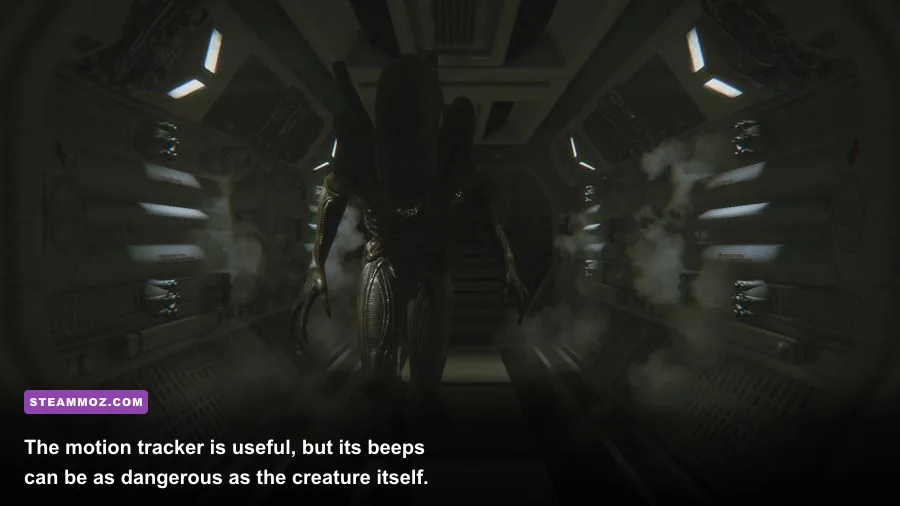
The best part of Safe Haven is the way every objective creates a small economy of risk. You may need to restore power, access a terminal, retrieve a key item, and reach an exit, but the Alien does not politely wait while you complete each step. It patrols, investigates sound, reacts to distractions, and occasionally abandons a predictable route when your behavior becomes too obvious.
The motion tracker remains your most valuable information tool. Its green sweep tells you whether the creature is approaching, but it also narrows your attention. Veteran players learn to check the tracker in short bursts, then look at the actual room. The screen can miss important visual details: an android turning a corner, a Working Joe standing near a door, a human survivor carrying a firearm, or a vent above you beginning to open.
Safe Haven is at its best when the Alien is nearby but not directly visible. You hear the scrape of claws, the clicking vocalization, or the heavy impact of a landing above the ceiling. Those sounds are telegraphs, not random decoration. A ceiling vent opening usually means the creature is entering the local zone; a distant roar can mean you have a few seconds to move before it starts searching. Do not wait for confirmation if your current position has no cover.
Noise management matters more than raw speed. Sprinting creates a large sound footprint, while walking is safer but not invisible. Opening doors, operating terminals, firing weapons, and using the maintenance jack all produce opportunities for the Alien to investigate. A flare can pull it away from a doorway, but a noisemaker is stronger when you need the creature to commit to a specific location. Do not throw both automatically. Save the noisemaker for an objective that leaves you exposed.
| Tool or action | Best use in Safe Haven | Main danger | Recommended habit |
|---|---|---|---|
| Motion tracker | Checking approach direction and distance | Distracts you from nearby humans or androids | Use brief glances, then scan the room |
| Flare | Creating a temporary distraction or safe movement window | Can waste a resource without relocating the Alien far enough | Throw it across your route, not beside your feet |
| Noisemaker | Pulling the Alien away from a terminal or objective | Its noise can attract other threats or return the Alien to your route | Deploy it only after identifying your escape path |
| Flamethrower | Breaking an immediate close-range encounter | Fuel is limited and repeated bursts teach the Alien to retreat briefly | Use short bursts, then hide and reposition |
| EMP mine | Disabling Working Joes and stopping android pressure | Does little against the Alien | Reserve it for an android blocking a mandatory route |
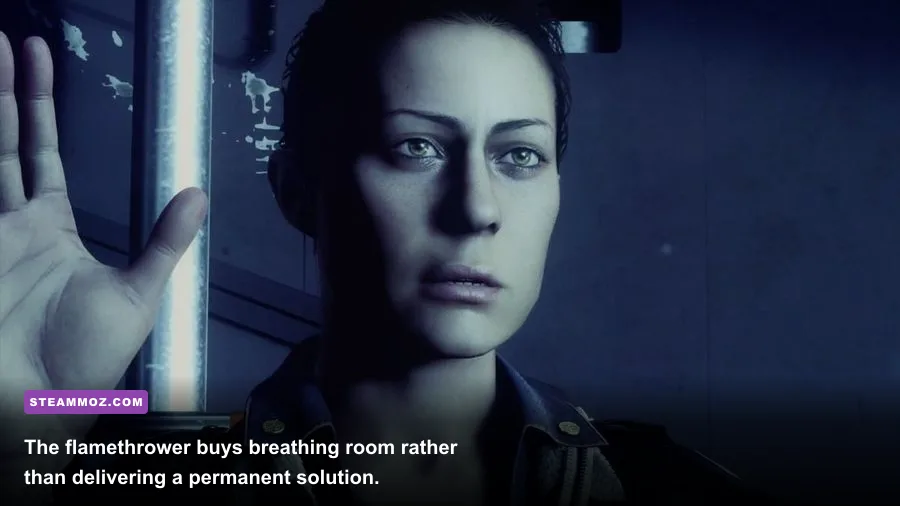
The flamethrower deserves special attention. It is not a win button. A short burst can make the Alien recoil and create the gap you need, but holding the trigger drains fuel quickly. The creature can also circle back, especially if you remain in the same room. Fire, move, break line of sight, and stop making noise. The weapon’s true value is tempo: it turns an unavoidable grab into a chance to escape.
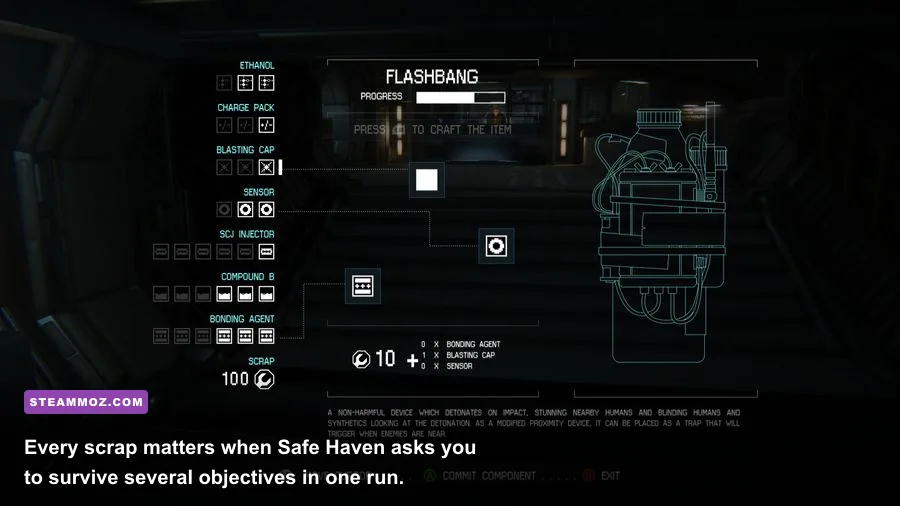
Crafting is similarly about tempo rather than hoarding. Medkits are essential because Safe Haven’s long objective chains make chip damage expensive. Smoke bombs are excellent when you need to cross a doorway under pressure, while flashbangs can interrupt humans or provide a brief opening against an android. Molotovs are powerful but loud, and the fire may block your own route. A well-stocked inventory is not automatically a good inventory if every item is reserved for a future emergency that never arrives.
How to approach each objective without wasting resources
Safe Haven rewards a route-first mindset. Before activating a terminal or pulling a lever, identify at least two exits. One should be a normal door or corridor; the other can be a locker, vent, side room, or loop around the objective. If you only know the way forward, the Alien will eventually turn that route into a trap.
Restore power before you commit
Power-related tasks often change the map’s rhythm. Lights, doors, and machinery may activate, but the sound also gives the Alien a reason to investigate. Approach the interaction point while crouched, check the tracker, and listen for the creature’s position before starting the animation. If the objective takes several seconds, do not begin simply because the tracker is quiet. Quiet can mean the Alien is above you or outside the tracker’s immediate sweep.
Use terminals as controlled exposure
Terminals are dangerous because they lock your attention and usually place you in a predictable location. Clear the nearby room first. Close doors when possible, but avoid repeatedly opening and closing them while the Alien is close. If you have a flare, throw it toward a side corridor before accessing the terminal. If you have a noisemaker, save it for the moment the terminal objective starts rather than using it during the approach.
Treat Working Joes as route blockers
Working Joes do not create the same panic as the Alien, but they are often more troublesome when you are trying to preserve stealth. Their footsteps are loud, their patrols can force you into open areas, and a hostile unit can absorb valuable time. The stun baton is the cleanest close-range answer when you have room to follow up, while an EMP mine is safer if the android blocks a narrow doorway. Avoid wasting shotgun shells unless the machine is already aggressive and you have no alternate route.
Know when to abandon an objective
There is no prize for finishing an interaction while the Alien is standing in the next room. Cancel your approach, hide, and let the search cycle pass. The creature often investigates the last sound, checks a nearby hiding area, and then moves on. Staying still for ten seconds can save a medkit, a flamethrower burst, and an entire failed run. Safe Haven’s timer encourages speed, but a dead run has the worst possible time.
| Situation | Primary response | Backup response | Resource priority |
|---|---|---|---|
| Alien is approaching an exposed terminal | Break line of sight and wait | Throw a noisemaker away from the terminal | Spend time before spending fuel |
| Alien enters the room during an interaction | Cancel, hide, and let it investigate | Use a short flamethrower burst and relocate | Preserve health and ammunition |
| Hostile Working Joe blocks a narrow corridor | Reroute through a side room | EMP mine or stun baton | Use EMP before firearms |
| Human survivors hold the next objective | Distract with a flare or flank quietly | Revolver or shotgun from cover | Keep noise low until the Alien is distant |
| You are injured with several objectives left | Craft a medkit immediately | Search nearby lockers before moving on | Health beats leaderboard time |
The map’s difficulty curve is not based on stronger enemies or higher damage numbers. It comes from overlapping threats. An android can push you into the Alien’s patrol, a terminal can trap you during a search, and a careless sprint can turn a manageable route into a full chase. The smartest runs feel slow even when the final score is fast because the player is constantly preventing bad situations before they happen.
Performance and presentation still hold up on PC
Alien: Isolation remains one of the strongest-looking games from 2014. The industrial art direction does more than create atmosphere: signage helps navigation, steam hides movement, fluorescent lights reveal open sightlines, and shadows communicate whether a locker or desk is safe enough to reach. Safe Haven benefits from that clarity because its compact spaces are designed around visual recognition.
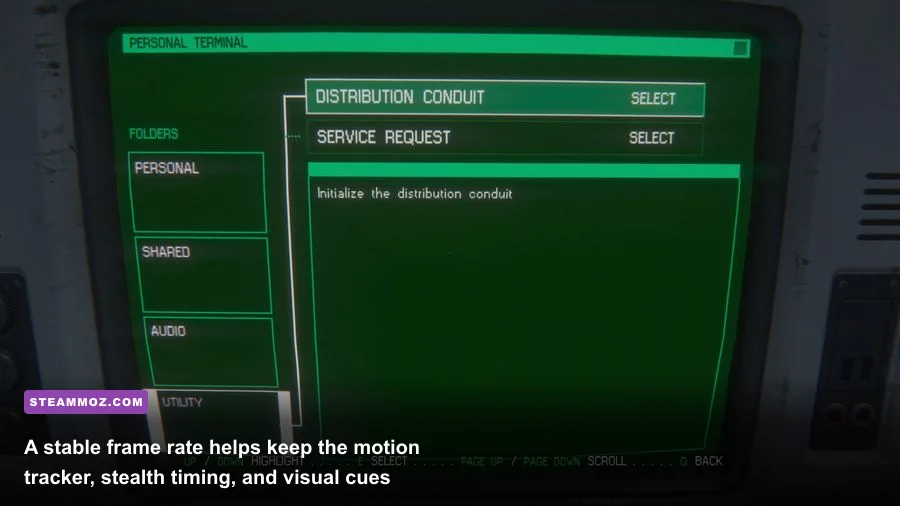
On modern PCs, the biggest practical target is a stable 60 frames per second at 1080p or 1440p. Higher refresh rates can make camera movement feel cleaner, but they do not transform the underlying stealth systems. Consistency matters more than chasing 144 FPS. A sudden frame-time spike while the Alien is entering a room is far more damaging than playing at a locked 60.
| Setting | Recommended value | Performance impact | Visual note |
|---|---|---|---|
| Resolution | Native monitor resolution | High at 1440p and 4K | Preserves sharp signage and tracker readability |
| Texture quality | High | Low on modern GPUs with sufficient VRAM | Keeps suit, vents, and metal surfaces detailed |
| Shadow quality | High or medium | Moderate | Medium is a good compromise in crowded rooms |
| Ambient occlusion | High | Moderate | Improves depth around lockers, desks, and machinery |
| Anti-aliasing | FXAA or SMAA | Low to moderate | SMAA is cleaner; FXAA is lighter on older hardware |
| Motion blur | Off | Small gain | Makes quick tracker checks and turns easier to read |
| Film grain | Personal preference | Negligible | Off gives a cleaner image; on preserves the filmic mood |
Controller support is solid, although mouse aiming makes the revolver, shotgun, and flamethrower easier to manage under pressure. Headphones are more important than ultra settings. Alien: Isolation’s sound mix tells you when a vent opens, when a Working Joe has spotted you, and whether footsteps are coming from your level or above it. Stereo separation can be the difference between hiding in the correct room and walking into the creature.
For platform details, Creative Assembly’s official Alien: Isolation page provides the developer’s presentation of the game, while the official Feral Interactive page is useful for checking supported versions on non-Windows platforms. The PC release is generally the best fit for Safe Haven because mouse control, mod support, and modern display options make repeated challenge runs more comfortable.
Is Safe Haven worth buying in 2026?
The answer depends on what you expect from downloadable content. If you want more of Amanda Ripley’s story, Safe Haven will disappoint. It does not expand the campaign in the way a full narrative episode would, and its limited presentation means you will see fewer cinematic character moments. If you want a concentrated test of the game’s stealth, sound design, and resource systems, it is one of the strongest pieces of Alien: Isolation content available.
| Player type | Recommendation | Why | Best way to play |
|---|---|---|---|
| First-time Alien: Isolation player | Buy later | The campaign teaches the systems more effectively | Finish the main story first |
| Returning campaign player | Strong buy | Compact objectives expose the game’s best survival mechanics | Start on a forgiving difficulty, then chase score |
| Leaderboard-focused player | Excellent buy | Routes, resource timing, and risk management create replay value | Learn objective order and optimize distractions |
| Story-only horror fan | Wait for a bundle | There is little new narrative content | Purchase the Season Pass or complete edition on sale |
| Alien fan seeking atmosphere | Recommended | It captures the film’s industrial tension exceptionally well | Use headphones and play without assist options |
Safe Haven also makes a useful companion to other compact, systems-driven games. If you enjoy a challenge built around route planning and pressure, Steamoz’s AI War 2 secret rewards guide scratches a similar planning itch from a very different angle. For broader horror recommendations, our list of games like Goatz offers louder, sillier alternatives, while Bomb Rush Cyberfunk’s 2026 review covers another stylish older release that remains easy to recommend.
There are a few reasons not to overrate it. The format can feel repetitive once you understand the map, the Alien’s behavior can occasionally produce an awkward search loop, and the DLC’s score chasing is less meaningful if you do not enjoy replaying the same spaces. The lack of a new story also means its emotional impact is much lower than the main campaign’s best missions.
But Safe Haven’s restraint is ultimately its advantage. It does not dilute Alien: Isolation with new weapons, inflated enemy health, or artificial progression. It takes the motion tracker, the vents, the save stations, the crafting bench, and the creature’s sound-driven AI, then asks you to use them with discipline. In 2026, that design still feels sharper than many newer horror games that rely on scripted scares.
Final verdict
Alien: Isolation Safe Haven is worth playing in 2026, especially on sale or as part of the Season Pass. Treat it as a high-pressure Survivor Mode challenge, not a missing campaign chapter. The Safe Haven and Basement maps are compact, replayable, and unusually good at exposing whether you actually understand the game’s stealth systems.
New players should complete the main campaign first, learn the difference between distraction and escape, and become comfortable crafting under pressure. Veterans should approach Safe Haven as a route-optimization puzzle: minimize noise, preserve the flamethrower, use EMP mines for Working Joes, and never activate an objective without knowing where you will hide afterward.
It is not essential story content, but it is excellent Alien gameplay. The Xenomorph remains terrifying because the DLC refuses to turn it into a boss you can solve permanently. You can only buy time, make noise somewhere else, and hope the next door opens before the creature finds you. That is a small idea, brilliantly sustained—and it still holds up.
For the broader franchise context, you can also compare the game with the official Alien: Isolation website and revisit Steamoz’s best games like Bounty Train list if you are looking for more focused, replayable experiences after surviving Sevastopol.