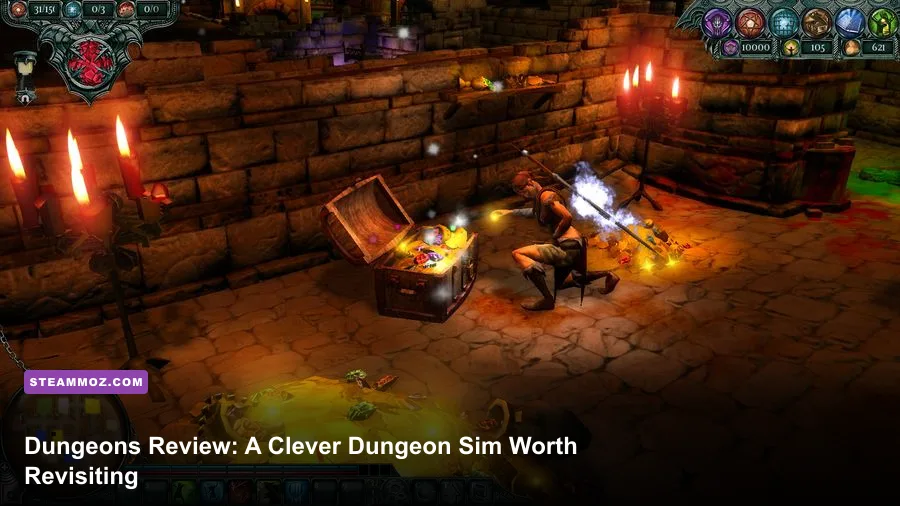
Yes, Dungeons is worth playing in 2026—but only if you want a compact, old-school dungeon-management game rather than a modern Dungeon Keeper clone. Kalypso Media’s 2011 strategy game has a wonderfully nasty central idea: you don’t protect heroes from danger; you lure them into your lair, harvest their emotions, and turn their suffering into power. Its campaign is uneven, its interface feels dated, and the combat never reaches the tactical depth of its premise. Still, the mix of room planning, hero manipulation, and sarcastic villainy remains distinctive enough to earn a recommendation at the right price.
This is the original Dungeons, not Dungeons 2 or Dungeons 3. That distinction matters. The first game is closer to a mission-based management strategy title with direct Dungeon Lord combat than to a full-time sandbox. If you’re coming from Legend of Keepers, you’ll recognize the pleasure of turning adventurers into a renewable resource. If you expect the freeform creativity of Dungeon Keeper 2, Dungeons can feel surprisingly restrictive.
What Dungeons actually asks you to do
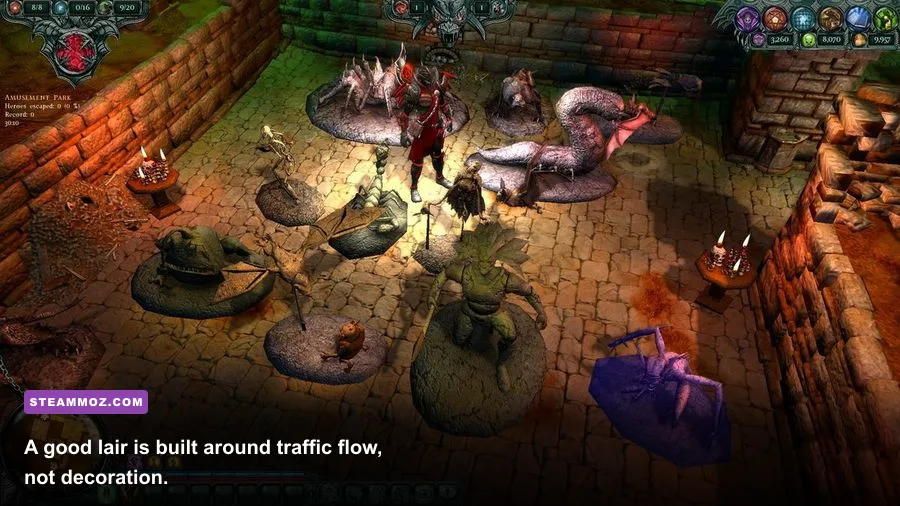
Every mission starts with an underground territory, a Dungeon Heart, a limited set of rooms, and a simple objective: become powerful enough to crush the heroes invading your domain. You expand by placing functional rooms on claimed floor tiles, then send creatures and the Dungeon Lord to handle threats. The twist is that killing heroes immediately is often inefficient. Heroes generate “soul energy” when they suffer, and that energy fuels your abilities and dungeon infrastructure.
That creates the game’s most entertaining strategic loop. You build a torture chamber or other service room, attract a hero, keep the adventurer alive long enough to produce useful emotions, and only finish the encounter when the reward outweighs the risk. The process feels less like traditional base defense and more like running a cruel theme park where every visitor arrives with a health bar.
The campaign teaches this loop through a series of authored maps rather than one endless sandbox. That structure keeps missions focused, but it also means replay value depends heavily on whether you enjoy optimizing familiar layouts. The story is deliberately broad and comedic, with the Dungeon Lord’s theatrical arrogance carrying much of the presentation.

🎮 DUNGEONS
Looking to experience this game? Grab your digital key directly on our store for $0.99.
View on Steammoz Store →Room placement is the game’s real strategy
Dungeons looks simple until a mission starts sending heroes through multiple entrances. Corridors, room access, creature recruitment, and the distance between your Dungeon Heart and the front line all matter. A torture room hidden behind a short, well-defended route is useful. The same room placed near an exposed entrance becomes an invitation for heroes to wreck your economy.
Rooms generally serve one of three purposes: generating resources, improving or recruiting creatures, or processing heroes. Treasury-style infrastructure supports your economy, while training and creature-focused spaces help you maintain a stronger fighting force. The important point is that every room competes for usable floor area. You can’t simply cover the map with every option, so the strongest layouts are compact and deliberate.
Build around chokepoints rather than stretching your lair into a maze. Put defensive rooms and creature activity close to likely approach lanes, then keep high-value rooms farther back. Leave enough open space for your Dungeon Lord to reach a threatened room quickly. The game’s pathfinding is functional, but it won’t rescue a layout that forces units to take a scenic tour while a hero destroys your core.
| Dungeon Priority | Why It Matters | Best Placement | Common Mistake |
|---|---|---|---|
| Dungeon Heart | Mission-critical survivability | Deep behind a short defensive route | Leaving it beside an entrance |
| Torture Room | Converts heroes into useful emotion | Behind creatures and a chokepoint | Building it where every hero reaches it first |
| Training Area | Improves your creature line | Near the central defense lane | Making creatures walk across the map |
| Treasury Infrastructure | Supports room and creature growth | Protected interior space | Expanding faster than income allows |
The hero system is clever, but surprisingly thin

Heroes are more than generic hit points. They arrive with different roles and behaviors, and their presence is what makes the dungeon’s economy tick. A melee fighter can pressure your front line, while ranged and support-oriented adventurers punish you if your creatures are forced to fight in open ground. The best response isn’t always “build more monsters.” It’s controlling where the hero stands, how long the encounter lasts, and whether the hero can reach a valuable room.
That said, the emotional-resource system is not as deep as the premise suggests. You don’t get a huge web of psychological states to manipulate, and many encounters eventually collapse into familiar patterns: lure heroes toward a productive room, let your forces soften them up, then collect the reward. The system is still satisfying because it changes the normal dungeon-sim objective. You’re not just blocking a raid; you’re managing the raid for profit.
Watch the health of your Dungeon Heart constantly. A profitable torture cycle is worthless if the next wave reaches the core. Pause frequently when several groups arrive at once, select the Dungeon Lord, and use his abilities where they can alter the shape of the battle rather than merely add damage. Dungeons rewards intervention, but not frantic clicking.
Combat works best as a preparation test
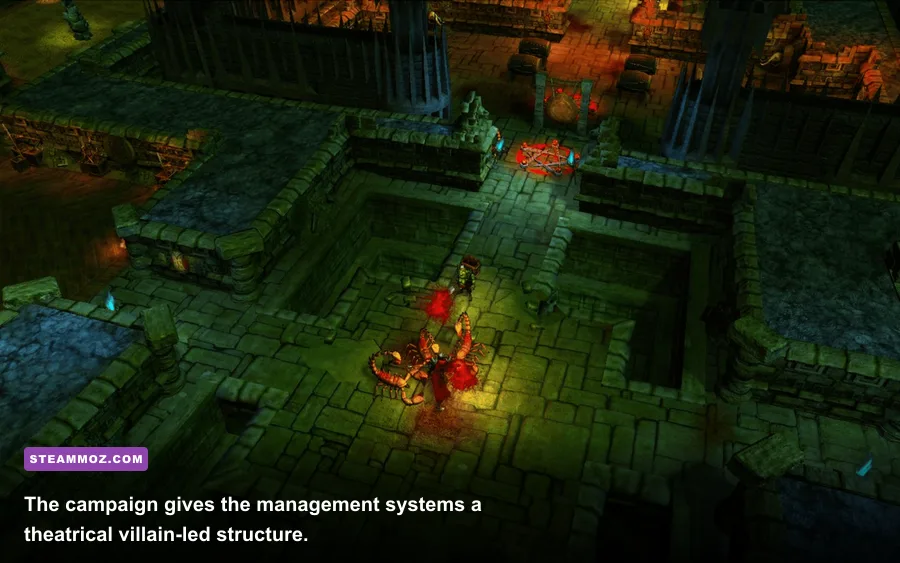
Direct combat is serviceable rather than brilliant. The Dungeon Lord can move through the map and fight alongside creatures, while abilities provide bursts of control or damage. The problem is that enemy encounters often feel more like checks on your room layout and creature availability than elegant tactical puzzles. If you reach a fight underprepared, there usually isn’t a magical micro trick that will completely save the situation.
Use the Dungeon Lord as a mobile anchor, not a reckless solo damage dealer. Let creatures absorb the first contact, then position the Lord to finish weakened targets or support the side of the fight that is losing. Pull back when your front line is scattered. A retreat through a narrow corridor can buy enough time for reinforcements to arrive, while standing in an open chamber lets ranged heroes punish your entire group.
The game’s villains and set-piece encounters add flavor, but don’t expect the boss design of a modern action strategy hybrid. The strongest “boss mechanic” is usually the map itself: entrances, waves, resource pressure, and the need to protect your Heart while still harvesting heroes. That’s less flashy, but it fits the management-first identity.
| Situation | Primary Danger | Counterplay | Useful Tool |
|---|---|---|---|
| Early hero wave | Front line reaches rooms too quickly | Fight at a chokepoint and delay the lead target | Creature grouping |
| Ranged-heavy party | Damage spreads across your units | Close distance and attack from cover or corners | Dungeon Lord support |
| Multiple entrances | Reinforcements arrive too slowly | Keep a mobile reserve near the center | Short corridors |
| Heart under pressure | One lost fight ends the mission | Abandon farming and defend immediately | Pause-and-reposition play |
Progression gives you toys, not a deep buildcraft system
Progression is enjoyable during the campaign because new rooms, creatures, and abilities change your available solutions. You gradually move from basic defensive arrangements toward more specialized dungeon economies. There’s a nice sense of escalation as the lair gains personality and your toolbox expands.
But the game doesn’t offer the intricate stat scaling or endless build experimentation you might expect from a modern strategy RPG. Creatures have distinct battlefield roles, yet you’re not managing a detailed equipment screen full of randomized affixes. The progression curve is about access and map knowledge. Once you understand what a mission wants, the optimal plan can become obvious.
That’s why Dungeons works better in focused sessions than as a forever game. A first campaign run delivers the best discoveries: finding which rooms generate value, learning how long heroes can be kept alive, and discovering where a map’s pressure points are. A second run can be more efficient, but also less surprising.
Performance and compatibility in 2026
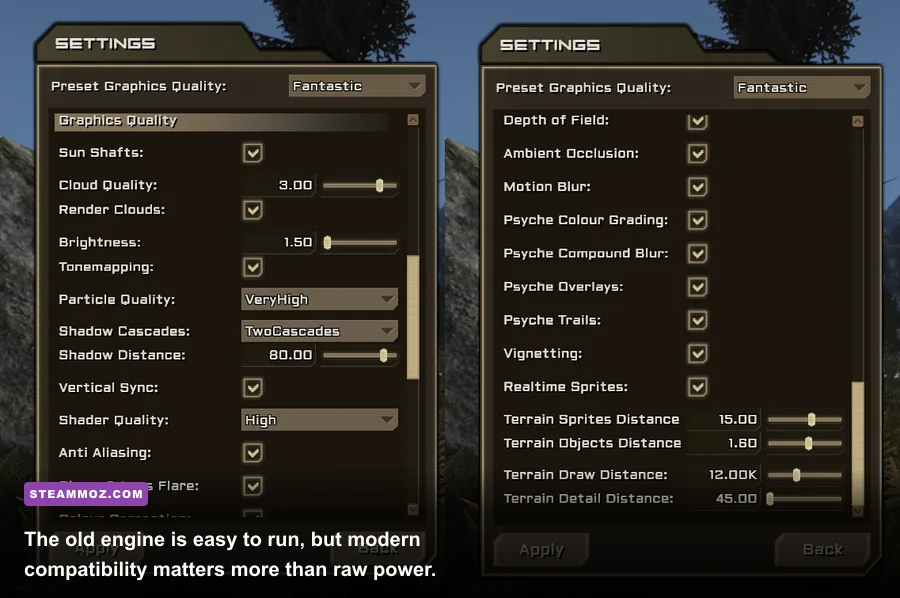
Modern hardware has no trouble pushing Dungeons. The original Steam listing targets Windows XP, Vista, and 7-era PCs, with a 2 GHz dual-core processor, 2 GB of RAM, DirectX 9-class graphics, and roughly 8 GB of storage. Those requirements are tiny by 2026 standards. The real concern is operating-system compatibility, display scaling, and whether the old renderer behaves properly on your specific Windows setup.
Don’t buy this expecting modern ultrawide support, advanced lighting, or a polished 144 Hz presentation. The visuals are readable, colorful, and suitably theatrical, but the age shows in character animation, terrain detail, and interface density. A locked 60 frames per second is a sensible target; chasing extremely high refresh rates adds little to a game built around pausing, planning, and managing rooms.
| Setting or Hardware | Original Target | 2026 Recommendation | Practical Note |
|---|---|---|---|
| CPU | 2 GHz dual-core | Any modern 4-core processor | CPU power is rarely the limiting factor |
| Memory | 2 GB RAM | 8 GB system RAM | Useful for the OS and background apps |
| Graphics | DirectX 9-class GPU | Integrated graphics should suffice | Compatibility matters more than performance |
| Frame rate | 30 FPS-era presentation | Stable 60 FPS | Prioritize consistent frame pacing |
| Display | 4:3 and 16:9-era monitors | Use native resolution if available | Expect interface scaling quirks on ultrawide screens |
Before buying, check the official Steam page for current compatibility notes, community fixes, and recent user reports. Kalypso’s official publisher site is also worth checking for support information. For broader context, fans comparing it with newer dungeon games should look at games like Dragonkin and other management-heavy PC games.
Should you play Dungeons in 2026?
Dungeons is worth playing if you enjoy authored strategy campaigns, compact management systems, and villainous humor. Its best idea—turning heroes into a resource instead of simply slaughtering them—is still memorable. Room placement gives each map a satisfying spatial puzzle, and the Dungeon Lord adds just enough direct control to stop the experience from becoming a passive construction sim.
It’s a weaker recommendation if you want a deep sandbox, robust mod support, modern accessibility options, or combat with serious tactical complexity. The campaign can feel repetitive, the interface takes patience, and some of the systems tease more depth than they ultimately provide. Dungeons is not a lost masterpiece hiding beneath the classics. It’s a clever, flawed experiment that never quite grows into its best ideas.
At a low sale price, though, those flaws are easy to forgive. Treat it as a 2011 strategy curiosity with a sharp premise, not as a replacement for every modern dungeon sim. If you like revisiting older PC games, our 2026 revisit of Bomb Rush Cyberfunk covers a similarly strong case for playing outside the current release cycle. Dungeons earns its place in that conversation: rough around the edges, occasionally repetitive, but still wickedly fun when the plan comes together and an entire band of heroes walks willingly into your trap.