
The safest beginner build for Legend of Keepers: Soul Smugglers is a control-first dungeon: use a durable front monster, stack one reliable damage type behind it, and let traps remove hero momentum before the final fight. Spend early gold on survivability and roster depth, not flashy upgrades. The winning rhythm is simple: weaken heroes in the trap room, break their morale or health with the first squad, then finish with a fresh three-monster team that counters their remaining resistances.
Soul Smugglers can feel brutal because it doesn't play like a normal RPG. You aren't building one hero with a perfect weapon. You're managing a campaign economy, three combat positions, monster fatigue, room order, morale, stress, and enemy resistance. That means a strong opening build needs to be repeatable. It should still work when the map refuses to give you the exact monster or artifact you wanted.
This guide focuses on the DLC's beginner fundamentals rather than a fragile high-roll strategy. For a similar approach to opening-game planning, compare our Creaks beginner build guide and the resource discipline in our Caravan survival tips.
The Best Soul Smugglers Opening Build

Start by treating your roster as three jobs rather than three random damage dealers. The first slot needs to survive focus fire. The second should apply the damage type the current hero group struggles to resist. The third is your finisher: either a fast attacker that acts before a dangerous hero or a specialist that punishes the team's lowest resistance.
Your default structure should be front-line sustain, middle control, back-line burst. A skeleton, orc, or similarly durable early monster can handle the first position while your damage dealers work safely behind it. If the available choices are different, prioritize the monster with the best health and resistance profile over the one with the biggest tooltip number. A dead damage dealer contributes zero, and Soul Smugglers is excellent at punishing greedy lineups.
Keep one physical source and one elemental source in the same squad whenever possible. Physical damage is dependable, but heroes can heavily resist it. Fire, frost, poison, nature, and shadow damage each create different counterplay, so don't build an entire team around one icon unless the encounter clearly rewards it. Stress and morale tools are equally valuable: a hero who reaches a morale break can become easier to finish than a hero with a large health pool.
| Build Slot | Beginner Priority | What to Look For | Why It Works |
|---|---|---|---|
| Front | Sustain | High health, resistance, reliable defensive effect | Buys turns for your damage dealers |
| Middle | Control | Stress, debuff, speed control, or repeatable damage | Reduces the enemy's ability to snowball |
| Back | Burst | Strong single-target or resistance-matching attack | Deletes the most dangerous hero quickly |
| Trap room | Softening | Mixed damage and morale pressure | Creates favorable health totals before combat |
Don't obsess over a named “perfect” Soul Smuggler skill route. Unlocks and rewards can change between runs, and the correct purchase is the one that fixes the next weakness on your map. If your monsters are dying, buy durability. If heroes reach the final room untouched, improve traps. If fights stall, add a second damage type or a faster finisher.

🎮 Legend of Keepers: Soul Smugglers
Looking to experience this game? Grab your digital key directly on our store for $2.99.
View on Steammoz Store →How to Spend Your First Gold and Souls
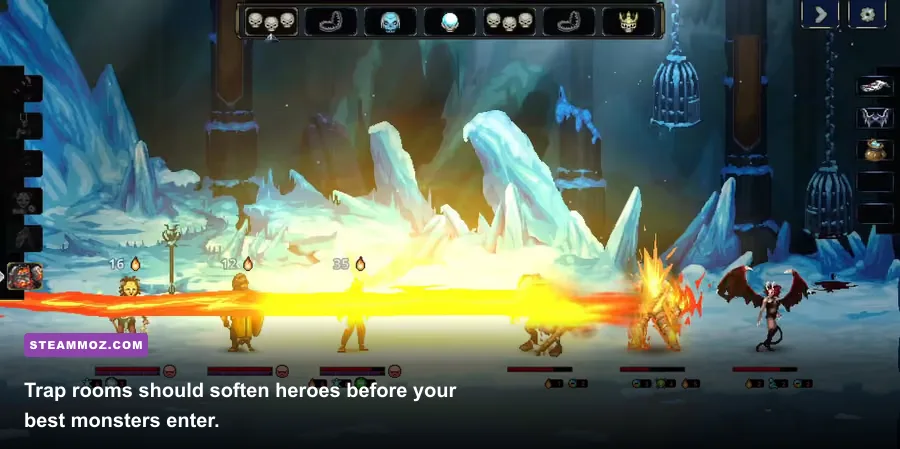
The first few visits establish whether the campaign becomes comfortable or permanently starved. Gold is your immediate operating budget, while souls are best viewed as a long-term upgrade resource. The beginner mistake is spending both currencies on one impressive monster and then discovering that the rest of the dungeon has no bench, no trap pressure, and no recovery plan.
Use your first gold purchases in this order: fill a missing combat role, improve the room that is currently underperforming, then upgrade your strongest repeatable effect. A roster with four usable monsters is safer than a roster with one elite monster and two liabilities. You have three monster slots in each fight, so your bench matters because fatigue and bad matchups can make the original team unavailable.
Souls should normally support permanent progression or a high-impact unlock rather than a minor temporary convenience. Before buying, ask whether the upgrade helps every fight or only one ideal encounter. A broad health, resistance, morale, or room improvement usually outperforms a narrow bonus during a first campaign.
Events are part of the build, not interruptions to it. Take a risky reward only when your roster can absorb a bad result. If the choice is between a small amount of gold and a permanent loss of a key monster, the gold is rarely worth gambling your core formation. The same logic applies to fatigue: a tired monster may technically be stronger than a fresh replacement, but its reduced performance can ruin two rooms instead of one.
| Early Resource | Best First Use | Avoid | Beginner Rule |
|---|---|---|---|
| Gold | Roster gap or essential room upgrade | Luxury upgrade on one monster | Buy consistency before peak damage |
| Souls | Permanent progression or broad passive | Low-impact temporary bonus | Choose effects that help multiple rooms |
| Monster slot | Fresh counter or durable replacement | Duplicate role with the same damage profile | Maintain mixed damage |
| Recovery | Remove fatigue from core monsters | Running exhausted units repeatedly | Rotate before the penalty decides the fight |
For a wider look at how PC roguelites handle performance and pacing, our Don't Be Afraid settings guide has useful optimization pointers. The game itself is lightweight, but smooth menus help when you're checking several tooltips between rooms.
Monster Skills and the Correct Combat Rotation
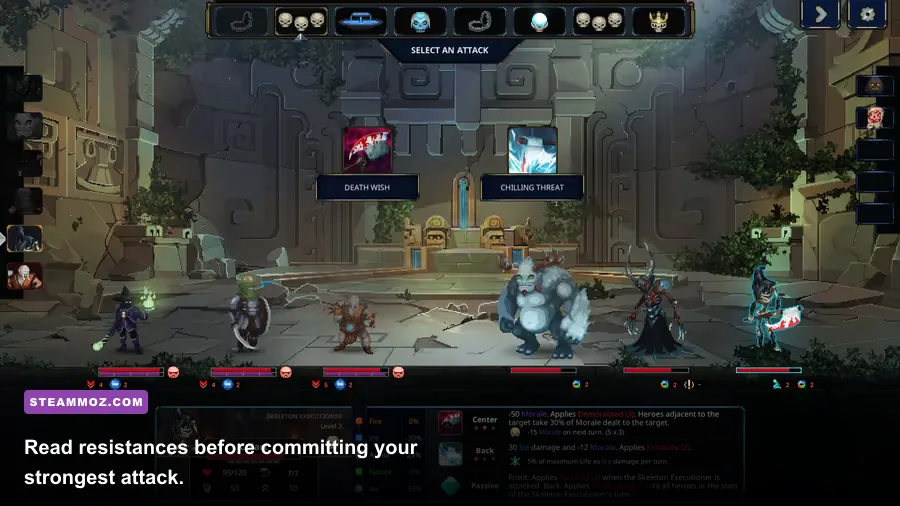
Every fight should begin with information, not panic. Inspect the hero group, identify its highest damage threat, then compare the resistances against your available attacks. Legend of Keepers uses resistance and vulnerability to make damage selection matter, so the biggest number is not automatically the best button. A smaller attack against a weakness can outperform a powerful neutral hit over the whole fight.
Your opening turn should usually apply control or remove the most dangerous enemy's momentum. If a hero can heal, buff, or deliver a devastating area attack, target that hero first unless its resistance makes the exchange inefficient. Don't waste a limited cooldown on an enemy who is already close to death; use basic or repeatable attacks to preserve your high-value skill for the next room.
The core rotation looks like this:
- Scout: check hero health, resistances, speed, and special effects.
- Disrupt: use stress, a debuff, or a speed-control effect if it prevents the enemy's strongest turn.
- Focus: concentrate two attacks on one priority hero instead of spreading damage evenly.
- Stabilize: use defensive or recovery effects before your front monster reaches a dangerous health threshold.
- Finish: spend burst once the target is in range and the resistance matchup is favorable.
In Soul Smugglers, a three-monster lineup is a battery of future turns. If your first squad wins with one monster barely alive, that is not a clean victory; it may be unusable for the next room. Rotate injured or fatigued units sooner than feels necessary. The best “DPS increase” for a campaign is often keeping a reliable attacker fresh.
Use stress as a second win condition. Health damage is obvious, but morale pressure can bypass a long attrition fight. A control monster paired with a burst attacker is especially strong: the control unit buys time while the finisher removes one hero, causing the remaining group to lose the ability to answer your rotation.
Never fire your best area attack into a group that heavily resists its damage type just because all three targets are available. A focused neutral or weakness hit is usually better. Save area damage for clustered heroes with low resistance or for a turn where it also applies a valuable debuff.
Trap Rooms That Make the Build Work
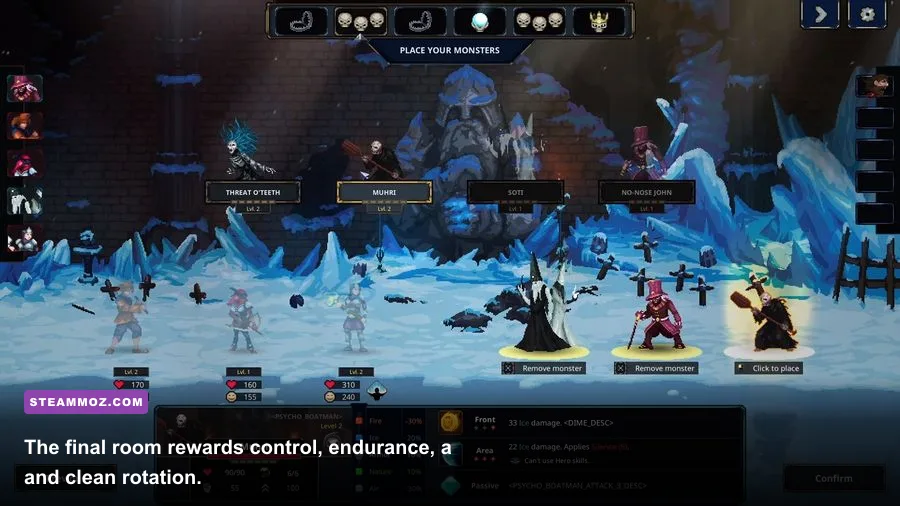
Traps are not a separate build pasted in front of your monsters. They are the first half of the same combat rotation. Your trap room should create a health, morale, or resistance advantage that your first monster team can exploit. A room packed with only one damage type looks powerful until a resistant hero walks through it and arrives at the battle almost untouched.
For a beginner, mix a dependable physical trap such as spikes with an elemental option such as a fire geyser, then add a control or morale effect when the room offers one. The exact trap names and availability can depend on the campaign unlocks, but the principle stays fixed: two damage profiles plus pressure that changes how heroes enter the next room.
Place your most reliable effect where it will actually trigger. If the room order allows heroes to pass through multiple trap spaces, don't spend every high-impact trap on the first encounter. Early heroes often have enough health to survive a single hit, while later groups are the ones that threaten the campaign. Think in terms of total dungeon damage, not the biggest single-room screenshot.
Trap upgrades should follow the same priority as monsters. Improve consistency first, raw damage second. A trap that applies its effect repeatedly or creates a weakness for your monsters can be more valuable than a larger one-off number. If heroes are arriving with full morale but manageable health, add morale pressure. If they are losing morale yet surviving comfortably, improve the damage profile that your final squad can exploit.
| Hero Problem | Trap Response | Monster Follow-Up | Common Mistake |
|---|---|---|---|
| High health | Stack reliable damage types | Focus one target immediately | Spreading damage across all heroes |
| High physical resistance | Use fire, frost, poison, nature, or shadow | Match the lowest resistance | Forcing an all-physical lineup |
| Strong morale | Add stress or morale pressure | Continue control before burst | Ignoring non-health win conditions |
| Dangerous final group | Reserve the strongest room effects | Send fresh counter monsters | Using every trap early |
For perspective on building around room-by-room pressure, our Bloodgrounds starting build guide covers a similarly important lesson: a strong opener is valuable because it survives the next encounter, not because it wins one flashy exchange.
Map Choices, Fatigue, and Campaign Pacing
The map is where beginner runs are actually won. Choose nodes that repair the weakest part of your current dungeon, not the reward with the highest theoretical value. A new monster is excellent when you lack a counter. A training or upgrade node is better when your core team is already good but your rooms are falling behind. Recovery is valuable before a difficult sequence, especially if your best front-line unit has carried several consecutive fights.
Track fatigue after every room. Fatigue is not a cosmetic penalty: it turns a narrow matchup into a loss, and it compounds when you keep sending the same monster because its base stats look attractive. Build a rotation of at least five or six useful monsters as soon as the campaign allows. Three fight, three recover or cover the next room. That flexibility is more important than a perfect rarity curve.
Don't upgrade every room evenly. Pick one trap room and one monster-oriented room as your backbone, then spend only enough on secondary rooms to prevent them becoming dead weight. Soul Smugglers rewards specialization with redundancy: one room creates the advantage, while the roster ensures you can still fight when the map counters it.
Difficulty also changes what “greedy” means. On lower difficulty, you can experiment with fragile damage teams and recover from a bad event. On higher difficulty, sustain and resistance coverage become mandatory much earlier. If your first attempt fails, don't simply add more damage. Review where the run broke: hero healing, trap immunity, monster fatigue, missing damage type, or an overambitious event choice.
The Final-Room Checklist for New Players
Before committing to a dangerous room, run this checklist. You want three fresh monsters, at least two damage types, one answer to the enemy's strongest attack, and enough room pressure that the heroes don't enter at full health and morale. If one of those pieces is missing, change the lineup or spend your next resource on the weakness instead of starting the fight.
Put your durable monster in front unless the hero group clearly punishes that position with a counter. Put the control unit where it can act before the priority hero if speed allows. Keep the burst attacker safe until the target's resistance and health make its best attack efficient. This isn't about following a rigid script; it's about protecting the action economy that lets your dungeon snowball.
- Check every hero's resistance before selecting attacks.
- Focus the healer, buffer, or area-damage threat first.
- Use traps to create an advantage, not merely to deal random damage.
- Rotate fatigued monsters instead of chasing their highest printed damage.
- Save one powerful cooldown for the room's real threat.
- Spend souls on effects that improve multiple future encounters.
The official Legend of Keepers Steam page is worth checking for current DLC and patch information, while Goblinz Studio's official site is the best place to verify developer updates. If you are playing on a modest PC, our Last Heroes performance guide also explains the kind of settings trade-offs that keep turn-based games responsive.
The short version is ruthless but useful: protect your front line, cover at least two damage types, use traps to shape the fight, and rotate before fatigue turns a good squad into a liability. Soul Smugglers becomes far less random once every purchase has a job. Build for the next three rooms rather than the current victory, and your first successful campaign will start feeling deliberate instead of lucky.