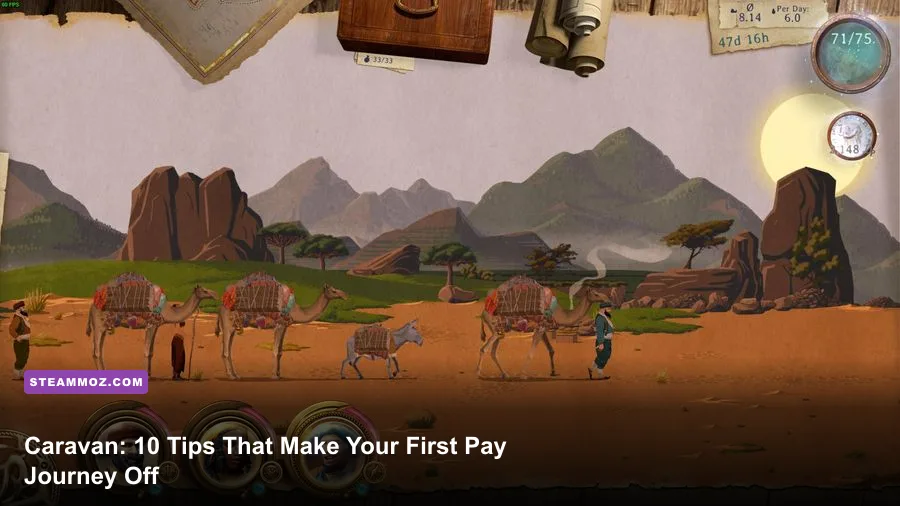
Caravan becomes far more manageable when you treat your first trip as a controlled business venture instead of a heroic sightseeing tour. Carry a reserve of food and water, buy trade goods only when the price is clearly favorable, recruit companions who cover different combat roles, and keep enough money to recover from a bad encounter. These 10 Caravan tips will help new players survive the opening routes, build a reliable party, and turn short journeys into a steady profit.
Developed by it Matters Games, Caravan on Steam mixes exploration, trading, party management, and turn-based battles in a world inspired by Arabian Nights. It isn't a game about rushing toward the next quest marker. Your most important decisions happen before you leave town: what you buy, who travels with you, how much weight you carry, and which risks you can actually afford.
1. Treat food and water as your first expenses
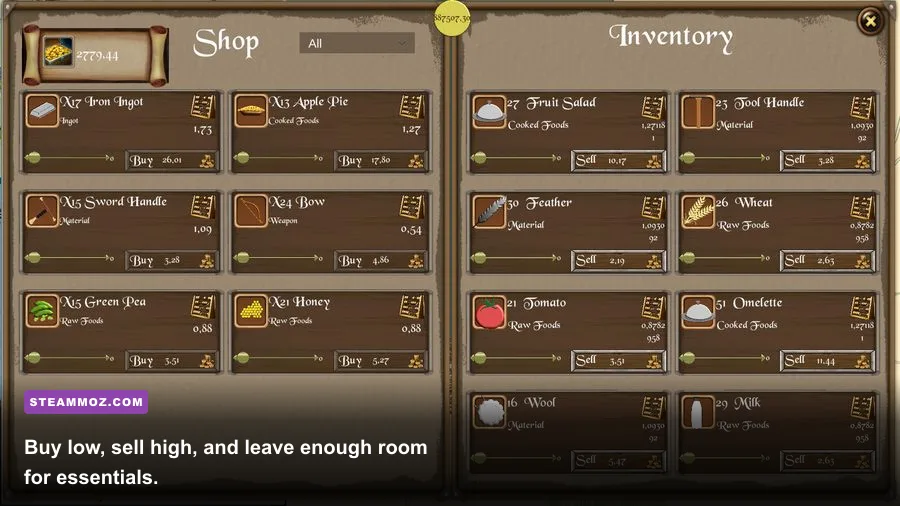
The most common beginner mistake is spending nearly all of your starting money on merchandise. A promising trade run can collapse because the caravan runs out of basic supplies halfway to the next settlement. Food and water aren't optional conveniences; they are the operating cost of movement. If you can't keep the party supplied, the value of every other item in your inventory becomes irrelevant.
Before buying trade goods, reserve money for a travel buffer. A useful opening rule is to keep roughly one-third of your current cash untouched for necessities and unexpected purchases. Don't interpret that as a permanent mathematical law—the exact cost changes with the route—but it creates the right habit. Short trips let you carry a smaller reserve, while long desert crossings demand much more conservative planning.
Check your inventory immediately before departure, not just when you accept a quest. A detour, a failed negotiation, or an unexpected fight can extend the journey. If your party reaches a settlement with only enough provisions for one more day, buy supplies first and trade second.

🎮 Caravan
Looking to experience this game? Grab your digital key directly on our store for $1.19.
View on Steammoz Store →2. Learn the economy before chasing big profits
Caravan's trading system rewards observation more than blind buying. Settlements don't all value the same goods equally, so the profitable route is usually built around a price difference between two destinations. Buy an item where it is common or cheap, then sell it somewhere that lacks it. The important part is recording prices instead of trusting a single good-looking deal.
On your first few journeys, choose one or two inexpensive goods and note their purchase and sale prices. That gives you a baseline without tying up your entire budget. A trade that produces a modest margin with low weight is often better than a flashy item that consumes your capacity and leaves you unable to afford supplies.
| Trade Decision | Good Beginner Target | Why It Works | Main Risk |
|---|---|---|---|
| Small local run | One low-cost commodity | Easy to test prices and demand | Limited profit per trip |
| Established route | Two complementary goods | Uses cargo space efficiently | Prices can shift between visits |
| Long expedition | High-margin goods plus reserves | Fewer stops and larger upside | Travel costs and combat losses |
| Emergency sale | Any item with a positive margin | Creates cash for food or healing | Destroys future profit potential |
Most importantly, don't sell your entire cargo just because you reached a town. Keep goods that may be valuable at the next destination, particularly if your current sale price is weak. Trading is a route-planning game, not a simple sell button.
3. Keep cargo space flexible
Maximum capacity is not the same thing as useful capacity. Filling every slot with merchandise sounds efficient, but it leaves no room for loot, quest items, food, or water. A caravan with a little empty space can react to opportunities; a full caravan is forced to abandon them.
As a beginner, leave a portion of your carrying capacity open until you understand the route. This also makes combat rewards more valuable because you won't have to discard something important after a difficult encounter. When comparing upgrades, prioritize improvements that increase usable capacity without pushing maintenance and supply costs beyond your profits.
Use your inventory as a checklist before every departure. Confirm provisions, healing supplies, trade goods, equipment, and spare cash. It takes seconds and prevents the kind of mistake that turns a profitable run into a forced march back to town.
4. Recruit for coverage, not just damage

Your first companions should make the party dependable, not merely increase the biggest damage number on the screen. A balanced group needs someone who can absorb pressure, someone who can deal consistent damage, and someone who can support or restore the team. A party made entirely of fragile attackers may win easy battles quickly, then collapse when enemies survive the opening exchange.
Read each recruit's abilities and equipment before hiring them. Look for complementary roles: a durable front-line character can protect weaker ranged or support members, while a healing or utility specialist helps preserve resources across multiple encounters. The best companion is not automatically the one with the highest listed attack value; it's the one who solves a problem your current group actually has.
| Party Role | Priority | What to Look For | Best Use |
|---|---|---|---|
| Front line | High | Durability and reliable attacks | Holding enemy pressure away from fragile allies |
| Damage dealer | High | Consistent damage and useful range | Removing dangerous targets quickly |
| Support | High | Healing, buffs, or control | Extending the party's endurance |
| Flexible slot | Medium | A role that covers your weakness | Adapting to route-specific encounters |
Recruitment also affects your economy. A companion who turns every encounter into a costly recovery cycle may be less valuable than a slightly weaker recruit who keeps the party healthy. Track results over several fights instead of judging a character from one battle.
5. Upgrade equipment with a plan
Don't spread upgrades randomly across every character. Early money disappears quickly when you purchase marginal improvements for the entire party. Instead, identify your most important combat role and give that character the first meaningful upgrade. A sturdier front liner or a more reliable damage dealer can improve the outcome of every subsequent fight.
Pay attention to the difference between a weapon's immediate usefulness and its long-term value. A powerful weapon that drains your budget may delay the purchase of food, water, or a critical companion. That trade-off is rarely worth it during the opening hours. Upgrade when the item changes how safely you can fight, not simply because it has a larger number.
Keep old equipment when replacing it if the game allows you to redistribute gear among companions. A hand-me-down weapon can be more valuable than its resale price, especially when a newly recruited character is under-equipped.
6. Build your party around combat positioning
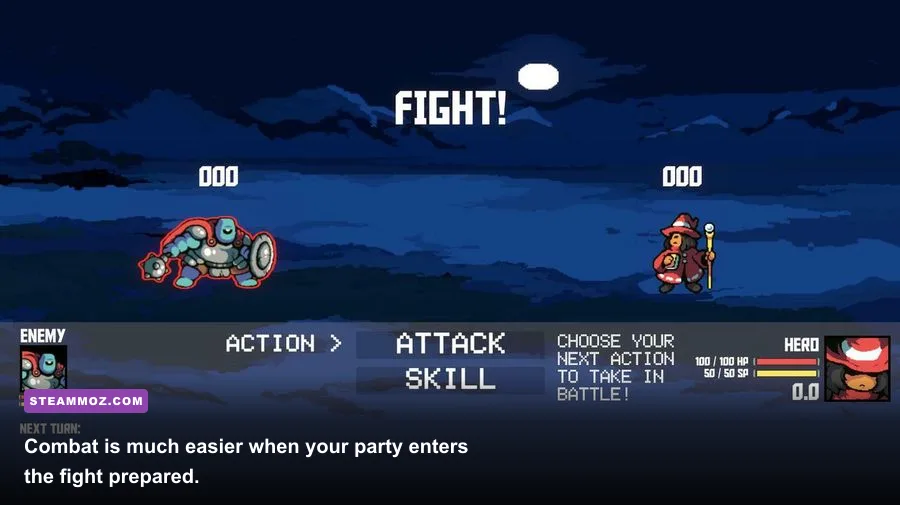
Caravan's battles are turn-based, so every action should answer a simple question: what enemy becomes more dangerous if I ignore it for one more turn? Focus-fire usually beats spreading damage across the entire opposing group. Removing one attacker reduces incoming damage immediately, while three partially damaged enemies can still act at full effectiveness.
Protect fragile companions by keeping them away from the most direct pressure. If an enemy has already committed to attacking your front line, don't waste a turn moving that character unless the repositioning prevents a much larger threat. Use durable allies to buy time for ranged attackers and support characters to work.
Target priority matters more than flashy abilities. Eliminate enemies with healing, strong ranged attacks, or crowd-control effects before dealing with slower, durable opponents. Save recovery abilities for moments that prevent a knockout rather than spending them automatically at the first sign of damage.
7. Don't accept every fight on the road
Not every encounter is profitable. A battle can cost healing items, companion durability, equipment repairs, and several days of supplies. Before committing, compare the likely reward with the condition of your party and the distance to the next settlement. If your caravan is already damaged and carrying valuable cargo, avoidance may be the smarter victory.
This is especially important when returning from a successful trade route. Players often become overconfident after making money, then lose the profit in one unnecessary fight. Treat health and supplies as part of your cargo value. A combat reward isn't truly profitable if collecting it forces you to replace equipment or abandon merchandise.
When you do fight, enter with a clear objective. Some battles are about winning quickly; others are about surviving without spending scarce resources. Choose the approach that matches the next stage of your journey.
8. Explore side paths only when the math works
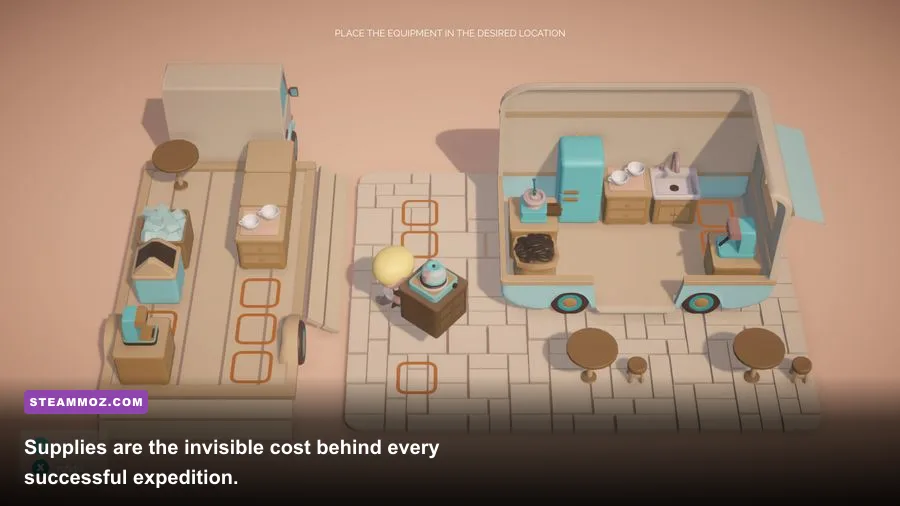
Exploration is one of Caravan's best sources of surprises, but every detour has a price. Extra travel consumes food and water, exposes the party to more encounters, and delays the trade route that is already generating income. Before leaving the main path, check your supplies, cargo value, party health, and remaining cash.
A detour makes sense when it offers a meaningful reward, a needed recruit, a quest objective, or access to a settlement that improves your route. It makes less sense when you're merely wandering with a nearly full inventory and no reserve. Mark unexplored areas mentally—or with your own notes—and return when the caravan is stronger.
Don't confuse discovery with progress. Caravan rewards deliberate exploration, not random movement across the map. The best journeys have a purpose for every stop.
9. Save before major commitments
Use manual saves strategically before recruiting an expensive companion, buying a large cargo load, accepting a risky quest, or taking a route with limited access to settlements. This isn't about replaying every imperfect decision. It's protection against a bad investment that you couldn't reasonably evaluate in advance.
Keep separate saves for your main trading run and your exploratory experiments. That gives you freedom to test an unfamiliar route without risking hours of careful progress. If a journey fails, examine why it failed: insufficient supplies, poor party composition, weak equipment, or a trade margin that never justified the distance. Reloading is most useful when it teaches you something.
10. Tune performance before long expeditions
Caravan is not an especially demanding PC game, but stable performance still matters during map travel and busy interfaces. Start with the official Steam listing for current platform information, then test your system in an actual settlement rather than judging performance from the title screen.
| Setting | Recommended Starting Value | Performance Impact | Visual Trade-Off |
|---|---|---|---|
| Resolution | Native display resolution | Medium to high | Lowering it softens interface text |
| Shadows | Medium | Low to medium | Less depth in environments |
| Effects | Medium | Low to medium | Reduced combat and environmental detail |
| Anti-aliasing | Medium or game default | Low to medium | More visible edge shimmer when reduced |
| V-sync | On if tearing appears | May add latency | Smoother presentation |
If the game stutters, lower shadows and effects before sacrificing resolution. Close overlays and unnecessary background applications, then verify the game files through Steam. Players troubleshooting several older PC releases may also find our guides to crashes and low FPS and stutter fixes useful because the same basic Windows checks apply.
A reliable opening route for new players
Your first few hours should follow a simple progression curve. Begin with a short route between settlements so you can learn prices without risking a large cargo investment. Buy only enough merchandise to test the market, retain your supply reserve, and return before the party's health or provisions become a problem.
After two or three successful runs, invest in one meaningful equipment improvement and recruit a companion who fills the biggest gap in your party. Then expand to a longer route with a larger margin. Resist the temptation to buy every upgrade at once. Caravan rewards compounding advantages: better supplies prevent losses, better companions reduce recovery costs, and better cargo decisions create the cash for stronger equipment.
For broader party-building ideas, Steamoz's Bloodgrounds starting-build guide offers useful lessons about role coverage and early investment, while this beginner build guide covers the same kind of disciplined upgrade thinking in a different RPG.
The mistakes that end most first caravans
New players usually fail for one of four reasons: they spend all their money on trade goods, travel without enough food and water, recruit a party with no defensive or support option, or accept every encounter as if combat has no economic cost. None of these mistakes comes from a lack of reflexes. They come from ignoring the connection between travel, trade, and combat.
Keep a cash reserve. Leave room in the inventory. Watch party health before choosing a fight. Sell at a profit rather than selling automatically. These habits sound modest, but together they transform Caravan from a punishing sequence of surprises into a readable strategy game.
Finally, check the developer's official Steam news and community discussions for compatibility notes and player-discovered information. Caravan is at its best when you plan one trip ahead, not ten. Once your supplies, party roles, cargo space, and route all support the same goal, even a modest run through the desert starts feeling like the beginning of a real trading empire.