The best beginner build in Alone in the Dark is a resource-first Emily Hartwood setup: start on the standard difficulty, prioritize revolver accuracy and shotgun ammunition, keep one healing item available, and treat melee as a last resort rather than your main damage source. There is no traditional skill tree, armor rating, or attribute allocation in the 2024 game, so your “build” is really a disciplined combination of character choice, weapon habits, inventory decisions, and exploration route.
That distinction matters. If you arrive expecting an RPG-style page of strength, agility, or perk upgrades, you’ll waste time looking for a system that isn’t there. Alone in the Dark on Steam is a cinematic survival-horror game built around fixed weapons, limited supplies, dodge timing, puzzles, and branching character perspectives. The strongest beginner plan is therefore simple: use Emily Hartwood for your first campaign, learn enemy spacing with the revolver, save the shotgun for interruption windows, and search Derceto Manor as if every drawer could contain the item that saves your next fight.
Pick Emily Hartwood for the Cleanest First Run

Both Emily Hartwood and Edward Carnby are valid protagonists, and neither character has a permanent statistical advantage. Their campaigns share the central investigation at Derceto Manor, but they include different scenes, dialogue, memories, and narrative emphasis. For a first playthrough, Emily is the easier recommendation because her connection to Jeremy Hartwood gives the investigation a more natural emotional anchor. You’ll also get a strong introduction to the manor’s clues and the game’s recurring rhythm of exploration, puzzle-solving, combat, and surreal detours.
Edward is not a harder-mode character. His route is simply a different lens on the same nightmare, and it works especially well as a second playthrough when you already understand Derceto’s layout and the game’s deliberately awkward combat. Picking Emily first also lets you focus on learning the systems rather than wondering whether you missed story context.
What your “build” actually controls
Alone in the Dark has no spendable skill points and no weapon upgrade tree. You cannot turn Emily into a high-damage glass cannon or Edward into a tank. The choices you can control are much more practical:
| Build decision | Best beginner choice | Why it works | Common mistake |
|---|---|---|---|
| Character | Emily Hartwood | Clear story motivation and a comfortable first investigation | Assuming Edward has better combat stats |
| Difficulty | Standard or the game’s middle setting | Preserves resource pressure without turning every hit into a reset | Choosing the hardest mode before learning enemy tells |
| Main weapon | Revolver | Reliable range and useful ammunition economy | Firing rapidly without confirming hits |
| Emergency weapon | Shotgun | High stopping power at close range | Spending shells on isolated weak enemies |
| Combat priority | Dodge, create space, then shoot | Reduces damage taken and prevents panic reloads | Standing still to trade hits |
On difficulty, don’t confuse “harder” with “more authentic.” The game’s survival-horror tension comes from uncertainty and limited resources, not from enemies becoming damage sponges. Standard is the sweet spot for learning. If you’re completely new to third-person horror, use the more forgiving option for the opening hours, then raise the challenge on a later run. This is the same practical mindset we recommend in our run-saving survival tips: preserve options instead of chasing perfect-looking fights.

🎮 Alone in the Dark
Looking to experience this game? Grab your digital key directly on our store for $13.19.
View on Steammoz Store →Build Your First 90 Minutes Around Exploration
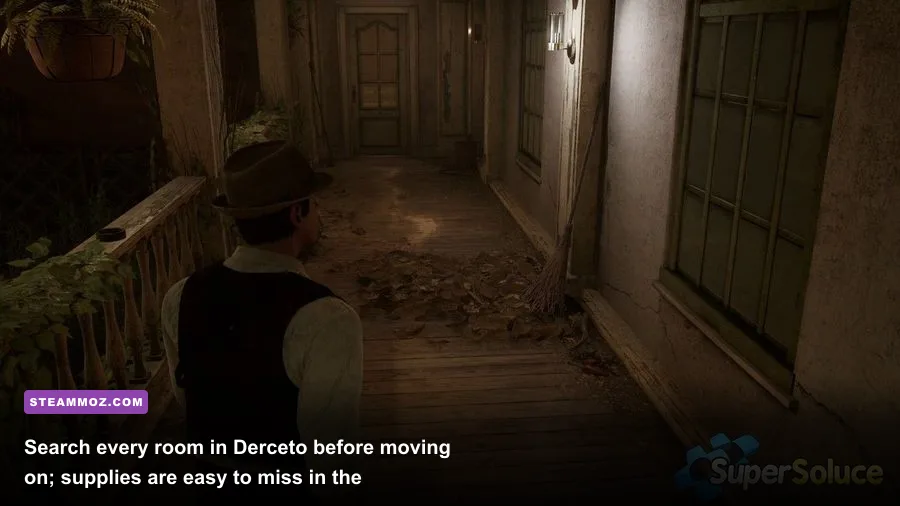
Your opening objective is not to kill everything in Derceto. It’s to establish a supply cushion before the game starts sending you into larger combat spaces. Search bedrooms, offices, corridors, and side rooms before following the next obvious objective marker. Check tables, shelves, cabinets, and corners near doors. The game hides useful supplies in places that look like decoration, and missing one healing item early can make a later encounter feel unfair.
Keep your inventory flexible. Don’t fill every slot with ammunition for one weapon, because the game’s supply distribution nudges you toward switching tools. Carry the revolver as your default, keep the shotgun ready for close-range pressure, and reserve any specialist ammunition for enemies or situations that genuinely demand it. When a room offers a consumable, take a second to identify what it is before moving through the next door. Inventory hesitation during combat is where many beginner deaths happen.
The opening loop that saves resources
- Secure the room. Before interacting with a clue or puzzle, scan for exits, breakable objects, and possible enemy entry points.
- Search before progressing. Revisit nearby rooms after major story beats. Some routes and scenes change the spaces you can inspect.
- Solve puzzles without burning supplies. The talisman and environmental clues cost attention, not ammunition. Read notes and inspect objects instead of guessing repeatedly.
- Fight only when the route requires it. If an enemy can be avoided safely, walking away is a successful survival-horror decision.
- Reload during safety windows. A weapon with a partial magazine is better than an empty one when a creature appears around a corner.
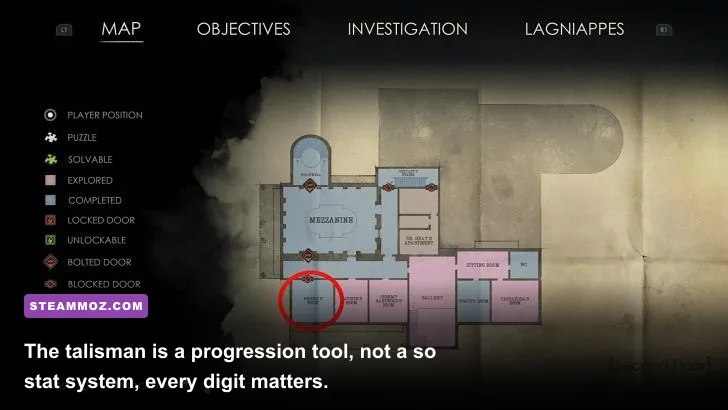
The talisman is particularly important. Its number combinations open progression routes and connect clues across Derceto and the game’s other locations. It doesn’t improve your damage, but solving its puzzles quickly preserves health and ammunition because you spend less time wandering into repeat encounters. Write down combinations mentally or in a note when the game presents a number clue; relying on memory while under pressure is an unnecessary self-inflicted debuff.
Don’t sprint through every hallway, either. Walking gives you more time to notice visual clues and audio cues. The game often telegraphs danger with sound before you see the creature. Headphones help more than another five percent of theoretical damage ever could.
Use the Revolver for Control and the Shotgun for Interrupts
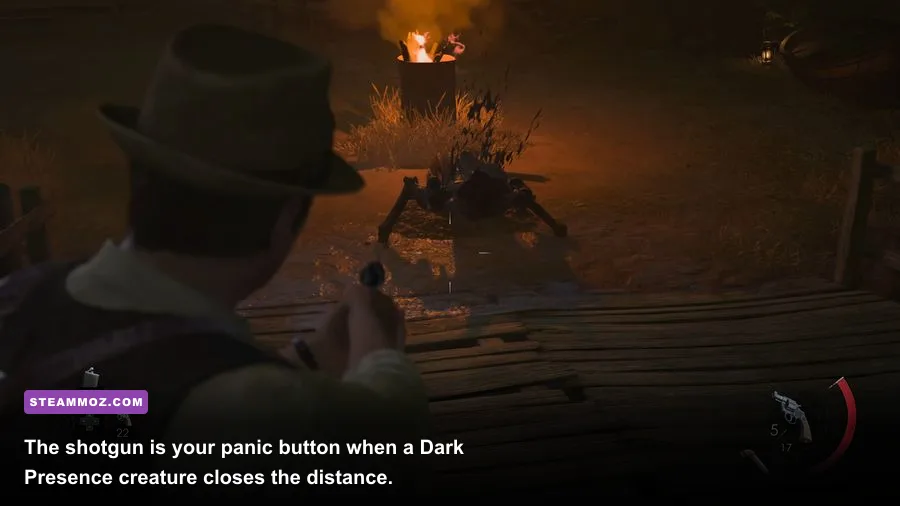
The revolver should be the center of your beginner loadout. It gives you a dependable ranged option without forcing you into point-blank danger, and its ammunition is more useful when you treat each shot as a deliberate interruption. Aim for exposed weak points or the upper body, fire, then reposition. The goal is not to empty the cylinder as quickly as possible; it’s to stop an enemy’s approach long enough to regain control of the room.
The shotgun is your close-range answer to a bad situation. Use it when a hostile creature reaches melee range, when a narrow corridor prevents a clean dodge, or when a heavy enemy exposes itself after an attack. Don’t waste shells on a target that is already staggered by another weapon. The shotgun’s value comes from buying space, not from being your default firearm.
Melee attacks are best used to finish a vulnerable enemy or create a brief opening, not to begin every encounter. The timing is less forgiving than a modern action game’s parry system, and whiffing a swing leaves you exposed. A dodge followed by a controlled firearm shot is a safer rotation than repeated melee swings. If you do commit to close combat, strike once or twice, watch the enemy’s recovery, and disengage before greed turns a winning exchange into a grab.
| Weapon | Role | Use it when | Beginner rule |
|---|---|---|---|
| Revolver | Primary ranged control | You have space and a visible target | Aim, fire, reposition; don’t panic-dump ammunition |
| Shotgun | Close-range interruption | An enemy commits to an attack or corners you | Save shells for dangerous, aggressive targets |
| Thompson submachine gun | High-volume emergency damage | A later encounter gives you sustained pressure | Short bursts beat holding the trigger |
| Crossbow | Specialist ranged option | You need a quieter or situational attack | Don’t spend its limited ammunition casually |
| Melee | Finisher and space-maker | The enemy is staggered or isolated | Never trade hits just to save a bullet |
When the Thompson becomes available, it can feel like the answer to every problem. It isn’t. Automatic weapons are powerful precisely because they can erase your ammunition reserve in seconds. Fire short bursts, release the trigger before recoil pulls you off target, and stop shooting once the enemy is no longer an immediate threat. The weapon-efficiency principles in our gear tier guide apply here too: a weapon is only strong if you still have ammunition when the next encounter begins.
Choose Supplies Before Damage Every Time
The strongest beginner resource strategy is conservative without becoming passive. You want enough ammunition to escape a forced encounter, enough healing to survive one mistake, and enough open inventory space to pick up what the next room offers. That means you should not heal automatically after every scratch, but you also shouldn’t enter a major story sequence with a dangerously low health bar just because you’re saving an item for some imaginary future.
Use healing after a fight when your health is low enough that one unexpected hit could kill you. If you’re only slightly hurt and the next section is clearly safe, keep the item. The game’s exploration sections often give you a chance to recover your position, while combat can begin with little warning. The important habit is checking your condition before opening a suspicious door, climbing into a new area, or starting a puzzle sequence.
When to run instead of fight
Run when the arena has multiple exits, the enemy is not blocking the objective, or the encounter is consuming more ammunition than the reward justifies. Fight when the creature seals your route, protects a required item, or can be staggered safely from a prepared position. A short retreat around furniture or through a doorway can reset the engagement and let you reload. You don’t need to win every encounter in the middle of the room.
Pay attention to telegraphs. A creature closing distance directly at you is often inviting a panic shot; wait until it commits, dodge laterally, then fire while it recovers. A wide swing is a cue to move, not to squeeze off one more round. If an enemy disappears or the environment shifts into one of the game’s dreamlike sequences, stop assuming normal room geometry applies. Reorient yourself before wasting ammunition on a target you can’t reliably track.
For more resource-focused thinking, our survival-horror performance guide covers the broader principle: clarity and consistency matter more than flashy settings or reckless aggression.
Use These Settings and Progression Habits
On PC, prioritize stable frame pacing over maximum visual quality. Alone in the Dark is built around close-range aiming, dodge timing, and dark environments, so a stuttering image can make combat feel worse even when the average frame rate looks acceptable. Start with the game’s recommended preset, then lower the expensive effects that create visual noise or inconsistent performance before reducing texture quality.
| Setting area | Recommended beginner value | Performance impact | Visual reason |
|---|---|---|---|
| Resolution | Native monitor resolution | High | Preserves clue readability and aiming precision |
| Upscaling | Quality mode if available | Medium to high benefit | Improves stability while retaining useful detail |
| Textures | High if VRAM allows | Low to medium | Worth keeping for readable environments |
| Shadows | Medium | Medium to high | Usually a better performance trade than lowering textures |
| Volumetric effects | Medium or low | High | Reduces heavy fog and lighting cost |
| Motion blur | Off if aiming feels muddy | Minimal | Makes enemy movement easier to read |
| Frame cap | Stable target below hardware limit | Improves consistency | Steadier dodges beat occasional peak frames |
Don’t blindly copy settings from a different game. The PC settings advice in our performance library is useful because it focuses on stability, but Alone in the Dark’s dark scenes make shadows and volumetrics especially important. Test the opening areas, walk through a hallway, aim at a moving target, and only then lock your profile.
How the progression curve really works
Your progression is knowledge-based rather than stat-based. You learn Derceto’s logic, recognize which rooms deserve a second look, understand that ammo is a future option rather than a score, and become comfortable with the dodge timing. The strongest upgrade is reducing the number of mistakes you make.
Keep a simple mental checklist whenever you enter a new location: current health, revolver ammunition, shotgun shells, healing supply, escape route, and objective. If two of those are in bad shape, search nearby rooms before pushing forward. If the game gives you a new weapon, spend the next encounter learning its range and recoil instead of assuming it replaces your previous tools.
Finally, don’t rush to replay on the hardest difficulty until you’ve completed one character’s story. Emily and Edward offer enough different material to make a second run worthwhile, and your first campaign should teach you the game’s rules without turning every missed clue or mistimed dodge into frustration. The official THQ Nordic page and Pieces Interactive website are useful references for updates and official information, but your best in-game resource remains careful observation.
The finished beginner build is straightforward: Emily Hartwood, standard difficulty, revolver as your default, shotgun for emergency interruption, melee only against staggered targets, and exploration before combat whenever the route allows it. Keep your frame rate stable, solve the talisman clues patiently, and leave fights with more resources than your panic wanted to spend. Alone in the Dark becomes far less punishing once you stop playing it like an action shooter and start treating every bullet, hallway, and locked drawer as part of the same survival puzzle.