Yes, Dustborn is still worth playing in 2026—but only if you want a character-driven road trip more than a polished action game. Red Thread Games delivers a sharp, stylish journey about chosen family, propaganda, and identity, with memorable conversations and a terrific premise. The catch is that combat, driving, and some chapter pacing never reach the same standard as the writing. At a discounted price or through the official Steam release, it remains an easy recommendation for narrative-adventure fans.
Dustborn's Road Trip Still Has a Great Hook
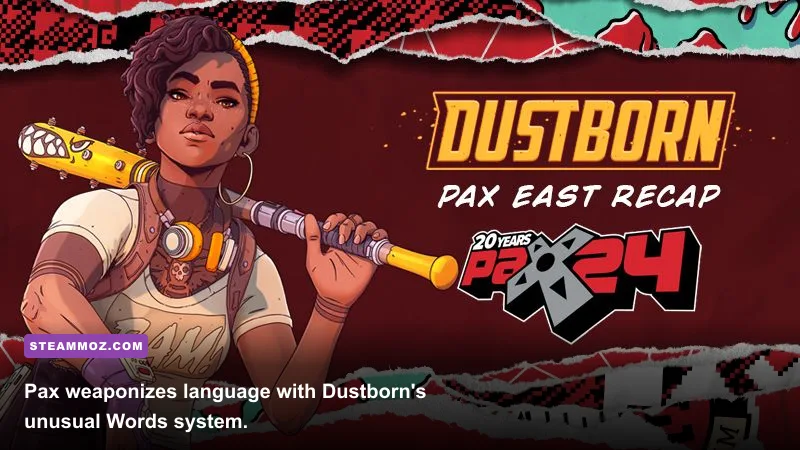
Dustborn is set in an alternate 2030 America fractured by a phenomenon called the Noise. Society has been reshaped by misinformation, political extremism, and a powerful authoritarian force known as Justice. You play Pax, a fugitive courier with a literal talent for weaponizing language. She takes a stolen bus across the Divided States of America while transporting a mysterious package to Nova Scotia.
That setup gives the game a strong episodic rhythm. Each destination feels like a tour stop in a hostile country: you arrive, meet locals, complete jobs, manage the crew, and eventually push onward before Justice catches up. The bus is not just transport. It's a mobile safehouse, rehearsal room, and pressure cooker where Pax, Antea, Sai, Ziggy, Bruno, and Theo clash over the trip's risks.
The world is one of Dustborn's biggest strengths because it doesn't simply copy real-world America. The game filters its politics through comic-book language, exaggerated factions, masked enforcers, and a deliberately graphic-novel presentation. The result is strange, sometimes unsubtle, but rarely bland. If you enjoyed the rebellious neon road culture of Bomb Rush Cyberfunk, Dustborn offers a similarly committed style, although its focus is conversation rather than movement.

🎮 Dustborn
Looking to experience this game? Grab your digital key directly on our store for $2.99.
View on Steammoz Store →How the Words and Riffs Combat System Works

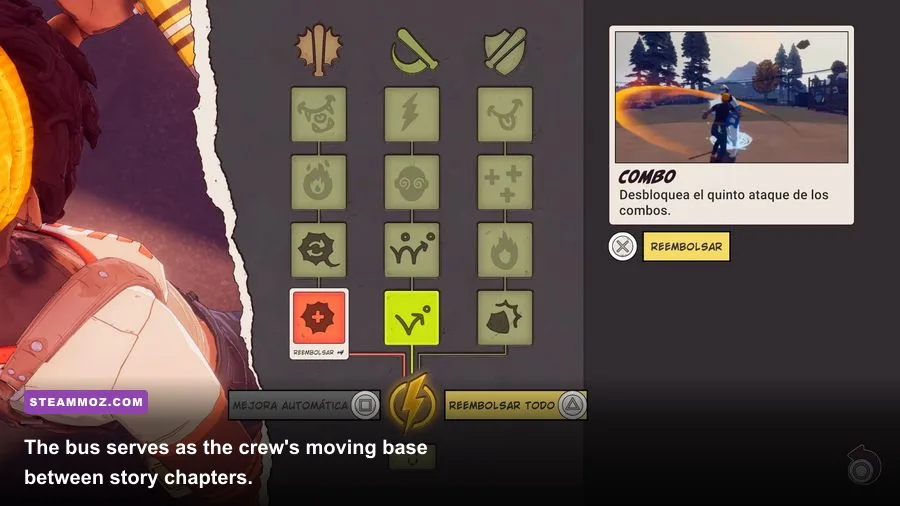
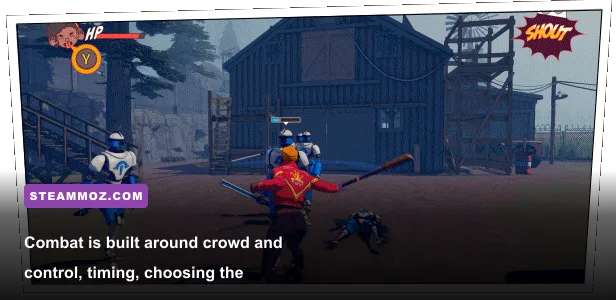
Pax's special ability is the Word system. During confrontations, she can use spoken Words to interrupt enemies, stagger groups, pull targets into danger, or alter the flow of a fight. The basic combat loop mixes ordinary attacks with these verbal abilities, then adds the Riff system once the crew joins in. Riffs are team-based special moves that let companions amplify an opening or control the battlefield.
This is an inventive idea, but the execution is more functional than thrilling. Encounters generally ask you to identify the most disruptive enemy, create space, and spend the right Word at the right moment. The telegraphs are readable, and crowd control matters more than button-mashing. Still, enemy variety is limited, hit feedback can feel soft, and repeated arena fights begin to blur together during longer chapters.
There are no traditional weapon stats, armor ratings, or loot rarities to grind. That is important when deciding whether Dustborn fits your tastes. Progression is mostly narrative and ability-based, so you won't be comparing damage values or farming materials for a perfect build. Instead, you'll unlock additional Words and Riffs while learning how different crew members support Pax in combat.
| Combat Tool | Primary Role | Best Use | Weakness |
|---|---|---|---|
| Basic attacks | Reliable single-target pressure | Finish staggered enemies | Unsafe against groups |
| Words | Control and interruption | Stop dangerous enemy actions | Requires timing and cooldown awareness |
| Riffs | Crew-assisted crowd control | Turn a bad encounter around | Less useful if activated without setup |
| Environmental objects | Extra damage or positioning | Exploit clustered enemies | Not available in every arena |
The best approach is to treat fights as short tactical puzzles rather than conventional brawls. Interrupt the enemy preparing the most dangerous attack, keep mobile enemies away from Pax, and save a Riff for a cluster instead of burning it on the first target you see. The system becomes considerably more enjoyable when you stop expecting a deep character-action game and appreciate its role as punctuation between story scenes.
The Crew Makes or Breaks the Experience
Dustborn works because its crew feels like a group of difficult, funny, emotionally complicated people instead of a collection of quest dispensers. Pax is guarded and pragmatic, but her history with Antea keeps breaking through the professional mask. Antea brings emotional history and musical energy to the trip, while Sai, Ziggy, Bruno, and Theo each pull the group toward different ideas of loyalty and survival.
Your choices affect those relationships through conversations, optional stops, crew activities, and decisions about how Pax handles conflict. The game isn't a branching RPG with dozens of radically different endings. Its choices are more intimate. A careless response can sour a relationship, change the tone of a later conversation, or make a tense bus scene noticeably colder. That smaller scale is a strength because the consequences feel personal rather than mechanically advertised.
The script also understands that a road trip needs downtime. You may rehearse with the band, play games, talk during travel, or investigate side content at a stop. These moments are where the crew becomes memorable. They aren't all equally successful—some banter lands awkwardly, and a few characters are introduced with more attitude than depth—but the strongest scenes have the messy warmth of people who genuinely need one another.
| Activity | What It Adds | Why It Matters in 2026 |
|---|---|---|
| Main story missions | World-building and major relationship turns | Essential for the political and personal arc |
| Crew conversations | Character context and trust changes | Often the best-written material |
| Band rehearsals | Breathing room and crew bonding | Helps prevent the campaign feeling like nonstop exposition |
| Optional exploration | Extra lore, collectibles, and local stories | Worth doing for atmosphere, not power rewards |
If you play mainly for systems, this structure may feel thin. If you play for characters, the crew is the reason to stay on the bus. Dustborn's emotional payoff depends on spending time with them rather than rushing from objective to objective.
Performance, Presentation, and Accessibility on PC
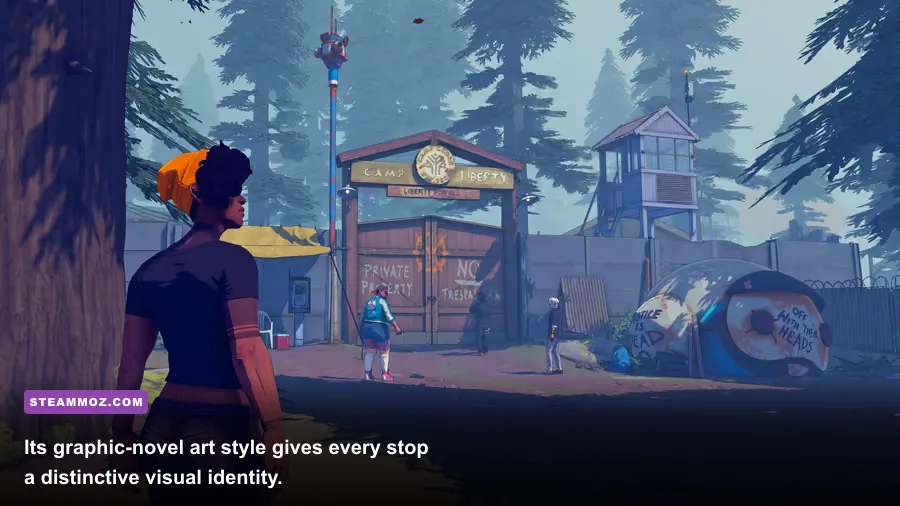
Dustborn's cel-shaded, comic-inspired presentation is its most consistent technical triumph. Strong silhouettes, bold colors, thick outlines, and stylized environments make the world instantly recognizable. Locations such as the Pacific Northwest and the wider American road network feel designed rather than photorealistic, which helps the game age better than a lot of technically ambitious 2024 releases.
On PC, the sensible target is a locked 60 frames per second rather than chasing maximum settings at any cost. The game is not a reflex-heavy competitive title, so a stable frame rate makes more sense than occasional peaks. Lowering shadows and effects is usually preferable to sacrificing texture quality, because the art direction depends on clean surfaces and readable character shapes.
| Setting | Recommended Value | Performance Impact | Visual Trade-Off |
|---|---|---|---|
| Resolution | Native or 100% render scale | High | Best image clarity; lower first if necessary |
| Texture quality | High | Low to medium | Preserves comic-style surface detail |
| Shadow quality | Medium | Medium to high | Good place to recover frame rate |
| Effects quality | Medium | Medium | Reduces visual noise during combat |
| Anti-aliasing | High or the game's default | Low to medium | Keeps outlines from shimmering |
| Frame cap | 60 fps | Improves consistency | Better pacing than unstable uncapped output |
Before buying, check the current Steam system requirements and user reports, since driver behavior and patches can affect individual PCs. Dustborn isn't a hardware benchmark, but its stylized visuals benefit from stable performance and an SSD that keeps transitions smooth.
Where Dustborn Falls Short
The main weakness is uneven pacing. The campaign has a clear destination, but several chapters take too long to reach their strongest scenes. Driving sections can feel like connective tissue rather than meaningful play, while exploration occasionally asks you to search a space that contains little beyond a collectible or a short line of dialogue. These problems are less irritating when you approach the game as an interactive graphic novel, but they stand out if you expect every activity to be mechanically rich.
The political writing is similarly divisive. Dustborn is interested in disinformation, authoritarianism, language policing, and the way national myths are manufactured. It presents those themes loudly, through slogans and visual metaphors rather than subtle realism. That gives the game personality, but it can also make certain exchanges feel like speeches written to be quoted rather than conversations between frightened people.
Combat is the other obvious ceiling. The Words are clever and the crew combinations add flavor, yet the limited enemy roster and straightforward arenas don't support a campaign built around repeated encounters. This isn't a reason to skip Dustborn entirely; it is a reason to set your expectations correctly. The game wants to be a road narrative with action scenes, not a new benchmark for brawling mechanics.
Players who prefer tightly tuned stealth may get more from Alien: Isolation, while those chasing pure mechanical depth should look elsewhere. Dustborn's appeal is narrower, but within that lane it has a genuinely distinctive voice.
Is Dustborn Worth Playing in 2026?
Dustborn earns a qualified yes. Its campaign is worth experiencing for Pax, the crew, the unusual alternate-America setting, and the way spoken language becomes both a narrative theme and a combat mechanic. It also benefits from being a self-contained single-player game: there is no seasonal grind, battle pass, or online population to worry about in 2026.
Buy it at full price only if you already know you enjoy dialogue-heavy adventures with experimental combat. Everyone else should watch for a sale or play it through a subscription option. The value improves dramatically when you judge it by its strongest scenes rather than by the amount of action it provides.
| Player Type | Verdict | Reason |
|---|---|---|
| Story-first adventure fan | Strong buy | Excellent crew dynamics and a memorable setting |
| Choice-and-consequence player | Buy on sale | Meaningful relationship shifts, but limited large-scale branching |
| Action-combat specialist | Wait for a deep discount | Words are inventive, though encounters lack variety |
| Exploration completionist | Buy on sale | Optional content adds atmosphere more than major rewards |
| Game Pass subscriber | Play it now | Low-risk way to sample its narrative strengths |
For more story-focused recommendations, our Dungeons review covers a very different kind of campaign, while Car Mechanic Simulator 2015 is a better fit if you want a slower, systems-first experience. Dustborn sits between those extremes: highly authored, occasionally awkward, and impossible to mistake for anything else.
That makes the final verdict simple. Dustborn is not a hidden masterpiece waiting to be rescued by time, and its rough edges are still obvious in 2026. But it is a bold, heartfelt game with a cast worth meeting and a road worth traveling. Give it the right expectations, and Pax's trip remains one of the more distinctive narrative adventures of its generation.
For development background and updates, visit Red Thread Games and the game's official Dustborn website.