If you're starting Art of Rally's Australia stages, use a stable, forgiving Group 2 or Group 3 car, keep the differential near the middle, move brake bias slightly toward the front, and run conservative suspension. That setup won't produce the flashiest replays, but it gives beginners the traction, braking confidence, and recovery time needed for Australia's loose gravel, blind crests, tight hairpins, and awkward roadside obstacles.
There is one important correction to the phrase “starting build”: Art of Rally doesn't have RPG-style skill points, weapon slots, or a permanent upgrade tree. Your build is the combination of car class, car choice, tuning sliders, assists, camera, and driving habits. Those choices matter more than chasing a supposedly perfect meta car. A fast car with a nervous setup will punish a new player; a predictable car will teach you why each corner works.
This guide focuses on the Australia content and the early-career mindset that makes it manageable. For broader PC performance advice, Steamoz's smooth FPS settings guide is also useful, since consistent frame pacing matters enormously in a rhythm-based racer.
The Best Beginner Build for Australia
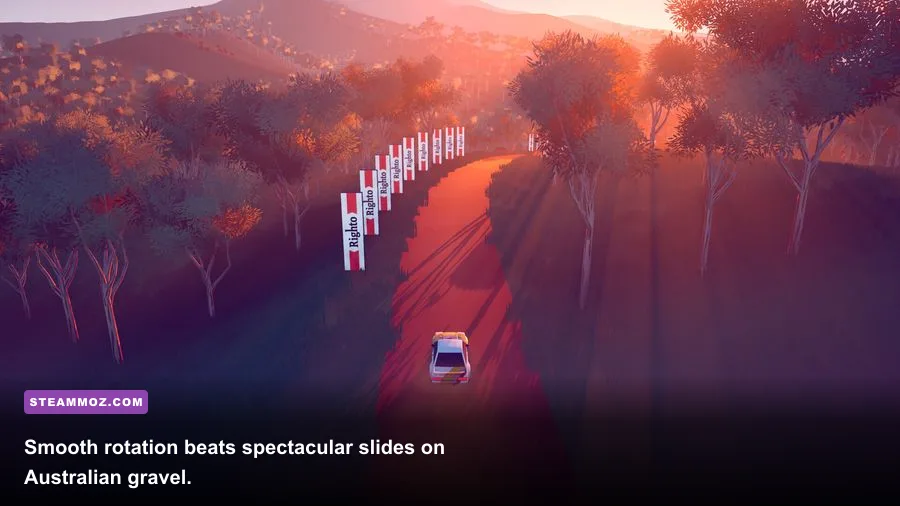
Start with a front-engine, four-wheel-drive car if one is available in your unlocked roster. If your career progression has not opened that option yet, choose the most controllable Group 2 or Group 3 car rather than jumping immediately into a high-powered Group B machine. Australia gives you enough long, fast sections to expose poor throttle control, but its tighter gravel turns still demand low-speed rotation.
The ideal beginner setup has three characteristics: it settles quickly after a jump, it does not snap into oversteer when you lift off the throttle, and it stops in a straight line. You are building consistency, not a qualifying-lap fantasy. A stable car lets you concentrate on the pace notes and road surface instead of correcting a slide every three seconds.
| Build Element | Beginner Recommendation | Why It Works in Australia | When to Change It |
|---|---|---|---|
| Car class | Group 2 or Group 3 | Moderate power and forgiving momentum | Move to Group 4 after clean stage finishes |
| Drivetrain | Four-wheel drive when available | More confidence on loose exits and crests | Use rear-wheel drive to practice rotation later |
| Brake balance | Slightly front-biased | Reduces rear lockups under downhill braking | Move rearward only if the car refuses to rotate |
| Differential | Middle or mildly open setting | Balances corner entry rotation and exit traction | Close it for long, slippery exits |
| Suspension | Neutral with a small softening bias | Keeps the car composed over rough gravel | Stiffen it if repeated landings bottom out |
| Downforce | Neutral or one step above minimum | Preserves stability without killing speed | Add more for high-speed sections you already know |
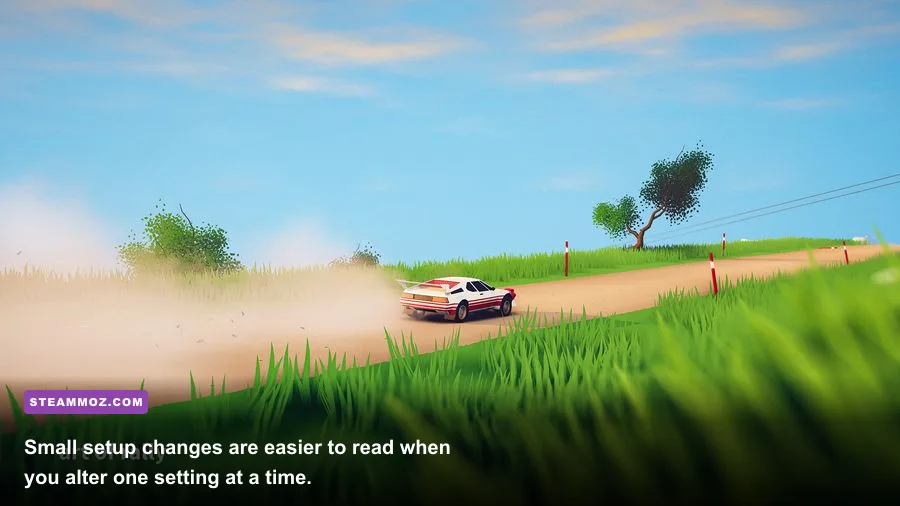
Don't treat those settings as sacred numbers. Art of Rally's tuning interface and car behavior can vary by vehicle, and the game communicates handling through feel rather than a dense engineering dashboard. The useful rule is to make one adjustment, drive the same stage again, and compare the first split, the worst corner, and the finish. Changing five sliders at once only hides the lesson.
Which car class should a beginner use?
Group 2 is the safest classroom. It carries enough speed to make lines matter but gives you time to catch a slide. Group 3 is the next step: more acceleration, sharper braking demands, and a greater reward for getting the car straight before applying full throttle. Group 4 is exciting, but its higher speed makes every late correction expensive. Group B and the fastest historical classes are better treated as an advanced challenge, not as a shortcut through Australia.
That progression is similar to the logic behind a good survival build in other genres. Steamoz's Crawls beginner build guide makes the same valuable point: reliability creates room to learn, while maximum damage or speed often magnifies mistakes.
🎮 art of rally: australia
Looking to experience this game? Grab your digital key directly on our store for $6.29.
View on Steammoz Store →Australia Setup Tuning Without Guesswork
Australia's red-earth visuals can make the road look smoother than it is. The surface changes your braking distance, and a car that feels planted on tarmac can become lively over loose gravel. Before chasing a faster setup, make the car predictable during three moments: initial braking, the direction change at the apex, and throttle application on exit.
Brake balance and braking technique
Begin with the brake balance toward the front. That costs a little rotation, but it prevents the rear from stepping out when you brake over a crest or while turning. If the car pushes wide at every hairpin, move the bias rearward by a small amount rather than stabbing the handbrake. The handbrake is a rotation tool, not a replacement for basic braking.
Brake in a straight line whenever the road drops away. Release pressure progressively as you turn, then use a short handbrake tap only when the corner is genuinely too tight for normal rotation. Holding the handbrake through the entire bend overheats your decision-making even if it doesn't create a literal temperature penalty: you lose speed, angle, and the exit line at the same time.
Differential, suspension, and throttle
A more open differential usually helps a beginner rotate the car into slow corners, but too much freedom can make the rear unpredictable when you lift. A more locked differential can improve traction while accelerating out of a hairpin, especially in a four-wheel-drive car, but it may make the front wash wide on entry. Start in the middle and only move toward locked behavior after you understand whether your problem is entry rotation or exit traction.
Softening suspension slightly helps the tires follow rough gravel and absorb small landings. Go too soft and the car wallows through direction changes; go too stiff and it skips across bumps, losing grip in a way that feels random. If the car lands and immediately darts left or right, check your approach speed and steering input before stiffening everything. Many “bad suspension” problems are actually airborne steering problems.
| Symptom | Likely Cause | First Adjustment | Driving Fix |
|---|---|---|---|
| Rear snaps out under braking | Brake bias too far rearward | Move bias forward | Brake earlier and release before turn-in |
| Front pushes wide on hairpins | Too much entry speed or locked differential | Open differential slightly | Use a slower, later apex |
| Wheelspin on corner exit | Throttle applied before the car is straight | Close differential slightly | Feed throttle in stages |
| Car skips over rough ground | Suspension too stiff or steering too aggressive | Soften suspension one step | Relax the wheel over bumps |
| Car feels sluggish after corners | Too much downforce or cautious gearing | Reduce downforce slightly | Carry more momentum into open bends |
Do not tune around a single spectacular crash. Run a full stage, because a setup that feels brilliant in one hairpin may become exhausting through a sequence of fast bends. The best Australia build is the one that produces repeatable split times with fewer corrections.
How to Drive Australian Gravel Stages
Your pace notes are the real upgrade. Listen for the number describing corner severity, then pair it with the road's shape and the following hazard. A medium corner that tightens after the entry deserves more respect than an isolated medium turn with a wide exit. The note tells you what is coming; your visual scan tells you how much grip and space you actually have.
Use the three-phase corner routine
First, prepare. Lift or brake before the corner's visual turning point. On gravel, waiting until the road looks tight usually means you've already spent the grip needed to rotate. Second, rotate. Turn with a single clean input, using a small handbrake tap only when necessary. Third, launch. Straighten the wheel before asking for full throttle. This routine sounds basic, but it stops the most common beginner loop: entering too fast, sliding wide, correcting twice, and exiting slower than a cautious driver.
For hairpins, approach from the outside, brake earlier than your instinct suggests, and aim for a late apex. A late apex gives you a straighter exit and makes the next acceleration phase safer. If the road falls away on the outside, sacrifice even more entry speed. Australia rewards the driver who protects the exit rather than the driver who wins the first half-second of the turn.
Jumps, crests, and roadside punishment
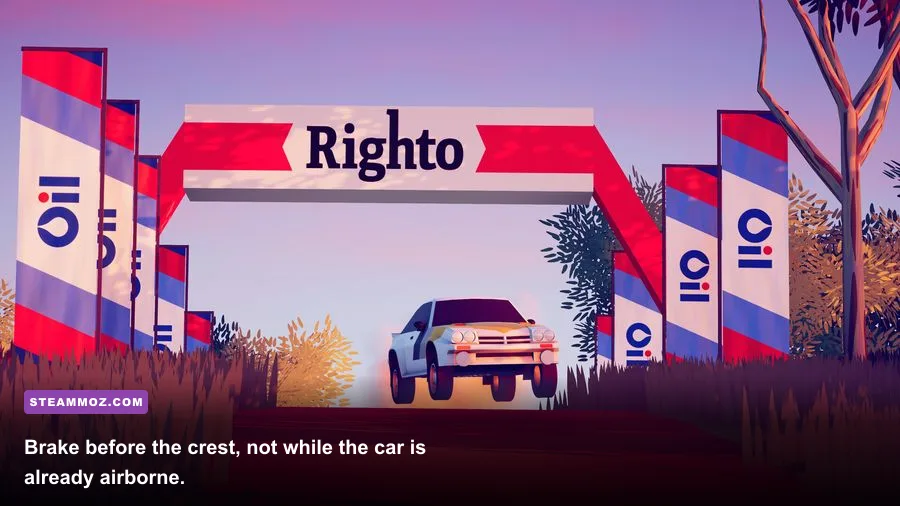
Brake before a crest if the pace note warns of a jump or immediate corner. Braking in midair gives you little useful control, and landing while turning can bounce the car into a tree, barrier, or embankment. Keep the steering close to neutral over the crest, land with the car aligned to the road, and only then return to heavy inputs.
Don't use the outside scenery as a soft wall. Art of Rally's stylized presentation can make trees, fences, and rocks appear forgiving, but contact usually destroys your line and may cost more time than a cautious lift. When in doubt, choose the side with the clearest exit rather than the side that looks shortest.
For players coming from more technical racers, Steamoz's tier-list breakdown is a useful reminder that “best” depends on context. In Australia, a car's ability to preserve momentum through rough transitions matters more than its headline top speed.
Assists, Camera, and Performance Settings

Beginners should use assists as learning instruments, not as a badge of shame. Turn on the help that prevents a specific mistake, then remove it once you can explain what it was doing. Counter-steer assist can help you survive early slides, while throttle control is valuable if your trigger or keyboard inputs are too abrupt. Brake assist is more restrictive and can interfere with learning your own braking points, so it is the first aid to reduce once your basic control improves.
Choose the camera that keeps the road readable. The far chase camera offers the best peripheral awareness around obstacles, while a closer camera makes vehicle movement easier to sense but can hide the road edge. Whichever view you choose, keep it consistent during practice. Constantly switching cameras makes a familiar stage feel new and ruins useful comparisons.
| Setting | Beginner Profile | Performance Impact | Reason |
|---|---|---|---|
| Frame rate | Stable 60 FPS target | Moderate depending on hardware | Consistent timing helps braking and corrections |
| Resolution | Native monitor resolution | High at 1440p or 4K | Lower only if frame pacing is unstable |
| Shadows | Medium | Medium to high | Keeps scenery readable without a major cost |
| Reflections | Medium or Low | Medium | Minor visual loss, useful FPS savings |
| Anti-aliasing | High if stable | Low to medium | Reduces distracting edge shimmer |
| Motion blur | Off for practice | Low | Sharper braking references and road detail |
| V-sync | On if tearing appears | Small latency trade-off | Prioritize smooth, tear-free timing |
Art of Rally is not a demanding modern open-world racer, but a locked 60 FPS is still more useful than unstable high-refresh numbers. If the game stutters, lower shadows and reflections first, then verify that background applications are not interrupting frame delivery. Steamoz's guides on stutter troubleshooting and PC specifications cover the same practical diagnosis process.
Australia Progression Plan for New Players
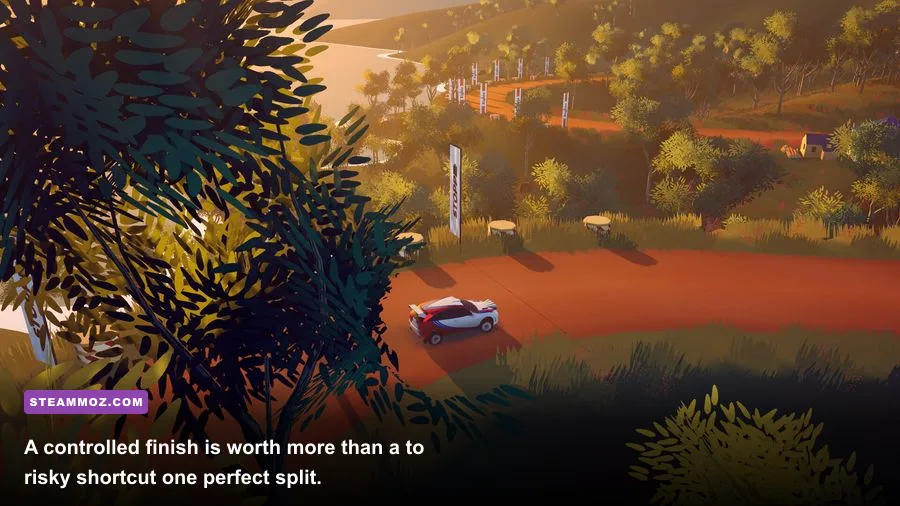
Don't repeatedly restart the moment you miss a corner. Finish the stage and identify the first mistake that caused the collapse. Did you brake late? Turn while airborne? Hold too much throttle on exit? Art of Rally teaches faster when you diagnose a pattern than when you chase one clean attempt through random resets.
Run 1: Learn the route
Use your safest car and focus on hearing every note. Ignore the leaderboard. Mark the corners where the road tightens, the crests that hide the next direction, and the sections where the surface encourages you to carry too much speed. Your first goal is a complete stage without a major collision.
Run 2: Fix braking points
Keep the same setup and attack only the braking zones. Brake earlier, release pressure smoothly, and compare how much speed you gain on exits. If an early brake lets you apply throttle sooner, it was probably faster overall even if the entry felt slow.
Run 3: Adjust one tuning variable
Now change one setting based on evidence. Open the differential if the front refuses to turn in; close it if the rear or driven wheels lose traction under acceleration. Soften the suspension if rough landings are unsettling the car. Move brake bias forward if braking creates a snap. If the change doesn't help after a full stage, undo it.
| Progression Goal | Recommended Car | Target Result | Move On When |
|---|---|---|---|
| Learn pace notes | Group 2 | Finish without major contact | You can predict most corners |
| Build consistency | Group 2 or Group 3 | Three clean runs with similar times | Your mistakes are specific, not random |
| Practice rotation | Rear-wheel drive Group 2 or 3 | Controlled lift-off and handbrake turns | You can recover without overcorrecting |
| Chase speed | Group 3 or Group 4 | Faster exits without collisions | You preserve momentum through full stages |
| Advanced challenge | Group B or faster classes | Competitive times on familiar routes | You want precision under extreme speed |
Career progress unlocks more cars and locations, but you don't need to clear Australia with the fastest machine to prove anything. The best checkpoint is control: you should be able to enter a familiar corner, explain your braking choice, and recover from a small slide without panic. That skill transfers directly to every later class.
Common Beginner Mistakes to Avoid
Chasing top speed: Australia has open sections, but a car that is brilliant on one straight can lose huge time in the next technical sector. Pick the car that lets you stay on the road.
Using full throttle everywhere: Throttle is a steering input on loose gravel. A partial squeeze can keep the front tires loaded and stop the rear from rotating too far. Full throttle belongs on the exit, after the car points where you want to go.
Overusing the handbrake: A handbrake turn looks dramatic, but it often creates a slow exit. Try normal braking and a late apex first.
Tuning after every crash: Crashes are data only when you can name the trigger. If you hit a tree because you ignored a crest note, no suspension slider will solve the problem.
Changing cars too early: Learn the stage with one forgiving vehicle before judging the setup. Different cars change your reference points, rotation, and throttle response, making it hard to know whether you improved.
For official information on the game, check the Art of Rally Steam page, the developer's Art of Rally page, and the official game website. Those are the safest places to confirm platform details, updates, and available content.
Australia's best beginner build is ultimately a discipline build: moderate power, stable braking, neutral differential, forgiving suspension, and a frame rate you can trust. Start with Group 2, learn the notes, brake before the crest, rotate once, and accelerate only when the car is straight. Once you can finish cleanly, increase speed or move up a class. That route may feel slower than grabbing the wildest car in the garage, but it is the quickest way to become genuinely fast.