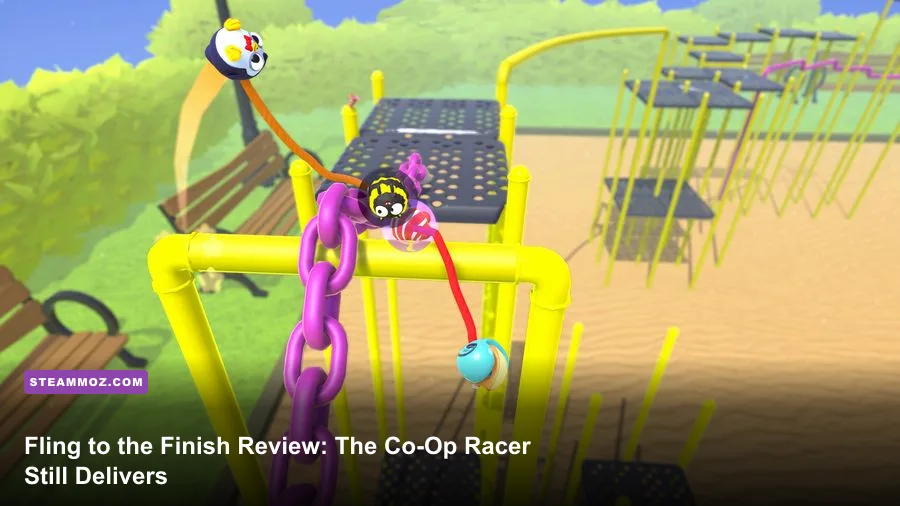
Yes, Fling to the Finish is still worth playing in 2026—but only if you have a reliable partner, preferably sitting beside you. Its central idea remains brilliant: two racers are tied together by an elastic rope and must fling, swing, drag, and occasionally rescue one another through obstacle courses. The controls are easy to understand, but the cooperation is wonderfully difficult. Solo players should look elsewhere; two to four friends who enjoy loud mistakes will find one of Steam's most entertaining co-op party racers.
That verdict hasn't changed because the game's strengths are mechanical rather than content-driven. Fling to the Finish doesn't compete with a huge live-service roadmap or a deep progression system. It wins through a simple loop that creates instant stories: one player grabs a checkpoint, the other overshoots a rotating platform, the rope snaps tight, and both racers are suddenly launched into a wall. In 2026, that formula still works exceptionally well.
This review focuses on the PC version, including its campaign structure, controls, multiplayer performance, replay value, and the kind of group that should buy it. For a contrasting look at older co-op-friendly PC games, our Dungeon Siege review shows how differently classic co-op design can age.
What makes Fling to the Finish so much fun?
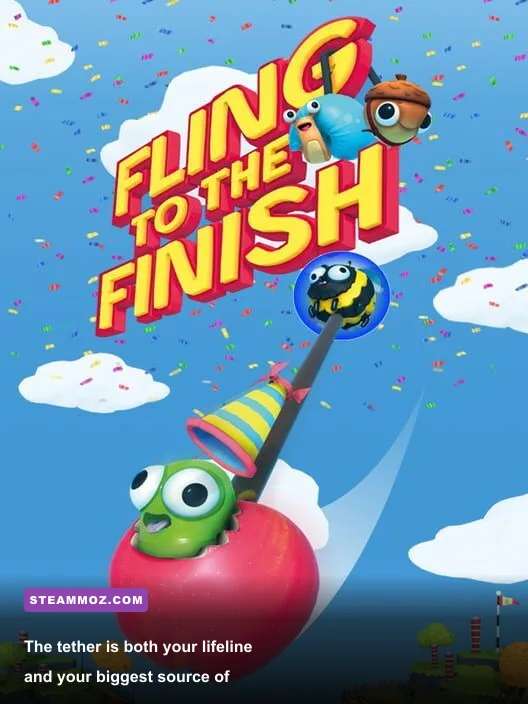
Fling to the Finish gives each pair of players two colorful characters joined by a flexible tether. You can run normally, jump, grab onto surfaces, and use the rope's tension to pull your teammate across gaps. The game is not simply a race where both players move toward the finish line. It is a shared physics puzzle disguised as a frantic platform racer.
The rope changes everything. If both players move in the same direction, it goes slack and allows comfortable progress. If one player reaches a higher ledge, the other can use the stretched connection like a launch line. A player can also stay behind as an anchor while the teammate swings around a barrier. That creates a surprising amount of control once you stop treating the tether as a nuisance.
The best teams develop a quick vocabulary: “anchor,” “swing left,” “hold,” “jump now,” and “reset.” You don't need professional-level coordination, but you do need someone willing to communicate. Silent partners tend to duplicate mistakes, especially when a camera angle hides the safe landing zone.
The controls are approachable, not effortless
Movement is deliberately forgiving, but momentum is not. A jump made while the rope is fully stretched behaves very differently from a jump made beside your teammate. New players often mash the jump button and blame the course, when the real problem is that both characters are accelerating in opposite directions.
The crucial habit is learning when to stop moving. Holding position can be more useful than sprinting. If your partner is airborne, stay planted and let the rope transfer momentum. If both players panic and run, the tether becomes a rubber band that flings the team away from the checkpoint.
That learning curve is the game's secret sauce. The first few levels feel clumsy, then the same mechanics suddenly become expressive. You start planning launches instead of reacting to them. When a difficult crossing works, it feels earned because both players physically contributed to the solution.

🎮 Fling to the Finish
Looking to experience this game? Grab your digital key directly on our store for $2.24.
View on Steammoz Store →Campaign, courses, and replay value in 2026

The campaign is built around a collection of themed obstacle courses rather than a conventional racing championship. Steam lists more than 30 levels, and the game supports up to four players in local and online multiplayer. The courses introduce hazards gradually, then combine them into increasingly messy tests of timing.
You will encounter moving platforms, gaps, narrow routes, spinning obstacles, ramps, vertical sections, and layouts that force one player to take a different path from the other. The variety is strongest when a level asks you to understand the rope before it asks you to move quickly. Later stages are less about memorizing a racing line and more about improvising after someone inevitably misses one.
There is no elaborate RPG-style progression to pad the campaign. You aren't collecting strength upgrades or unlocking faster movement stats. That is a positive for competitive fairness, but it also means the long-term hook depends on mastering courses and replaying them with different groups.
| Mode or feature | What it offers | 2026 verdict |
|---|---|---|
| Campaign | More than 30 themed obstacle courses | Best way to learn the rope and course language |
| Local multiplayer | Shared-screen play for up to four players | Strongest format for parties and couch co-op |
| Online multiplayer | Cooperative racing with friends | Worthwhile when everyone has voice chat |
| Replay runs | Faster clears, cleaner launches, fewer falls | Excellent for skill-focused groups, limited for solo players |
| Cosmetic roster | Colorful character choices and presentation | Fun personality, not a deep progression system |
Replay value comes from shaving time, reducing deaths, and learning shortcuts. The game is especially good at producing “one more run” sessions because failure is usually readable. You can identify the moment the plan failed: a late jump, a bad anchor, or a teammate who released tension too early.
Still, players expecting a large number of unlockables or a solo campaign with independent progression may feel the content runs thin. This is a party game first. Its shelf life is tied to your friends list, much like other compact multiplayer experiences. Steamoz's Dungeons 3 tips guide covers a much more traditional campaign structure, while Fling to the Finish is all about repeating a shared mechanical challenge.
The smartest strategies for surviving difficult courses
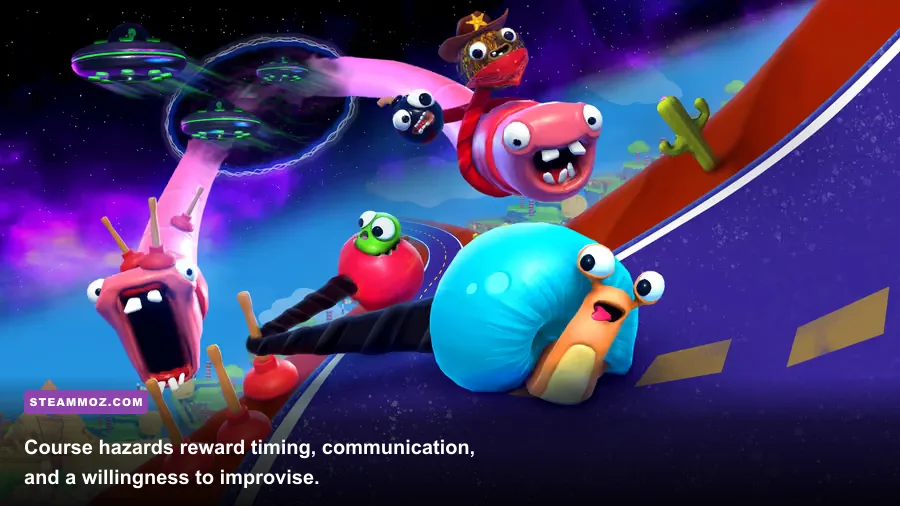
Winning isn't mainly about speed. It is about assigning jobs before the rope turns a simple jump into a disaster. The strongest teams naturally fall into an anchor-and-runner rhythm, then swap roles whenever the layout demands it.
Use the anchor-and-runner system
The anchor stays near safe ground while the runner explores the next section. The runner can stretch the tether, swing around corners, or reach a checkpoint first. Once the route is secure, the anchor uses the rope to launch forward. This is safer than having both characters leap blindly together.
Manage rope tension deliberately
A tight rope is useful only when you know where the energy is going. Before a launch, the anchor should stop moving and face the intended direction. The runner then jumps or pulls away from the anchor. If the anchor is still walking sideways, the stored momentum becomes unpredictable.
Stop resetting too early
Many failed attempts are recoverable. If one character falls below the route, the other can often pull them onto a ledge by creating a shallow angle rather than yanking directly upward. A reset makes sense when both players are stuck, but abandoning a recoverable position wastes more time than careful rescue.
| Course problem | Common mistake | Better response | Best role assignment |
|---|---|---|---|
| Wide gap | Both players jump together | Keep one player grounded as an anchor | Anchor plus runner |
| Vertical ledge | Runner climbs without checking rope angle | Pause at the top and pull from a straight line | Runner climbs, anchor stabilizes |
| Rotating platform | Jumping before the platform faces the exit | Wait for alignment, then use short controlled jumps | Both move in sequence |
| Split route | Players pull in opposite directions | Call the route and keep the rope slack briefly | Lead player chooses direction |
| Missed landing | Immediate panic movement | Stop, find a ledge, and rescue before resetting | Higher player becomes anchor |
Voice chat is effectively a gameplay tool. Call the exact action rather than vague warnings. “Jump” is less useful than “hold still, I’m swinging right.” The difference sounds small, but it prevents both players from making emergency corrections at the same time.
For local play, sit close enough that you can see your partner's hands. Online, use a low-latency voice channel and avoid playing with someone whose connection constantly drops. Fling to the Finish is physics-heavy in feel, so inconsistent input timing can make a perfectly executed plan look broken.
Performance, controls, and PC value
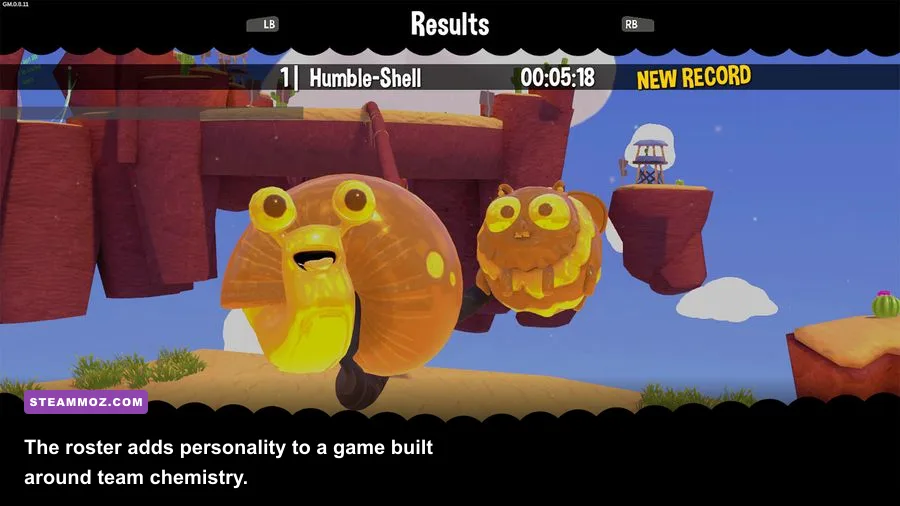
Fling to the Finish is visually bright and stylized rather than technically demanding. Its colorful environments, animated characters, and readable hazards are designed to stay clear during frantic multiplayer action. On modern gaming PCs, the important performance target is a stable frame rate and responsive input, not maximum visual spectacle.
The game is a sensible choice for older laptops and modest desktops, although your exact experience depends on resolution, background applications, and whether you are hosting online play. Keep V-Sync enabled if you notice tearing during fast swings; disable it if input latency bothers you and your display supports variable refresh. The visual style loses little when you lower quality settings, so reducing effects is preferable to accepting stutter during a difficult jump.
| Setting or hardware factor | Recommended approach | Gameplay impact | Visual trade-off |
|---|---|---|---|
| Resolution | Native display resolution first | Best clarity for hazards and ledges | Lower resolution improves headroom |
| Frame rate | Target a stable 60 FPS | More consistent jumps and rope timing | Higher rates are nice but not essential |
| V-Sync | Use it with visible tearing | Cleaner motion, potentially more latency | No meaningful image-quality loss |
| Effects and shadows | Lower these before resolution | Can reduce dips on older hardware | Less environmental polish |
| Network connection | Prefer wired or stable 5 GHz Wi-Fi | Reduces desync and missed inputs online | No visual change, major consistency benefit |
The PC requirements are modest enough that this is not a game you should buy for a graphics upgrade. Buy it for the input design and multiplayer format. Before purchasing, check the official Steam page for current system requirements, supported features, reviews, and controller information.
Controller play is the comfortable option for most groups. Keyboard controls work, but a controller makes simultaneous movement and jumping feel more natural, especially when a player needs to make tiny corrections while the rope is stretched. If a controller is not recognized, check Steam Input before blaming the game; the platform's configuration layer can solve many layout issues.
For broader PC optimization ideas, see Steamoz's Drawful 2 PC requirements breakdown and our ELEX crash and FPS fixes. They address different games, but the same basics apply: update drivers, close unnecessary overlays, and test performance before inviting a full group.
Who should play Fling to the Finish in 2026?
Fling to the Finish is an easy recommendation for couples, couch co-op groups, and friends who enjoy games that turn coordination into comedy. It works particularly well when your group likes Fall Guys-style chaos but wants more direct cooperation. Every player matters, and even a mistake can become a successful recovery if the team communicates.
It is a weaker recommendation for solo players. The game's identity depends on the tether, and controlling a partner yourself removes the spontaneous negotiation that makes each course memorable. It is also not ideal for players who want ranked competition, deep character builds, a large unlock tree, or a story campaign. There are no weapon stats, class builds, or meaningful power curve to master here; the progression is your team's skill.
That focus makes the game refreshingly honest. You don't grind for better movement or buy an advantage. You improve because you learn to position the anchor, read the rope, and trust your teammate. The best reward is clearing a section that previously looked impossible, then discovering that you can do it faster on the next attempt.
| Player type | Recommendation | Why |
|---|---|---|
| Couch co-op group | Strong buy | Fast setup, clear controls, hilarious shared failures |
| Online friends with voice chat | Buy on sale or at a good price | Excellent teamwork, provided connections are stable |
| Solo player | Skip unless you have a regular group | The tether is far less compelling without social coordination |
| Competitive racer | Try before committing | Timing matters, but there is no serious ranked ladder |
| Casual party host | Strong buy | Easy to explain and entertaining within minutes |
Before buying, check the SplitSide Games website for developer information and the official Steam community hub for current player reports, multiplayer discussions, and support threads. The Steam news page is also the right place to verify updates and event information rather than relying on old review snippets.
Final verdict: Fling to the Finish remains worth playing in 2026 if you treat it as a social co-op challenge, not a long-term solo racer. Its physics can occasionally produce an awkward launch, and its limited progression won't satisfy everyone, but the rope mechanic is still distinctive, readable, and remarkably funny. Bring one good teammate, use controllers, keep voice chat open, and expect to fail loudly. At the right price, this is an easy addition to a multiplayer library—and one of the rare games where getting dragged across the finish line can feel like a genuine team victory.