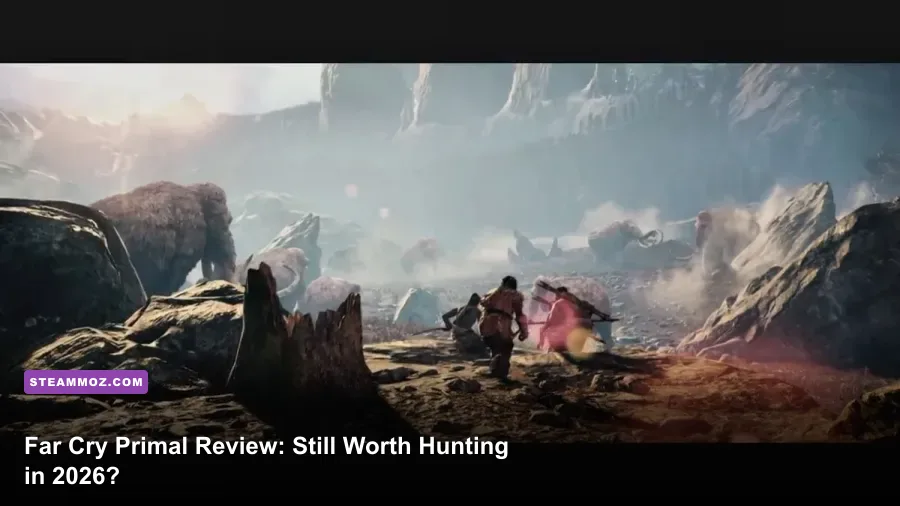
Yes—Far Cry Primal Standard Edition is still worth playing in 2026, provided you want a focused single-player adventure rather than a modern live-service sandbox. Its prehistoric setting, excellent animal-companion system, and brutal first-person combat still feel distinctive, while the repetitive outpost formula, thin enemy variety, and dated PC presentation show their age. At a discounted price, the Standard Edition is the right version for most players: it contains the complete base campaign and all core progression systems without requiring cosmetic extras or premium equipment.
That recommendation comes with one important warning. Primal is not Far Cry 4 with dinosaurs, and it isn't a full survival simulation. You play as Takkar, a Wenja hunter rebuilding his scattered tribe in Oros around 10,000 BCE. The game replaces rifles and vehicles with clubs, spears, bows, fire, stealth, and tameable predators. The result is slower, more intimate, and often more atmospheric than the numbered entries—but also less mechanically varied after the first 10 hours.
What the Standard Edition actually delivers
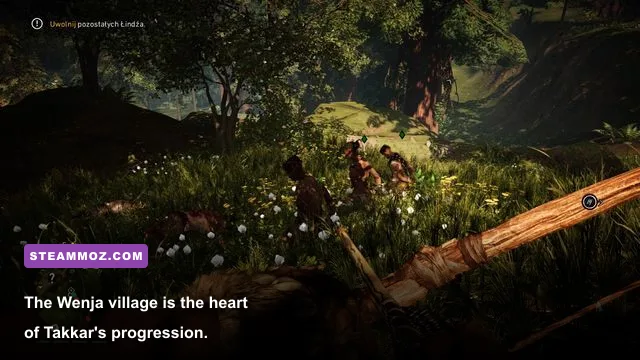
The Standard Edition includes the main Far Cry Primal campaign, the entire Oros open world, Takkar's skill trees, village upgrades, side quests, outposts, forts, hunting activities, collectibles, and the storylines involving the Wenja, Udam, and Izila. You can recruit key specialists such as Sayla, Tensay, Wogah, Jayma, and Karoosh, then improve their huts to unlock new abilities and crafting options.
It does not need an online population to work. Primal is built as a solo adventure, and Ubisoft's old multiplayer infrastructure is irrelevant to the main experience. The Standard Edition also gives you the same fundamental combat loop as higher-priced bundles. Deluxe packages add extras such as the Legend of the Mammoth content and bonus items, but they don't transform the campaign or fix its pacing.
For a current overview of ownership options, check the official Steam page. Before buying, verify which launcher the current store listing requires and whether your platform supports the edition you want. On PC, the game can still be affected by modern launcher, overlay, and controller quirks even though its original hardware demands are modest by 2026 standards.
| Edition | What you receive | 2026 verdict |
|---|---|---|
| Standard Edition | Base campaign, Oros, village upgrades, all core skills and story missions | Best value for most players |
| Deluxe Edition | Base game plus bonus weapons, resources, and extra content depending on platform | Only worthwhile at a small price difference |
| Collector or special bundles | Digital or physical extras, soundtrack, art, and promotional items | For fans, not necessary for gameplay |

🎮 Far Cry Primal Standard Edition
Looking to experience this game? Grab your digital key directly on our store for $7.49.
View on Steammoz Store →Why Oros still feels different from every other Far Cry
Oros is the reason Primal has survived better than its launch reputation suggests. There are no radio towers, assault rifles, or trucks to flatten the landscape. You move on foot, climb with limited tools, and constantly read the environment for danger. Day and night change visibility, while weather and dense foliage make even a familiar route feel uncertain. A burning grassland can expose you, but it can also scatter enemies and open a stealth route.
The world is split between the Wenja, the cannibalistic Udam, and the technologically advanced Izila. Those factions aren't just window dressing. Udam warriors favor heavy clubs and close-range pressure, while Izila fighters use fire, shields, and better armor. A basic hunt can become a three-way battle if you throw a spear too loudly or drag a carcass near a patrol.
That tension is strongest early, before your skills and village bonuses erase the survival edge. You begin with fragile equipment, limited resources, and no reliable answer to every threat. Hunting a deer for meat, collecting hardwood, and finding flint genuinely matters. Later, your resource pouch grows, your animal companion handles distractions, and the map becomes easier to dominate.
The story is straightforward but effective. Takkar isn't a chosen superhero; he's a survivor trying to gather the Wenja after a disastrous migration. Sayla's mission line gives the campaign emotional weight, while Tensay's mystical quests lean into visions and ritual. Karoosh provides the most direct warrior perspective, and Wogah's missions add a grim, memorable edge. The performances are carried by invented prehistoric languages with subtitles, so don't expect a conventional voice-driven Far Cry script.
Combat, skills, and the progression curve
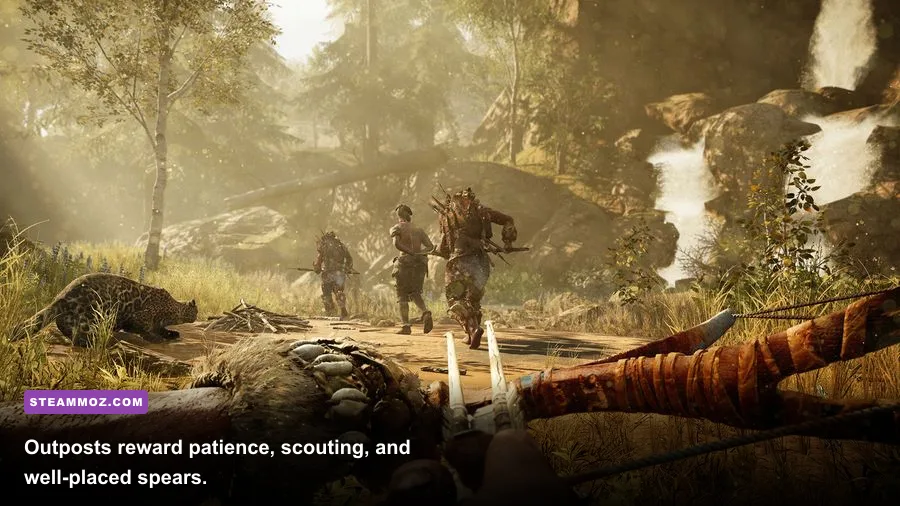
Primal's combat is built around quick decisions rather than enormous weapon inventories. The Hunter Bow handles quiet headshots, the Long Bow trades speed for power, and the Double Bow fires two arrows with a damage penalty. Spears are excellent for killing armored targets and can be thrown for heavy burst damage. The Club is your dependable melee tool, while the Two-Handed Club hits harder but leaves Takkar exposed.
Crafting turns those tools into a flexible kit. Upgrade the weapon hut to improve damage and capacity, then keep hardwood, animal skins, flint, and animal fat in reserve. A fire shard can ignite grass or an enemy, a berserk shard can turn a target against allies, and a sting bomb creates a poison cloud. The game rarely forces one solution, but it rewards carrying several options before entering an outpost.
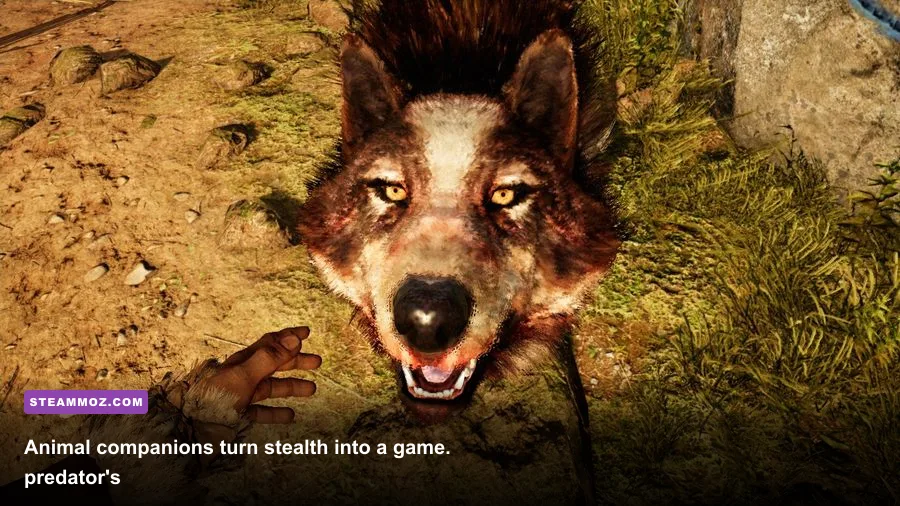
The most important early skill is Beast Master. Unlocking it allows Takkar to tame predators, and later upgrades improve companion health, revive speed, and command options. The Owl is equally valuable: it scouts areas from above, marks enemies, and can drop projectiles once upgraded. Used together, the Owl and a tamed wolf let you map an outpost, isolate a guard, and begin the assault on your terms.
For a first playthrough, prioritize Survival skills that increase health and resistance, then invest in Beast Master and Hunter. Don't rush every crafting upgrade. Village specialists provide major benefits: Sayla's hut improves health, Tensay's hut develops animal abilities, and Wogah's hut unlocks grappling-related utility. The skill trees are generous enough that a normal campaign will let you purchase most practical abilities, but the first few points have a much bigger effect than the final ones.
| Priority | Skill or upgrade | Why it matters | Best timing |
|---|---|---|---|
| S-Tier | Beast Master and Owl scouting upgrades | Reveals enemies, creates distractions, and reduces stealth risk | First several hours |
| S-Tier | Health upgrades in Survival | Prevents one mistake from ending a fight or hunt | Immediately after core utility |
| A-Tier | Hunter Bow and weapon pouch upgrades | Improves silent kills and keeps more tools available | Early and mid-game |
| A-Tier | Village hut upgrades | Unlocks crafting, health, animal, and utility bonuses | Whenever resources allow |
| B-Tier | Heavy melee and late combat perks | Powerful, but less useful than scouting and survivability | Mid to late campaign |
Combat has readable telegraphs, but it can feel imprecise by modern standards. Heavy enemies telegraph swings with obvious wind-ups; dodge sideways instead of backing away, because the reach on Udam clubs is longer than it looks. Against Izila shields, reposition rather than repeatedly attacking the front. Throwing a spear at an exposed head is faster than trying to chip through armor with a club.
What still disappoints in 2026
Primal's biggest weakness is repetition. Once you've cleared several outposts, the sequence becomes familiar: scout with the Owl, tag guards, remove an alarm threat, use an animal distraction, and finish the survivors with arrows or spears. The setting changes the scenery, but not always the structure. Side activities frequently boil down to hunting, gathering, rescuing Wenja, or burning enemy supplies.
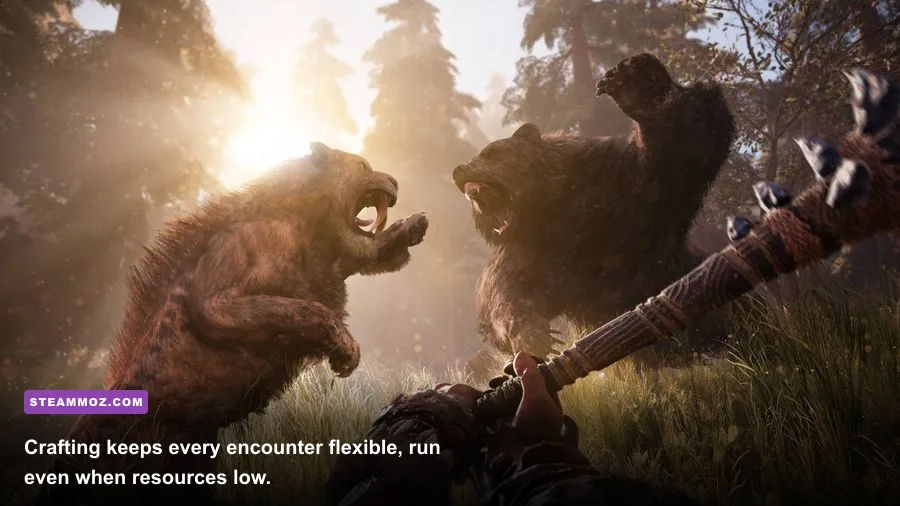
Enemy variety is also narrower than Far Cry 5 or Far Cry 6. Udam and Izila have recognizable roles, but you don't get a broad roster of specialized encounters. Animals add unpredictability, especially cave bears, sabretooth cats, and dangerous predators, yet many fights still resolve through the same handful of ranged attacks.
The campaign's pacing is uneven. The opening hours are excellent because every upgrade feels meaningful. In the middle, however, the map can become a checklist of icons. The main missions are more enjoyable when you follow the character storylines rather than trying to clear every activity immediately. Save full map completion for after the campaign if repetitive collectibles usually make you lose momentum.
There are also presentation limits. Oros looks beautiful at a distance, with warm firelight, misty rivers, and dramatic mountain silhouettes, but facial animation and environmental interaction are clearly from the 2016 generation. The world doesn't have the systemic density of a newer open-world game. You can't expect every animal group, NPC, or weather event to produce a complex emergent story.
Those flaws matter less if you approach Primal as a 15-to-25-hour story adventure instead of a 70-hour completionist commitment. The campaign can last longer if you explore every cave, hunt rare animals, and fully upgrade the village, but the core experience is strongest before the checklist fatigue sets in. Players who loved grim single-player adventures may find the same appeal here: a hostile world, practical progression, and a protagonist shaped by survival.
PC performance and the best settings for modern hardware

Far Cry Primal is relatively easy to run on a 2026 gaming PC, but its age doesn't guarantee a flawless setup. The official PC requirements originally targeted hardware such as an Intel Core i3-550 or AMD Phenom II X4 955 at minimum, with 8 GB of RAM and graphics cards around the GeForce GTX 460 or Radeon HD 5850 class. The recommended target was roughly an Intel Core i7-2600K or AMD FX-8350 with a GeForce GTX 780 or Radeon R9 280X.
Modern GPUs should handle the game comfortably at 1080p and 1440p. The useful upgrades are not simply “turn everything to Ultra.” Volumetric fog, shadows, post-processing, and anti-aliasing can cost more than expected while offering limited benefits during fast combat. If you want a locked frame rate, start with the game's High preset, disable unnecessary overlays, and cap frames through your driver or an external limiter.
| Setting | Recommended value | Performance impact | Visual trade-off |
|---|---|---|---|
| Resolution | Native 1080p or 1440p | Very high | Keep native for sharper subtitles and foliage |
| Textures | High or Ultra with 4 GB+ VRAM | Medium | Improves rocks, clothing, and animal detail |
| Shadows | High | Medium to high | Ultra adds subtle depth but costs frames |
| Volumetric Fog | High | High | Lower this first if misty areas stutter |
| Post-Processing | High | Medium | Lowering it can improve clarity and responsiveness |
| Anti-Aliasing | Use the least blurry acceptable option | Medium | Test vegetation shimmer at your resolution |
| Motion Blur | Off | Small | Cleaner aiming and less visual smear |
Stutter is more likely to come from background processes, shader compilation behavior, or storage than from raw GPU power. Install the game on an SSD, update graphics drivers, and test borderless versus exclusive fullscreen if alt-tabbing causes trouble. If you are comparing old PC ports, our crash and low-FPS troubleshooting guide has broadly useful steps for overlays, drivers, and configuration files.
Controller support is generally the better fit for melee and movement, while mouse aiming makes the Bow and spear much more precise. Use whichever feels natural; there is no competitive advantage to optimize for because Primal is entirely a solo experience.
How to play Primal without burning out
Start on Normal unless you specifically want resource pressure. Hard difficulty makes mistakes more punishing and gives the hunting loop more value, but it doesn't solve the game's repetition. Survival difficulty can make the early hours tense, yet it also increases friction in a campaign whose best moments come from momentum and exploration.
Follow the main village upgrades early. Explore around objectives instead of sweeping the entire map. Keep at least one stack of meat, hardwood, and animal fat before entering a hostile camp. Use the Owl first, mark alarm fires, and decide whether you're clearing stealthily or creating chaos. Half-committing is where most failed attacks happen: either eliminate the alarm threat immediately or accept that the entire camp is about to mobilize.
For hunting, watch the animal's behavior rather than firing instantly. Predators telegraph attacks with a crouch and growl, while herbivores tend to flee in a straight line. A tamed wolf is ideal for early hunts because it distracts prey without the risk of a sabretooth cat. Revive companions quickly when safe, but don't waste the animation in the middle of a Udam crowd.
Use fire tactically, not constantly. Burning grass can split a group and force enemies out of cover, but it also destroys visibility and can make looting awkward. Berserk shards are particularly strong against clustered patrols; hit a heavy enemy, let the target create chaos, then finish the survivors with the Bow. Against Izila defenses, fire arrows and spears are more reliable than trying to brute-force shielded units.
There are useful quality-of-life details that the game never emphasizes enough. Loot bodies after major fights because resources are needed for hut upgrades. Mark rare animals with the Owl before chasing them. Fast travel only after clearing enough territory to make the return route safe. And don't ignore cave entrances: some contain crafting materials, while others provide shortcuts through regions filled with patrols.
If you enjoy methodical progression, you might also like Steamoz's fast-progression advice for Death Howl or the resource-focused approach in Chef Life: Tokyo Delight. They aren't direct genre matches, but both reward the same habit Primal does: invest in systems that reduce future friction instead of chasing every shiny objective.
Final verdict: worth playing or skip it?
Far Cry Primal Standard Edition earns a recommendation in 2026. Buy it if you want a self-contained open-world game with a setting few big-budget releases have attempted, satisfying stealth-and-hunt combat, and one of Ubisoft's better companion systems. Takkar's relationship with Oros feels more personal than the usual Far Cry power fantasy, especially during the first half of the campaign.
Skip it if you need constant mission variety, a deep survival simulation, modern facial animation, or a huge multiplayer community. The second half repeats its outpost and resource patterns, and the story never reaches the character depth of the best narrative-focused action games. A full-price purchase is hard to justify in 2026, but a sale price makes the calculation easy.
| Player type | Recommendation | Reason |
|---|---|---|
| Far Cry fan | Buy on sale | Familiar open-world structure with a genuinely different combat identity |
| Stealth player | Strong buy | Owl scouting, animal distractions, bows, and environmental fire work beautifully together |
| Completionist | Buy cautiously | Plenty to do, but repeated activities can become exhausting |
| Survival-game enthusiast | Try first or wait for a deep discount | Resource gathering supports progression but isn't a full simulation |
| Story-focused player | Buy on sale | Strong atmosphere and a likeable cast, though the plot is conventional |
My final score for the Standard Edition in 2026 is 8/10 for the right audience, or closer to 7/10 if you've already exhausted several modern Ubisoft open worlds. Primal's age is visible, but its core fantasy remains unusually sharp: scout a valley, hear a predator in the dark, craft one last spear, and decide whether to stalk the camp or start a firestorm. Few games still deliver that exact rhythm. If that sounds like your kind of night, Oros is absolutely worth visiting.
For official background, consult Ubisoft's Far Cry Primal page, the official support hub, and the game's Ubisoft Store listing before purchasing.