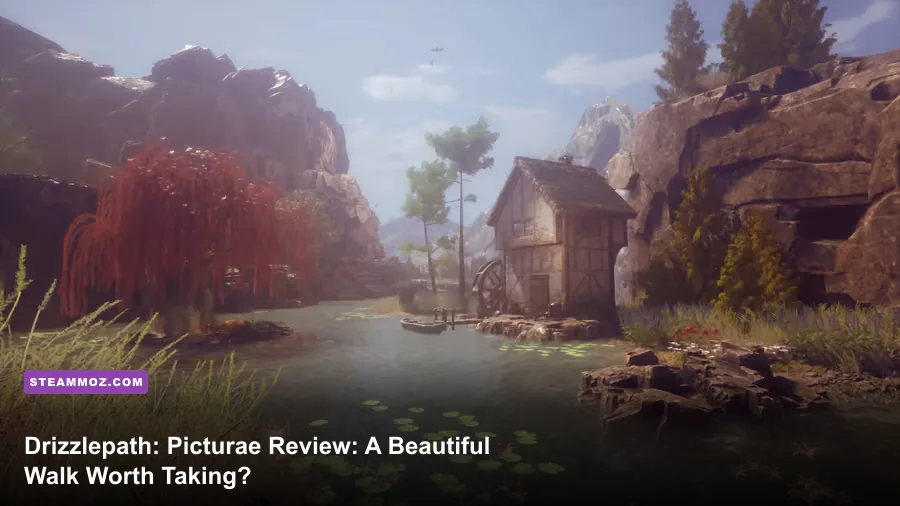
Drizzlepath: Picturae is worth playing in 2026 only if you want a short, low-pressure walking simulator built around scenery rather than challenge. It has no combat, character build, loot chase, boss encounters, or conventional puzzle system to keep you busy. What it does offer is a compact first-person journey through mountain paths, woodland, rain, and open vistas, presented with the reflective mood that defines Tonguç Bodur's Drizzlepath games. At its best, Picturae feels like a playable landscape painting. At its weakest, it feels like a scenic walk stretched over too little interaction.
That distinction matters more now than it did at release. In 2026, Steam is packed with polished walking simulators, free exploration games, and atmospheric indies that understand pacing better. Picturae still has a specific appeal, though: it asks almost nothing from you. There is no fail state to trigger, no upgrade tree to optimize, and no combat tutorial to survive. You simply move forward, absorb the environment, and decide whether the journey's quiet rhythm works for you.
What Drizzlepath: Picturae Actually Is
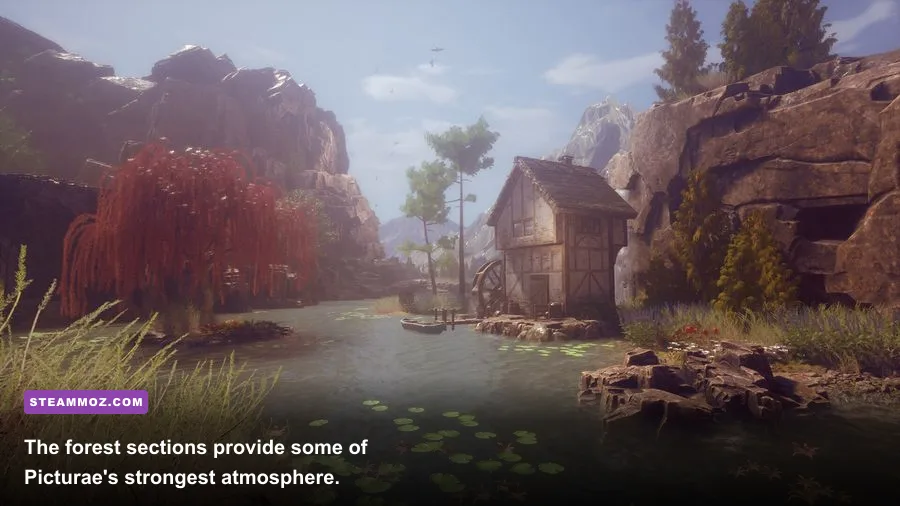
Picturae is a first-person exploration game rather than a traditional adventure game. You walk through a linear outdoor route, observe the scenery, and follow the path toward its conclusion. The design is intentionally spare. Movement and looking are the primary verbs, with the environment acting as the content instead of a backdrop for systems.
That means there are no weapon statistics to compare, no named skills to unlock, and no progression curve in the RPG sense. If you're expecting a game with the mechanical density of a dungeon crawler, it will feel almost empty. If you treat it as an interactive visual and audio piece, the minimalism makes more sense. Picturae's structure is closer to taking a guided hike than solving a conventional game world.
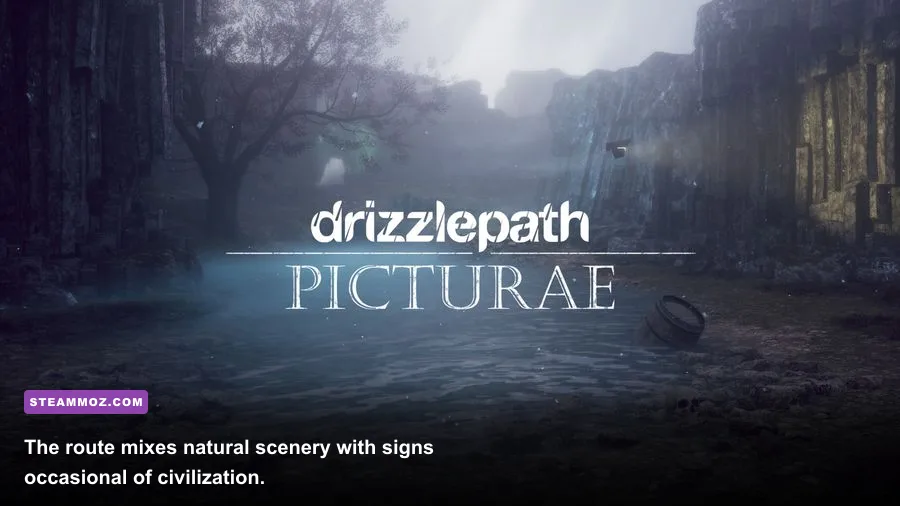
The route uses familiar Drizzlepath ingredients: natural scenery, changing weather, distant structures, gentle elevation changes, and long stretches where the act of walking becomes the point. The game doesn't constantly throw objectives at you. Instead, it uses sightlines to suggest direction. A path bends around a hillside; a landmark appears beyond the trees; a brighter section of sky encourages you forward.
For a useful comparison, readers who enjoy atmospheric exploration may also want to see our In Stars and Time review, although that game has far more narrative and systemic structure. Picturae is the quieter, less demanding option.

🎮 Drizzlepath: Picturae
Looking to experience this game? Grab your digital key directly on our store for $1.99.
View on Steammoz Store →Scenery, Sound, and the Art of Going Nowhere
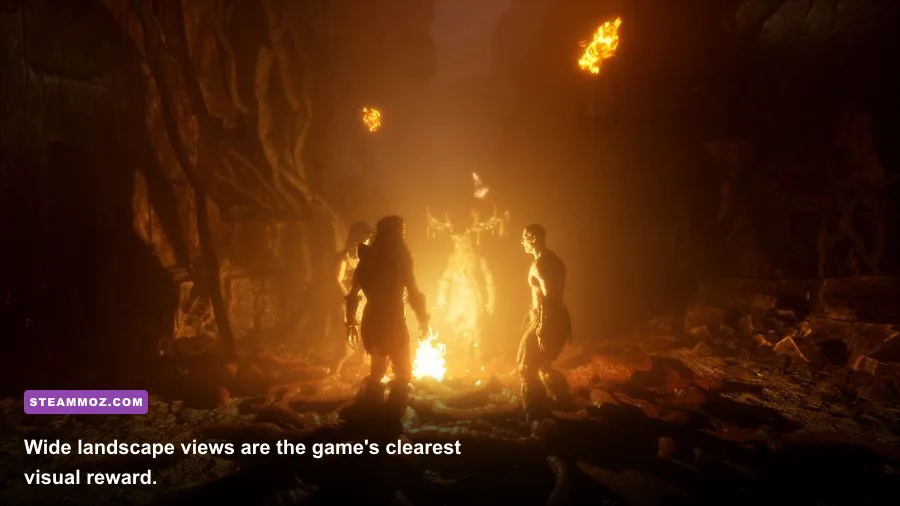
The visual design is Picturae's strongest argument. Its best moments arrive when the path opens onto a large view and the game gives the composition room to breathe. Mountain silhouettes, damp ground, tree lines, and muted skies create a convincing sense of place without needing a busy map full of collectibles.
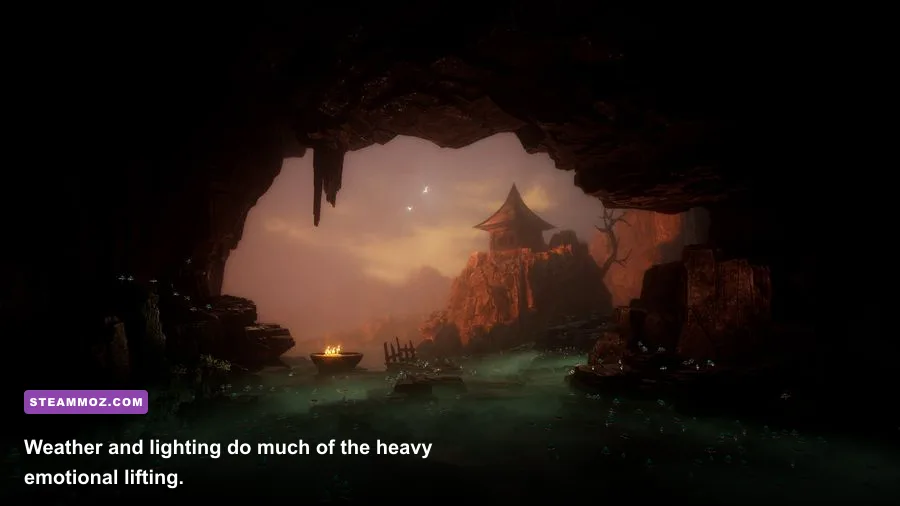
Lighting does a lot of the work. A rainy stretch can make the same basic walking loop feel more solitary, while a brighter clearing provides a small emotional release. These changes aren't dramatic set pieces, but they stop the route from becoming visually flat. The environment is also readable at a glance: roads and footpaths are usually obvious, and the game rarely asks you to perform pixel-hunting navigation.
Audio is similarly restrained. Footsteps, wind, rainfall, and environmental ambience establish the mood without turning every area into a musical cue. That restraint is a plus if you want something calming in the background, but it also exposes the game's lack of interactive variety. Once you've understood the rhythm, there aren't many surprises left.
Don't expect cutting-edge 2026 rendering. Picturae is an older, compact indie production, and some textures, vegetation, and distant geometry show their age. Still, screenshots can undersell the experience because the game depends on motion, weather, and the gradual reveal of a vista. It isn't a technical showcase; it's a composition-focused one.
| Element | What Picturae Does Well | Where It Shows Its Age | 2026 Verdict |
|---|---|---|---|
| Landscape composition | Strong sightlines and scenic reveals | Limited environmental variety | Still effective |
| Lighting and weather | Creates mood without combat or puzzles | Effects lack modern fidelity | Atmospheric, not cutting-edge |
| Textures and foliage | Works at normal walking distance | Obvious repetition up close | A noticeable compromise |
| Audio ambience | Quiet, fitting, and unobtrusive | Little dynamic variation | Good for relaxed play |
How Long Is It, and What Do You Actually Do?
The honest answer is that Picturae is short and uncomplicated. Your practical objective is to follow the route, inspect what catches your eye, and keep moving. There is no combat loop to master and no inventory screen to manage. The game doesn't pretend that walking is secretly a complex system; it commits to the idea that atmosphere can carry a small experience.
That commitment makes the game easy to recommend for a specific kind of evening. If you've just finished a difficult action game and want something gentle, Picturae can work as a one-sitting palate cleanser. It also suits players who enjoy putting on headphones and exploring without pressure. The lack of failure is not a missing feature in this context; it's the reason the game can be relaxing.
But shortness becomes a problem when the scenery stops surprising you. There are no substantial optional systems to extend the playtime, and replay value depends almost entirely on whether you want to revisit the mood. Achievement hunters may get another reason to return through Steam achievements, but players looking for branching routes or hidden story layers should keep expectations modest.
That places Picturae in a very different lane from a game like Dungeon Rushers. There is no grind here, no build planning, and no optimal route in the usual gaming sense. The only meaningful optimization is choosing the right display, audio setup, and frame-rate target for a comfortable walk.
| Player Type | Fit | Why | Main Warning |
|---|---|---|---|
| Walking-sim fans | S-Tier fit | Scenery and atmosphere are the central reward | Interaction remains extremely limited |
| Relaxed exploration players | A-Tier fit | No combat, timers, or fail states | Some stretches feel repetitive |
| Completionists | B-Tier fit | Compact scope makes completion approachable | Few reasons to replay naturally |
| Action-game fans | C-Tier fit | Easy controls and zero pressure | No combat, upgrades, or mechanical mastery |
| Narrative adventure fans | C-Tier fit | Environmental mood creates a gentle journey | Don't expect a deeply authored plot |
Performance and PC Settings in 2026
Picturae is a sensible choice for modest gaming PCs because it isn't built around the heavy simulation, dense crowds, or ray-traced lighting that punish modern hardware. The exact experience still depends on resolution, graphics drivers, background applications, and the game's presentation settings. Before buying, check the current requirements and compatibility notes on the official Steam search listing, since store metadata can change.
The most useful performance adjustment is resolution. At 1080p, older desktop systems should have a comfortable target, while 1440p and ultrawide output increase the cost of rendering every distant landscape. Shadows and post-processing are the settings most likely to affect visual smoothness, especially in scenes with foliage, rain, and long sightlines. If frame pacing feels uneven, reduce those before sacrificing texture quality.
Use a frame-rate cap if your display supports it. A stable 60 frames per second feels better for first-person walking than an unstable number that jumps between 45 and 90. You don't need 144 fps to appreciate Picturae, and chasing a very high refresh target can make minor stutters more obvious. Borderless windowed mode is convenient, while exclusive fullscreen may still be preferable on older systems.
| Setting | Recommended Value | Likely Performance Impact | Visual Note |
|---|---|---|---|
| Resolution | Native 1080p | Baseline | Best balance for most displays |
| Frame-rate cap | 60 fps | Improves consistency | More important than chasing 120 fps |
| Shadows | High, then Medium if needed | Medium to high | Lowering can soften depth in forests |
| Post-processing | Medium or High | Medium | Controls much of the atmospheric finish |
| Texture quality | High if VRAM allows | Low to medium | Usually safer to preserve than shadows |
| V-sync | Match your display setup | Minimal GPU cost | Useful if tearing appears during camera movement |
If you run into stutter or crashes, start with basic PC housekeeping rather than assuming the game is unusable. Update the GPU driver, verify the Steam installation, close overlays, and test windowed mode. Our guides to fixing PC performance problems and stopping crashes and low FPS cover the same troubleshooting steps in more detail.
Is Drizzlepath: Picturae Worth Playing in 2026?
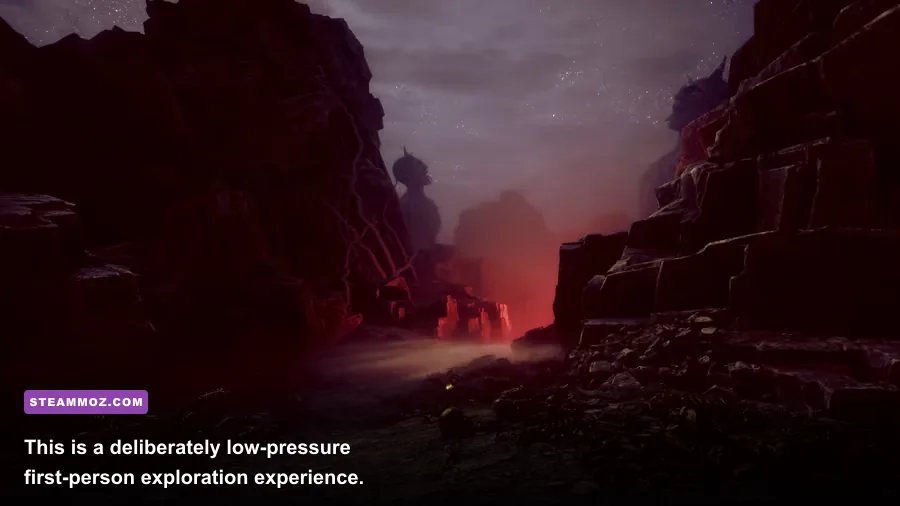
Yes, but only with the right expectations. Picturae remains an appealing small-scale walking simulator because its best quality is also its clearest identity: it is content to let a landscape be the event. The absence of combat and progression isn't a design failure when you're specifically looking for a quiet, scenic experience. It becomes a failure only if you buy it expecting a conventional adventure.
Its age is visible in the asset quality, animation, and environmental repetition. The journey doesn't evolve mechanically, and the limited interaction means there isn't much to discuss in terms of strategy. This is not a hidden RPG, a puzzle box, or a horror game waiting to ambush you with a second act. It is a focused walk with a reflective mood.
My recommendation in 2026 is straightforward: pick it up at a discount if you enjoy short atmospheric games, landscape photography, or meditative first-person exploration. Play with headphones, avoid treating the destination as the only reward, and give the game one uninterrupted sitting. If you need challenge, story density, or a reason to replay, spend your money elsewhere.
Final verdict: 7/10 for the right audience, 4/10 for everyone expecting a full adventure. Drizzlepath: Picturae hasn't become a richer game with age, but it doesn't need to. Its value is in a specific, modest experience that remains easy to access and pleasantly undemanding. For a quiet evening on PC, it still earns a cautious recommendation.
For more atmosphere-first recommendations, compare its compact approach with our Eternal Destiny review. And for the developer's broader catalog, visit Tonguç Bodur's official Steam developer page.