
The best First Strike: Classic starting build is simple: expand once or twice, research defensive infrastructure, build a compact launch network, and keep your nuclear force hidden until an opponent commits first. Beginners lose by grabbing too much territory, spending every resource on missiles, or treating the game like a conventional RTS. First Strike: Classic rewards deterrence, survivability, and disciplined timing far more than constant aggression.
This guide focuses on the original First Strike: Classic ruleset, not a hero-based progression system. There are no character levels, equipment rolls, or traditional unit production queues to memorize. Your “build” is an opening sequence: which action you take first, how quickly you expand, what you research, and when you switch from growth to deterrence. The plan below gives new players a reliable foundation while leaving enough flexibility for the selected nuclear power and map position.
Before jumping in, check the official Steam page for First Strike and the Blindflug Studios website for current platform information. If you enjoy compact strategy games with unforgiving openings, our guides to Delta Zeal’s starting build and Dins’ Curse survival tips cover the same kind of early-game decision pressure.
The beginner build in one clean opening

Start with expansion, but stop before the map begins to dictate your strategy. Your first objective is not world domination. It is to establish enough territory for research and launch infrastructure while keeping the number of borders small enough to defend. In most beginner matches, that means one safe expansion followed by a second only when it improves access to a useful region or creates a buffer against a nearby rival.
Once the first expansion is complete, move into research instead of immediately filling every available slot with offensive weapons. Defensive upgrades and improved launch coverage are more valuable at the beginning because a surviving arsenal wins the late game. A missile that is destroyed before launch contributes nothing; a modest arsenal spread across protected locations can still deliver a devastating counterstrike.
| Opening step | Action | Why it works | Stop condition |
|---|---|---|---|
| 1 | Claim one nearby expansion | Improves economic reach without creating a sprawling front | Stop if the next target borders two or more rivals |
| 2 | Research defensive or survivability technology | Keeps launch assets alive during the first exchange | Switch only when a direct attack is clearly imminent |
| 3 | Build a compact arsenal | Shortens reaction time and makes defense manageable | Stop when every important region has coverage |
| 4 | Scout rival activity | Reveals whether an opponent is expanding, arming, or preparing to fire | Do not fire simply because a rival is growing |
| 5 | Hold a reserve | Preserves retaliation after the first incoming strike | Launch only when the strategic gain outweighs deterrence |
The key detail is the transition point. Your opening build ends when you have a defensible footprint, not when every territory on screen belongs to you. New players often continue expanding because the action feels productive. In reality, every new border creates another angle of attack and another location that may require launch coverage.
What to do during the first minute
Pause mentally after each action and read the map. First Strike: Classic is real-time, but it does not reward frantic clicking. Identify the nearest enemy power, the direction of its expansion, and whether your own starting region has a natural defensive shape. A country with one obvious approach can afford a more compact build. A country surrounded by several rivals needs earlier scouting and a larger reserve.
Do not launch a test missile. There is no harmless warning shot in a nuclear strategy game. A launch can expose your position, trigger retaliation, and force neutral powers to treat you as the immediate threat. If you want a more aggressive game after learning the basics, the early pressure ideas in Steamoz’s Dungeons 2 beginner build are useful for understanding when expansion should become pressure instead of greed.

🎮 First Strike: Classic
Looking to experience this game? Grab your digital key directly on our store for $2.99.
View on Steammoz Store →Research priorities and the arsenal you actually need
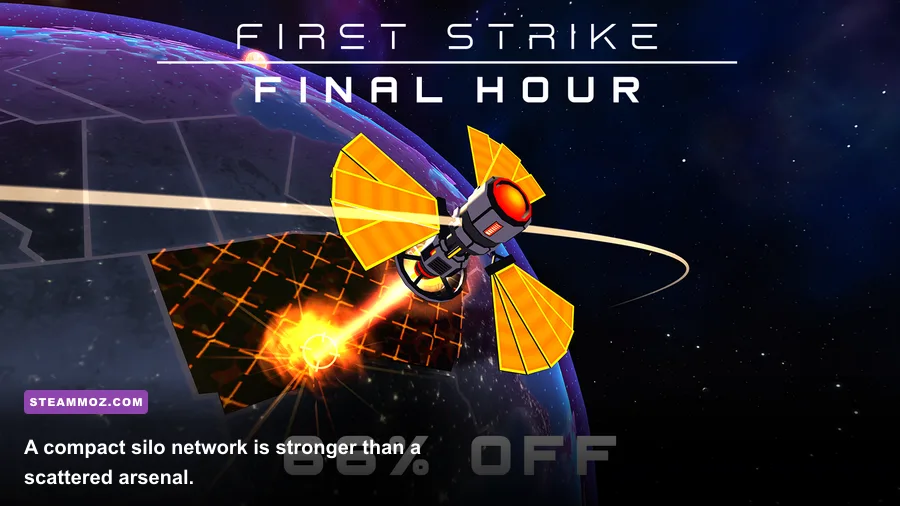
Research should solve a specific weakness. If you cannot survive an opening exchange, prioritize defense and survivability. If your arsenal is safe but cannot reach a rival, improve coverage and mobility. If you are boxed in, expansion technology may be correct—but only long enough to create breathing room. Researching randomly is one of the fastest ways to arrive in the late game with impressive-looking technology and no coherent plan.
Remember how First Strike: Classic differs from a conventional RTS. Your nuclear assets are not interchangeable infantry units. A silo, bomber, or submarine serves a different strategic purpose because survivability and launch position matter as much as explosive output. Static assets are easy to understand and useful for coverage, but predictable. Mobile or concealed platforms are more important once opponents begin targeting your visible infrastructure.
| Asset or priority | Early-game value | Main weakness | Best beginner use |
|---|---|---|---|
| Expansion | High | Creates extra borders and defense obligations | Take one safe region for room and reach |
| Research | Very high | Provides no immediate deterrence if the arsenal is empty | Choose survivability or coverage based on the map |
| Land-based launch assets | High | Can become predictable targets | Use them to cover nearby approaches |
| Bombers | Situational | Require time and positioning to matter | Keep them as flexible response tools |
| Submarines | Very high later | Do not replace early territorial stability | Use them as a second-strike reserve |
| Offensive stockpile | Medium early, high late | Can drain resources needed for defense | Build steadily, never empty the reserve |
The strongest beginner pattern is “coverage before volume.” You want enough launch capability to answer an attack from each relevant direction, then enough reserve to retaliate after losing visible assets. Ten weapons concentrated in one exposed location are less useful than a smaller force distributed across locations that cannot all be removed at once.
That does not mean scattering everything across the map. Excessive dispersion creates its own problem: slow reactions and expensive defensive coverage. Use a triangle or compact ring around your core territory. Keep one important reserve outside the obvious center of your empire. This gives you a practical second-strike option without turning every region into a separate logistics project.
How to manage expansion without becoming the target
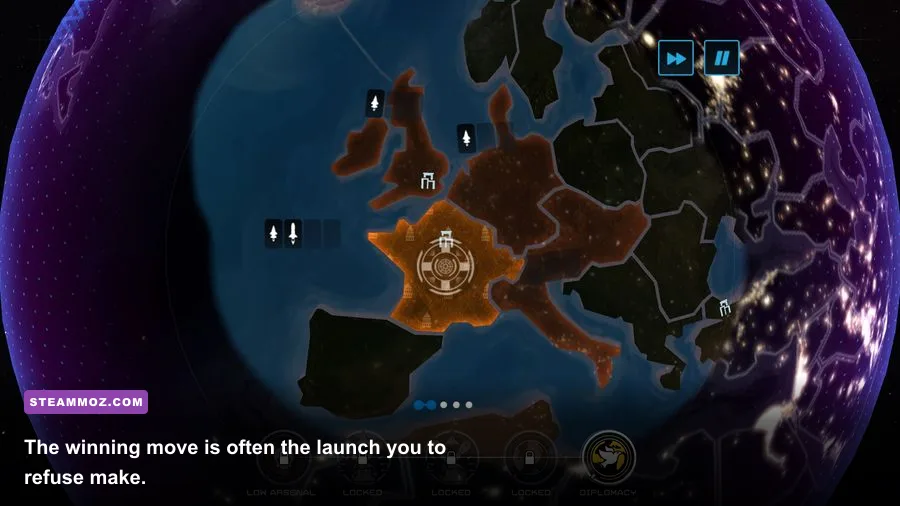
Expansion is the most misunderstood mechanic in First Strike: Classic. Capturing territory feels like progress, but the political signal matters just as much as the economic benefit. A rapid land grab makes your nation look like the match’s long-term winner, encouraging rivals to coordinate against you or launch before you become impossible to contain.
Use three questions before every expansion. Does this region improve launch range or defensive depth? Does it remove a dangerous approach? Can you defend it without pulling assets away from your core? If the answer is no to two of those questions, skip the expansion. A neutral region that looks attractive on the map can become a liability once it stretches your response time.
The two-expansion rule
For a first playthrough, treat two early expansions as the upper limit. The first should improve your economy or create a buffer. The second should be conditional: take it only if the first move has not opened a vulnerable border or if a rival is about to claim the same strategic space. After that, spend time consolidating. Upgrade your coverage, reposition your force, and watch the diplomatic temperature created by your growth.
There is also a timing trick beginners miss. Expand while rivals are busy researching or moving assets, not when they are visibly massing near your border. Expansion consumes attention and often leaves your new territory under-defended for a short period. If an opponent is already pointing weapons at the region, adding more land can give them a larger target instead of giving you safety.
| Map situation | Correct response | Common mistake | Reason |
|---|---|---|---|
| One nearby rival, open rear area | Expand once toward the rear, then consolidate | Push directly into the rival | A buffer is safer than an exposed border |
| Two rivals on opposite sides | Build central coverage and preserve a reserve | Expand toward both rivals | You cannot defend two new fronts cheaply |
| Rival is rapidly expanding | Research, scout, and prepare deterrence | Race expansion blindly | The larger empire is not automatically the stronger one |
| New territory is isolated | Take it only if it provides strategic reach | Claim it for score or appearance | Isolation increases reaction time and defense cost |
This measured approach resembles the town-preservation lessons in Dins’ Curse: protecting the structure that keeps your run alive matters more than grabbing every available reward. In First Strike, that structure is your survivable nuclear network.
Combat rotation: scout, posture, punish
First Strike: Classic does not have a character combat rotation, but it absolutely has a strategic one. Your repeatable sequence is scout, posture, punish. Scout rival expansion and launch preparation. Posture by moving assets, preserving reserves, and keeping enough defensive coverage to make an attack unattractive. Punish only when a rival exposes itself or launches first.
Scout
Watch for three signals: an unusual increase in construction, assets moving away from their core, and a rival suddenly stopping expansion. Any one signal can be harmless. Two together usually mean the opponent is preparing an offensive window. Do not stare exclusively at the largest nation; the closest rival is often the immediate threat because distance and response time matter more than total territory.
Posture
Reposition visible assets so no single strike can erase your entire response. Keep your launch reserve away from the most obvious frontline. If you have bombers or submarines available, treat them as retaliation insurance rather than automatic attack tools. The point is to make the opponent calculate what survives after the first exchange.
Punish
When a rival fires, resist the urge to unload everything at once. First identify what the launch actually threatens. If the strike targets an empty expansion, your best response may be to preserve your force and hit the attacker’s exposed infrastructure later. If it threatens your core or removes your ability to retaliate, answer quickly with enough force to cripple the attacker—not necessarily with every weapon you own.
| Enemy signal | Threat level | Your response | Do not do this |
|---|---|---|---|
| Fast expansion near your border | Medium | Improve coverage and prepare a reserve | Launch just because the border moved |
| Weapons shifting toward your core | High | Disperse assets and ready retaliation | Leave all launch power in one region |
| First nuclear launch detected | Critical | Defend the threatened zone and preserve a second strike | Fire every weapon at the same target |
| Rival loses visible launch assets | Opportunity | Scout for hidden reserves before committing | Assume the rival is disarmed |
Target selection should follow strategic value, not emotional value. Removing a rival’s ability to retaliate is often better than destroying a distant region that merely looks important. At the same time, avoid firing at several powers in sequence unless you are certain you can survive the diplomatic and military response. Nuclear chains escalate quickly, and a “winning” first strike can leave you vulnerable to the next nation’s counterattack.
Late-game adjustments and mistakes that end runs
Once the map settles, stop thinking about the opening build and start thinking about the end state. You need a credible reserve, protected launch options, and enough information to know who is most likely to fire. A late-game nation with fewer territories can still win if its arsenal is intact and its rivals have already spent their weapons fighting one another.
The biggest beginner mistake is firing because the game feels quiet. Silence is valuable. Use quiet periods to research, repair your network, reposition platforms, and watch for overextended powers. Deterrence is doing its job when every opponent knows that attacking you will produce an unacceptable answer.
The second mistake is overbuilding offense. Offensive weapons are satisfying because they produce visible progress, but the stockpile has no value if your command structure collapses before launch. Maintain a simple priority order: core survival, second-strike capability, coverage, then extra offensive volume. This is also why you should avoid spending your final reserve to finish a rival who is already weakened.
The third mistake is confusing territory with victory. First Strike: Classic is a nuclear survival game wrapped in a global map. Territory helps, but it is not a substitute for timing. A small, quiet power with a hidden reserve can outlast a massive empire that has become the first target for everyone else.
| Build profile | Tier | Strength | Weakness | Best situation |
|---|---|---|---|---|
| One expansion, defensive research, compact reserve | S-Tier | Reliable, flexible, and difficult to eliminate early | Requires patience | Standard beginner match |
| Two expansions, balanced coverage, mobile reserve | A-Tier | More reach and better late-game options | Needs careful border management | Safe map with one clear rival |
| Immediate offensive stockpile | B-Tier | Can punish a careless neighbor | Weak defense and poor recovery | Aggressive challenge runs |
| Maximum early expansion | C-Tier | Fast economic growth | Too many fronts and obvious threat profile | Rarely correct for new players |
A repeatable beginner checklist
At the start of each match, identify your nearest rival and claim one useful expansion. Immediately choose research that fixes your biggest vulnerability. Build or position enough assets to cover the core, then place a reserve where a single attack cannot remove it. After that, stop expanding unless the next region improves your defensive shape.
Every few moments, ask: Can I still retaliate if my most visible region disappears? If the answer is no, you are not ready to attack. If the answer is yes, ask a second question: Will this launch remove a rival’s ability to threaten me, or will it simply make everyone else nervous? Fire when the strategic answer is clear, not when your cursor gets impatient.
For more classic strategy reading, Steamoz’s Dungeon Siege retrospective and Desperados III review both examine games where positioning and restraint matter more than constant action. You can also compare the original rules and current release details through the First Strike Steam listing, the developer’s First Strike page, and the official First Strike website.
Follow that opening and First Strike: Classic becomes much less random. Expand enough to breathe, research enough to survive, and keep enough nuclear power hidden to make aggression a terrible bargain. That is the real beginner build—and it wins more games than pressing the launch button first.