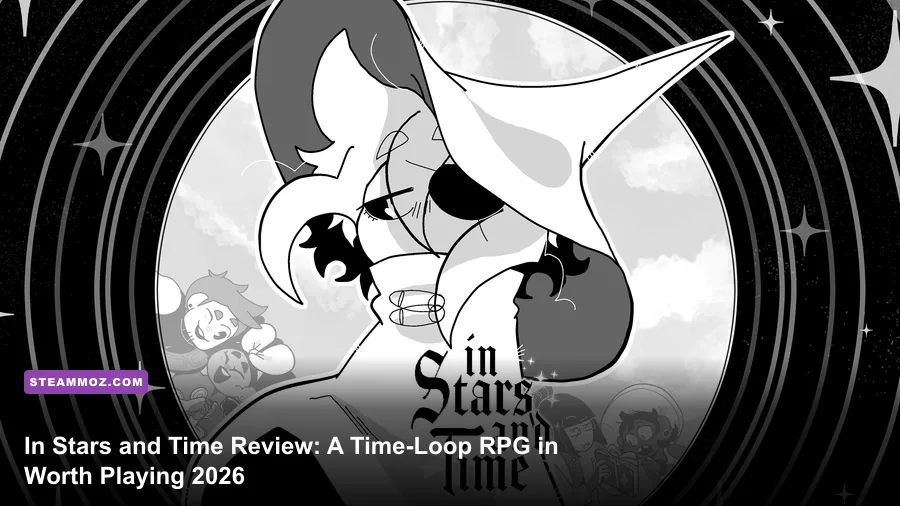
Yes, In Stars and Time is absolutely worth playing in 2026—especially if you want a compact RPG with genuinely clever writing, memorable characters, and a time-loop structure that respects your intelligence. Its pixel art and turn-based battles look deliberately simple, but the game keeps finding new ways to make repetition meaningful. The catch is that you need to enjoy revisiting familiar scenes, reading dialogue carefully, and sitting with uncomfortable emotions. This isn't a power-fantasy RPG; it's a story about fear, identity, sacrifice, and the exhausting cost of trying again.
Developed by insertdisc5 and published by Armor Games Studios, In Stars and Time follows Siffrin, a masked adventurer trapped in a repeating two-day cycle. Siffrin travels with Mirabelle, Isabeau, Odile, and Bonnie toward the House of Change, where the tyrannical King is waiting. The party's mission is straightforward: defeat the King and save the country of Vaugarde. The reality is much messier. Each time Siffrin dies, the clock returns to the start of the journey, while Siffrin alone carries the memories of what happened.

What makes In Stars and Time special in 2026
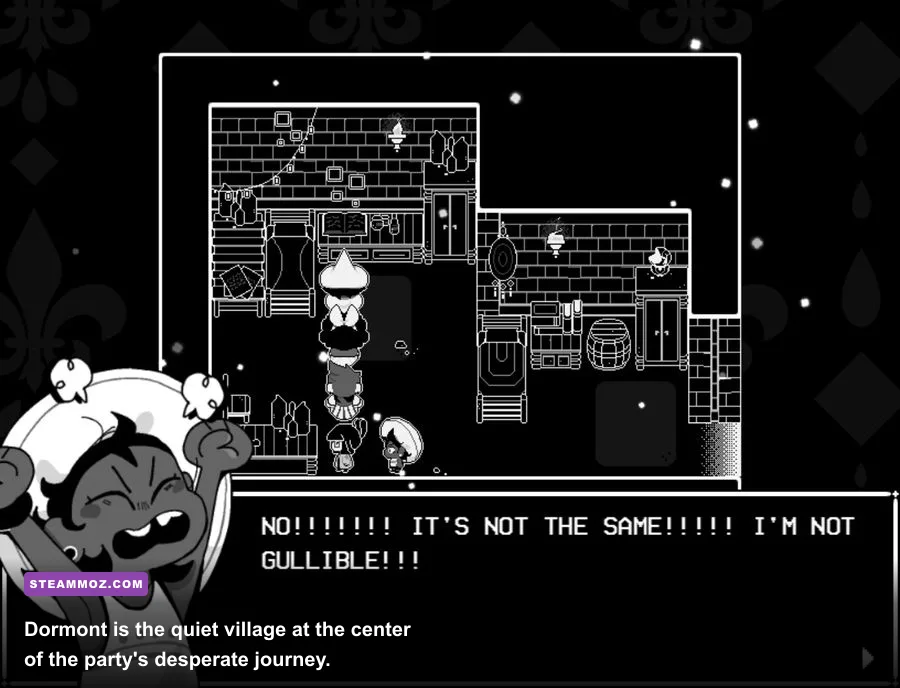
The obvious comparison is Undertale, but In Stars and Time has its own identity. It is less interested in subverting RPG conventions for a joke and more interested in examining what those conventions do to a person. Siffrin can retry a battle, repeat a conversation, and use knowledge from one loop to change the next. That familiar game structure becomes the source of the character's psychological pressure.
The loop is also designed around information rather than grinding. You don't spend hours farming experience so that the King becomes manageable. You learn that a particular enemy reacts badly to one type of attack, discover which item solves a locked-room problem, or realize that a conversation needs to happen before another event can trigger. Progress comes from paying attention.
That design choice keeps the campaign focused. The game usually takes around 15 to 25 hours for a first ending, depending on how much optional dialogue and experimentation you pursue. A completionist run can take longer, particularly if you explore every party interaction and chase the game's alternate outcomes. It is long enough to make the cast feel lived-in without stretching its central mystery past the point of tension.
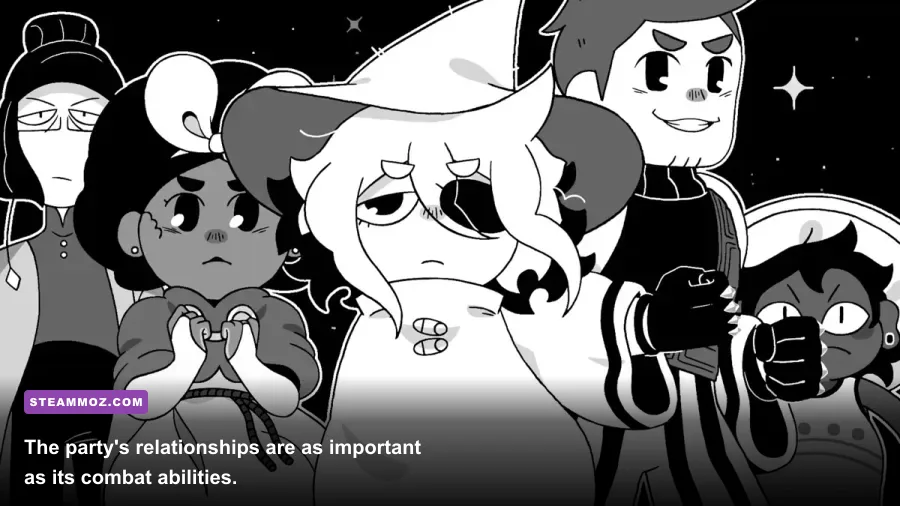
The writing is the real reason to play. Siffrin's humor is defensive and often ridiculous, while Mirabelle's sense of duty, Isabeau's warmth, Odile's skepticism, and Bonnie's blunt energy create a party that feels like a group of people rather than a collection of RPG roles. Their camp conversations and repeated reactions slowly reveal how differently each character understands the mission.
For more narrative-focused recommendations, Steamoz's Borderlands 2: Commander Lilith review covers another expansion that succeeds largely because of its character work, though In Stars and Time is much more intimate and deliberately paced.
🎮 In Stars And Time
Looking to experience this game? Grab your digital key directly on our store for $11.99.
View on Steammoz Store →Story, characters, and the emotional cost of repetition

In Stars and Time's story is built on a clever contradiction: the player becomes more capable with every loop, but Siffrin becomes less able to experience the journey normally. A first visit to Dormont can feel mysterious and charming. The tenth visit can feel like work. The game understands that shift and makes it part of the narrative instead of pretending repetition is always fun.
Siffrin is an unusually strong protagonist because the character's knowledge is both a superpower and a burden. You know which doors matter, which encounters are dangerous, and which conversations can be skipped. Siffrin knows those things too, but the rest of the party doesn't. That gap creates some of the game's best scenes, particularly when Siffrin tries to control the group's route without explaining why.
The party members avoid the common RPG problem where everyone exists only to praise the hero. Mirabelle is disciplined and conscious of her responsibility. Isabeau brings a more relaxed, supportive energy, but that doesn't make him shallow. Odile frequently challenges assumptions instead of accepting the party's first plan. Bonnie is younger, impatient, and capable of cutting through a conversation with one brutally direct sentence.
There are also strong themes around cultural identity and the way people survive political violence. Vaugarde is not just a colorful backdrop for a boss fight. The country's history affects how characters talk about the King, the Change, and the people who are expected to fix everything. The game trusts players to notice contradictions and read between the lines.
That trust comes with a warning. The tone can swing from silly item descriptions and cartoonish reactions to grief, panic, and deeply uncomfortable revelations. The transition is intentional, but players looking for a consistently cozy adventure may find the darker material surprising. Check the game's official Steam page for the current content notes before buying.
Combat is simple on paper, smarter in practice
Combat uses a readable type-based system rather than a sprawling collection of weapons and passive bonuses. Enemies are associated with attack types, and choosing the effective response matters more than selecting the most expensive-looking ability. The result is approachable, but not mindless. You still need to watch enemy behavior, manage resources, and decide when to defend rather than force damage.
The party's identity matters here. Siffrin's dagger attacks, Mirabelle's sword techniques, Isabeau's spear-and-shield approach, Odile's ranged support, and Bonnie's axe attacks give each character a distinct role even though the game doesn't drown you in a traditional skill-tree interface. You aren't constantly replacing gear with marginally stronger versions. You are learning how the team functions together.
That makes combat strongest during the first few attempts at an encounter. You identify the enemy's pattern, test an action, and eventually understand the safest sequence. Once you know the correct solution, repeat battles become faster, which is essential in a time-loop RPG. The game generally doesn't demand that you fight every enemy again just to maintain your level.
| Gameplay element | What it does | Why it matters | Best player habit |
|---|---|---|---|
| Attack types | Match party actions to enemy weaknesses | Prevents battles from becoming random damage races | Test enemy reactions early, then use the known counter |
| Party roles | Gives Siffrin, Mirabelle, Isabeau, Odile, and Bonnie different jobs | Makes team composition feel meaningful without complex builds | Rotate actions instead of repeating one favorite attack |
| Items and resources | Provide emergency healing and tactical options | Turn preparation into a way to reduce loop risk | Carry recovery items before entering unfamiliar areas |
| Enemy patterns | Telegraph danger through behavior and presentation | Rewards observation more than grinding | Use the first attempt to gather information |
The limitation is that veteran RPG players may want more mechanical depth. There is no giant equipment spreadsheet, no elaborate materia system, and no dozens-of-hours character optimization project. If your favorite part of an RPG is building a mathematically perfect party, In Stars and Time will feel lightweight. If you prefer battles that reinforce story and pacing, its restraint works beautifully.
How the time loop changes exploration
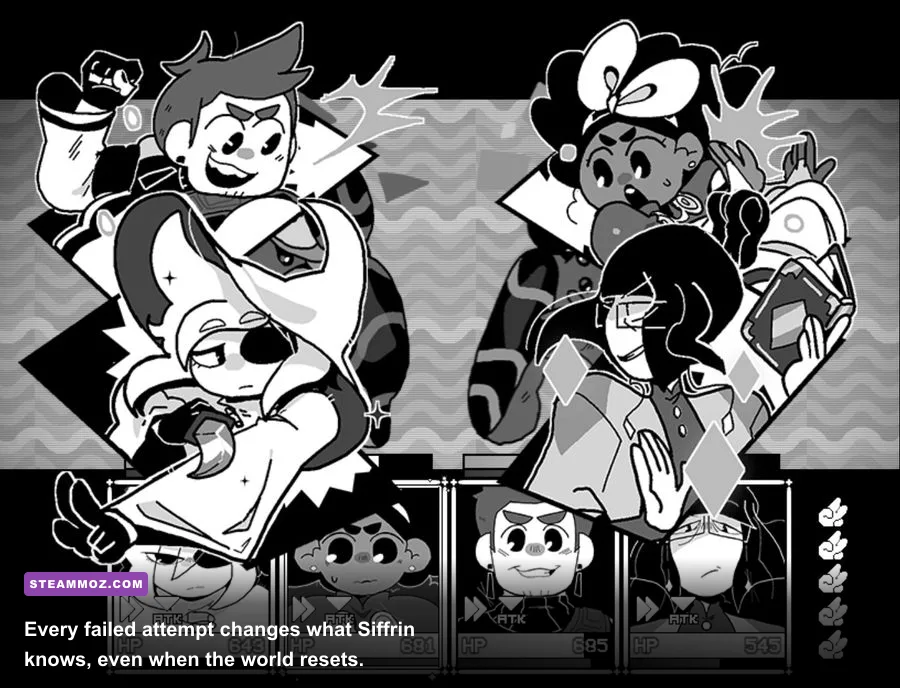
The game's loop is more than a reset button. It turns knowledge into a form of progression. A room that once looked like a dead end can become useful after you remember an interaction. A suspicious character's comment may reveal what to investigate next. The correct solution often comes from combining information acquired in different parts of the cycle.
The House of Change is especially effective because its structure makes you question what is fixed and what can be manipulated. At first, the location feels like a conventional RPG dungeon: strange rooms, obstacles, enemies, and a route toward the King. After several loops, the same spaces become a mental map. You stop asking, “Where should I go?” and start asking, “What changed since the last attempt?”
That is also where the game can test your patience. Some progression gates are deliberately opaque, and the solution may involve using a key item or conversation clue in a way that isn't immediately obvious. The game usually provides enough information to solve these moments, but not always in the order you want. If you're stuck, revisit earlier locations, speak to party members, and inspect objects that seemed irrelevant during the previous loop.
Don't treat every loop as a failed run. A loop where you discover one enemy weakness, learn a route through the House, or trigger a new party conversation is still progress. The most productive mindset is closer to investigative work than traditional dungeon crawling. Take notes if you need to. Remembering a detail from a previous scene is often more valuable than finding a stronger item.
Performance, platforms, and Steam Deck play
In Stars and Time is an easy game to run by modern standards. Its pixel-art presentation, compact environments, and modest effects mean that frame-rate concerns rarely define the experience. On a contemporary Windows PC, even budget hardware should handle it comfortably. The more important question is input feel and display scaling, especially on handhelds.
The Steam release is particularly well suited to Steam Deck. The game's short scenes, low hardware demand, and ability to play in brief sessions fit handheld use perfectly. Text readability is generally good, though players who struggle with small pixel fonts may prefer a larger screen or increased system scaling. Battery life is also far less of a concern than it would be with a 3D action RPG.
| Platform profile | Recommended setup | Expected experience | Who should use it |
|---|---|---|---|
| Budget Windows PC | Steam-listed minimum hardware, current graphics driver | Stable performance with minimal adjustment | Players using older laptops or office PCs |
| Modern desktop | Native display resolution, default settings | Comfortable full-screen play with fast loading | Players who want the cleanest large-screen presentation |
| Steam Deck | Default profile, 60 FPS cap, preferred scaling mode | Excellent handheld fit and low battery pressure | Players who like reading-heavy games on the go |
| Older integrated graphics | Windowed or lower resolution if scaling feels soft | Usually playable; visual sharpness matters more than raw FPS | Players on aging notebooks |
Because this isn't a demanding game, don't waste time chasing unnecessary performance tweaks. If you run into crashes or inconsistent input, start with the basics: verify the files, update the graphics driver, disable overlays, and test borderless versus full-screen mode. Steamoz's PC crash and FPS fixes are useful for that general troubleshooting process.
The official system requirements are modest, but compatibility can still vary with unusual display scaling or controller software. The developer's official site is the best place to check current support information, while the Steam news feed is useful for updates and patch notes.
Who should play it—and who probably shouldn't
You should play In Stars and Time if you enjoy character-driven RPGs, mystery-box storytelling, and games where remembering a line of dialogue can matter more than acquiring a legendary sword. Fans of Undertale, OneShot, Omori, Outer Wilds, and other discovery-focused games will likely recognize its appeal, although its structure and emotional register are distinct.
You should also play it if repetition usually frustrates you but you're willing to see repetition used as a storytelling tool. The game doesn't erase the annoyance completely. Some repeated conversations and travel sequences can drag, especially if you already know the optimal route. Still, the developers understand that problem and make most loops shorter once you know what you're doing.
You may want to skip it if you need fast combat, open-ended exploration, voice acting throughout, or a huge loot-driven progression system. The campaign is linear beneath its looping structure. You have freedom to experiment, but the game is ultimately guiding you toward specific discoveries and emotional beats.
There are also moments where the writing's theatrical style will either land perfectly or bounce off you. Characters express themselves with dramatic reactions, strange jokes, and exaggerated sprite animations. That presentation is part of the game's charm, but it can feel overly precious if you're looking for naturalistic dialogue.
Final verdict: a must-play indie RPG with one important caveat
In Stars and Time is worth playing in 2026, and its age has done nothing to weaken its central idea. The combination of time-loop logic, sharp character writing, and manageable turn-based combat still feels unusually confident. It understands that repetition can be funny, exhausting, comforting, and frightening depending on context. More importantly, it makes those changing feelings the point.
Its weaknesses are real. Combat could offer more depth, a few progression solutions are less obvious than they should be, and repeated scenes may test players who don't enjoy rereading dialogue. But those issues don't undermine the experience. They are trade-offs made in service of a focused story, not signs of a game that ran out of ideas.
My recommendation is simple: buy it if you're in the mood for a story-first RPG that rewards patience and attention. Give it a quiet evening, use headphones, and resist the urge to rush through familiar dialogue. The best moments don't arrive because you leveled up. They arrive because you finally understand what a character was trying to say several loops ago.
Steamoz verdict: 9/10. In Stars and Time remains one of the strongest time-loop RPGs available on PC and Steam Deck. It isn't a game about escaping repetition as quickly as possible. It's about discovering why the loop exists, what it costs to keep fighting, and whether saving the world is enough to save the person doing it.