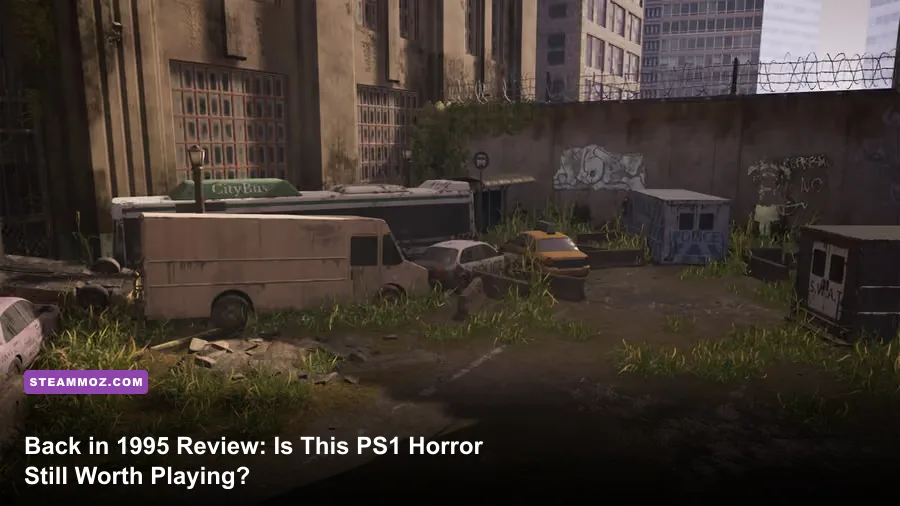
Yes, but only if you want a short, rough-edged PS1-style survival-horror experiment rather than a polished modern remake. In 2026, Back in 1995 is worth playing for its eerie atmosphere, fixed-camera tension, strange story, and convincing low-resolution presentation. It isn't worth buying for deep combat, generous checkpoints, modern controls, or a lengthy campaign. Treat it as a compact retro horror curiosity—ideally during a dark evening—and its awkwardness starts to feel like part of the appeal.
Released in 2016 by Throw the War Switch, Back in 1995 deliberately recreates the look and feel of late-1990s console survival horror. You play as Kent, a father searching for his missing daughter after a mysterious disaster has emptied and distorted the city around him. The game borrows the visual language of Resident Evil, Silent Hill, and low-budget PlayStation horror, but it never tries to hide its small scale. This is an indie homage, not a lost Konami blockbuster.
What Back in 1995 actually feels like
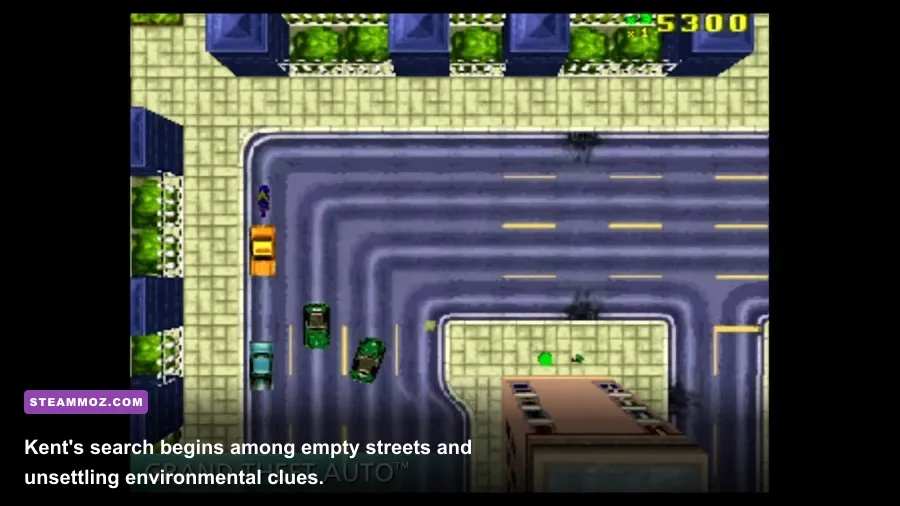
The first thing you'll notice is how aggressively the game commits to its period style. Characters are built from chunky polygons, textures are muddy by design, and rooms are framed through fixed camera angles that often conceal more than they reveal. The result isn't conventionally beautiful, but it creates a useful visual distance. Corridors become threatening because you can't fully read the space beyond the camera's edge.
Kent's journey is built around exploration, item collection, environmental puzzles, and combat against hostile creatures. You move between abandoned urban spaces, investigate documents and objects, unlock blocked routes, and gradually assemble an explanation for the catastrophe. The city feels less like a seamless world and more like a sequence of connected nightmare rooms. That limitation works surprisingly well: each new location has the theatrical quality of a stage set waiting to spring its next surprise.
The game also has a deliberately unusual relationship with memory and presentation. Its title refers to 1995, but the setting isn't simply a realistic flashback. The story uses technological decay, visual glitches, and dislocated spaces to make the player question what is happening. Don't expect a neatly explained science-fiction mystery. Back in 1995 is more interested in mood and implication than in delivering a perfectly mapped timeline.
| Element | What the game delivers | 2026 verdict |
|---|---|---|
| Campaign length | Compact, focused survival-horror campaign | Good for a weekend; thin for a full-price purchase |
| Perspective | Fixed camera angles with third-person movement | Authentic, but occasionally frustrating |
| Combat | Simple firearm-based encounters and resource management | Functional rather than deep |
| Puzzles | Item hunts, environmental clues, and classic locked-route progression | Best when explored patiently |
| Visual style | Low-poly models, low-resolution textures, CRT-era effects | Still distinctive on modern displays |

🎮 Back in 1995
Looking to experience this game? Grab your digital key directly on our store for $2.49.
View on Steammoz Store →Does the PS1 presentation still work?
More often than not, yes. The visual limitations are doing real horror work instead of functioning as a novelty filter pasted over modern assets. Distant objects dissolve into darkness, character faces are too angular to read naturally, and environmental details become suggestive rather than explicit. A shape at the end of a hall might be a monster, a prop, or a texture seam. That uncertainty is far more effective than the clean visibility offered by most modern horror games.
The fixed camera is equally important. Modern players may instinctively want free control, but the old-school framing lets the developer control what enters your field of view. You can hear danger before you see it. You can walk around a corner while the camera stays behind a wall. You can also miss an item because the angle doesn't flatter the room. That last point is a genuine weakness, but the tension created by the framing is real.
There are limits. The pixelation can make small interactive objects difficult to identify, especially when several background textures use similar colors. Some visual effects that looked atmospheric on a CRT feel harsh on a modern monitor. If you dislike intentional texture warping, abrupt camera changes, or models that resemble early 3D prototypes, the style may feel less like horror and more like visual archaeology.
Recommended display setup
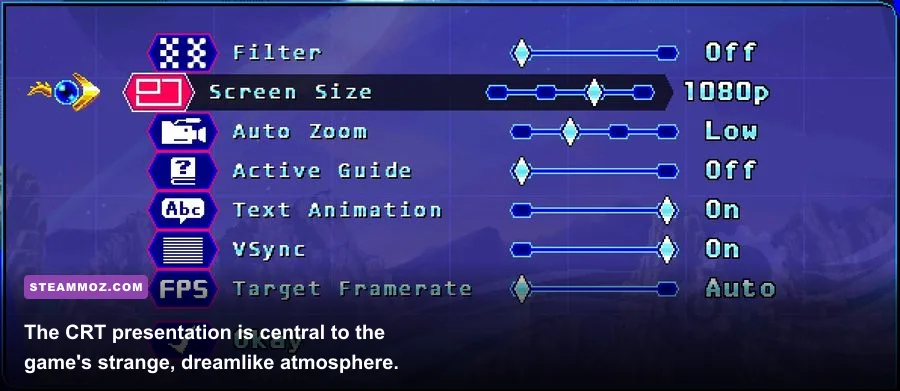
Start with the native presentation before adding modern smoothing. A high-resolution window, integer-style scaling where available, and a moderate display brightness preserve the game's contrast without turning every dark room into a black rectangle. If the CRT filter is available in your build and you find it too heavy, disable it before abandoning the game; the underlying low-poly art still carries much of the atmosphere.
| Setting or choice | Recommended value | Performance impact | Visual note |
|---|---|---|---|
| Resolution | Native monitor resolution or 1080p | Low on modern PCs | Keeps menus and text readable |
| VSync | On if camera movement tears | Minimal | Helps preserve the deliberate, cinematic framing |
| CRT effect | On for authenticity; off for clarity | Usually negligible | Scanlines can obscure small clues |
| Window mode | Borderless or windowed during troubleshooting | Minimal | Useful if fullscreen scaling behaves badly |
| Display brightness | Slightly above default | None | Reveals environmental details without erasing darkness |
Players who enjoy older visual design should also look at Steamoz's PC fixes for Bottle Pilgrim. The games are very different, but both reward patience when a small indie release doesn't behave perfectly on current hardware.
Combat is tense, but not especially sophisticated
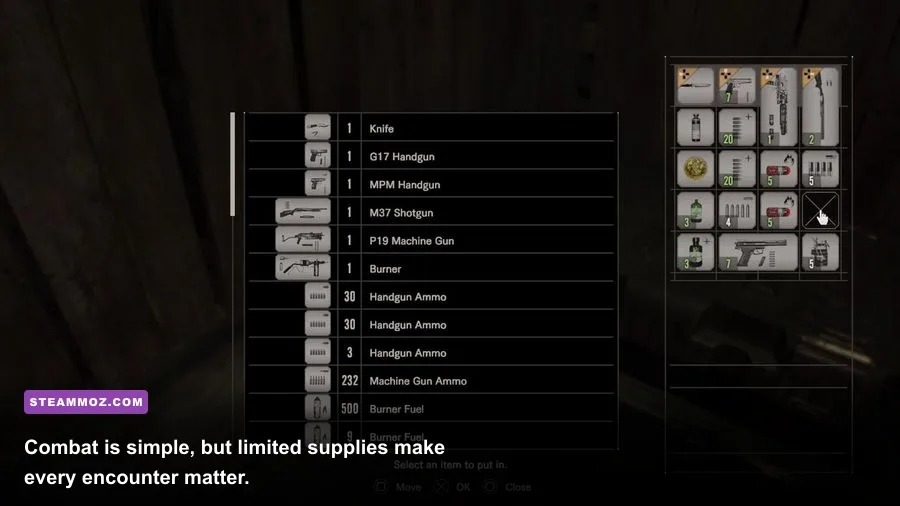
Back in 1995 understands the classic survival-horror rule: a weapon doesn't make you powerful when ammunition and space are limited. Kent's firearms are tools for creating an escape route, not an invitation to clear every room. The combat system is straightforward, with aiming, firing, movement, and item management carrying most of the pressure. There is no elaborate skill tree, weapon crafting loop, damage build, or RPG progression to distract from the fundamentals.
That simplicity can be refreshing. You aren't comparing critical-hit percentages or upgrading a dozen attachments. You are deciding whether a hostile creature is worth the ammunition, whether you can slip past it, and whether the next room contains a safer place to recover. The fixed camera makes those decisions less reliable than they would be in a modern over-the-shoulder game. An enemy can disappear behind the frame, and repositioning Kent may change the camera angle at the worst possible moment.
The key is to stop treating combat like an action game. Fire only when an enemy blocks a necessary route or forces you into a bad position. Create distance before aiming whenever possible. If a room contains several threats, don't panic-fire at the first target you see; use the available space, learn the camera transition, and look for the exit. A missed shot is costly not because the ammunition economy is a complex numerical system, but because every mistake makes the next exploration section more stressful.
| Combat situation | Main danger | Best response | Why it works |
|---|---|---|---|
| Single enemy in a wide room | Wasting ammunition | Create distance, aim carefully, then fire | Gives the camera time to settle |
| Enemy near a doorway | Camera shift during escape | Back away before interacting with the exit | Prevents a surprise collision during transition |
| Multiple threats | Locking yourself into a bad angle | Move toward open space before shooting | Improves visibility and preserves retreat options |
| Unfamiliar room | Spending supplies too early | Scout the layout before committing to combat | Lets you identify the objective and escape route |
| Low-health exploration | One mistake ending the run | Revisit safe areas and avoid optional encounters | Preserves healing items for forced fights |
This is the point where expectations matter most. If you want the crunchy, responsive gunplay of Resident Evil 4, or the elaborate enemy design of Signalis, you'll find Back in 1995 underpowered. If you enjoy the vulnerability of early survival horror, the stiffness becomes part of the challenge. Steamoz's Dead Island hidden-reward guide covers a much more action-heavy game, and that contrast makes Back in 1995's restraint especially obvious.
Are the puzzles and story worth your time?
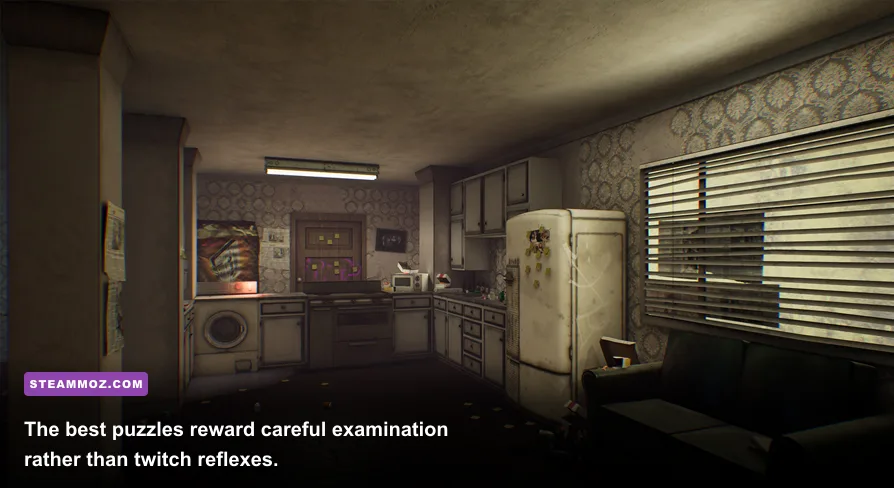
The puzzles are closer to classic item-routing than modern environmental logic. You'll search rooms for usable objects, inspect clues, and return to previously seen areas after discovering what a locked path requires. The intended rhythm is deliberate: explore, notice something strange, find an item, test it against the environment, and gradually open the map. Sprinting from objective marker to objective marker would miss the point, because the game expects you to remember places and read the surrounding fiction.
Some solutions feel satisfying because the environment has already shown you the answer. Others can feel arbitrary, particularly when the low-resolution presentation makes an important object blend into a wall or desk. Keep an eye on every document, sign, computer, and unusual piece of scenery. If the game lets you inspect something, assume it may matter later—even if the immediate description sounds like flavor text.
Kent is the strongest reason to stay with the story. His search for his daughter gives the surreal locations an emotional anchor, while the disaster's unexplained nature creates a constant sense of unease. The narrative is intentionally fragmented and occasionally cryptic. You may finish with a clearer emotional impression than a clean explanation. That won't work for everyone, but it suits a game built around distorted memories, empty places, and unreliable visual information.
Don't expect a huge cast or a branching relationship system. This isn't a character-driven RPG. The storytelling comes through the spaces Kent visits, the objects he finds, and the way the world refuses to behave like a normal city. Fans of games that explain every mystery through audio logs may find it underwritten; fans of ambiguous horror will likely appreciate the restraint.
How does it run on a 2026 PC?
Hardware isn't the obstacle here. The game is built around deliberately simple 3D assets, so any contemporary gaming PC should have ample headroom at standard resolutions. The more relevant issues are compatibility, display scaling, controller behavior, and whether you prefer the original rough presentation. Don't buy a modern graphics card expecting a dramatic visual upgrade: performance can improve, but the game's art direction remains firmly rooted in the PlayStation era.
Before playing, update your GPU driver, test both keyboard-and-mouse and controller input, and keep a manual save whenever the game permits it. If fullscreen introduces stretching or unusual brightness, borderless windowed mode is a sensible first fix. Players accustomed to modern autosave systems should also avoid assuming that every checkpoint is forgiving. Classic survival horror is at its most unpleasant when a technical issue and a missed save combine.
| Component | Minimum practical target | Recommended in 2026 | Pro-tuned profile |
|---|---|---|---|
| CPU | Any recent dual-core processor | Modern Core i3 or Ryzen 3 | Not CPU-limited on current systems |
| GPU | Integrated graphics from the last several years | Any modern integrated or entry-level GPU | Use native resolution without concern |
| Memory | 4 GB RAM | 8 GB RAM | Close background launchers to reduce troubleshooting variables |
| Storage | Several hundred megabytes free | SSD installation | Improves launch and loading consistency |
| Display | 720p-capable monitor | 1080p monitor with integer-friendly scaling | Disable aggressive sharpening and preserve dark contrast |
For another perspective on playing older-looking PC releases today, see Steamoz's Construction Simulator 2015 review. The technical demands are obviously different, but the same question applies: is the underlying experience strong enough to overcome age-related friction?
Back in 1995 versus modern retro horror
Back in 1995 sits in an interesting middle ground. It has more personality than a straight asset-flip homage, but less refinement than later retro-inspired standouts. Games such as Signalis modernize inventory design, storytelling, and combat while preserving the genre's pressure. Tormented Souls offers a more lavish take on fixed cameras and mansion exploration. Back in 1995 is smaller, stranger, and more openly interested in reproducing the limitations themselves.
That makes it a poor first recommendation for someone who wants to discover survival horror. Start with a better-polished classic or a modern tribute if you need clear controls and reliable signposting. But if you've already played the major names and want something that feels like an obscure rental found on a dusty shelf, this game has exactly that energy.
| Player type | Recommendation | Reason |
|---|---|---|
| PS1 survival-horror fan | Buy on sale | The fixed cameras, low-poly art, and resource pressure land well |
| Modern action-horror player | Try first, don't blind-buy | Combat and movement may feel too stiff |
| Story-focused horror fan | Worth a short playthrough | Kent's search and the surreal mystery provide a memorable hook |
| Completionist | Only if inexpensive | Limited systems and a compact campaign offer little long-term grind |
| Retro-game preservation fan | Recommended | It captures a specific low-budget 1990s horror mood effectively |
Verdict: should you play Back in 1995 in 2026?
Back in 1995 is worth playing in 2026, but its audience is specific. It succeeds as a moody, compact homage that understands why fixed cameras, limited visibility, awkward movement, and sparse storytelling made early survival horror so memorable. Kent's search gives the oddity a human center, while the low-resolution city remains more atmospheric than its simple technology suggests.
It also carries every weakness you'd expect from a small retro-styled release. Combat won't impress you, puzzle logic occasionally wobbles, the camera can hide useful information, and the presentation may look abrasive on a modern monitor. The campaign's brevity means the experience works best when priced like an indie curiosity rather than a major horror release.
My recommendation is simple: pick it up during a sale, play with a controller, use headphones, and resist the urge to “fix” the visuals before you've experienced the intended presentation. Give it one focused evening. If the idea of a lost 1995 survival-horror game sounds more exciting than another technically flawless modern thriller, Back in 1995 still has a creepy little signal worth tuning into.
You can check the current edition and platform details on the official Steam page, learn more from Throw the War Switch's developer page, and compare its retro-horror approach with Steamoz's Blackguards 2 campaign advice if you enjoy games that demand careful planning rather than constant action.