
If Absolute Drift Zen Edition has you chasing cleaner lines, longer combos, and that perfect handbrake snap, start with Art of Rally, Inertial Drift, and CarX Drift Racing Online. Art of Rally is the closest match for stylish, skill-first driving; Inertial Drift is the best pure control experiment; and CarX is the deeper online sandbox. Drift21 rounds out the list if you want to work on the car as much as you drive it.
Absolute Drift remains special because it strips drifting down to its essentials. There are no weapon pickups, no bloated open-world map, and no upgrade tree trying to distract you. You steer, modulate throttle, use the handbrake, and learn how weight transfers through a corner. The Zen Edition also includes the original game and the Enter the Dragon expansion, giving you more challenges without changing that minimalist rhythm.
The games below keep that same “one more run” energy, but each pushes the idea in a different direction. Some add rally stages, some introduce twin-stick steering, and others bring in tuning, online lobbies, or hands-on workshop systems.
Which Absolute Drift alternatives are actually worth playing?
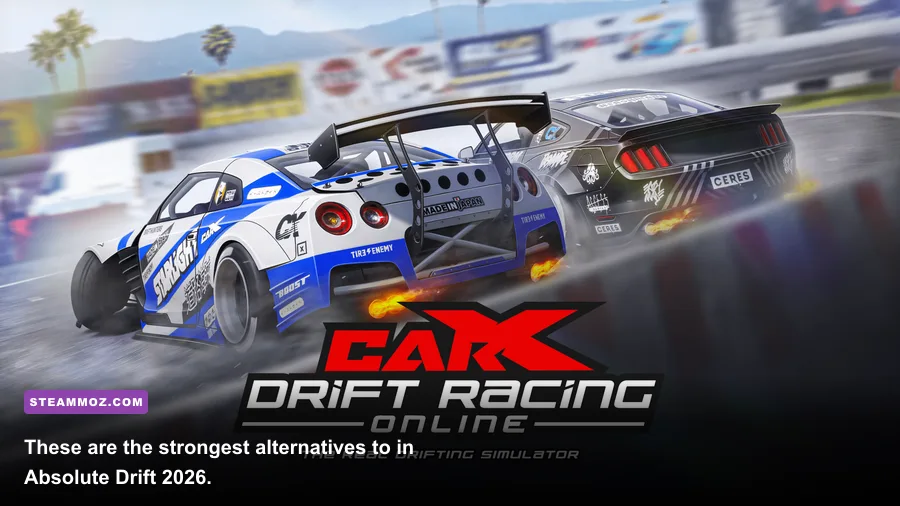
The right choice depends on what you love about Absolute Drift. If it’s the elegant presentation and precise score attack, Art of Rally should be your first download. If the unusual steering model fascinates you, Inertial Drift is the most rewarding follow-up. If you want real-time competition and dozens of setup options, CarX Drift Racing Online has the most runway.
| Game | Best For | Driving Feel | Progression Depth |
|---|---|---|---|
| Art of Rally | Stylish solo rally and score chasing | Accessible, momentum-focused | Medium |
| Inertial Drift | Mastering unusual drift controls | Twin-stick, technical | Medium |
| CarX Drift Racing Online | Online battles and tuning | Loose, customizable, physics-heavy | High |
| Drift21 | Workshop building and realistic practice | Simulation-leaning | High |
| Absolute Drift Zen Edition | Pure minimalist score attack | Clean, deliberate, arcade-focused | Low to medium |
All four alternatives run well on modern gaming PCs, but their priorities are very different. Absolute Drift is built around immediate repetition. CarX and Drift21 ask you to spend more time in menus, while Art of Rally and Inertial Drift offer clearer solo campaigns. For more practical PC optimization advice, Steamoz’s guide to checking whether your system can handle a PC game is a useful reference.

🎮 Absolute Drift Zen Edition
Looking to experience this game? Grab your digital key directly on our store for $7.49.
View on Steammoz Store →Art of Rally is the closest match for Absolute Drift fans

Art of Rally on Steam understands the same fundamental truth as Absolute Drift: a good corner should feel like a small piece of music. You enter wide, settle the car, rotate it with a lift or handbrake tap, and get back onto the throttle before the exit disappears. The camera is higher and the stages are longer, but the emphasis on rhythm is nearly identical.
Its campaign travels through rally-inspired regions including Finland, Japan, Norway, Germany, Sardinia, and Kenya. Each environment changes the conversation. Finland rewards commitment over fast forest crests, Japan compresses the road into tighter technical sections, and Kenya punishes lazy positioning with rougher surfaces and longer sightlines. You aren't simply drifting for points; you're managing grip, braking distance, and momentum across an entire stage.
Why its handling works
Art of Rally uses a forgiving but expressive model. The handbrake can rotate the car, but leaning on it constantly kills exit speed. The better technique is a brief lift before the corner, a small steering input, and early throttle as the car points toward the next gate. Four-wheel-drive cars feel more stable on loose surfaces, while rear-wheel-drive machines demand more throttle discipline.
The game also gives you assists that can quietly change the learning curve. Start with automatic transmission if you’re still learning stage lines, then switch to manual once braking becomes predictable. Turn down steering assist rather than removing every aid at once. Absolute Drift players usually adapt quickly because both games reward smooth inputs instead of frantic corrections.
| Art of Rally Approach | Recommended Setting | Why It Helps | Common Mistake |
|---|---|---|---|
| Learning new stages | Automatic transmission, moderate assist | Lets you focus on braking and lines | Memorizing speed without learning landmarks |
| Improving times | Manual transmission, low assist | Better control over exits and engine braking | Overusing the handbrake |
| Score-focused runs | Manual, minimal assist | Preserves momentum and cleaner slides | Chasing angle instead of exit speed |
| Loose surfaces | Earlier throttle, softer steering | Maintains stability through surface changes | Making sharp corrections mid-slide |
Art of Rally is less about collecting perfect donuts in a small arena and more about carrying a beautiful slide through a complete route. That makes it the best recommendation for players who love Absolute Drift’s visual calm but want a real campaign, varied terrain, and a stronger sense of travel. It’s also a great change of pace after something stressful, much like the focused atmosphere found in Katana ZERO’s sharp, replayable challenge design.
Inertial Drift makes the controls feel completely new

Inertial Drift is the boldest recommendation here because it replaces conventional steering with a twin-stick system. The left stick handles steering, while the right stick controls the rear of the car. Push the right stick to initiate and shape a slide, then use the left stick to place the nose. It feels strange for the first ten minutes and brilliant for the next ten hours.
That separation gives you unusually fine control over angle. In Absolute Drift, the handbrake is a deliberate trigger; in Inertial Drift, the rear stick becomes a constant conversation with the road. You can hold a stable angle while adjusting your direction independently, correct a slide without snapping the front wheels, and link corners with far less panic than a traditional controller layout allows.
How to learn the twin-stick model
Don't immediately chase maximum angle. Start by driving a wide corner with the right stick held only briefly. Once the rear steps out, release it gradually rather than flicking it back to center. The key is learning that the right stick controls attitude, not speed. Throttle still determines whether you maintain the slide or spin.
The campaign introduces rival drivers and increasingly demanding routes, so it has a stronger competitive structure than Absolute Drift’s open-ended challenges. Different cars also have distinct responses to throttle and steering. A light, responsive car is easier for learning transitions, while a heavier setup can feel calmer once you understand how to catch oversteer.
| Skill | Input Focus | What You Should Feel | Training Drill |
|---|---|---|---|
| Initiation | Short right-stick input plus throttle lift | Rear rotates without losing the nose | Repeat the same wide corner at low speed |
| Angle control | Small right-stick corrections | Stable slide rather than violent oscillation | Hold one constant radius for three seconds |
| Transition | Release rear input before changing direction | Weight shifts cleanly across the chassis | Link two opposite corners without handbrake spam |
| Exit speed | Throttle modulation with left-stick placement | Car straightens while still accelerating | Judge success by exit speed, not drift angle |
Inertial Drift is not a clone of Absolute Drift, and that’s exactly why it belongs on this list. It gives you a fresh muscle-memory challenge while preserving the genre’s satisfying loop of practice, failure, and sudden improvement. If you enjoy games where mastery comes from input precision rather than grinding, this is the one to try next.
CarX and Drift21 deliver deeper garages and harder practice
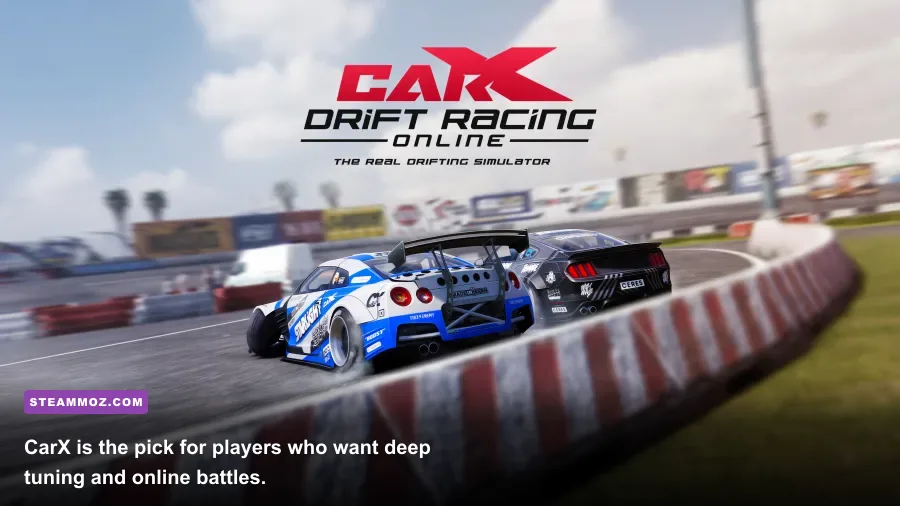
CarX Drift Racing Online is where the clean simplicity of Absolute Drift gives way to tire smoke, tuning menus, and multiplayer chaos. You can change suspension behavior, steering angle, tire grip, wheel fitment, differential settings, and power delivery. The game is far less immediately readable, but it offers a huge amount of room to build a car around your preferred style.
Start with a moderate-power rear-wheel-drive car rather than jumping straight into a high-horsepower monster. A stable setup with lower tire pressure at the rear, a reasonably open differential, and enough steering angle to catch long slides is easier to learn than a setup designed for spectacular smoke. More power doesn't automatically mean better drifting; it often just hides poor throttle control until the car snaps into a spin.
CarX also shines in online rooms. Tandem battles teach you to read another driver’s line, maintain proximity, and avoid braking unpredictably. That’s a very different skill from Absolute Drift’s solo score attack. Expect some rough public lobbies, but private rooms and well-matched runs can be fantastic.

Drift21 takes the workshop side even further. Its appeal is not only sliding through tracks; it’s preparing a car, fitting parts, and understanding how those parts change behavior. The famous Ebisu Circuit gives the game a recognizable home for practice, with layouts designed around sustained drifts, elevation changes, and linked corners.
The important distinction is that Drift21 can punish impatience. A poorly prepared car, worn component, or mismatched setup makes the driving feel wrong before you can blame your technique. Use the workshop to establish a baseline, change one component at a time, and test the result on the same section of track. If you change suspension, tires, and differential together, you’ll never know which adjustment helped.
| Game | First Setup Priority | Best Practice Location | Ideal Player |
|---|---|---|---|
| CarX Drift Racing Online | Power delivery and rear grip | Open practice maps and online rooms | Players chasing tandems and customization |
| Drift21 | Mechanical condition and suspension balance | Ebisu Circuit layouts | Players who enjoy workshop detail |
| Art of Rally | Transmission and driving assists | Finland or Japan stages | Players focused on clean solo runs |
| Inertial Drift | Controller comfort and twin-stick control | Campaign routes and rival battles | Players seeking a new handling model |
These games are also more sensitive to frame pacing and controller latency than Absolute Drift’s simple presentation suggests. If you’re fighting inconsistent performance, Steamoz’s PC fixes for crashes and low FPS cover the usual Windows-side checks, while the Hunt: Showdown performance guide explains why stable frame pacing matters more than a flashy average FPS number.
Best settings and progression plan for drift-game beginners
Don’t approach these games by trying to master every mechanic immediately. Build a repeatable practice loop. Pick one car, one route, and one measurable goal: hold a slide for three seconds, exit a corner above a target speed, or complete a lap without a correction. Absolute Drift teaches this perfectly through its small arenas, and the same discipline transfers to every game here.
A practical first-week plan
Session one: learn throttle control. Drive without chasing angle and focus on keeping the car balanced. If you spin, note whether you added throttle too early or turned too sharply.
Session two: practice initiation. Use the handbrake in Absolute Drift and Art of Rally, the rear stick in Inertial Drift, and a brief throttle lift or handbrake tap in CarX. The goal is repeatability, not drama.
Session three: work on transitions. A transition starts before the current corner ends. Reduce steering load, let the chassis move, then guide the car into the next direction. Waiting until the car is fully straight makes the next slide late and ugly.
Session four: tune only one variable. In CarX or Drift21, change rear grip, steering angle, or differential behavior, then return to the same corner. Keep the setup that improves consistency, not the one that creates the biggest smoke cloud.
Session five: chase a clean run. Turn off distractions, use a stable camera, and prioritize exits. A shorter drift with strong acceleration will usually beat a huge angle that kills momentum.
| Performance Target | Recommended Profile | FPS Priority | Visual Sacrifice |
|---|---|---|---|
| Low-end gaming laptop | 1080p, medium effects, low shadows | Stable 60 FPS | Smoke density and reflections |
| Mainstream gaming PC | 1080p or 1440p, high textures, medium shadows | Consistent 60–120 FPS | Minimal |
| High-end PC | 1440p or 4K, high textures and effects | Stable refresh-rate target | None unless frame pacing suffers |
| Competitive online play | Lower post-processing and reflections | Lowest possible input latency | Atmospheric effects |
Cap the frame rate to a number your system can hold instead of letting it bounce between peaks and drops. A locked 60 FPS feels dramatically better than an unstable 90 FPS when you’re catching a transition. Keep motion blur off if you need clearer visual references, and lower shadows before textures; texture quality usually affects clarity less than shadow and reflection settings.
For more genre-adjacent recommendations, Steamoz’s Industry Empire review is worth a look if you enjoy systems-driven progression, while its Just Cause 3 locations guide offers a reminder that open-world driving can be fun when exploration, rather than grind, stays in charge.
The final verdict for Absolute Drift players
Choose Art of Rally if you want the closest overall mood: clean visuals, expressive handling, compact challenges, and a soundtrack-friendly flow. Choose Inertial Drift if you want a genuinely new way to control a car and don’t mind spending time retraining your hands. Choose CarX Drift Racing Online for online tandems, extensive customization, and a community-driven sandbox. Pick Drift21 when the garage is as exciting to you as the track.
Absolute Drift Zen Edition still wins for purity. Its top-down arenas, minimalist art direction, and instantly readable scoring make it an ideal five-minute game that can quietly consume an entire evening. The best alternatives don’t replace that feeling; they stretch it in different directions. Art of Rally turns the drift into a road journey, Inertial Drift turns it into a control experiment, and CarX turns it into a social hobby.
If you only play one next, make it Art of Rally. If you want the most interesting long-term skill ceiling, go with Inertial Drift. And if you’re ready to spend more time tuning than you ever did in Absolute Drift, CarX Drift Racing Online is waiting with a smoky rear axle and an entire garage full of bad decisions.