
Yes—Katana ZERO is absolutely worth playing in 2026, especially if you want a short, stylish action game that respects your time and rewards obsessive mastery. Its roughly five-hour first campaign is still one of the sharpest blends of one-hit-kill combat, time manipulation, pixel-art presentation, and psychological storytelling on PC. The catch is that it isn't a relaxing action-platformer: every room is a lethal puzzle, the story ends on a deliberately unfinished note, and repeating missions is essential if you want to see the best of what it offers.
Askiisoft's 2019 release has aged unusually well. The controls remain crisp, the soundtrack still hits like a neon-soaked adrenaline rush, and the game's core idea—plan a perfect massacre, then execute it in seconds—hasn't been diluted by years of larger, noisier releases. This is a review for newcomers deciding whether to buy it now, returning players wondering if it holds up, and anyone comparing it with games such as other games worth revisiting.
What Makes Katana ZERO Still Hit So Hard

Katana ZERO gives you one primary rule: almost anything that can kill you dies in one hit, and you usually die in one hit too. The protagonist, known as Subject Zero, carries a katana and can move, jump, roll, throw picked-up objects, deflect bullets, and activate Chronos to slow time. There isn't a conventional health bar, stamina meter, experience system, or equipment screen cluttering up the action. Your improvement is mostly your own.
That simplicity creates a wonderfully clean feedback loop. You enter a room, identify the threat order, use the environment, and try to string together a route that looks effortless. A shotgunner needs to be handled differently from a sword-wielding enemy; a shielded guard changes your angle; a glass bottle can stun an opponent long enough to create an opening; a thrown knife can solve a problem before you ever cross the room. The game is not asking you to grind damage numbers. It's asking you to understand space.
Every stage is divided into compact rooms, so failure rarely feels expensive. Death reloads the current room almost instantly. That matters because Katana ZERO is hard in a precise, readable way rather than a punishing, endurance-test way. You can try the same sequence ten times in a minute, changing one decision each attempt. The best runs become choreography: roll under the bullet, cut the first guard, throw a bottle at the second, deflect the next shot, and reach the exit before the soundtrack has time to breathe.
| Core system | What it does | Why it matters in 2026 |
|---|---|---|
| Katana | Instantly kills most standard enemies and can deflect bullets | Still feels more responsive than many modern action-platformers |
| Chronos | Slows time and helps you read bullets, throws, and enemy movement | Turns reaction-heavy rooms into deliberate tactical puzzles |
| Roll | Moves you through danger and under certain attacks | Provides a reliable escape without adding a stamina resource |
| Throwable objects | Bottles, knives, guns, and other objects create alternate solutions | Keeps rooms from becoming repetitive sword-only exercises |
| Instant restart | Reloads the failed room almost immediately | Removes the friction that usually makes hard games exhausting |
The result is closer to a puzzle game wearing an action game's jacket than to a traditional brawler. If you need character progression, loot, or a long campaign, this stripped-back structure may feel slight. If you enjoy mastering a compact ruleset, it's still exceptional.

🎮 Katana ZERO
Looking to experience this game? Grab your digital key directly on our store for $8.99.
View on Steammoz Store →Combat Review: Every Room Is a Tiny Speedrun
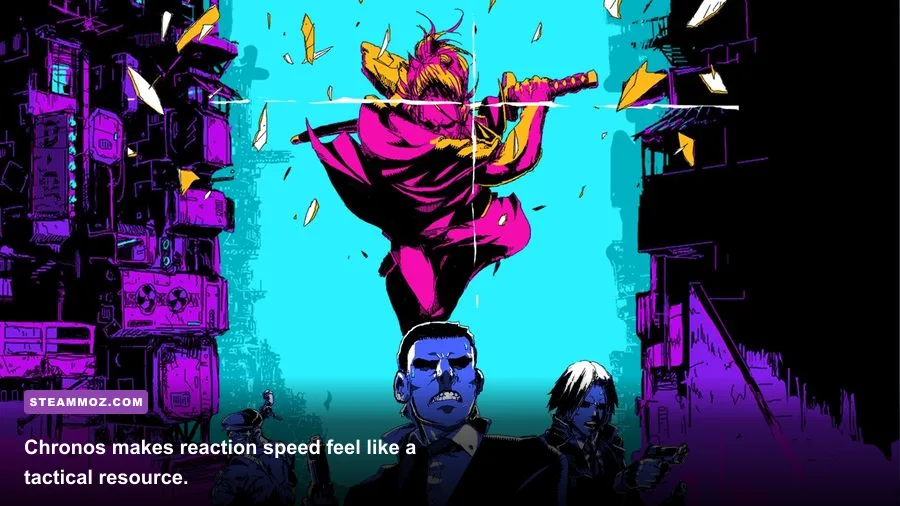
The combat remains Katana ZERO's strongest reason to play. Subject Zero's sword has a generous-feeling horizontal slash, but the game never lets you mindlessly swing your way through a level. Enemies attack from multiple elevations, off-screen angles, doorways, and windows. Firearms are especially dangerous because a single bullet can end a run, yet bullets are also opportunities: a well-timed katana swing sends them back toward the shooter or another target.
Chronos is powerful, but it isn't a free win button. Its time-slowing effect gives you space to read a shotgun blast, line up a deflection, or decide whether to roll behind an enemy. The challenge is learning when not to use it. Burning through your available time manipulation early can leave you exposed when a later room demands a precise bullet counter. The best players treat Chronos as a planning tool, not panic armor.
Enemy telegraphs are clear once you stop trying to play the game like a conventional platformer. A melee guard commits to a swing. A shotgun enemy signals the direction and timing of the blast. A sniper's laser gives you a narrow but readable warning. The real difficulty comes from overlapping threats. You need to solve the order of operations: kill the fast melee attacker, use the corpse or a throwable to interrupt the gunner, then deal with the second shooter before crossing the room.
There are also subtle movement tricks. Rolling can preserve momentum and carry you through a dangerous line of fire, while jumping lets you alter the timing of a slash or avoid low threats. Doors can become weapons, throwable items can stun, and environmental hazards can remove enemies without requiring a direct sword hit. The game rarely explains every possibility because discovering that a room can be solved three different ways is part of the pleasure.
| Threat | Dangerous telegraph | Reliable counter | Common mistake |
|---|---|---|---|
| Melee guard | Visible wind-up before the slash | Strike first, roll past, or attack from above | Backing into another enemy while retreating |
| Shotgun enemy | Weapon aim and short firing window | Use Chronos, deflect the blast, or stun with an object | Jumping without planning the landing |
| Automatic gunner | Longer firing sequence and predictable aim | Break line of sight, then close distance quickly | Trying to outrun bullets in an open corridor |
| Sniper | Laser sight gives away the shot path | Move between cover, roll at the shot, or redirect fire | Standing still after the laser disappears |
| Shielded enemy | Front-facing protection limits sword damage | Attack from behind, use objects, or exploit the room layout | Repeatedly slashing the shield head-on |
The game also records your completed rooms as instant-replay footage, which is a brilliant touch. Watching a messy first clear transform into a smooth run makes the learning curve visible. It gives Katana ZERO a natural second life through speedrun attempts, alternate solutions, and challenge-focused replays. For more games built around efficient routes, Steamoz's Deleveled hidden-rewards guide scratches a similar optimization itch, although its puzzle language is very different.
Story, Characters, and the Ending

Katana ZERO's narrative is much more ambitious than its compact runtime suggests. Subject Zero is a traumatized assassin who works for a handler, relies on the Chronos drug, and experiences time in a fractured, unreliable way. The game uses repeated conversations, abrupt interruptions, and surreal scenes to make you question whether Zero is predicting events, remembering them, or simply losing control of reality.
The story's strongest scenes take place outside combat. The Studio apartment functions as a recurring emotional anchor, while conversations with the Psychiatrist frame Zero's missions as both employment and treatment. The mysterious little girl next door adds warmth without turning the protagonist into a conventional hero. Meanwhile, the Dragon and the Chronos conspiracy gradually suggest that Zero's identity is tied to a much larger conflict than his nightly contracts imply.
Dialogue choices are not cosmetic. You can interrupt people, intimidate them, stay silent, or trigger alternate interactions by being patient. Some choices open different scenes, while others expose optional details about Zero's condition and the world around him. A particularly aggressive approach can make the protagonist feel like the weapon his employers designed, whereas restraint reveals a more conflicted person underneath.
That psychological ambiguity is effective because the game doesn't stop to explain every symbol. It trusts you to connect the red-and-blue imagery, Chronos side effects, the Psychiatrist's questions, and Zero's visions. The downside is equally clear: the campaign concludes with major plot threads unresolved. The ending is a cliffhanger, not a neatly packaged finale. Askiisoft has discussed additional story content, but anyone buying Katana ZERO in 2026 should approach it as a brilliant first chapter rather than a fully closed saga. Check the official Steam page for the current release and content details.
That unfinished feeling won't bother every player. If you primarily want a complete narrative arc, it is a legitimate reservation. If you enjoy games that leave room for interpretation—especially games that turn a character's unreliable perception into a mechanical idea—the story is one of Katana ZERO's most memorable achievements.
Presentation, Performance, and PC Settings

Visually, Katana ZERO still looks fantastic. Its pixel art is dense without becoming muddy, and the neon palette gives each location a distinct mood. Rainy streets, grimy apartments, luxury interiors, and industrial facilities all use color and lighting to reinforce the story's tension. The animation sells weight particularly well: sword swings have a sharp snap, bodies react instantly, and explosions fill the screen without burying the action.
The soundtrack by Ludowic and Bill Kiley is just as important. Dark electronic tracks push you forward during a mission, then give way to quieter pieces when the game wants you to sit with a conversation. Audio cues also help with combat timing. Gunshots, door impacts, and enemy reactions make a successful room clear feel like a piece of music you assembled yourself.
Performance is rarely a concern on modern hardware. The official PC requirements are tiny by current standards: the Steam listing asks for a 2 GHz processor, 1 GB of RAM, around 200 MB of available storage, and a DirectX 10-compatible graphics card. A modern integrated GPU should have no trouble, although very old laptops may still benefit from a lower-resolution configuration. This is the opposite of a demanding game such as the PC titles covered in Steamoz's FPS settings guide.
| Setting or factor | Recommended value | Performance impact | Visual or gameplay note |
|---|---|---|---|
| Resolution | Native display resolution | Low on modern PCs | Pixel art stays sharp when scaling is clean |
| Fullscreen | Fullscreen for consistency | Usually negligible | Can reduce desktop-related stutter on older systems |
| VSync | On if tearing is visible | May add slight input latency | Turn it off if your display has reliable adaptive sync |
| Frame-rate target | Stable 60 FPS or higher | Minimal on supported hardware | Consistency matters more than chasing excessive frames |
| Display scaling | Integer scaling where available | None | Preserves crisp pixel edges at lower resolutions |
The important performance point is stability, not raw benchmark numbers. Katana ZERO's input timing is forgiving enough for ordinary play, but a fluctuating frame rate can still disrupt the rhythm of bullet deflections and rapid room retries. If you encounter stutter, start with fullscreen mode, disable overlays, close browser video tabs, and test VSync. You shouldn't need a graphics downgrade to run this game; troubleshooting should focus on presentation layers and background software first.
How Long Is Katana ZERO in 2026?

A first playthrough usually takes around four to six hours, depending on how often you replay rooms and how much optional dialogue you pursue. That number sounds small next to a 30-hour action game, but it matches the design. Katana ZERO has no filler missions, no inventory management, and no empty map to cross. It delivers its mechanics, escalates them, twists the story, and gets out before the central idea loses its edge.
The real longevity comes after the credits. Hard Mode changes the pressure by making encounters less forgiving, while Speedrun Mode turns the campaign into a series of route-optimization problems. You can replay missions to discover alternate solutions, improve completion times, and revisit dialogue decisions. The goal shifts from merely surviving to finding the cleanest possible line through every room.
There is an important distinction here between replay value and content volume. If you need fresh levels, new weapons, and substantial character upgrades, Katana ZERO won't suddenly become a 40-hour game. Its replayability is closer to Hotline Miami or a score-attack platformer: the same spaces become more interesting as your understanding improves. That is terrific value for players who enjoy mastery, but limited value for anyone who rarely replays completed campaigns.
| Player type | Expected value | Best way to play |
|---|---|---|
| Story-focused newcomer | High value across one intense weekend | Explore dialogue and don't rush optional scenes |
| Action-platformer fan | Excellent value from combat mastery | Replay rooms and experiment with objects |
| Speedrunner | Very high value from route optimization | Use Speedrun Mode after learning the story campaign |
| Completionist | Good, but dependent on discovering alternate scenes | Revisit missions and test aggressive dialogue choices |
| Player seeking a long RPG | Low value because there is no conventional progression | Buy only if a compact campaign sounds appealing |
There are no character builds, permanent stat upgrades, weapon trees, or loot tiers to chase. That is a strength, not an omission, when the purpose is precision. It also means the game won't satisfy players looking for the build experimentation found in something like a traditional build-focused action game.
Verdict: Buy It If You Want Precision, Not Padding
Katana ZERO is still worth playing in 2026 because its central combat idea remains immaculate. The sword is immediate, Chronos is versatile without removing danger, enemy behavior is readable, and the instant-restart loop turns failure into useful information. Few games make a five-second room clear feel as satisfying as this one does.
Its limitations are real. The campaign is short. The story's cliffhanger ending can frustrate. Some late encounters lean more heavily on memorization, and players who dislike repeating rooms may bounce off the entire structure. The game also offers little conventional progression, so you won't unlock a radically different playstyle halfway through.
Those drawbacks don't outweigh the strengths. Katana ZERO understands that difficulty works best when the game removes friction between failure and another attempt. It gives you clear rules, lethal consequences, flexible tools, and just enough narrative mystery to make every mission feel loaded with meaning. The presentation has aged gracefully, and the low PC requirements make it an easy recommendation for almost any current gaming setup.
| Category | Rating | Editorial verdict |
|---|---|---|
| Combat | 9.5/10 | Fast, lethal, readable, and endlessly satisfying to refine |
| Story | 8.5/10 | Bold and memorable, though intentionally incomplete |
| Presentation | 9/10 | Excellent pixel art, animation, sound design, and music |
| Performance | 9.5/10 | Runs comfortably on modest modern hardware |
| Longevity | 8/10 | Short campaign, strong replay value for mastery-minded players |
| Overall | 9/10 | An essential compact action game with an unfinished story |
Steamoz verdict: 9/10. Buy Katana ZERO if you want a stylish, demanding action game you can finish in a few evenings and keep replaying for cleaner runs. Skip it only if you need a long campaign, deep progression, or a fully resolved story. In every other case, Subject Zero's neon-soaked killing spree remains one of the easiest indie recommendations to make in 2026. For more compact PC recommendations and technical advice, browse Steamoz's low-spec game coverage.
For the latest publisher information, visit Askiisoft's official site, check the Devolver Digital website, and review the official Steam community hub for current updates and player discussions.