
Deleveled's hidden rewards are found by leaving the obvious route, not by hunting for conventional switches. The game hides optional collectibles and secret exits inside its numbered puzzle rooms, usually behind one-tile gaps, delayed gravity flips, or a route that only becomes reachable after you deliberately lose your current position. This guide maps the secret hunt across the campaign, explains the visual clues that reveal each location, and gives you a reliable cleanup method for all 120 levels.
Before chasing anything, make sure you're using the same numbering shown by your own level-select screen. Deleveled's Steam release presents stages as numbered rooms, and completion markers are the most reliable reference because a restart, checkpoint reload, or platform-specific display can make informal world names confusing. The game is built by The Quantum Astrophysicists Guild, whose official developer site also lists the studio's puzzle catalogue.
How Deleveled's secrets actually work
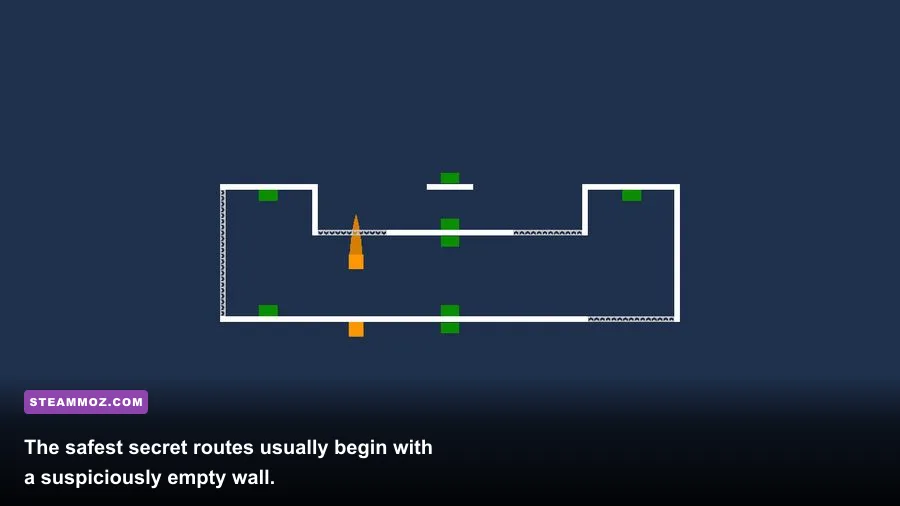
Deleveled doesn't hand you a glowing treasure chest or a minimap icon. Its collectible logic is tied to the same movement rules used by the main puzzle: horizontal input, gravity changes, momentum, and the position of the connected blocks. A secret is normally revealed in one of three ways.
- Dead-end walls: A wall that appears to terminate a route may contain a narrow side pocket. If the camera leaves more empty space than the puzzle seems to need, test the edge before committing to the exit.
- Delayed gravity windows: Some rewards require you to flip gravity after crossing a platform, not before. The timing carries your block into a ceiling channel that is easy to skip when solving the room directly.
- False exits: The standard goal can be reached while an upper or lower lane remains unexplored. Completing the stage first doesn't always expose the secret, so replay it from level select and take the unusual lane before touching the goal.
There is no benefit to rushing the first solution. Deleveled's physics are deterministic, so a failed attempt is useful data. Watch where your square stops, note whether momentum survives the flip, and then alter only one input. That method is far more effective than repeatedly mashing the gravity control.
| Secret clue | What it usually means | Best response | Common mistake |
|---|---|---|---|
| One-tile gap beside a wall | Optional side pocket | Approach slowly and preserve horizontal momentum | Flipping gravity too early |
| Empty space above the exit | Upper secret lane | Finish the setup, then reverse gravity | Taking the goal immediately |
| Platform that seems useless | Launch or braking surface | Use it to align the next flip | Treating it as decoration |
| Long return path | Hidden reward checkpoint | Mark the room and replay from level select | Assuming the route is wasted |

🎮 Deleveled
Looking to experience this game? Grab your digital key directly on our store for $1.49.
View on Steammoz Store →Secret locations in the early numbered levels
The opening group of stages teaches the basic movement vocabulary, but it also introduces the game's first optional routes. In the first handful of rooms, don't look for a collectible sitting in plain sight. The early secrets are tucked beside the intended line and are designed to test whether you understand that a gravity flip changes your approach angle, not simply your vertical direction.
Levels 1-10
In the earliest rooms, inspect the space behind the first vertical barrier. The correct solution often has you moving toward the goal, flipping gravity, and landing on the opposite side of the same structure. Instead, slow down before the final approach and use the rebound to enter the narrow pocket behind it. If your square clips the lower lip, you reached the area too quickly; reset and begin the flip one platform earlier.
Levels 6-10 introduce the most frequently missed early reward: an upper route positioned above the obvious finishing lane. The tell is a ceiling ledge that appears to have no purpose. Keep enough horizontal speed to clear the goal's platform, then reverse gravity only after your square passes its midpoint. A premature flip drops you onto the normal route and makes the secret look inaccessible.
Levels 11-20
Here, secrets stop being simple side pockets. The hidden routes are usually behind a return trip. Solve the room mentally first, then avoid the final goal and travel back through the chamber while your gravity orientation is inverted. Pay close attention to isolated platforms: a platform with no obvious connection is almost always a setup point for an optional lane.
The cleanest strategy is to make two runs. On run one, identify the safe landing sequence and finish the stage. On run two, repeat the sequence with one change at the isolated platform. This avoids wasting attempts on a full reset when the secret only needs a single timing adjustment. For broader puzzle-game route planning, Steamoz's secret-location guide for Edge of Eternity covers the same useful habit: separate discovery runs from collection runs.
Mid-campaign secrets and the hardest hidden lanes
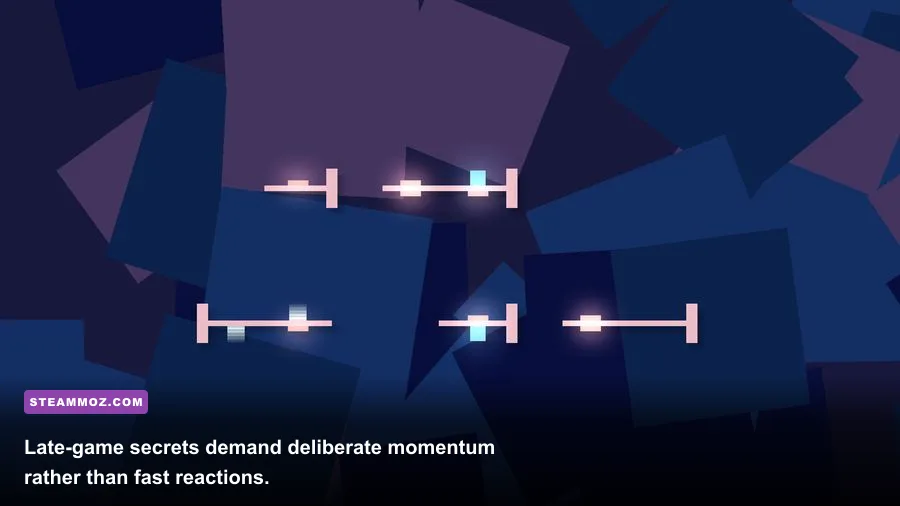
Levels 21-60 are where Deleveled's secret design becomes genuinely mean. The rooms are larger, the safe surfaces are less generous, and a gravity flip can preserve enough momentum to send you past the landing point. The important distinction is that you aren't searching for a new mechanic. You're searching for a different order of operations.
Levels 21-40: use the return route
In this section, check the opposite side of every room after the first successful crossing. A common pattern places the normal exit on the lower-right side while the secret lane begins from a high-left platform. Reach the high platform using the intended route, stop instead of flipping immediately, and let your square settle before changing gravity. The pause matters: moving while airborne changes the horizontal alignment that determines whether you enter the hidden channel.
When a secret seems to require an impossible jump, look for a nearby surface that lets you reverse direction without changing gravity. Deleveled frequently expects you to bounce off a wall, carry that momentum through a flip, and enter the reward lane from behind. Trying to force the route with repeated input usually produces the same failure because the starting angle is wrong.
Levels 41-60: the delayed-flip puzzles
The biggest trap here is flipping as soon as your square reaches the correct height. Wait until the block is horizontally aligned with the opening. In several of these rooms, the secret is visible for only a moment during the crossing, but the visible gap is not the entry point; it's a timing marker. Use the next platform as your reference and trigger the flip when your square is roughly one block-width away from its center.
| Campaign range | Secret pattern | Timing priority | Recommended approach |
|---|---|---|---|
| 1-10 | Side pockets and ceiling ledges | Medium | Explore edges before touching the goal |
| 11-20 | Inverted return routes | Medium | Complete a safe route, then replay with reversed gravity |
| 21-40 | Opposite-side lanes | High | Use wall rebounds to preserve alignment |
| 41-60 | Delayed-flip openings | Very high | Trigger gravity only after horizontal alignment |
| 61-120 | Multi-stage optional routes | Very high | Record each landing and solve in short segments |
Late-game rewards in levels 61-120
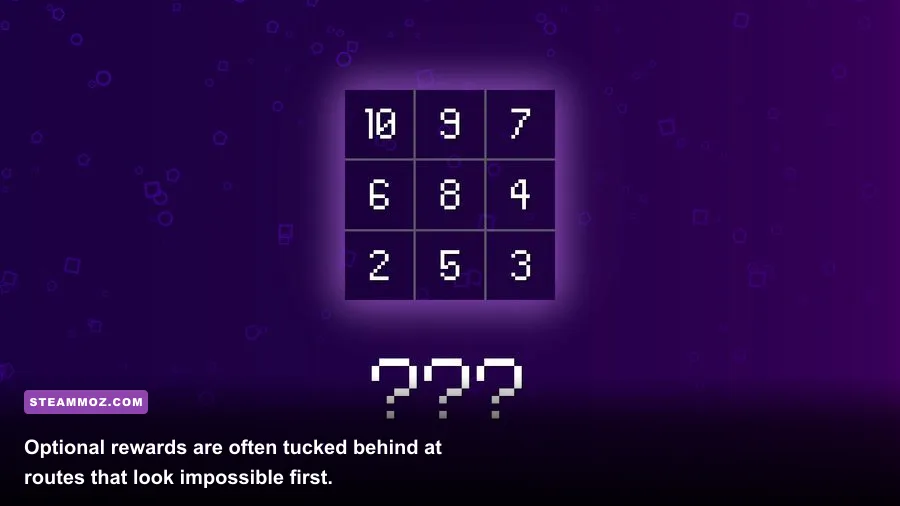
The final half of the campaign hides rewards behind chained movement rather than one clever trick. A late secret may require three correct landings, a gravity reversal, and a return to a platform you already used. Treat every landing as a checkpoint in your plan. If you cannot explain what the next surface is doing, you probably haven't found the intended route yet.
From levels 61-80, inspect corridors that force you toward the goal. The secret often sits behind the pressure of that forced movement: instead of accepting the first available landing, use the corridor wall to redirect your square. Keep your input brief. Holding a direction through a gravity change is the fastest way to overshoot a narrow platform.
Levels 81-100 add long vertical sequences. The hidden route is commonly on the side you leave behind after the first flip. Before descending, identify whether the opposite wall has a ledge or a one-tile recess. If it does, enter the sequence with less horizontal velocity than the standard solution requires. The secret route rewards control, not speed.
Levels 101-120 are the cleanup test. The rooms can hide optional lanes above the apparent ceiling or below the final platform, and the correct route may look like a mistake until the last flip. Keep the goal untouched while scouting. Once you reach a new area, pause and confirm whether the room has a return route before proceeding. This prevents the classic late-game error of finding the secret but accidentally ending the stage before collecting it.
For precision-heavy games, stable performance matters more than visual polish. Deleveled is lightweight, but borderless-window latency or an unstable refresh rate can make the narrowest flips feel inconsistent. Steamoz's guides to higher-FPS settings and frame-rate optimization explain the same basic principle: remove input delay before blaming your timing.
Best cleanup route for missed hidden rewards
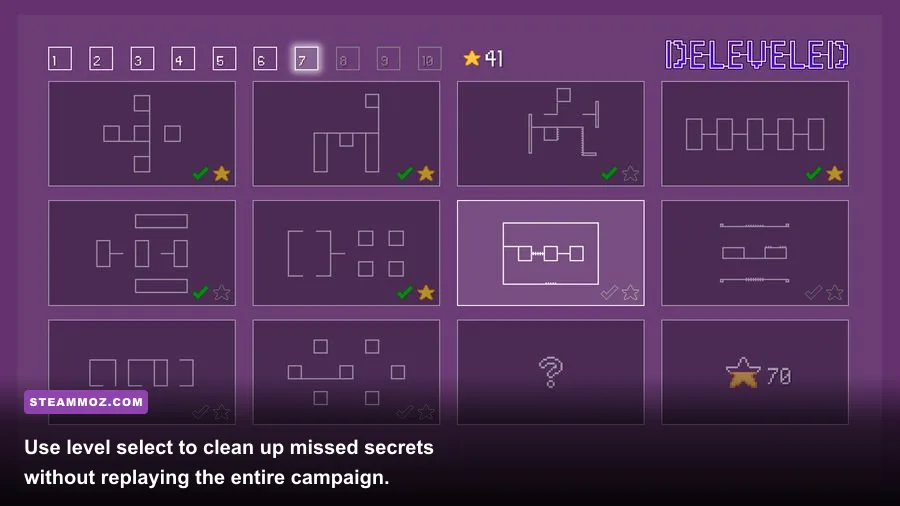
Don't replay the entire campaign from the beginning. Use level select and work in ten-level blocks: 1-10, 11-20, and so on through 111-120. After every successful secret, return to the menu and verify that the room's completion marker changed. If it didn't, you probably reached the hidden lane without triggering the reward, or you touched the goal before finishing the optional objective.
Keep a simple checklist with three columns: level number, clue discovered, and confirmed reward. Marking a room as “seen” isn't enough. Deleveled's most deceptive secrets are the ones you can visit without completing the collection condition. A confirmed result should mean that the stage remains cleared after a restart and that the level-select screen records the progress.
| Cleanup step | Action | Why it works | Stop condition |
|---|---|---|---|
| 1 | Sort missed rooms by ten-level block | Limits repeated loading and keeps patterns familiar | Every room has a checklist entry |
| 2 | Replay without touching the goal | Prevents accidental stage completion | Optional lane is fully explored |
| 3 | Test wall pockets and isolated platforms | These are the game's most consistent clues | No unexplored edge remains |
| 4 | Restart and verify the marker | Separates discovery from confirmed collection | Progress survives the reload |
Movement habits that make every secret easier
The best Deleveled players aren't necessarily faster. They're better at preserving options. Enter a room with a plan for your next landing, but don't hold a direction longer than needed. Short taps give you room to correct your alignment after a gravity change, while long holds turn a manageable puzzle into an overshoot.
Use the normal exit as a rehearsal. If the intended solution crosses a room in four movements, remember those four landing points and then ask which one gives access to an unused wall or ceiling. Most secrets are not random detours; they're alternate readings of the same geometry. The route is already teaching you how to reach the hidden space.
Finally, don't confuse a failed secret attempt with a bad run. The game is deliberately built around repetition, and its best hidden rewards are often discovered when you stop trying to win. Slow down, observe the block's exact stopping point, and change a single variable on the next attempt. With that mindset, the full secret hunt becomes a satisfying second campaign rather than a frustrating pixel hunt.
For another tightly designed indie-game checklist, Steamoz's Bounty Train survival tips are worth bookmarking. You can also check the game's official Steam listing for updates, controller notes, and platform information before starting a full cleanup run.