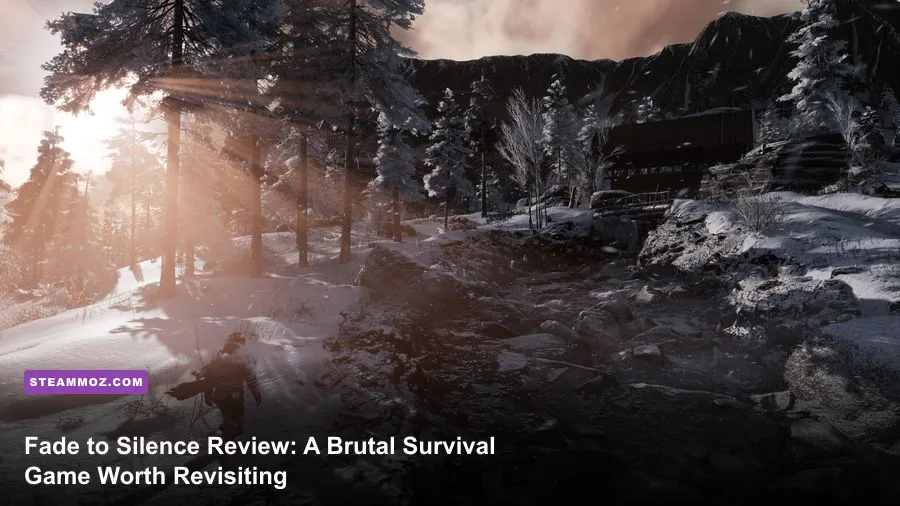
Fade to Silence is worth playing in 2026 only if you want a demanding, lonely survival game rather than a polished open-world blockbuster. Black Forest Games’ 2019 post-apocalyptic adventure still has a gripping premise, excellent winter atmosphere, recruitable survivors, shelter management, and surprisingly tense exploration. It also has clumsy melee combat, uneven voice acting, awkward menus, and a progression loop that can feel more like maintenance than mastery. At its current bargain prices, it’s a fascinating flawed game; at full price, it’s a much harder recommendation.
You play Ash, a survivor moving through a world consumed by the mysterious Endless Winter. The landscape is split between frozen wilderness, ruined industrial areas, and corrupted zones patrolled by monsters called the Rippers. Ash isn’t rebuilding civilization from a comfortable command center. He’s trying to keep a handful of people alive while hunger, cold, injury, and a hostile environment steadily erase his margin for error.
That setup remains unusually effective. Fade to Silence understands that survival horror doesn’t need constant jump scares. A dark treeline, a nearly empty food meter, and a storm rolling over the route home can create more tension than a scripted monster ambush. The problem is that the game’s rough edges are always visible. This review breaks down what still works, what has aged badly, and whether the experience is a smart 2026 purchase.
What Fade to Silence gets right
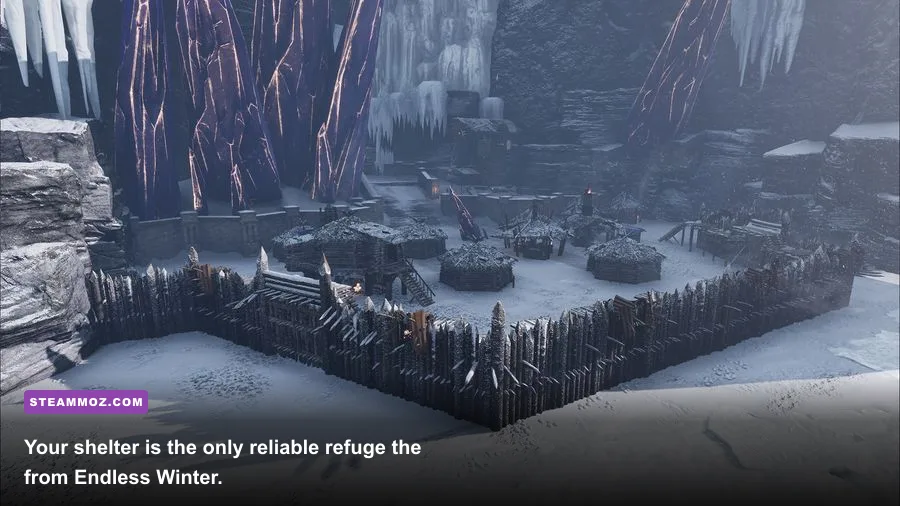
The best part of Fade to Silence is the relationship between movement, weather, and preparation. Every expedition begins with a practical question: how far can you travel before your food, warmth, stamina, or health becomes a problem? The map initially feels mysterious, but it quickly becomes a mental spreadsheet of shelter locations, resource nodes, monster patrols, and shortcuts.
Ash’s main shelter acts as the center of that loop. Survivors can be recruited in the world and assigned to jobs that improve your settlement’s ability to produce food, materials, or equipment. Recruiting someone isn’t just a collectible exercise. Each new person increases the demand placed on your fragile supply chain, so bringing home a survivor you can’t support may create a bigger problem than leaving them behind.
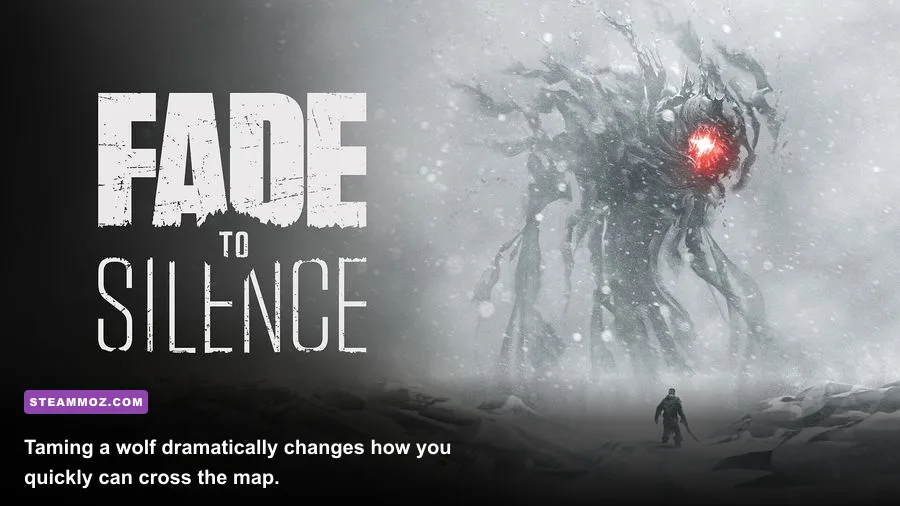
The game also makes travel feel meaningful. You can walk, use sled routes, or eventually ride a tamed wolf. The wolf is more than a cosmetic companion: it improves traversal speed and makes long-distance gathering less exhausting. That matters because the world’s distances are deliberately inconvenient. A resource trip that is safe at noon may become lethal when a storm arrives or your stamina is already depleted.
The atmosphere carries a lot of the experience. Snow muffles the landscape, abandoned structures feel exposed, and the color palette sells a world starved of warmth. There’s a grim beauty to reaching a lookout point and seeing frozen roads, broken settlements, and hostile creatures spread below you. For players who enjoy methodical survival games, this mood can justify tolerating several mechanical irritations.

🎮 Fade to Silence
Looking to experience this game? Grab your digital key directly on our store for $7.49.
View on Steammoz Store →How survival and shelter management really work
Fade to Silence is easier once you stop treating the shelter as a passive home base. It’s your production engine and your safety net. Before leaving, check your food stock, healing items, clothing condition, and crafting materials. A successful run should have a clear objective: recruit a named survivor, collect a specific material, activate a landmark, or clear a route. Wandering without a goal burns daylight and supplies for very little return.
Food is especially important because the shelter’s population consumes it over time. You want enough stored food to survive the next expedition and enough production capacity to prevent a slow collapse. The exact balance changes as you recruit more people, but the principle doesn’t: expanding too quickly is dangerous. A smaller shelter with reliable supplies is stronger than a larger settlement where every worker is hungry.
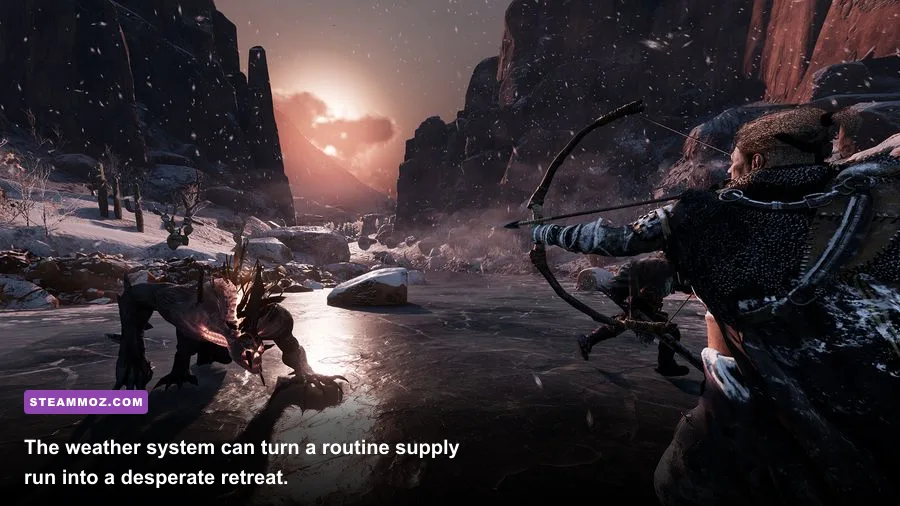
Weather is the game’s most important environmental threat. Cold exposure doesn’t merely reduce a number on the interface; it compresses your available decision-making time. Once the weather worsens, detours become expensive and fights become more dangerous because stamina is already under pressure. Learn the location of shelters and avoid beginning long trips late in the day unless you already know the route.
There’s a useful rhythm to a good campaign. Spend one outing gathering common materials, another recruiting or completing a major objective, and then return to improve your shelter before pushing farther. If you constantly attempt high-risk objectives with damaged equipment and limited food, the game feels unfair. If you prepare deliberately, the same world becomes tense but readable.
| Survival priority | Why it matters | Best habit | Common mistake |
|---|---|---|---|
| Food | Supports Ash and your shelter population | Build a reserve before recruiting widely | Adding survivors without production capacity |
| Warmth | Limits how long you can remain outside | Plan shelter stops before departure | Ignoring storms because the route looks short |
| Stamina | Controls sprinting, dodging, and attacks | Arrive at combat with a full bar | Running everywhere and entering fights exhausted |
| Materials | Enable crafting and settlement upgrades | Gather with a specific recipe in mind | Carrying low-value loot until inventory fills |
If you enjoy survival games that turn logistics into drama, Fade to Silence’s loop still has teeth. It’s less flexible than the building systems in larger sandbox titles, but its restrictions give every trip a reason to exist. For another survival-focused perspective, our Everafter Falls survival tips article covers a far friendlier version of resource planning.
Combat is tense, but rarely elegant
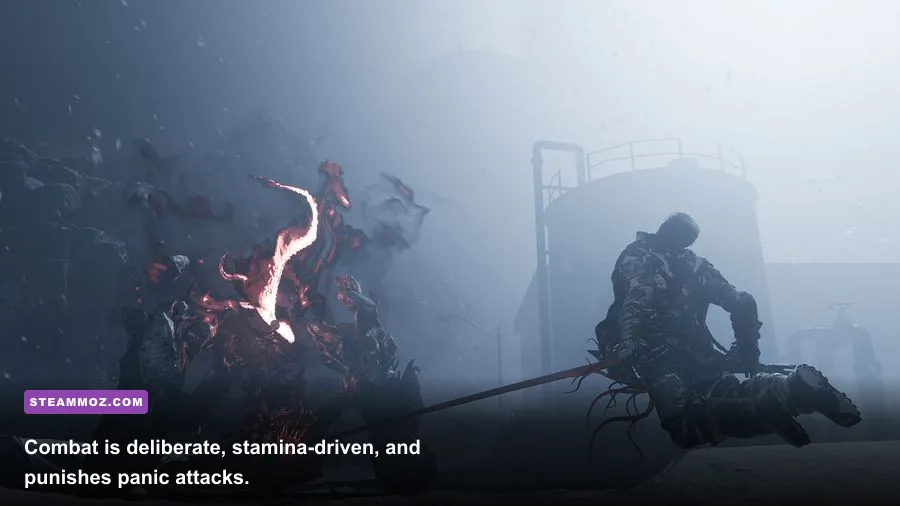
Combat uses stamina as its central currency. Light and heavy attacks, dodges, and defensive movement all compete for the same limited reserve. That creates the right basic idea: watch the enemy, bait an attack, punish the recovery window, then retreat before greed gets you killed. The trouble is that the animation timing and camera can make those decisions feel less precise than they should.
Rippers are the enemies you’ll learn first. Their attacks have readable wind-ups, but multiple enemies can overwhelm Ash quickly. The safest response is to isolate targets rather than charge into a group. Keep enough distance to see the animation begin, dodge sideways instead of backward when possible, and avoid chaining attacks after the first clean hit. A second enemy arriving from off-screen is a common cause of unnecessary deaths.
Ranged weapons improve your options, particularly when you can pull one enemy away from a group or soften a dangerous target before closing in. They don’t turn the game into a shooter, though. Ammunition and positioning matter, and the environment can make aiming awkward. Treat the bow as a tool for control rather than a license to eliminate every threat from safety.
Melee weapons feel best when you accept their limitations. Don’t expect a character-action combo system. Fade to Silence rewards short exchanges, patient dodges, and careful target selection. If you mash attacks, Ash’s stamina disappears and the enemy gets the initiative. If you keep the camera pulled back, use terrain intelligently, and retreat before the bar is empty, fights become much more manageable.
Boss encounters and larger creatures are less satisfying. Their attack patterns can be memorable, but the game’s hit feedback doesn’t always communicate whether you made a smart dodge or simply benefited from distance. The combat is functional enough to support the survival loop, yet not refined enough to carry the game by itself.
| Combat situation | Primary danger | Reliable response | What to avoid |
|---|---|---|---|
| Single Ripper | Overcommitting to a slow attack | Wait for the swing, dodge, use one or two hits | Emptying stamina on a full combo |
| Two or more Rippers | Being staggered from different angles | Circle wide and separate the group | Fighting beside cliffs or tight objects |
| Ranged engagement | Running out of ammunition or stamina | Open with a shot, then reposition | Standing still while enemies close in |
| Large creature | Long recovery animations and area attacks | Study the telegraph and punish briefly | Attacking during an unclear recovery window |
Progression has a strong opening and a weaker middle
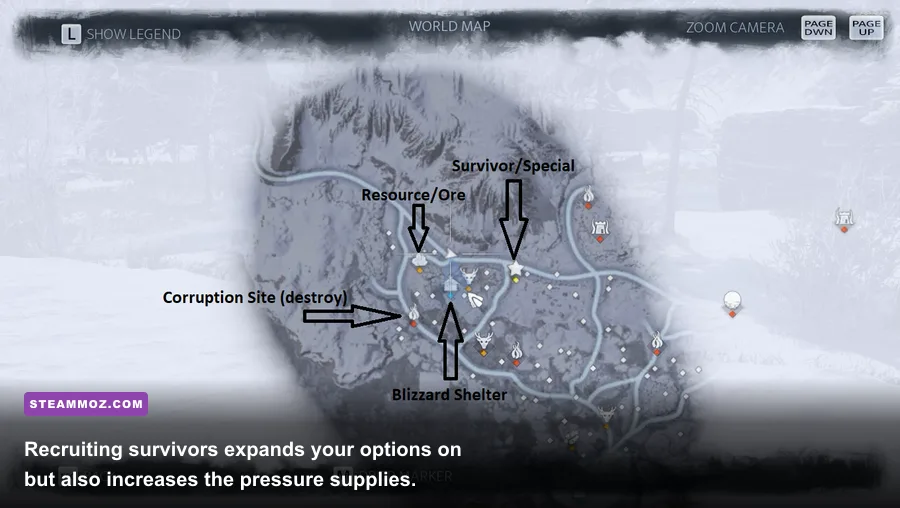
The early hours are Fade to Silence at its most compelling. You’re under-equipped, the map is unfamiliar, and every new survivor or landmark expands your understanding of the world. Unlocking a safer route feels valuable because it changes future travel rather than merely adding another icon to a checklist.
As the settlement grows, the game becomes more administrative. You spend more time checking production, assigning people, repairing equipment, and collecting materials. That can be satisfying if you like management layers, but the upgrade structure lacks the variety of a deeper colony simulator. Many improvements feel like removing friction rather than opening exciting new playstyles.
That’s also where the campaign’s pacing starts to wobble. The central mystery gives exploration a purpose, but not every objective feels equally important. Some tasks send you across the map for a modest reward, and repeated supply runs can make the world feel smaller rather than richer. A fast-travel or route-planning system with more flexibility would have helped enormously.
Still, there’s a genuine sense of accomplishment in stabilizing a shelter that once looked doomed. Recruiting survivors changes the mood of the base, and production improvements make later regions less punishing. The progression is not about becoming an unstoppable hero. It’s about turning a desperate camp into something that might survive the next storm.
Who will enjoy the progression
You’ll probably click with it if you enjoy games such as State of Decay, The Long Dark, or smaller-scale colony survival systems where preparation matters more than power fantasy. You may bounce off it if you want constant loot upgrades, generous checkpoints, or a cinematic narrative that never asks you to repeat a route.
For comparison, players who prefer highly optimized combat builds may find more depth in our Eldest Souls beginner build guide. Fade to Silence is less about perfecting a damage rotation and more about making sure you can afford to attempt the next one.
PC performance and the best settings in 2026
On PC, Fade to Silence remains playable, but don’t expect modern optimization standards. The snowy world can be surprisingly demanding because it combines broad outdoor views, weather effects, foliage, lighting, and traversal across open spaces. Performance depends heavily on your resolution and GPU, while stutter can appear when moving between areas or loading environmental details.
The official Steam requirements list Windows 7 64-bit as the minimum operating system, an Intel Core i5-6600K or AMD Ryzen 5 1600 processor, 8 GB of RAM, and a GeForce GTX 1060 or Radeon RX 580. The recommended specification rises to an Intel Core i7-6700K or AMD Ryzen 7 1700, 16 GB of RAM, and a GeForce GTX 1070 or Radeon RX Vega 56. Those are old recommendations by 2026 standards, but they remain useful as a baseline rather than a promise of perfect frame pacing.
Start with a 60fps target instead of pushing every setting to Ultra. Lowering volumetric effects, shadows, and foliage density usually produces a better improvement than reducing texture quality. If you have 8 GB of system memory, close browsers and background launchers before playing. An SSD can also reduce the irritation of loading and streaming pauses, even though it won’t fix every hitch.
| Setting | Recommended value | Performance impact | Visual trade-off |
|---|---|---|---|
| Resolution | Native 1080p | Baseline | Best clarity for a 60fps target |
| Shadows | Medium | High impact outdoors | Less depth around trees and structures |
| Volumetric effects | Medium or Low | High during storms | Snow and fog look less dense |
| Foliage | Medium | Moderate impact while exploring | More visible pop-in and thinner vegetation |
| Textures | High with 4 GB-plus VRAM | Low to moderate | Keep this higher for sharper surfaces |
| Post-processing | Medium | Moderate | Reduced bloom and cinematic effects |
For more detailed PC troubleshooting, see our guide to settings that turn stutter into smoother FPS and our max-FPS settings breakdown. The same basic rule applies here: stabilize frame pacing first, then restore visual quality one setting at a time.
Is Fade to Silence worth playing in 2026?
Yes, but only with the right expectations. Fade to Silence is not a hidden masterpiece waiting to dethrone modern survival games. Its combat lacks polish, its interfaces feel dated, and the later campaign can become repetitive. The story presentation is also uneven, with moments of strong environmental storytelling surrounded by dialogue and performances that don’t land with the same confidence.
What remains compelling is the combination of a hostile winter, meaningful shelter upkeep, recruitable survivors, and travel that never feels completely safe. The game makes you care about basic improvements. A better route, a stocked food supply, a healthier survivor roster, or a wolf mount can feel more valuable than a legendary weapon in a conventional RPG because each upgrade changes your odds of returning alive.
Buy it if you enjoy deliberate survival games, bleak post-apocalyptic settings, and systems that make preparation matter. Wait for a deep discount if you’re unsure, especially because the rough combat and repeated expeditions are not minor flaws. Skip it if you want a smooth co-op experience, a huge crafting sandbox, or a story-first adventure with little resource management.
My 2026 verdict is 7/10 for survival fans, 5/10 for everyone else. Fade to Silence is an ambitious, atmospheric game that never quite reaches the quality of its ideas. Yet those ideas are distinctive enough to make it worth revisiting. Give it a patient first session, play on a difficulty that lets you learn the systems, and treat every expedition as a planned operation rather than a casual stroll.
Before buying, check the official Steam page for the current PC build, discounts, and user feedback. You can also learn more about the developer through the Black Forest Games website and check publisher information at THQ Nordic’s Fade to Silence page. If the premise sounds like your kind of misery, the game still has a cold, compelling heart beneath the frost.