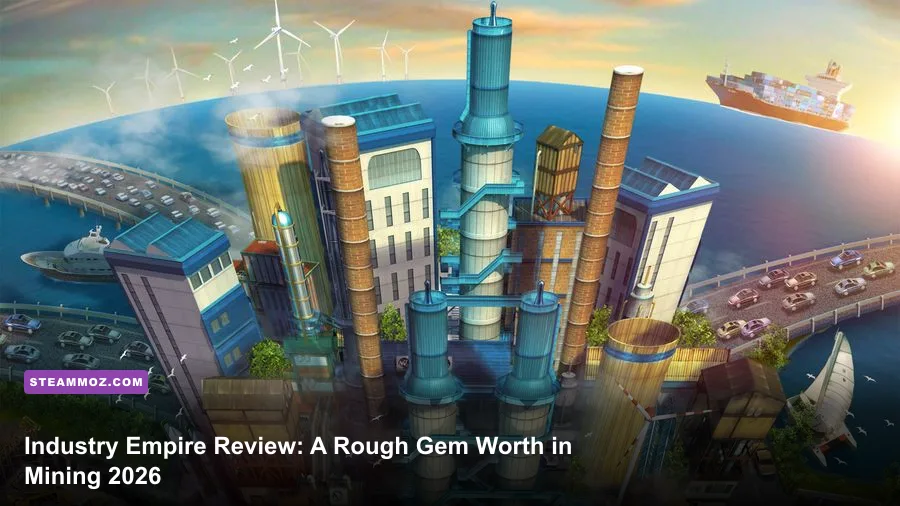
Industry Empire is worth playing in 2026 only if you enjoy slow, old-school business simulations and can tolerate rough edges. Its factory chains, transport planning, and steady climb from a small industrial operator to a regional powerhouse still have real appeal, especially at a discount. But this is not a polished modern tycoon game: the interface is dated, the presentation is plain, and the early hours can feel more like accounting homework than a satisfying strategy sandbox.
That makes the answer more interesting than a simple yes or no. Industry Empire remains a good fit for players who like production puzzles, careful expansion, and games that allow a profitable plan to unravel because one missing input stalls half a city. It is a poor choice if you want slick tutorials, expressive workers, detailed campaign storytelling, or the visual feedback found in newer management games.
This review focuses on how Industry Empire plays today, what its economy actually asks of you, where its systems hold up, and whether its flaws are deal-breakers in 2026. For the official store listing, current operating-system notes, screenshots, and player reviews, check the Industry Empire Steam search page before buying.
What Industry Empire Actually Does Well
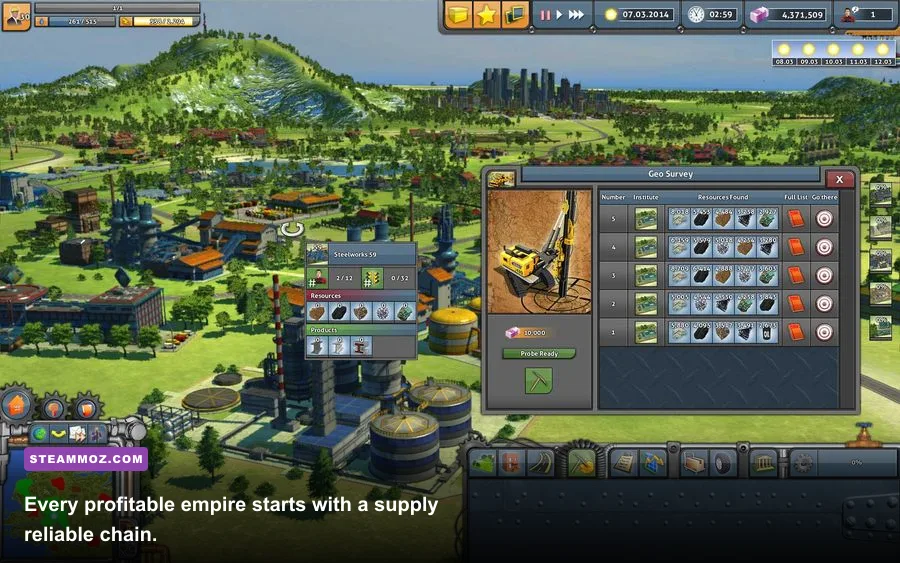
Industry Empire understands the basic pleasure of a tycoon game: a small decision becomes a visible system. You begin by placing the foundations of an industrial network, securing raw materials, processing them into useful goods, and selling those goods into the market. The individual steps are not flashy, but watching a chain stabilize is satisfying. A resource site feeds a processing plant, the plant supplies a more advanced factory, and the finished product finally turns all that spending into cash.
The game’s strongest idea is that growth is limited by logistics rather than by a simple “build more” button. A factory can look profitable on paper and still underperform because its inputs arrive too slowly, its delivery route is inefficient, or its output has nowhere worthwhile to go. That friction gives Industry Empire more strategic weight than its modest visuals suggest.
It also avoids turning every decision into a constant emergency. You can pause, inspect buildings, adjust your plans, and expand at a measured pace. There is no need to click frantically or memorize dozens of hotkeys. If you enjoy the deliberate planning of slower strategy games with layered systems, Industry Empire has a similar appeal, even though its focus is firmly economic.
| System | What You Manage | Why It Matters | 2026 Verdict |
|---|---|---|---|
| Production | Raw materials, processing, finished goods | Determines whether factories earn or burn cash | Still engaging |
| Logistics | Road connections and deliveries | Controls the speed and reliability of every chain | Best system |
| Construction | Factories, infrastructure, expansion | Shapes your long-term economic footprint | Functional, dated |
| Market | Sales, prices, and demand | Turns production into actual profit | Useful but not deep |
| Research | New industrial opportunities | Provides a reason to keep expanding | Basic progression |

🎮 Industry Empire
Looking to experience this game? Grab your digital key directly on our store for $2.39.
View on Steammoz Store →Production Chains Are the Real Challenge
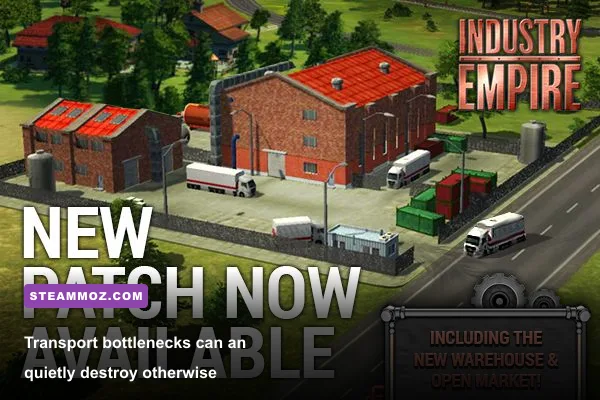
The best way to understand Industry Empire is to stop thinking of factories as isolated buildings. A coal operation or iron source is only valuable when it is connected to processing capacity, storage, transport, and a customer. The game rewards complete chains, not impressive-looking construction sites.
Early expansion usually revolves around basic materials such as coal and iron ore, then moves toward processed resources such as steel and manufactured goods. The exact chain depends on the scenario and available map resources, but the underlying rule stays consistent: every new production step adds potential profit and another point of failure. A steel plant may increase the value of your output, yet it also demands dependable deliveries and enough working capital to survive a slow start.
That is where beginners often get punished. They see an attractive factory, place it immediately, and discover that the building’s purchase price was only the first expense. Roads, incoming materials, outgoing deliveries, workers or operating costs, and unsold stock all matter. Industry Empire does not always explain those consequences clearly, so the safest approach is to build one complete chain before opening a second front.
Build for throughput, not decoration
Keep related buildings close together when the map allows it. Short routes make troubleshooting easier and reduce the chance that a single awkward connection causes missed deliveries. Leave room around industrial clusters rather than filling every available tile. You will want space for a second processor, a replacement route, or a higher-value factory later.
Stockpiling is another important lesson. A chain that produces exactly enough input for normal demand may look efficient, but it becomes fragile when demand changes or transport falls behind. A modest reserve of coal, iron ore, or intermediate products gives you time to fix the problem without shutting down the entire network. That safety margin costs money, but so does a factory sitting idle.
| Expansion Stage | Recommended Focus | Main Risk | Best Practice |
|---|---|---|---|
| Opening | One basic resource chain | Spending all starting cash | Keep a reserve for roads and operating costs |
| Early growth | Processing and dependable deliveries | Input shortages | Monitor stock levels before adding factories |
| Mid game | Higher-value manufactured goods | Overbuilding expensive capacity | Expand only when sales justify it |
| Late game | Multiple linked industrial clusters | One failure affecting everything | Separate routes and maintain backup inputs |
Logistics Makes or Breaks Your Company
Industry Empire’s logistics model is less sophisticated than the transport systems in newer titles, but it remains the source of most meaningful decisions. A production line cannot simply teleport its goods to the buyer. Connections, delivery distance, and network layout influence whether your factories operate smoothly.
The most common mistake is building a long road because it is cheap at the start. That route may become a permanent tax on the entire company once several factories depend on it. A distant iron source can still be worthwhile, but calculate the full cost of getting material to the processor and finished goods to market. Sometimes a slightly less productive site near your industrial district makes more money because it keeps the chain moving.
Use a hub-and-spoke layout for small networks: place storage or processing near the center, then connect resource sites with short, readable routes. When the empire grows, avoid creating one giant central choke point. If every delivery passes through a single congested connection, a minor disruption can idle multiple factories at once.
This is also where Industry Empire feels most like a puzzle. The right answer is not always the factory with the highest theoretical output. It is the arrangement that keeps inputs arriving, output leaving, and expenses below sales. Players who love optimizing routes in games like Bounty Train will recognize that same satisfaction in making a messy network behave.
Campaign, Sandbox, and the Progression Curve

Industry Empire is at its best when you treat the early game as a learning exercise rather than a race to unlock everything. The opening progression is deliberately restrained. You establish basic supply, prove that the company can make money, and only then move into more ambitious manufacturing. This is a sensible economic curve, although it can feel slow if you expect constant new toys.
The campaign structure gives that progression some direction, while sandbox play offers more freedom to test layouts and production strategies. Campaign scenarios are useful for learning because their constraints force you to pay attention to what the game is actually asking. Sandbox mode is better once you understand the fundamentals and want to experiment without a narrow objective.
There is no character drama or memorable cast carrying the experience. Your company, balance sheet, and expanding industrial footprint are the story. That works for a particular kind of player, but it also explains why the game can feel emotionally flat. A profitable month is the reward, not a cutscene or a character moment.
Progression can become repetitive in the late game. Once you have a stable core network, expansion often means repeating the same process with more expensive buildings and longer routes. The challenge shifts from discovering new mechanics to maintaining efficiency. That is compelling for optimization-minded players, but less so for anyone looking for constant surprises.
Graphics, Interface, and Performance in 2026
Technically, Industry Empire is easy to run on modern hardware. Its low visual complexity means frame-rate performance is rarely the reason to avoid it. The bigger issue is usability. Menus, building information, and economic feedback feel designed for an earlier generation of PC strategy games. Important information can take too many clicks to reach, and the game does not always make a struggling production chain obvious at a glance.
That does not make the interface unusable. After a few hours, the routine becomes familiar: inspect a building, check incoming resources, verify the delivery connection, and compare expenses with sales. The problem is that new players are expected to learn too much through experimentation. Tooltips help, but they do not replace a strong tutorial that explains how all the pieces interact.
For modern PCs, prioritize clarity over visual ambition. If the game offers resolution, shadows, effects, and anti-aliasing controls, lowering shadows and effects is the first sensible step, though most systems should handle the title comfortably. A locked 60 frames per second is more than enough for a management game, and visual settings have a much smaller impact than the number of buildings and simulated activity on a large map.
| Setting Area | Recommended Value | Performance Impact | Visual Difference |
|---|---|---|---|
| Resolution | Native monitor resolution | Medium | Best text and map clarity |
| Shadows | Medium | Low to medium | Cleaner building depth at higher values |
| Effects | Medium | Low | Minor impact on industrial atmosphere |
| Anti-aliasing | 2x or medium | Low | Smoother roads and building edges |
| Large-map play | Use a frame-rate cap | Improves consistency | Reduces late-game spikes |
If you regularly troubleshoot older PC games, our guide to crashes, stutter, and low FPS fixes covers general steps that are also useful here: verify files, disable unnecessary overlays, and test compatibility options only when the default setup misbehaves.
Who Should Play Industry Empire in 2026?

Industry Empire is aimed at a narrower audience than its name suggests. It is not a modern city builder with rich citizen simulation, and it is not a deep financial simulator with a living global market. It sits between the two: an accessible industrial management game where production chains and expansion decisions are more important than individual people.
You should play it if you enjoy watching numbers improve because of a layout you designed yourself. You should also be comfortable restarting or reworking an empire after realizing that a profitable-looking plan has a structural flaw. The game’s strongest moments come when you diagnose a problem, redesign the network, and see the balance sheet recover.
You should skip it if you need a polished interface, extensive mod support, sophisticated AI competitors, or a campaign with strong narrative momentum. Players seeking more modern survival or management systems may find better recommendations in our roundups of simulation games worth playing in 2026 and strategy games with more active progression.
My recommendation
Buy Industry Empire on sale, not at a premium price. Its age shows in the interface, visual presentation, and limited late-game variety, but the core loop remains honest and surprisingly absorbing. You are not paying for spectacle. You are paying for the small rush that arrives when a previously chaotic production network finally turns a reliable profit.
For the best first run, choose a straightforward map, establish one complete raw-material-to-market chain, and keep cash in reserve. Do not rush into expensive factories because their output looks valuable. Follow the deliveries, protect your routes, and expand only after the existing operation is consistently profitable.
Final verdict: Industry Empire is a 7/10 niche tycoon game in 2026. It is rough, under-explained, and undeniably dated, yet its production and logistics puzzle still works. If factory planning sounds relaxing rather than exhausting, this overlooked simulator is worth mining—provided the price matches its age.
For more information about the publisher and available PC releases, visit the official UIG Entertainment website and the Industry Empire Steam Community results for current player reports and compatibility notes.