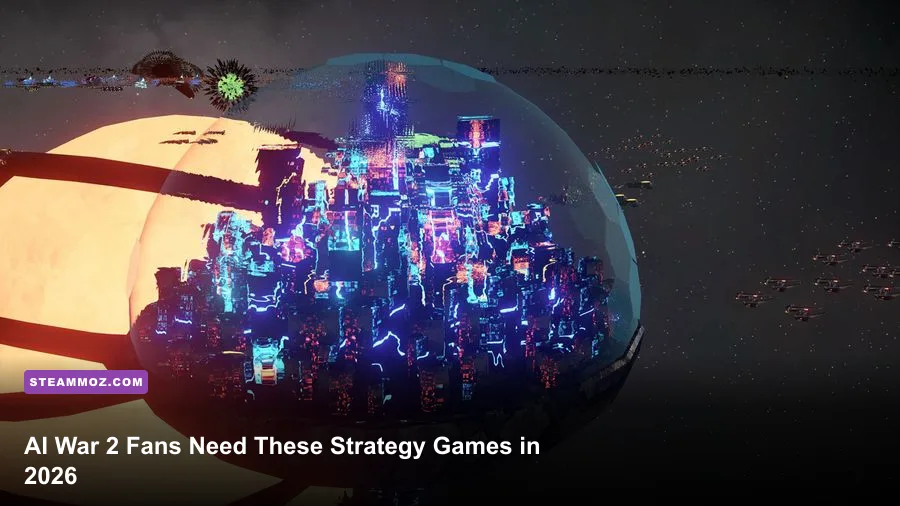
If AI War 2: The Spire Rises hooked you with hostile AI, asymmetric objectives, and the feeling that every victory makes the next attack worse, start with Distant Worlds 2, Sins of a Solar Empire II, and Terra Invicta. They aren't clones, but they preserve the important stuff: dangerous escalation, layered decision-making, and campaigns where survival matters more than painting the map your color.
That distinction matters. Plenty of strategy games advertise enormous galaxies, yet very few make you study an enemy's infrastructure before touching its front line. AI War 2's magic comes from restraint. You aren't simply building the biggest fleet; you're deciding which AI command station can be weakened, which worlds must remain quiet, and when a raid will provoke a response you can't afford. The games below earn their place because they create that same pressure through different systems.
This ranking focuses on the best games like AI War 2 for PC players in 2026, including direct space-4X alternatives, tactical fleet simulators, and one grim terrestrial strategy game that understands logistics better than most sci-fi epics. For a useful performance reference before you dive in, Steamoz's PC settings guide for smoother FPS is worth bookmarking.
The 2026 ranking at a glance
| Game | Tier | Best AI War 2 Match | Main Catch |
|---|---|---|---|
| Distant Worlds 2 | S-Tier | Living galaxy and hostile escalation | Slower opening and dense interface |
| Sins of a Solar Empire II | S-Tier | Real-time fleet warfare | Less stealthy asymmetric play |
| Terra Invicta | A-Tier | Multi-layered survival campaign | Long turns and punishing research curve |
| NEBULOUS: Fleet Command | A-Tier | Information warfare and fleet tactics | No grand campaign economy |
| Shadow Empire | A-Tier | Hostile world and operational planning | Turn-based, text-heavy presentation |
| Star Ruler 2 | B-Tier | Fast empire experimentation | Less oppressive AI personality |
The S-Tier choices are the safest recommendations. Distant Worlds 2 is the closest replacement for the “the galaxy is moving without me” sensation, while Sins of a Solar Empire II is the better pick if what you really want is immediate fleet action. A-Tier games demand more adjustment, but they reward players who enjoy building a plan across several systems instead of reacting one battle at a time.

🎮 AI War 2: The Spire Rises
Looking to experience this game? Grab your digital key directly on our store for $3.19.
View on Steammoz Store →S-Tier: Distant Worlds 2 is the closest strategic substitute
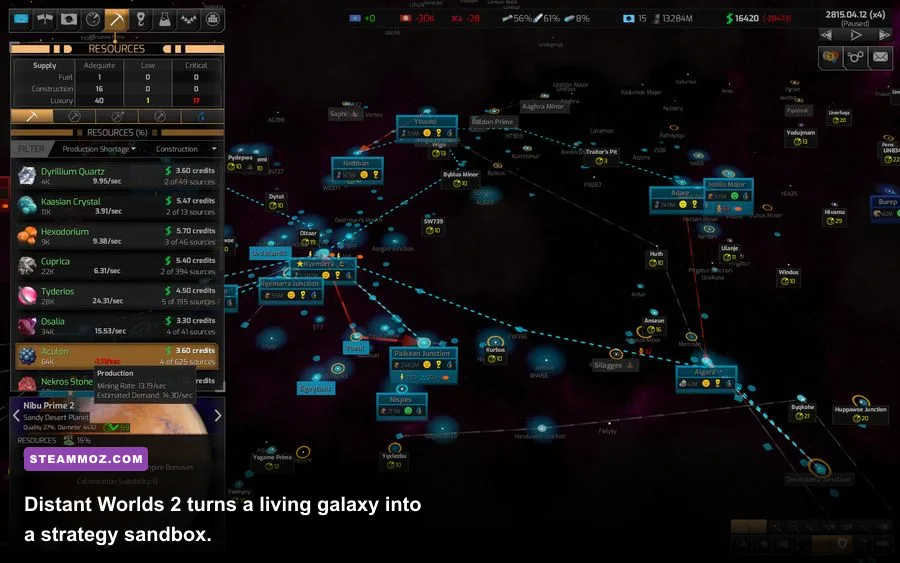
Distant Worlds 2 on Steam understands that a space empire should feel less like a board game and more like a machine with a mind of its own. Its automation system can manage civilian ships, exploration, construction, and parts of the military while you set priorities. That makes it unusually close to AI War 2's high-level appeal: you focus on the threat, not on clicking every freighter into existence.
The crucial difference is that Distant Worlds 2 is a 4X sandbox rather than a deliberately rigged defense scenario. You begin with tools for expansion, diplomacy, colonization, and research. The danger grows from pirate factions, rival empires, independent colonies, and the broader galaxy rather than from a single omnipresent AI intelligence. Still, the campaign becomes wonderfully tense once your supply lines stretch past your core worlds.
Why it works for AI War 2 players
Use automation aggressively, but don't hand over military judgment too early. Let the game handle civilian ships and basic construction. Keep control of strategic fleets, war declarations, research priorities, and colony policy. The result is a useful division of labor: the simulation handles routine motion while you decide whether the next target is worth exposing a border.
Its progression curve is also more interesting than a conventional tech ladder. Research unlocks components and hull roles, but the strongest fleet isn't defined by a single “best ship.” Long-range beam weapons, point defense, armor, shields, fuel capacity, and fleet command limits all compete for space and resources. A cruiser optimized for sustained laser fire may collapse against missile saturation if its defensive grid is too thin.
| System | Recommended approach | Why it matters | AI War 2 comparison |
|---|---|---|---|
| Automation | Automate civilians, retain fleets | Removes repetitive micromanagement | Similar high-level command feel |
| Fleet design | Mix escorts, carriers, and line ships | Covers range and defensive gaps | Rewards counter-building |
| Expansion | Secure fuel and repair hubs first | Prevents distant fleets stalling | Mirrors infrastructure raids |
| Diplomacy | Delay wars while scouting borders | Buys time for research and logistics | Preserves threat awareness |
The downside is friction. The opening hours are slower, the UI is packed, and the game can bury an important warning beneath less urgent notifications. If you want a cleaner first session, check Steamoz's space-combat weapon tier list for the kind of role-based thinking that transfers well here.
S-Tier: Sins of a Solar Empire II turns pressure into spectacle
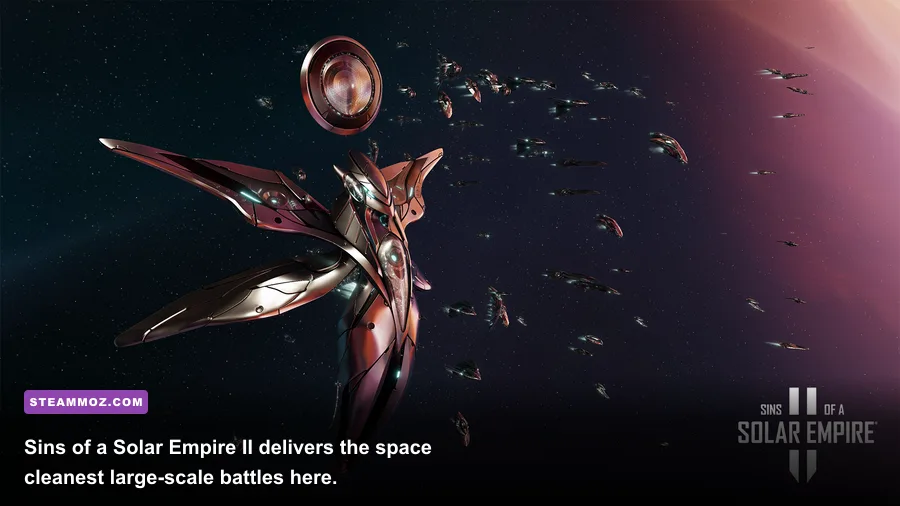
Sins of a Solar Empire II is the recommendation for players who remember the fleet clashes in AI War 2 more vividly than its economy screen. It runs in real time, but its battles breathe like 4X encounters. Capital ships gain experience, frigates fill specialized roles, and a planet is valuable because of its position, defenses, culture, and production—not merely because it adds another number to your income.
There are three major factions, each built around a different strategic rhythm. The TEC favors dependable industrial and military infrastructure. The Advent leans into culture, influence, and powerful late-game fleet interactions. The Vasari are more mobile and unusual, with tools that encourage aggressive repositioning and unconventional expansion. That faction identity gives each campaign a distinct answer to the same question: how do I create enough pressure to stop the opponent from scaling?
Build around a combined fleet instead of spamming capital ships. A carrier needs screens, anti-strikecraft support, and enough durable hulls to survive focus fire. Frigates with specialized anti-armor or anti-shield roles should operate behind a front line, while scouts reveal phase lanes and retreat routes. The game punishes the classic mistake of treating a fleet as one indivisible blob. Split raiders can force the enemy to react, but only if you maintain a reliable reinforcement path.
Sins II is less psychologically cruel than AI War 2. The enemy doesn't feel like a sleeping superintelligence that punishes careless growth. It feels like a strong rival commander. That makes it more approachable and better for multiplayer, though slightly less perfect for players seeking a pure asymmetric survival puzzle.
A-Tier: Terra Invicta makes every victory politically expensive
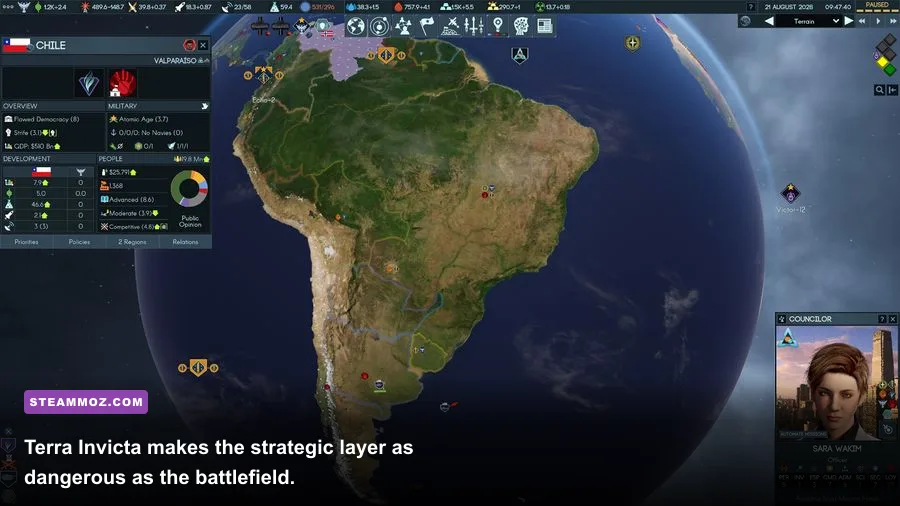
Terra Invicta is the strangest recommendation on this list, and possibly the most rewarding. Its premise is simple: aliens arrive, humanity fractures into competing factions, and the struggle extends from national politics to orbital warfare. You control councilors on Earth, take control points in countries, research technologies, build stations, and eventually fight across the Solar System.
That layered structure creates the same strategic anxiety as AI War 2, but on a much longer fuse. A campaign can be lost politically before your first serious fleet battle. Faction control depends on national cohesion, unrest, GDP, public opinion, councilor attributes, and the control-point cap. A country with high GDP may be powerful, but it can also consume a huge portion of your cap and become difficult to stabilize.
The key is to treat councilors as tools rather than heroes. Investigate enemy councilors, increase public opinion before attempting to control a nation, and use crackdown or purge actions only when the odds justify the cooldown and mission risk. On the space layer, don't rush deep expansion. Build mining and shipyard capacity near safe orbital bodies first, then protect those assets with layered defenses. The alien threat escalates through surveillance, abductions, bombardment, and increasingly capable fleets, so every shortcut can become a future liability.
| Campaign layer | Early priority | Common mistake | Better play |
|---|---|---|---|
| Earth politics | Secure stable control points | Overcommitting to one superpower | Balance GDP with cohesion |
| Councilors | Recruit varied attributes | Using one agent for every mission | Match skills to action type |
| Orbit | Build mines and defenses | Expanding before logistics | Establish protected staging zones |
| Research | Support economy and detection | Chasing only weapons | Invest in campaign-wide leverage |
Terra Invicta's biggest flaw is pace. It can take dozens of hours before the strategic picture fully reveals itself, and a bad early choice may not hurt until much later. For players who enjoy diagnosing a disaster and rebuilding around it, that's the point. For everyone else, it can feel like paperwork with occasional explosions.
A-Tier: NEBULOUS and Shadow Empire reward careful preparation
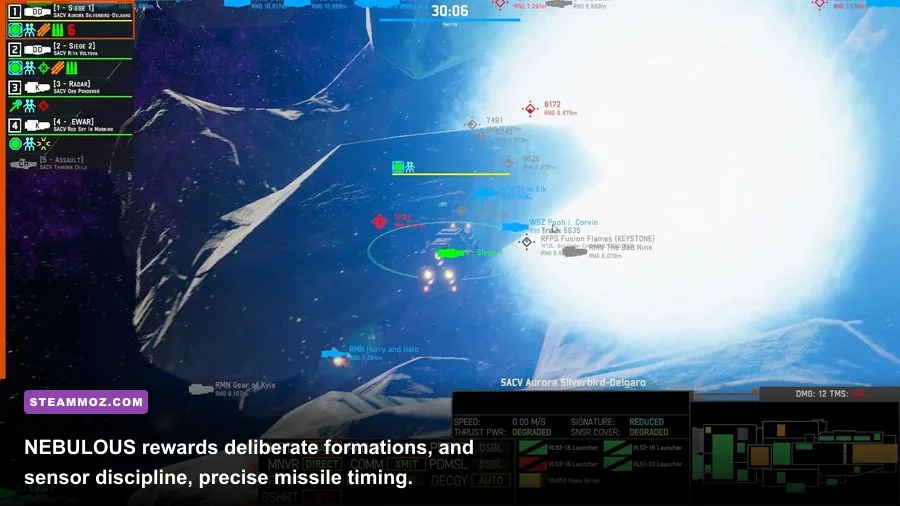
NEBULOUS: Fleet Command
NEBULOUS: Fleet Command strips away the empire layer and concentrates on the information war. You design task groups, assign weapons and modules, manage radar signatures, and issue orders across a tactical battlefield. It is not an AI War 2 replacement if you need colonization or a long economic campaign. It is an excellent substitute for the moment when you pause, inspect sensor contacts, and realize the opponent has built exactly the counter your fleet doesn't want to face.
Its combat rewards discipline. Active radar can reveal your position, passive sensors provide less information, and electronic warfare can distort the enemy's picture. Missiles are not simply a damage button: launch timing, seeker behavior, target signatures, point-defense coverage, and terrain all matter. A formation that looks safe in open space can become a death trap if it enters a missile engagement without enough separation.
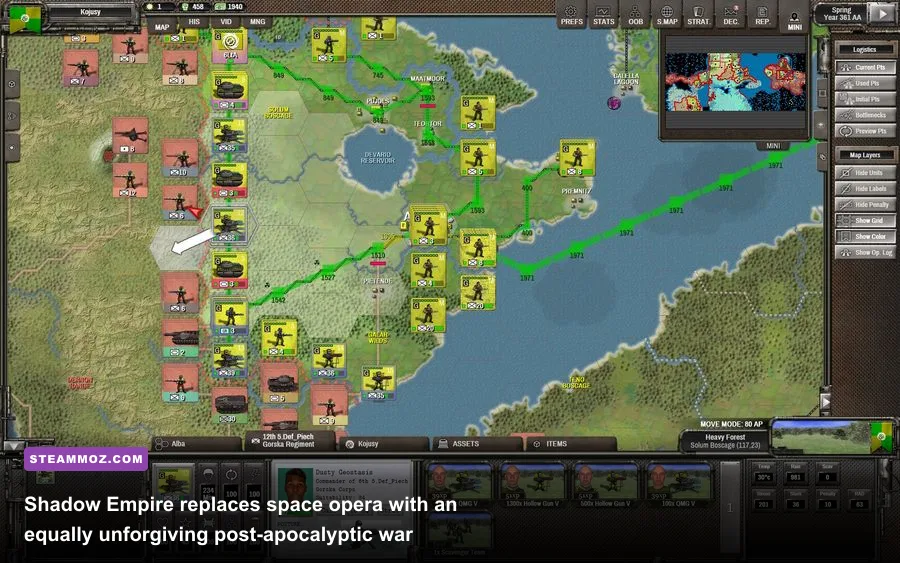
Shadow Empire
Shadow Empire is turn-based, on a ruined planet rather than a galactic map, but it nails the feeling of governing a hostile environment. Your regime must manage bureaucracy, worker requirements, raw materials, roads, supply points, and military formations. A tank unit isn't useful if fuel can't reach it. A city isn't safe simply because an enemy is out of attack range; unrest, weather, and logistical decay can dismantle your position without a dramatic battle.
This is the best option for players who loved AI War 2's infrastructure logic. Keep supply bases close to the front, improve roads before launching deep offensives, and don't create more formations than your administrative capacity can support. The procedural events can be bizarre, but the underlying pressure is concrete: production and logistics decide whether your plans exist beyond the next turn.
B-Tier: Star Ruler 2 is the fast, flexible wildcard
Star Ruler 2 is the pick for players who want experimentation without the heavier simulation overhead of Distant Worlds 2 or Terra Invicta. Its real-time 4X structure supports rapid expansion, ship design, diplomacy, research, and large battles. The card-based influence system gives diplomacy more texture than a simple relation meter, and the modular ship designer encourages specialized designs instead of one universal template.
It ranks below the others because its AI doesn't generate quite the same oppressive personality. The galaxy can become busy and dangerous, but it rarely creates the uniquely uncomfortable situation where your own success feels like a provocation. Still, Star Ruler 2 is fantastic for short campaigns and multiplayer experimentation. Try designing separate ships for anti-shield, anti-armor, scouting, and siege work rather than relying on one generalist blueprint.
The game also runs well on modest hardware, though late-game unit counts can stress CPU simulation. If your system struggles when several fleets collide, use a smaller galaxy, reduce AI empires, and cap background simulation where the options allow it. Steamoz's max-FPS settings breakdown offers useful general advice on prioritizing CPU-heavy options over cosmetic effects.
Which game should you play first?
Choose Distant Worlds 2 if you want the nearest overall replacement for AI War 2's autonomous galaxy and strategic triage. Choose Sins of a Solar Empire II if your priority is real-time fleet combat with a readable interface and strong faction identity. Pick Terra Invicta if the best part of AI War 2 was surviving an enemy that grows while you scramble to understand it.
Go with NEBULOUS: Fleet Command for brutally specific tactical decisions, and Shadow Empire for the best logistics-driven campaign outside the space genre. Star Ruler 2 is the easy recommendation when you want to test bizarre empire builds without committing to a hundred-hour campaign.
| If you value... | Play this first | Start with this mindset |
|---|---|---|
| Hostile AI and autonomous simulation | Distant Worlds 2 | Automate routine work, command the decisive layer |
| Large real-time battles | Sins of a Solar Empire II | Protect logistics and combine fleet roles |
| Escalating existential threat | Terra Invicta | Win politics before chasing weapons |
| Sensor and weapon counters | NEBULOUS: Fleet Command | Information is a resource |
| Supply lines and procedural war | Shadow Empire | Never outrun your logistics |
There isn't a one-to-one replacement for AI War 2: The Spire Rises, because its blend of asymmetric objectives, stealthy expansion, and hostile-AI psychology is unusually specific. That's good news rather than a problem. These games split that formula into its strongest ingredients, then push each one further. Start with Distant Worlds 2 for the broadest match, but keep NEBULOUS and Shadow Empire nearby when you want strategy that punishes lazy thinking instead of merely rewarding bigger numbers.
If you're also rotating through demanding indie strategy games, Steamoz's beginner build guide for Eldest Souls and Ecognomix weapon tier list are useful reminders of the same principle: learn what the game is actually asking you to optimize, then build around that pressure.