
If you enjoy Hunting Simulator 2: Elite Edition for its quiet tracking, realistic equipment, and slower pace, start with Way of the Hunter and theHunter: Call of the Wild. Way of the Hunter is the closest match for deliberate, ethical hunting, while Call of the Wild offers a larger sandbox, more reserves, and dramatically more weapons. For a wider 2026 shortlist, Red Dead Redemption 2 delivers the best living wilderness, Monster Hunter Wilds turns hunting into spectacular combat, and Call of the Wild: The Angler keeps the exploration without the shooting.
That distinction matters. Hunting Simulator 2 is built around identifying tracks, selecting the right caliber, managing scent, and waiting for a clean opportunity. Some games below copy that loop closely; others borrow only the satisfaction of studying an animal, preparing a loadout, and learning a landscape. I’ve ranked them by how well they replace that specific rhythm rather than simply labeling every game with wildlife a hunting alternative.
S-Tier alternatives for serious hunting fans
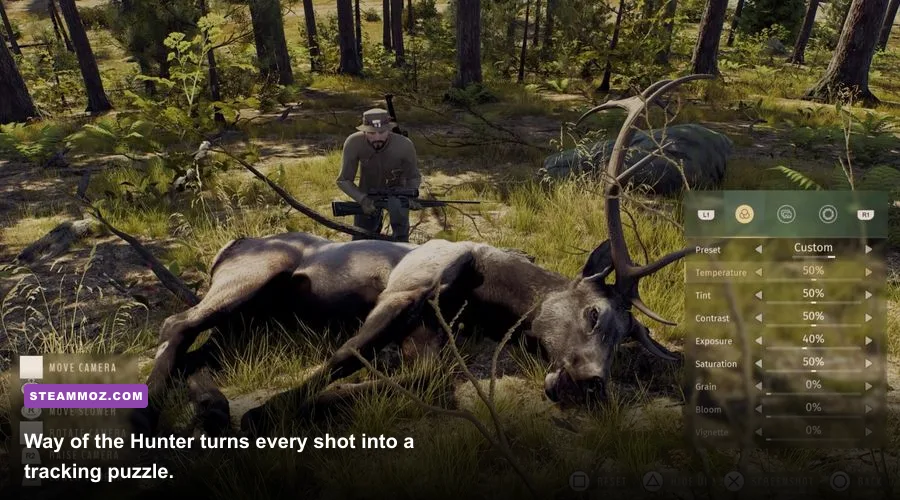
The two clear S-Tier picks are Way of the Hunter and theHunter: Call of the Wild. They are the games to buy if the best part of Hunting Simulator 2 is the moment before the shot, when a promising trail becomes a decision about wind, distance, animal age, and bullet placement.
1. Way of the Hunter
Way of the Hunter on Steam is the strongest recommendation for players who want a more structured and grounded simulation. Its story begins at Nez Perce Valley, where the campaign teaches the fundamentals through missions rather than dropping you into a giant map with every system unlocked. Transylvania offers a contrasting European environment, and later reserves add different species, terrain, and long-range sightlines.
The key difference is its animal herd simulation. A successful hunt is not just a kill; it can affect herd quality over time. Mature animals are more valuable targets, while repeatedly taking young or weak animals can produce a less satisfying population. The game also models animal health and shot results, so a bad hit can create a long, frustrating tracking sequence instead of an instant harvest screen.
Weapon choice is unusually meaningful. The 6.5 Creedmoor is a flexible early rifle for deer-sized game, while a heavier .300 Winchester Magnum gives you more reach and penetration for larger animals. The .223 Remington is better suited to smaller targets, and a 12-gauge shotgun with appropriate ammunition changes how you approach birds and close-range opportunities. Don’t treat the biggest caliber as an automatic upgrade: excessive energy can damage trophy organs, and the wrong cartridge can still produce a poor hit.
Its hunter sense highlights tracks, need zones, and blood evidence, but you’ll get better results by learning the normal signs. Watch the wind indicator before crossing a ridge, crouch near likely drinking zones, and use binoculars to confirm sex and maturity before raising your rifle. The skill tree also rewards patience: perks that improve spotting and information gathering are more valuable early than marginal weapon-handling bonuses.
2. theHunter: Call of the Wild
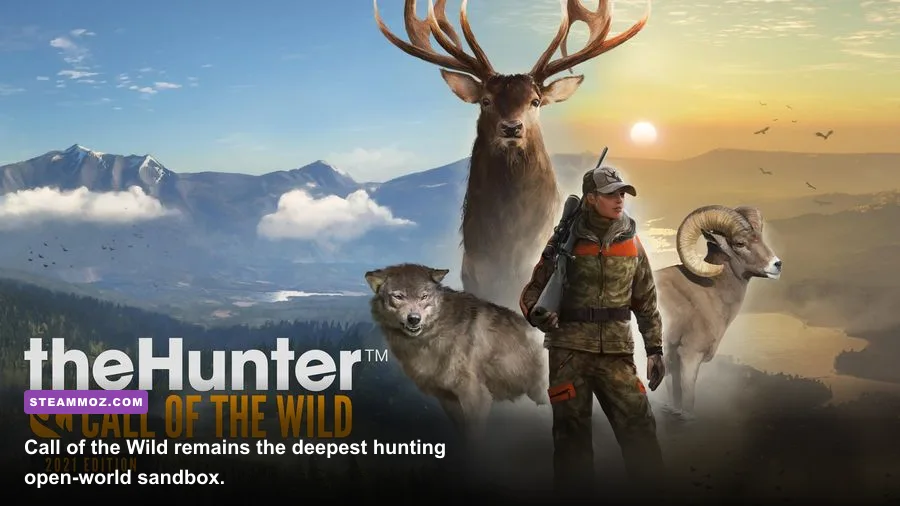
theHunter: Call of the Wild is the broader and more replayable option. Its reserves range from Hirschfelden’s European farmland to Layton Lake District’s forests, Medved-Taiga’s frozen terrain, and the tropical foliage of Parque Fernando. Each reserve changes visibility, animal behavior, and the value of particular weapons.
Call of the Wild is less concerned with a campaign narrative and more interested in building a long-term hunting sandbox. You’ll unlock lookout towers, establish outposts, discover need zones, and gradually improve your equipment. The Animal Class system is central: class 1 covers small animals such as rabbits and ducks, while larger categories climb toward class 9 animals such as moose, bison, and large bears. A weapon’s class range matters more than its raw damage number.
A .243 R. Cuomo is a famously useful early rifle because it covers class 2 to 6 animals, making it ideal for deer and similar game. The 7mm Regent Magnum reaches class 4 to 9 and is a powerful general-purpose upgrade, but recoil and ammunition cost make it less forgiving. For large class 9 targets, the .300 Canning Magnum offers strong penetration. Shotguns, bows, and handguns provide completely different approaches, particularly when you’re hunting in thick cover or trying to keep pressure low.
The game’s trophy and harvest checks reward clean placement, correct ammunition, and avoiding unnecessary follow-up shots. Aim behind the front leg for a broadside lung hit, hold your breath only long enough to stabilize, and never sprint directly through a need zone after spooking an animal. The enormous map library and active community make this the best pick if you want hundreds of hours rather than a compact campaign.
| Game | Hunting realism | Best strength | Best for |
|---|---|---|---|
| Way of the Hunter | Very high | Herd management and shot analysis | Players who want deliberate, ethical hunts |
| theHunter: Call of the Wild | High | Huge reserves and animal variety | Long-term sandbox players |
| Hunting Simulator 2 | High | Accessible tracking and equipment | Newcomers to the genre |
| Red Dead Redemption 2 | Medium | World immersion and wildlife encounters | Story-focused explorers |
| Monster Hunter Wilds | Low simulation, high action | Boss-style creature hunts | Combat-first players |

🎮 Hunting Simulator 2: Elite Edition
Looking to experience this game? Grab your digital key directly on our store for $5.92.
View on Steammoz Store →A-Tier picks with a different hunting rhythm
3. Red Dead Redemption 2
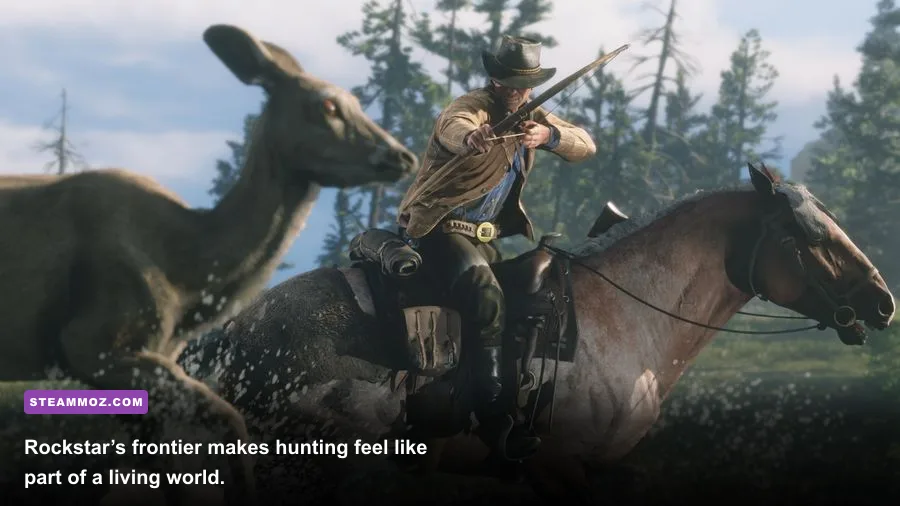
Red Dead Redemption 2 isn’t a hunting simulator, but it may be the best game here at making wildlife feel like part of a functioning ecosystem. Deer cross roads, bears can ambush you near streams, birds react to gunfire, and legendary animals turn familiar regions into tense expeditions.
The hunting system has clear rules. Small animals demand the Varmint Rifle or a bow with small-game arrows if you want a perfect pelt. Medium animals can be taken with a repeater or standard bow, while large game such as elk and bison usually wants a rifle. The Compendium records animal information, and Eagle Eye reveals tracks, scent trails, and clues. Use it to study the route rather than simply sprinting from icon to icon.
Perfect pelts depend on three variables: the animal’s initial condition, the quality of your weapon choice, and a clean kill. Press the study prompt before firing, confirm the three-star rating, then use Dead Eye to place a head or vital-organ shot. A poorly chosen firearm can downgrade the pelt even if the animal drops quickly. The Legendary Buck Antler Trinket, crafted after a successful legendary buck hunt, improves your odds of getting higher-quality parts from future kills, which makes early investment in legendary hunts worthwhile.
Its limitation is scale. You won’t spend an hour reading a herd’s age structure or comparing cartridge penetration. The game’s reward is atmosphere: setting up camp, cooking seasoned meat, crafting satchels, and riding through a thunderstorm while a distant wolf pack howls. If Hunting Simulator 2’s quiet wilderness is what you love, Red Dead Redemption 2 is an outstanding companion even though it is less technical.
4. Monster Hunter Wilds
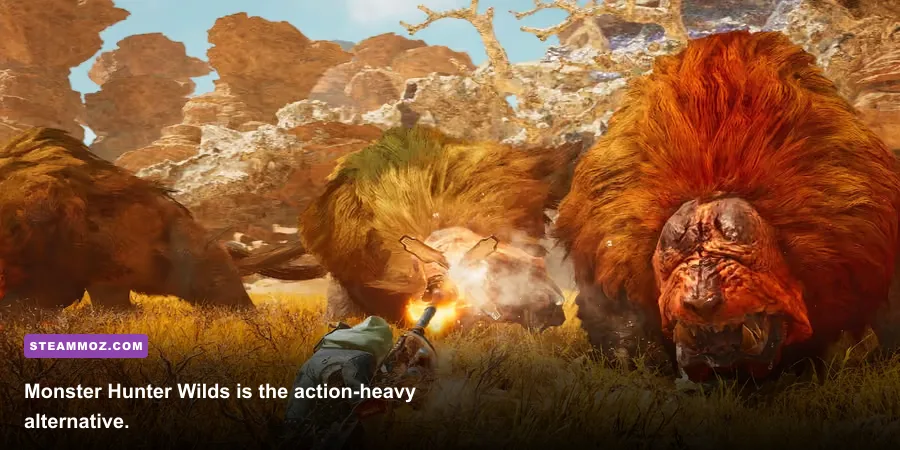
Monster Hunter Wilds takes the word “hunting” in a completely different direction. You track enormous monsters, break specific body parts, exploit elemental weaknesses, and survive multi-phase encounters that feel closer to raid bosses than wildlife observation.
The hook is preparation. Before a hunt, check a monster’s weaknesses, stock healing items, choose armor skills, and select a weapon that suits the target’s openings. The Great Sword rewards charged attacks and precise timing; Dual Blades burn through stamina but excel at rapid elemental damage; the Bow turns distance management into a constant resource puzzle. Your Seikret mount also lets you reposition, sharpen, and use items during a pursuit.
Monster telegraphs are the real equivalent of reading tracks. A monster lowering its head, puffing dust, or shifting its weight often signals a charge or area attack. Wounds and focus strikes create openings, but greed gets punished. Land one heavy combo, then disengage before the creature’s recovery animation ends. Environmental changes can also alter encounters, so don’t assume the same monster behaves identically in every weather state.
This is the pick for players who find Hunting Simulator 2 too passive. It has no realistic ballistics, no trophy scoring, and no need-zone routine, but it delivers a much deeper combat loop. Try it if your ideal hunt ends with a giant monster roaring, a broken horn on the ground, and a new armor set waiting at camp.
The best non-shooting alternative is The Angler
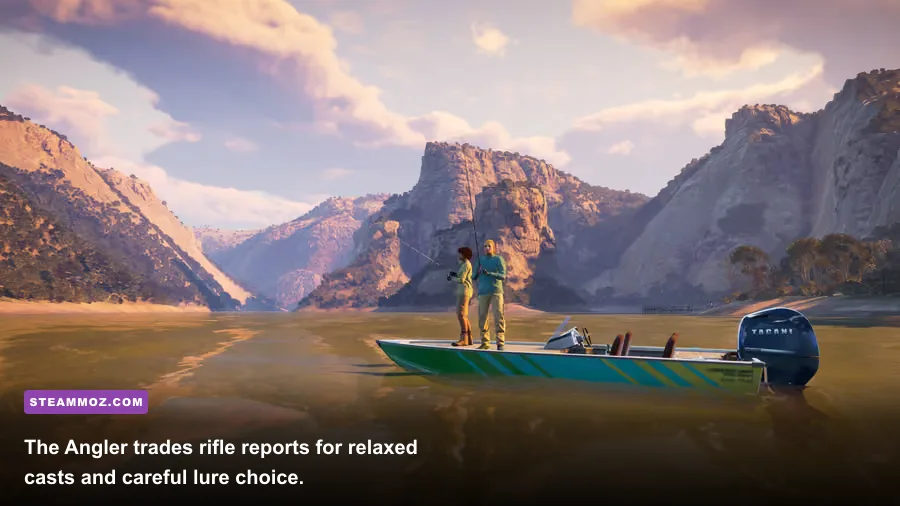
Call of the Wild: The Angler keeps the open-world exploration and nature photography of its hunting sibling while replacing rifles with rods, reels, lures, and patience. The Angler’s official Steam page is worth checking if you want a calmer game with the same broad wilderness appeal.
Golden Ridge Reserve is the starting region, and its lakes and rivers make a good introduction to species behavior. Fish respond to lure type, depth, retrieve speed, and location. A spinner can attract aggressive species during an active bite, while a float setup gives you a slower presentation when fish are holding in a particular depth band. Don’t just cast toward the prettiest water: use the map, scan for activity, and match the presentation to the target.
The fight itself has more nuance than the relaxed presentation suggests. Keep the line tension inside the safe zone, avoid holding the rod at an awkward angle, and use the reel rather than frantic movement to control a running fish. Stronger tackle helps with larger species but can reduce the challenge and alter how quickly you detect subtle bites. Like Hunting Simulator 2, it rewards observation before action.
The Angler works especially well as a second game. After a demanding session in Call of the Wild, you can drive to a scenic lake, complete a few challenges, and still feel like you’re learning a real system. It’s not a substitute if you specifically want rifles and animal tracks, but it captures the same satisfying loop of planning, waiting, and making one clean decision.
Choose the right game for your preferred playstyle
There isn’t one universal winner. Hunting Simulator 2 sits between accessible simulation and equipment management, so the best replacement depends on which part of that formula keeps you playing. If you want harder ballistics, choose Way of the Hunter. If you want content volume, choose Call of the Wild. If you want narrative immersion, choose Red Dead Redemption 2.
| Player priority | Best game | Why it wins | Main compromise |
|---|---|---|---|
| Most realistic tracking | Way of the Hunter | Herd health, shot analysis, and deliberate pacing | Smaller-feeling progression and fewer arcade conveniences |
| Largest hunting sandbox | theHunter: Call of the Wild | Many reserves, species, weapons, and need zones | Less focused campaign structure |
| Best wilderness story | Red Dead Redemption 2 | Wildlife integrated into a richly simulated world | Less detailed ballistics and trophy management |
| Most exciting combat | Monster Hunter Wilds | Deep weapons, breakable parts, and monster phases | Not realistic hunting simulation |
| Most relaxing alternative | The Angler | Exploration, gear choices, and patient encounters | Fishing replaces animal tracking |
For more systems-heavy recommendations, Steamoz’s Architect Life alternatives and Chef Life recommendations cover the same satisfying planning-and-progression appeal from very different angles. If you prefer games built around careful observation, these puzzle-solving tips are also worth a look.
Best starting setups for each recommendation
Starting cleanly makes a huge difference, particularly in the two dedicated hunting sandboxes. In Way of the Hunter, resist buying every rifle immediately. Begin with the 6.5 Creedmoor, binoculars, a reliable scope, and ammunition suited to the species in your current missions. Spend early skill points on spotting and tracking improvements. Your first objective should be learning how wind, animal direction, and terrain interact, not chasing the most expensive weapon.
In Call of the Wild, the .243 is a practical first purchase for class 2–6 animals. Unlock outposts and lookout towers before spending heavily on cosmetic gear. Establish need zones by observing animals rather than shooting the first target you see, then return during the correct time window. Carry a rifle for medium game and a shotgun or bow only when you understand the reserve’s terrain. A versatile loadout beats a glamorous one with narrow class coverage.
For Red Dead Redemption 2, get the Varmint Rifle early if perfect small-game pelts matter to your crafting plans. Keep a bow on your horse, study animals before firing, and use Eagle Eye to follow trails after a hit. In Monster Hunter Wilds, don’t spread resources across every weapon immediately. Pick one main weapon, learn its basic combo and defensive option, then build armor around the monster’s elemental weakness. In The Angler, upgrade line strength and reel control before chasing rare fish across the map.
Performance matters too. The open-world games stream large landscapes, so a fast SSD and 16GB of RAM are sensible targets. On PC, prioritize a stable frame rate over ultra foliage: lowering volumetric effects, shadow quality, and vegetation distance often produces a smoother hunt with a modest visual sacrifice. Keep textures high if your GPU has enough VRAM, because blurry animal silhouettes make identification harder at long range.
| Setting or priority | Recommended target | Why it matters | Typical trade-off |
|---|---|---|---|
| Frame rate | 60 FPS where possible | Improves scope tracking and camera control | May require lower shadows or foliage |
| Textures | High, within VRAM limit | Keeps distant animals and tracks readable | Higher memory usage |
| Shadows | Medium to High | Preserves depth without excessive GPU cost | Ultra can cause large frame-time spikes |
| Volumetric effects | Medium | Maintains atmosphere during fog and weather | Ultra haze can obscure sightlines |
| Motion blur | Off or Low | Makes binocular and scope movement clearer | Less cinematic camera movement |
That same patient mindset carries into other Steamoz guides, including progression tips for A Rogue Escape and PC performance fixes for Citizen Sleeper 2. The practical lesson is simple: learn the system you’re actually using before spending hours fighting it.
The final verdict for 2026
Way of the Hunter is the best overall game like Hunting Simulator 2 if you want realistic tracking, meaningful shot placement, and a slower campaign with a clear sense of purpose. theHunter: Call of the Wild is the better value for sheer variety and replayability, especially if you want to keep discovering reserves months later.
Choose Red Dead Redemption 2 when the setting and story matter as much as the hunt. Pick Monster Hunter Wilds when you want the tension of a hunt but prefer aggressive combat and spectacular boss encounters. And choose The Angler when what you really love is being outdoors, reading the environment, and waiting for the right moment.
Start with Way of the Hunter for the closest simulation match, then move to Call of the Wild when you’re ready for a much larger sandbox. That pairing gives you the strongest 2026 follow-up to Hunting Simulator 2: one game built around thoughtful shots, and another built around the endless promise that the next ridge might reveal something worth tracking.