A Good Snowman Is Hard To Build becomes much easier once you stop treating it like a snowball-pushing game and start treating it like a construction puzzle. Build each snowman from the bottom up, keep the three sizes separate, protect the narrow lanes around your target, and reset the moment a snowball loses its useful route. These 10 tips will teach you how to read the snow, avoid dead ends, and solve new areas without blindly shoving everything into a corner.
Alan Hazelden and Benjamin Davis designed the game around a wonderfully strict rule set. You play the unnamed monster, move snowballs through compact environments, and create snowmen from three pieces. There is no combat build, no inventory, and no timer to pressure you. The difficulty comes entirely from space, order, and commitment. That simplicity is exactly why a single careless push can ruin an otherwise perfect solution.
Learn the Three-Piece Rule Before You Push Anything

Tip 1: Memorize the required order. Every completed snowman needs one large bottom ball, one medium middle ball, and one small head. The finished stack is visually obvious, but the important part is that the lower piece must be placed first. Once a snowball is sitting beneath another, you generally lose the freedom to reposition it, so building the top too early can turn the bottom placement into a nightmare.
Tip 2: Think in size, not in distance. Snowballs grow as you roll them through usable snow. That means a ball near the target is not automatically the best candidate for the head. A nearby ball may already be too large, while a distant ball may have the cleanest route to become the small piece. Before moving, identify which ball can remain small, which one has enough snow to become medium, and which one can safely travel the longest path and become large.
| Snowball role | Required size | Best use | Main danger |
|---|---|---|---|
| Bottom | Large | Placed first on the open foundation | Growing too large to enter the target lane |
| Middle | Medium | Rolled separately, then stacked on the base | Accidentally touching extra snow |
| Head | Small | Saved for the final short approach | Growing before the lower pieces are ready |
The game never gives you a numerical size meter, so use the silhouettes as your measurement tool. A ball that has made several long passes through snow is usually no longer a safe head. If you are unsure, stop rolling and inspect its proportions against the other available balls. This small pause prevents a surprising number of failed attempts.
For players used to more complicated puzzle games, our Flat Heroes ability guide covers a very different kind of decision-making, but the same principle applies here: identify the job of every resource before spending it.

🎮 A Good Snowman Is Hard To Build
Looking to experience this game? Grab your digital key directly on our store for $4.49.
View on Steammoz Store →Read the Snow as a Limited Resource

Tip 3: Separate growth routes from travel routes. Snow is not simply a surface you walk across. It is the material that changes a ball's size. Rolling a ball over a snowy patch increases it, while moving through areas without usable snow lets you reposition without the same growth risk. In practice, every level has two kinds of space: safe corridors for transport and growth zones for manufacturing the correct size.
Do not roll a ball through every patch just because the route is open. A head can become unusable after one unnecessary loop. Instead, map a route mentally: where will this ball enter the snow, where will it leave, and can you still push it toward the target afterward? If the answer is unclear, leave the ball where it is and study another part of the room.
Tip 4: Use long straight passes for the large ball. The bottom piece usually needs the most growth, so it benefits from broad, uninterrupted snow. Make that ball first when the level gives you a large open area, but do not park it in the final position until you have confirmed the middle and head can still reach the stack. A huge base is useful only if it leaves room for the final approach.
This is where the game differs from ordinary Sokoban. In Sokoban, a box often has a fixed identity. Here, the identity changes as you roll it. A ball is not just an object; it is a future role. That is why a seemingly harmless detour can alter the entire solution.
Never Build Yourself Into a Corner

Tip 5: Protect the approach lanes. The final push toward a snowman is more important than the first push. Before placing the large base, trace the direction from which the medium ball must arrive. Then trace the head's route. If either route passes through the base's square, a wall, or a narrow bend that your character cannot circle, the placement is premature.
The monster can push, but it cannot pull. That single limitation explains most failed puzzles. A ball against a wall is not always dead, but a ball against a wall with no snow behind it and no room for you to get around usually is. Corners are especially dangerous because they remove the ability to change direction. Treat any corner placement as permanent unless you have already proven an exit exists.
Tip 6: Keep the monster's standing position in mind. You need space behind a ball to push it. Players often plan the ball's destination while forgetting the character must occupy the opposite square for every move. Narrow passages can look wide enough for the snowball but still fail because the monster cannot get behind it for the next push.
A good habit is to imagine the push from both ends. Ask, “Where will the ball go?” and immediately ask, “Where will I stand afterward?” If you cannot answer both, do not commit. This is also why completed snowmen can act as visual walls: they make the area easier to read, but they can close off an important route for anything still unfinished.
Use a Reliable Solve Order
Tip 7: Solve the most constrained piece first, not always the largest. The usual construction order is large, medium, small, but the planning order can be different. If the head has only one safe lane, study and protect that lane before you roll the base. If the large ball has plenty of open room, it can wait. The most restricted route controls the puzzle, so identify it before making any irreversible push.
A strong general sequence looks like this:
- Survey the entire area. Locate every snow patch, wall, opening, target space, and likely dead end.
- Assign roles. Decide which ball is the likely base, middle, and head before growing anything.
- Prepare the restricted route. Keep narrow lanes clear and test whether the character can circle each ball.
- Grow the large piece. Use the broadest snow field, then leave it somewhere that does not block traffic.
- Grow the medium piece. Avoid touching extra snow once it reaches the correct proportion.
- Finish with the head. Its route should be short, direct, and free of unnecessary snow.
Tip 8: Build one snowman at a time when the room allows it. Multiple unfinished snowmen create visual noise and consume the same corridors. Completing one stack can clarify the remaining space, but do not rush to fill the nearest target if doing so blocks another. Some rooms are effectively solved in an order dictated by their exits, not by the order in which the snowmen appear.
Take screenshots or make a quick sketch if a room overwhelms you. That is not overkill; the puzzle's difficulty comes from holding several future positions in your head. A ten-second diagram can replace five minutes of random pushing.
Reset Early and Experiment Without Panic

Tip 9: Reset as soon as the state becomes unsalvageable. There is no penalty for abandoning a bad arrangement. If a small ball has grown too much, if a large ball occupies the only turning point, or if you can no longer stand behind a required push, restarting is the correct move. Do not spend several minutes trying to force an elegant rescue from a position the rules have already closed.
That said, not every awkward position is a failure. Test whether a ball can be pushed away from a wall, whether a loop lets you get behind it, or whether an apparently oversized piece is actually intended for the base. The game rewards controlled experiments. Make one push, observe the new access route, and reassess. Avoid chaining five moves together before checking the consequences.
Tip 10: Use the interface to learn the puzzle's logic. Move slowly around unfamiliar objects. Watch how the character approaches a ball and notice whether the next push would send it onto snow, off snow, into a wall, or into another object. The soft, minimalist presentation can make a move feel harmless when its geometric consequence is permanent.
If you are playing on PC, keep the controls comfortable and avoid rushing inputs. This is not a game where higher frame rates create a competitive advantage, but clean movement makes careful positioning easier. Players troubleshooting other indie games can also compare our Gato Roboto PC specs guide and Fly Corp performance settings for broader low-demand PC advice.
What Experienced Players Notice First
Veteran players stop looking at the snowman target as a single destination. They see a sequence of temporary squares: the base's landing point, the middle's approach, the head's final push, and the character's standing positions after each move. That perspective is the key skill the game teaches. You are not merely moving snowballs toward a goal; you are preserving future access.
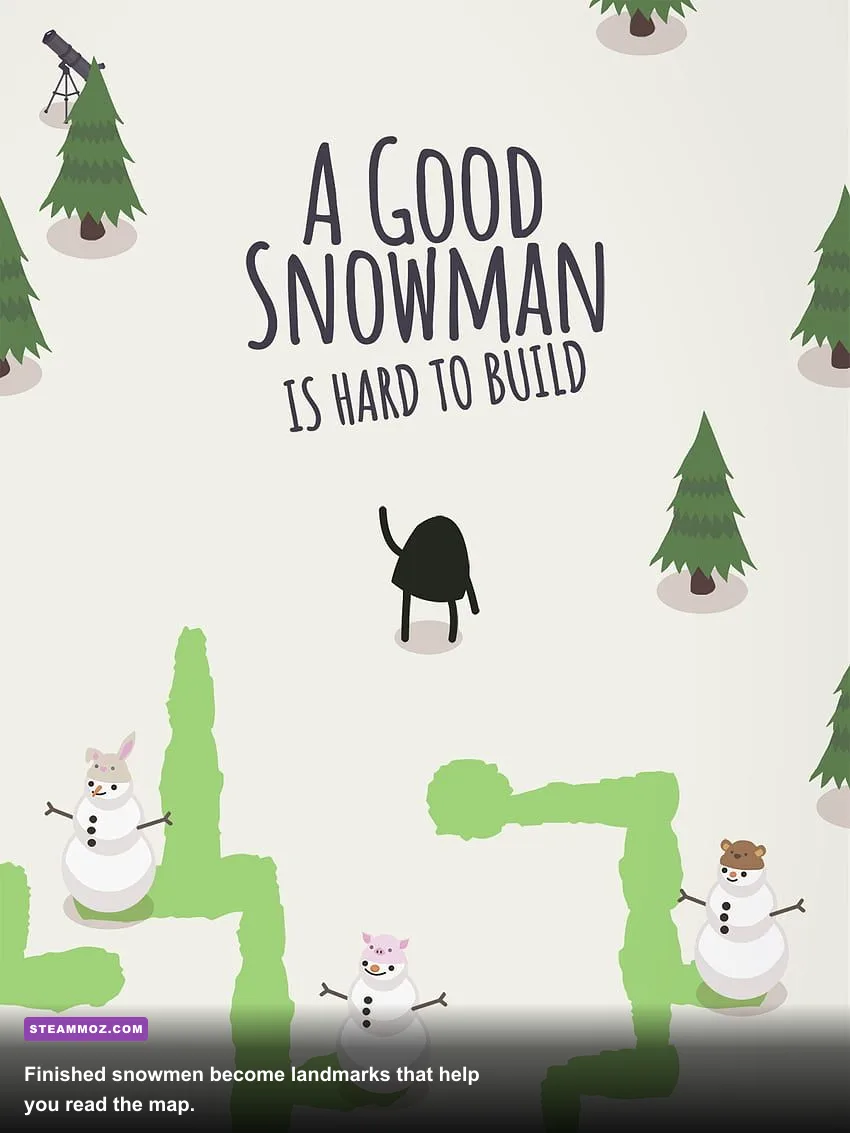
The visual design helps more than it first appears. Completed snowmen act as landmarks, open snow signals growth potential, and walls reveal where a route will terminate. The soundtrack and gentle presentation make experimentation feel safe, but the underlying logic is exact. A move either preserves the next route or it does not.
| Situation | Likely mistake | Best response | Why it works |
|---|---|---|---|
| Head is too large | It crossed a growth patch unnecessarily | Reset and reserve the shortest route | Size cannot be reduced through ordinary play |
| Base blocks the room | It was placed before checking final approaches | Move it only if a circling route remains; otherwise reset | The monster needs standing space behind every push |
| Ball is against a wall | It was pushed without an exit plan | Check for a safe side route before continuing | You cannot pull the ball free |
| Several balls overlap routes | Roles were assigned too late | Pause and label base, middle, and head | Role clarity prevents accidental overgrowth |
For the official version and platform details, visit the A Good Snowman Is Hard To Build Steam page. You can also find more about the creators through Draknek's official site and explore the game's presentation through its official game page.
If you remember only one rule, make it this: never push a snowball unless you already know its next useful position. Keep the head small, reserve open lanes, grow pieces deliberately, and reset without guilt. Once those habits click, the game's toughest-looking rooms stop feeling like trial and error and start reading like clean little machines waiting for the right sequence.
For more puzzle-minded gaming coverage, Steamoz also has guides to Dungeons 2 route planning and Heros Hour build choices. Neither game involves snowballs, but both reward the same discipline: understand the system first, then make every move count.