
If Chef Life: A Restaurant Simulator - Al Forno Edition hooked you on chopping, plating, menu design, and the stress of a real dinner rush, start with Cooking Simulator, PlateUp!, and Recipe for Disaster. They cover the three parts Chef Life does best: physical cooking, repeatable restaurant operations, and long-term management. Overcooked! 2, Good Pizza, Great Pizza, and Dave the Diver are excellent alternatives when you want more co-op chaos, a lighter daily loop, or a broader adventure around your restaurant.
The Al Forno Edition is a particularly good fit for players who enjoy the ritual behind a finished dish. You aren't just tapping a recipe button. You prep ingredients, manage cooking times, assemble plates, adjust your menu, and try to keep service moving without turning the kitchen into a traffic jam. The games below rank by how closely they reproduce that feeling, not simply by whether they contain food.

🎮 Get Chef Life: A Restaurant Simulator
Ready to dive in? Grab your copy today for just $4.49.
Check OfferS-Tier games for serious virtual chefs

1. Cooking Simulator
Cooking Simulator is the strongest recommendation if your favorite part of Chef Life is physically handling ingredients. Its first-person kitchen gives you pots, pans, knives, ovens, cutting boards, spices, plates, and a large set of interactive appliances. You can slice, pour, fry, boil, bake, season, and plate with far more tactile freedom than most restaurant games.
The difference is focus. Chef Life builds a full restaurant career around menu development and service. Cooking Simulator is more like a culinary sandbox with career tasks, timed recipes, and specialized scenarios. That makes it less polished as a complete business sim, but better when you want to experiment with a sauce, burn something spectacular, or discover that you forgot the salt after spending five minutes on a reduction.
Its recipe system rewards process discipline. Read the preparation list before grabbing ingredients, keep a clean counter, and group tools by station. A rushed player who leaves pans everywhere loses time through movement alone. On PC, mouse precision also matters: low sensitivity makes pouring and cutting easier, while excessive camera movement makes delicate actions feel clumsy.
Chef Life players should begin with the career mode rather than immediately treating the game as a physics toy. The career structure gives your experiments a purpose and teaches the kitchen equipment in manageable steps. The official Cooking Simulator Steam page is the best place to check current DLC and system details.
2. PlateUp!
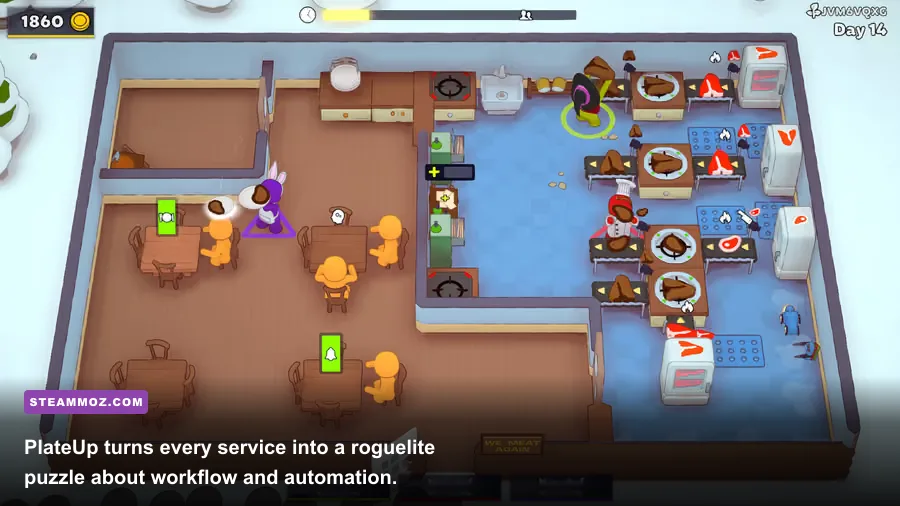
PlateUp! is the best alternative if your favorite Chef Life moment is the service rush rather than the individual recipe. It supports up to four players in online or local co-op, and each run asks you to build a restaurant, survive daily services, and improve the layout between shifts. A run can end permanently, but successful restaurants become longer-term franchises with new menus and upgrades.
The genius is that layout is effectively your build. A sink placed too far from the prep counter creates wasted movement. A dining table positioned badly can force customers and staff through the kitchen. Later, appliances such as conveyor belts, automated mixers, grabbers, and upgraded hobs let you redesign the restaurant around speed instead of manually carrying every plate.
Unlike Chef Life, PlateUp! doesn't aim for realistic culinary technique. The recipes are deliberately readable: burgers, pies, pizza, fish, steak, and other dishes create a decision tree of preparation steps. The real difficulty comes from the number of customers, the order queue, and the way daily card choices alter your next service.
Solo players should choose a simple main dish and prioritize a sink, a dining table, and a clear route between cooking and serving. In co-op, assign jobs before the first customer arrives. One player should own cooking, another can handle front-of-house, and a third should prep or wash dishes. If everyone does everything, you get the same problem as an understaffed real kitchen: duplicated work in one corner and a disaster in another.
| Game | Best For | Core Structure | Chef Life Similarity |
|---|---|---|---|
| Cooking Simulator | Hands-on cooking | Career and sandbox scenarios | Very high for preparation |
| PlateUp! | Service logistics | Roguelite restaurant franchises | Very high for workflow |
| Recipe for Disaster | Management decisions | Scenarios and freeform restaurants | High for operations |
| Overcooked! 2 | Multiplayer pressure | Level-based co-op campaign | Medium for cooking, high for urgency |

🎮 Chef Life: A Restaurant Simulator - AL FORNO EDITION
Looking to experience this game? Grab your digital key directly on our store for $5.99.
View on Steammoz Store →A-Tier picks for deeper management and replayability
Recipe for Disaster
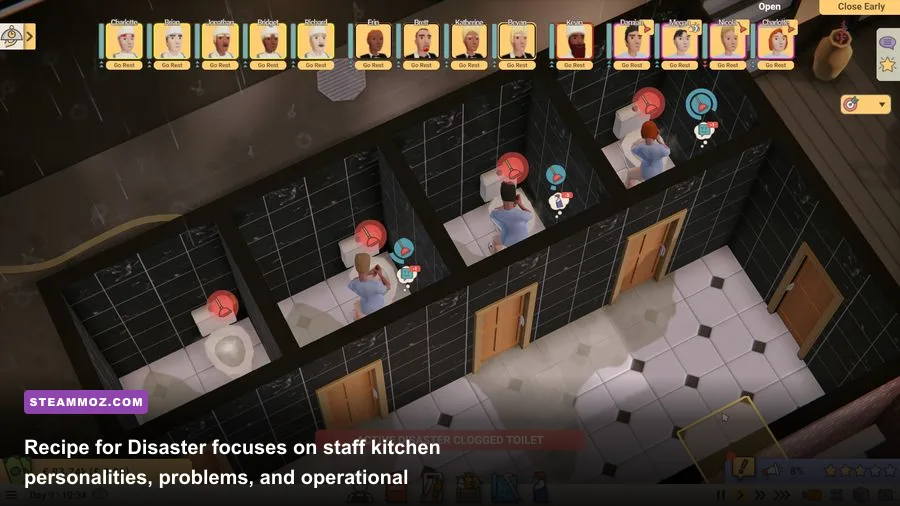
Recipe for Disaster is the closest match for players who want to manage a restaurant instead of personally performing every action. You design the floor plan, hire staff, assign roles, create dishes, set prices, and deal with the messy human side of service. Staff members have different skills, traits, relationships, and needs, so the best cook isn't automatically the best employee for every station.
That people-management layer gives Recipe for Disaster a different kind of tension. In Chef Life, a bad service usually means you mismanaged prep or timing. Here, the same failure might come from a tired employee, a poorly trained server, a broken appliance, a cramped route, or a menu that asks too much of your kitchen. You need to watch the information panels instead of staring only at the dining room.
Start with a short menu. Two or three dishes are easier to balance than a sprawling list that forces staff to bounce between unrelated stations. Keep ingredient storage near prep, place cooking equipment close to the pass, and leave enough space for staff to cross without colliding. If customer satisfaction drops, don't instantly raise prices or fire half the team. Check whether the problem is speed, food quality, seating, or employee morale.
The game is also valuable because it exposes what Chef Life abstracts away. Chef Life makes you feel like the chef-owner; Recipe for Disaster makes you confront payroll, labor coverage, customer patience, and equipment reliability. Visit the official Recipe for Disaster Steam listing for the latest updates and supported features.
Good Pizza, Great Pizza
Good Pizza, Great Pizza is less demanding mechanically, but its daily progression loop is wonderfully efficient. You run a pizzeria, interpret sometimes-awkward customer requests, prepare pizzas, and use the day's earnings to buy upgrades. The core challenge is translating language into a correct order: half toppings, specific crust expectations, sauce preferences, and customers who are not always clear about what they want.
That makes it a strong choice after a long Chef Life session. You still get the satisfaction of prep, service, and gradual expansion, but the pace is calmer and the controls are far more approachable. The game also gives each day a clear rhythm. Earn money during service, invest in equipment or ingredients, then return to the next day with a slightly more capable shop.
Don't treat every upgrade as equally valuable. Faster ovens and equipment that reduce repetitive input usually improve your income more than cosmetic purchases early on. Pay attention to customer wording, because a technically edible pizza can still lose value if it ignores the requested topping placement or quantity. The official Steam page also tracks platform and content information.
Dave the Diver
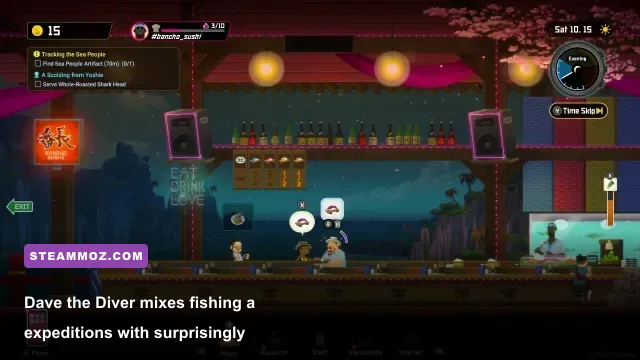
Dave the Diver is the most inventive recommendation here. During the day, Dave dives into the Blue Hole to catch fish and discover resources. At night, he works at a sushi restaurant managed with Bancho. The restaurant section is not a full Chef Life replacement, but it creates a satisfying two-part economy: diving supplies the ingredients, and restaurant performance funds better equipment and business upgrades.
The sushi service has clear priorities. Keep Bancho supplied, serve customers quickly, and use staff abilities to cover tasks such as serving, wasabi preparation, and drink service. As the restaurant improves, hiring and training let you reduce the amount of manual work. The strongest progression decisions often come from deciding whether to invest in diving gear, restaurant staff, menu quality, or storage.
It also has more narrative momentum than Chef Life. Characters, bosses, underwater locations, and research goals keep the campaign moving when a pure management loop might start to feel repetitive. If your ideal cooking game includes exploration and combat, Dave the Diver is an easy A-Tier pick. The official Dave the Diver Steam page has the current release information.
| Game | Progression Curve | Best Solo Use | Main Weakness Compared With Chef Life |
|---|---|---|---|
| Recipe for Disaster | Scenario-driven and open-ended | Planning staff and layouts | Less tactile cooking |
| Good Pizza, Great Pizza | Day-by-day upgrades | Relaxed service routine | Focused almost entirely on pizza |
| Dave the Diver | Adventure campaign | Balancing two businesses | Shorter, lighter restaurant management |
B-Tier games that change the recipe
Overcooked! 2
Overcooked! 2 is not a realistic restaurant simulator, but it is one of the best tests of kitchen communication ever made. Its campaign throws teams into shifting kitchens with moving platforms, portals, fires, conveyor belts, water hazards, and other obstacles. The basic tasks are familiar: chop, cook, plate, serve, and wash dishes. The execution is anything but calm.
Up to four players can work together, and the game is at its best when every person has a defined responsibility. Call out dropped ingredients, announce when a pan is ready, and never assume someone else is washing plates. A common beginner mistake is to chase the highest-value order while ignoring the dirty-dish backlog. That creates a delayed collapse: the kitchen looks productive for thirty seconds, then nobody has a clean plate.
Compared with Chef Life, Overcooked! 2 has almost no interest in pricing, menu composition, or culinary quality. Its value is pressure training. It teaches you to prioritize bottlenecks and communicate in short, useful calls. If your Chef Life services fail because you freeze when several orders arrive together, Overcooked! 2 will sharpen that instinct quickly. The official Overcooked! 2 Steam page lists its multiplayer and expansion content.
Tavern Master
Tavern Master swaps the modern professional kitchen for a medieval inn. You build rooms, seat guests, serve food and drinks, hire staff, and expand the business across a steadily growing establishment. Its systems are lighter than Chef Life's, but the placement-focused management loop makes it a pleasant option if you enjoy turning a tiny operation into a busy venue.
The key lesson is spatial efficiency. Keep storage and production close to the areas that consume them, avoid forcing servers to walk around unnecessary furniture, and expand only when your staffing can cover the additional demand. Tavern Master works best as a lower-stress management game rather than a culinary simulation. It is also a useful palate cleanser if the precision of Chef Life starts feeling like work.
Cook, Serve, Delicious! 3?!
Cook, Serve, Delicious! 3?! puts the restaurant on wheels and focuses heavily on fast order entry and preparation decisions. The food truck setting gives the game a different structure, while the keyboard-driven service can become surprisingly intense at higher difficulty. You build menus, prepare dishes, and attempt to satisfy a growing stream of customers without making costly mistakes.
It is a good fit for players who want more input-heavy challenge than Recipe for Disaster but less physical manipulation than Cooking Simulator. Learn the hotkey layout, keep common ingredients mentally grouped, and prioritize orders approaching their patience limit. The game is less visually grounded than Chef Life, yet its service rhythm is excellent for short sessions.
| Tier | Game | Choose It If You Want | Ideal Session |
|---|---|---|---|
| S-Tier | Cooking Simulator | Realistic kitchen interaction | 30 to 90 minutes of experimentation |
| S-Tier | PlateUp! | Co-op workflow and automation | One complete franchise run |
| A-Tier | Recipe for Disaster | Staff and restaurant management | Long-form planning |
| A-Tier | Dave the Diver | Cooking mixed with adventure | Story and progression sessions |
| B-Tier | Overcooked! 2 | Maximum multiplayer pressure | Short co-op bursts |
| B-Tier | Tavern Master | Relaxed venue building | Casual management |
Which Chef Life alternative should you buy?

Choose Cooking Simulator if the best part of Al Forno Edition is handling ingredients and equipment. It gives you the most direct replacement for the tactile side of Chef Life, even though its restaurant-management layer is thinner.
Choose PlateUp! if you play with friends or love redesigning a kitchen after every service. Its one-to-four-player structure and upgrade system create the strongest replayability on this list. It is also the most ruthless about bad layouts, which makes every successful automation upgrade feel earned.
Choose Recipe for Disaster if you want to think like an owner. Its staff traits, schedules, floor plans, and customer feedback make it the best follow-up for anyone who spends more time studying Chef Life's restaurant finances than perfecting a plate.
Choose Good Pizza, Great Pizza for a calmer, more accessible loop. It is ideal on handheld PCs or for short evening sessions because each day has a clean beginning and end. Choose Dave the Diver if you want story, exploration, fishing, combat, and a restaurant economy in one package.
Finally, pick Overcooked! 2 when the goal is laughter and panic with friends. It won't replace Chef Life's culinary detail, but it remains one of the best games for learning how quickly a kitchen falls apart when nobody communicates.
Performance and setup advice for PC players
These games have very different technical profiles. Chef Life and Cooking Simulator render detailed kitchens with many interactive objects, while PlateUp! and Good Pizza, Great Pizza are much easier to run. On a modern gaming laptop, prioritize stable frame pacing over maximum shadows. In a first-person kitchen, inconsistent frames make pouring, cutting, and camera movement feel worse than a lower but locked frame rate.
For Cooking Simulator, begin with High textures, medium shadows, ambient occlusion enabled, and motion blur disabled. If the kitchen becomes crowded with objects, lower shadows before textures. For Chef Life, reducing volumetric effects and reflections usually costs less visual quality than dropping texture detail. PlateUp!, Overcooked! 2, and Good Pizza, Great Pizza generally need little tuning, but borderless window mode can help if you switch frequently between the game and a recipe guide.
| Game | Recommended Starting Profile | First Setting to Lower | Why |
|---|---|---|---|
| Chef Life | High textures, medium shadows | Reflections or volumetrics | Preserves kitchen detail |
| Cooking Simulator | High textures, medium effects | Shadows | Many objects can increase scene load |
| PlateUp! | Native resolution, effects on | Resolution scale only if needed | Usually light on hardware |
| Overcooked! 2 | Native resolution, stable frame cap | Post-processing | Prioritizes readable hazards |
| Dave the Diver | Native resolution, medium shadows | Shadow quality | Keeps exploration smooth |
Use a controller for Overcooked! 2, PlateUp!, and Dave the Diver if that feels natural, but mouse and keyboard remain better for Cooking Simulator's precise interactions. Before troubleshooting, check the developer's patch notes and the official store requirements rather than relying on random configuration files. If you're also dealing with stutter in other PC games, Steamoz's PC crash and low-FPS troubleshooting guide covers the broad fixes worth trying first.
The final recommendation
There isn't one perfect Chef Life replacement because Chef Life combines several different fantasies: being a chef, designing a menu, running a service, and growing a restaurant. Cooking Simulator owns the hands-on kitchen fantasy. PlateUp! owns the workflow and replayability fantasy. Recipe for Disaster owns the staff-and-business side, while Dave the Diver delivers the most distinctive broader adventure.
For most players, the smartest two-game follow-up is Cooking Simulator plus PlateUp!. The first gives you careful prep and culinary experimentation; the second forces you to turn that kitchen knowledge into a functioning service. Add Recipe for Disaster when you want deeper management, or Overcooked! 2 when the dinner rush needs a multiplayer explosion.
And if you enjoy methodical progression games beyond restaurant sims, Steamoz's guides to stronger runs in Defend the Rook and Hero's Hour weapon choices are worth bookmarking. The common thread is the same: build a reliable system, identify the bottleneck, and don't panic when the next wave arrives.