
Yes, Just Cause 4: Dare Devils of Destruction is worth playing in 2026—but only if you want a compact, arcade-style vehicle combat expansion rather than a huge story add-on. Its 16 events deliver spectacular crashes, tricky arena layouts, and some of the funniest driving in Just Cause 4. The catch is simple: once you finish the campaign and unlock the main rewards, the DLC has very little depth beyond chasing better times and cleaner wins.
That makes this a strong recommendation for Just Cause fans who enjoy stunt driving, destruction, and short replayable challenges, especially when the expansion is discounted. It is a weaker buy at full price for players expecting new characters, a large map, or another narrative adventure. In 2026, its value comes from the quality of the driving sandbox—not the amount of content.
What Dare Devils of Destruction actually adds
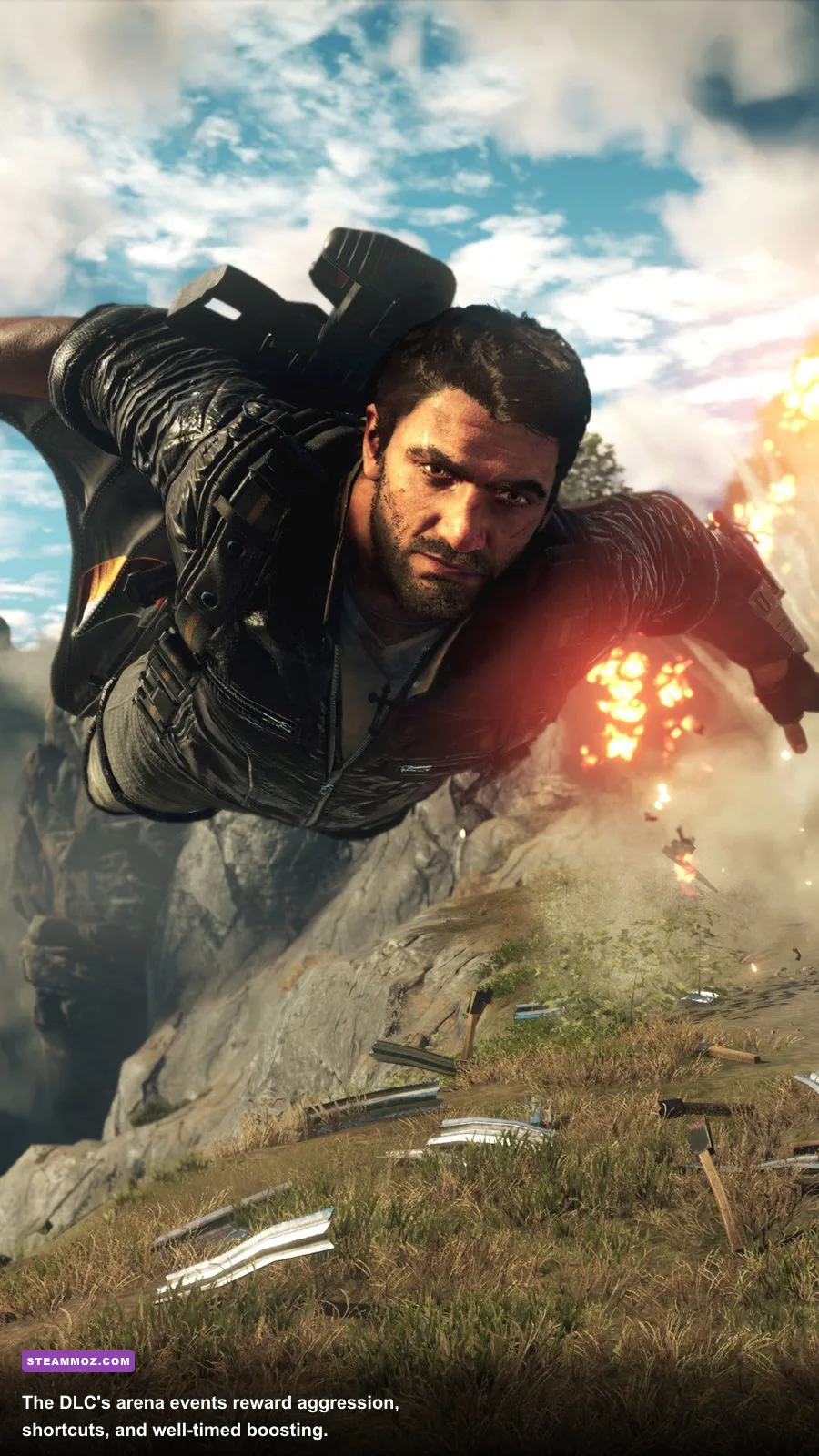
Dare Devils of Destruction is the first major expansion in the Danger Rising expansion pass and focuses almost entirely on vehicle-based challenges. Rico Rodriguez is pulled into a televised death-sport spectacle run by the Dare Devils, a group of drivers who turn Solís's roads and arenas into a demolition playground. The premise is deliberately thin, but it gives the DLC an excuse to put you behind the wheel more often than the base game does.
The expansion adds 16 events split across three event types: Race, Survival, and Rampage. Race events are the most conventional. You follow checkpoints, hit jumps, use ramps, and try to beat rival drivers to the finish. Survival events turn the arena into a moving hazard course, asking you to endure environmental dangers and enemy attacks while keeping your vehicle operational. Rampage events are the purest expression of the DLC: smash opponents, destroy targets, and create as much vehicular mayhem as the scoring system allows.
There are also new vehicles designed around these challenges, including the buggy-like Big Boy, the heavy Deathstalker, and other Dare Devils machines built for speed, impact resistance, or destructive force. They aren't a traditional RPG-style garage with dozens of upgrade paths. Instead, each vehicle has a clear handling identity. Light vehicles accelerate quickly and recover from jumps well, while heavier options can bully smaller rivals but feel sluggish when a course demands precision.
The events are accessed through the Dare Devils activity in Solís rather than through a sprawling new landmass. That distinction matters. You get new places to race and wreck cars, but not a second open-world region comparable to the base game's enormous map. If your favorite Just Cause 4 memories involve gliding across the mountains of Qacha, storm-chasing near the Illapa Project, or dismantling Black Hand bases, this DLC only occasionally feeds you back into that loop.
For a useful point of comparison, the expansion is much closer to a focused arcade challenge pack than a conventional story DLC. Players who enjoy short sessions may appreciate that structure. You can complete one race in a few minutes, replay it immediately, and test a different vehicle without committing to a long mission chain.
| Content | What You Get | 2026 Value |
|---|---|---|
| Event Types | Race, Survival, and Rampage challenges | Strong variety for short sessions |
| Vehicle Focus | Specialized Dare Devils cars and trucks | Best reason to play the DLC |
| Story | Light framing narrative around the Dare Devils | Functional, but not memorable |
| Open-World Content | Activities integrated into Solís | Limited compared with the base game |
| Replayability | Times, scores, and improved event ranks | Depends heavily on your competitive streak |
Before buying, check the official Steam listing for Dare Devils of Destruction to see whether the expansion is included in your edition or current bundle. Ownership can be confusing because Just Cause 4 has been sold through several editions and expansion-pass packages.

🎮 Just Cause 4: Dare Devils of Destruction
Looking to experience this game? Grab your digital key directly on our store for $3.99.
View on Steammoz Store →How the driving and combat hold up
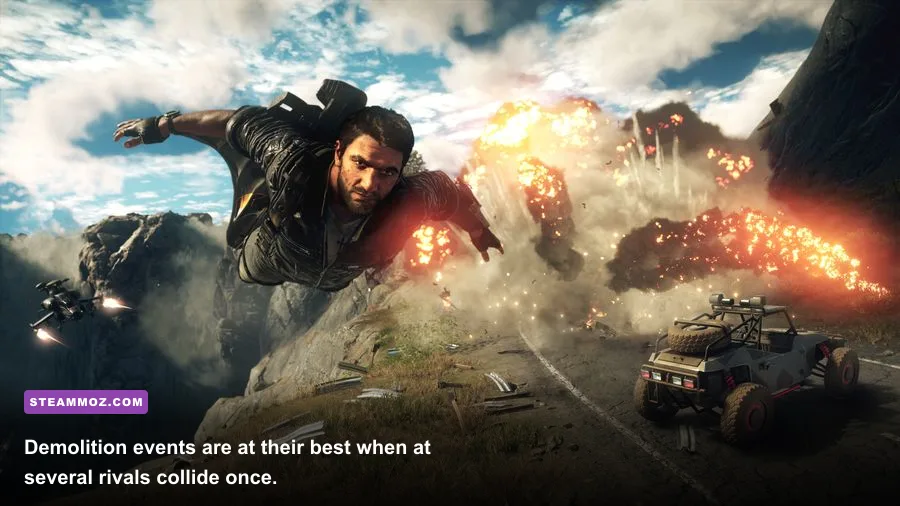
The big surprise is that Dare Devils of Destruction makes Just Cause 4's driving feel more deliberate. In the open world, vehicles are often disposable tools: grab a truck, smash through a gate, launch it off a cliff, and abandon it when the next shiny toy appears. Here, your vehicle is the entire game. You have to understand momentum, braking distance, collision angles, and when to stop fighting the road.
Acceleration is valuable, but it isn't always the winning stat. On narrow tracks, a heavy brake tap before a turn can save more time than holding the boost through a barrier. Light vehicles recover quickly after landing, which makes them excellent on jump-heavy Race courses. Heavy vehicles are better in Rampage events because a clean side impact can spin an opponent or shove it into an explosive hazard. The trade-off is that a heavy vehicle takes longer to point in a new direction, so missed turns are punishing.
Vehicle damage is readable without becoming a detailed simulation. Body panels buckle, smoke signals serious damage, and a heavily abused vehicle becomes harder to control before it finally fails. That visual feedback gives you a useful decision: stay aggressive and risk a knockout, or disengage long enough to preserve the vehicle for the final stretch. Survival events make this choice particularly important because careless collisions can leave you limping through the last checkpoint.
Rico's grappling hook remains the secret weapon. It can pull you around obstacles, yank opponents off-line, and create emergency corrections when a jump goes wrong. The hook isn't a magic shortcut through every event, though. Overusing it can leave your vehicle facing the wrong direction or drag you into a wall at an awkward angle. The best players use it as a steering assist, not as a replacement for learning the course.
Winning each event type
Race: Learn the route before chasing first place. Checkpoint gates are often positioned to reward a specific landing angle, and cutting too sharply can cost more time than taking the obvious road. Use boost after landing, not before a jump, unless the course clearly needs extra distance. Your goal is to turn every jump into forward momentum instead of a sideways crash.
Survival: Avoid the center of crowded arenas. Enemy vehicles and environmental hazards tend to converge there, leaving you vulnerable to chain collisions. Drive around the perimeter until the field thins out, then cut across when you need to reach the next checkpoint. A vehicle with reliable traction and enough mass to absorb impacts is generally safer than the fastest option.
Rampage: Don't chase the weakest target across the map. Position yourself near ramps, explosive objects, or narrow passages where rivals have fewer escape routes. A side hit is more useful than a rear tap because it changes the opponent's trajectory. If the scoring target is a destructible structure, clear nearby vehicles first so you aren't interrupted during the final attack.
| Event Type | Best Vehicle Trait | Common Mistake | Reliable Strategy |
|---|---|---|---|
| Race | Acceleration and stable landings | Boosting into every jump | Brake before turns and boost after landing |
| Survival | Durability and predictable handling | Fighting in the arena center | Use the perimeter and avoid chain collisions |
| Rampage | Weight and impact power | Chasing targets blindly | Force enemies toward ramps and hazards |
The physics are still unmistakably Just Cause 4. Cars can bounce in ways that feel absurd, traffic can ruin a perfect attempt, and a supposedly clean landing may send you rolling down a hillside. That lack of precision is part of the charm, but it also prevents the DLC from feeling like a serious racing game. If you're coming from Forza Horizon or Wreckfest, expect looser handling and more slapstick. If you're coming from the base game, the driving feels focused enough to be surprisingly satisfying.
Progression, rewards, and replay value

Dare Devils of Destruction uses event completion and ranking to push you through its content. Your first clear is often about survival: finish the route, learn the hazards, and figure out which vehicle the event favors. Later attempts are about efficiency. You start cutting corners, timing boosts, using the grappling hook for micro-corrections, and deliberately setting up impacts instead of reacting to them.
That progression curve works because the early events teach the vocabulary of the DLC without burying you in menus. You learn how much speed a jump needs, how quickly a heavy vehicle can turn, and how close you can get to an explosive object before committing. The problem is that the reward structure doesn't always offer enough motivation after you've earned the main unlocks. There is no deep vehicle-stat crafting system, no substantial skill tree, and no persistent competitive ladder.
The DLC is therefore at its most replayable when you create your own goals. Try to improve a bronze clear into a gold-level run, complete an event without using the grappling hook, or win a Rampage challenge while keeping your vehicle above half health. Players who enjoy leaderboards and time trials can extract several extra hours from the package. Everyone else may see the credits, unlock the useful gear, and move on.
One worthwhile benefit is how the new vehicles complement the rest of Solís. A specialized off-road machine can make cross-country travel more entertaining, while a heavier combat vehicle gives you a different way to approach hostile outposts. The DLC doesn't transform the campaign's progression, but it adds toys that make free-roaming more chaotic. That matters because Just Cause 4's best moments often happen between missions rather than inside them.
| Player Goal | Expected Playtime | Value Judgment |
|---|---|---|
| Finish the event chain | 2–4 hours | Good for a focused weekend session |
| Earn strong event ranks | 5–8 hours | Worthwhile if you enjoy retries |
| Master every route | 8+ hours | Mostly for challenge-focused players |
| Explore new vehicles in Solís | Open-ended | Excellent sandbox value, limited structured content |
Compared with other DLC packs, this is narrower but more mechanically coherent. It doesn't scatter a few unrelated missions across the map. Every event serves one idea: drive something fast, hit something hard, or survive a ridiculous obstacle course. That focus is refreshing, even if the overall package feels small beside Just Cause 4's huge base campaign.
Graphics, performance, and the best PC settings
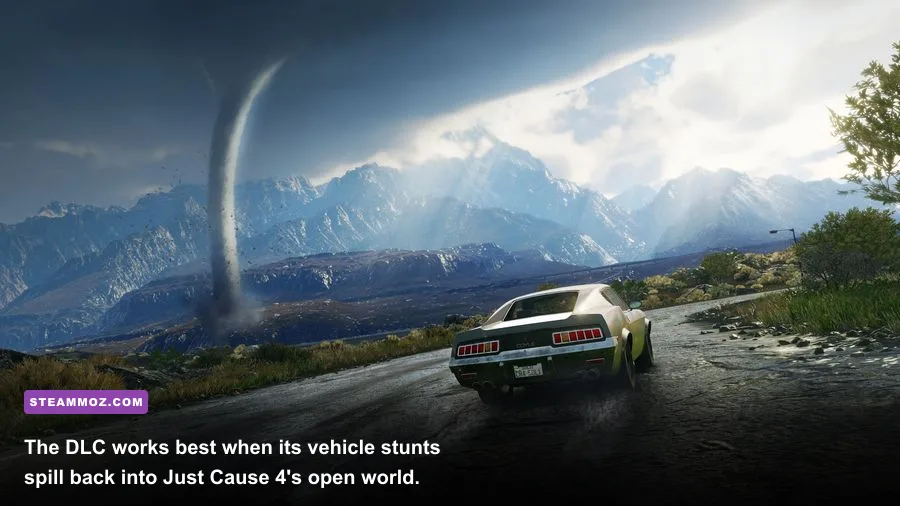
Dare Devils of Destruction doesn't radically change the game's visual presentation. The same tropical coastlines, dusty valleys, dense forests, and extreme weather systems are still doing the heavy lifting. The arenas can become particularly busy when several vehicles, explosions, smoke effects, and destructible objects overlap, so performance consistency matters more here than it does during quiet exploration.
On PC, the most demanding settings are usually resolution, shadows, water, and world-detail options. Motion blur is worth disabling for competitive driving because it makes fast camera movement harder to read. Volumetric effects can also muddy visibility during storms, although dropping them too far takes some atmosphere out of Solís. If your graphics card has limited VRAM, lowering texture quality is safer than accepting severe stutter during crowded destruction sequences.
The target should be a locked 60 frames per second rather than an unstable high average. A 90 FPS peak that collapses to 45 FPS during a pile-up feels worse than a consistent 60. Input timing is not as demanding as in a fighting game, but steering corrections and grappling-hook saves still benefit from a stable frame rate.
| Setting | Recommended Value | FPS Impact | Visual Result |
|---|---|---|---|
| Resolution | Native monitor resolution | Very High | Keep native unless GPU-limited |
| Textures | High, or Medium under 6 GB VRAM | Medium | High preserves vehicle and terrain detail |
| Shadows | Medium–High | High | Medium is a good performance compromise |
| Water Detail | Medium | Medium–High | Useful reduction near coastal arenas |
| World Detail | High | High | Lower this first if driving causes stutter |
| Volumetric Effects | Medium | Medium | Maintains weather atmosphere without excessive haze |
| Motion Blur | Off | Minimal | Sharper turns and clearer collision reads |
| Anti-Aliasing | High/default | Low–Medium | Reduces shimmering on roads and cables |
For broader troubleshooting, our guide to fixing PC crashes and low FPS covers the same useful fundamentals: update drivers, verify files, close overlays, and test the game without background capture software. Just Cause 4 can also behave differently depending on whether you're using borderless or exclusive fullscreen, so test both before blaming your hardware.
The official Just Cause 4 Steam page lists the game's supported platform details and base requirements. Those requirements are old by 2026 standards, but a modern budget gaming PC should still prioritize a dedicated GPU, an SSD installation, and enough system memory to avoid streaming hiccups while driving rapidly across the map.
Who should play it in 2026?
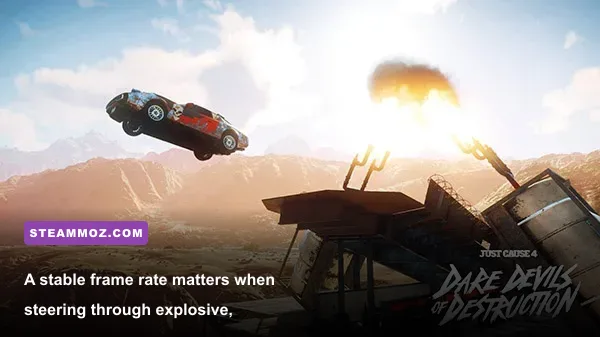
Dare Devils of Destruction is a great fit if you already own Just Cause 4 and want more reasons to drive instead of shoot. It gives the grappling hook a fresh purpose, makes vehicle damage meaningful, and turns the game's loose physics into the central attraction. The best events produce exactly the kind of ridiculous stories Just Cause is built for: a truck clips a ramp, flips over two opponents, lands on a target, and somehow crosses the finish line smoking but intact.
It is also a good choice for players who prefer bite-sized content. You don't need to remember a complicated plot or rebuild a character after a long break. Boot up the game, pick an event, and spend ten minutes trying to improve one corner. That structure feels especially welcome in 2026, when many open-world games demand dozens of hours before they reveal their best systems.
However, skip it if you want a serious racing model, co-op, or a meaningful continuation of Rico Rodriguez's story. There is no multiplayer competition to keep the events alive, and the narrative framing rarely rises above an excuse to start the next challenge. The DLC also can't fix the base game's uneven mission design, occasional AI weirdness, or the general feeling that Solís is more fun to dismantle than to liberate strategically.
It's worth remembering that Avalanche Studios designed Just Cause 4 around improvisation and spectacle. The expansion succeeds when you treat every event as a toy box rather than a test of perfect driving. Use the hook. Take the ugly shortcut. Let the explosion happen. A clean victory is satisfying, but a chaotic last-second finish is often the real reward.
If you're comparing this purchase with other games, Steamoz's Bionic Dues review and our Bang-On Balls: Chronicles gear guide cover two different kinds of replayable action: one built around tactical runs and one around gear-driven experimentation. Dare Devils sits somewhere else entirely. Its appeal is immediate, physical, and wonderfully disposable.
Final verdict: buy it on sale, then wreck everything
Just Cause 4: Dare Devils of Destruction earns a 7/10 in 2026. The expansion understands its assignment and sticks to it. The driving is loose but entertaining, the event types create enough variety to avoid repetition for a while, and the new vehicles make Solís more fun to roam. It doesn't deliver a major story, a new region, or a deep progression system, so its modest scale is impossible to ignore.
At a discount, it is an easy recommendation for anyone who owns the base game. The event chain offers a few energetic hours, and the sandbox vehicles provide extra value long after the structured content ends. At full price, the answer becomes more conditional: buy only if you specifically want arcade vehicle combat and don't mind replaying courses for better scores.
So, is Dare Devils of Destruction worth playing in 2026? Yes—but play it for the crashes, not the plot. If your ideal Just Cause session involves a flaming truck, a badly judged jump, a grappling-hook recovery, and Rico laughing while the arena collapses behind him, this is one of the series' most concentrated doses of chaos.
For details on the studio and the wider franchise, visit Avalanche Studios' official website and the official Just Cause 4 page from Square Enix. Just keep your expectations aligned: this is a sharp little destruction playground, not a second campaign.