
Yes, Bionic Dues is worth playing in 2026—if you enjoy brutally efficient roguelikes, deep mech loadouts, and turn-based combat that rewards planning more than reflexes. Arcen Games’ 2013 cyberpunk RPG is visually dated and occasionally clunky, but its central loop still works: assemble a squad of four mechs, strip useful parts from defeated machines, choose which city missions to tackle, and keep improving before the campaign’s pressure catches up with you. It’s not a modern blockbuster, but it remains one of Steam’s more focused hidden gems.
The important distinction is that Bionic Dues isn’t a traditional mech action game. You don’t pilot one giant robot through cinematic set pieces. You manage four machines at once, each carrying a different combat role, while the city map constantly tempts you into missions that may offer better loot than your current squad can safely handle. That makes it closer to a squad-management roguelike than a conventional RPG.
If you want a newer reference point for methodical tactical play, our Door Kickers raid tips cover a similar habit of thinking before you move. Bionic Dues is slower, more loot-driven, and far more focused on equipment synergy.
What Bionic Dues Actually Plays Like

Each run begins with a team of four mechs and four pilots. The battlefield is presented from an isometric viewpoint, and combat unfolds in real time with pause-style tactical control rather than traditional alternating turns. You can move, fire, retreat, and redirect the squad quickly, then pause when the situation becomes crowded. That hybrid structure is one of the game’s defining features: it feels active without demanding twitch accuracy.
Every mech can be configured around weapons, defensive equipment, and special systems. A front-line machine can carry close-range firepower and soak incoming damage, while another stays behind cover with lasers or missile systems. A third can specialize in crowd control, and the fourth can provide damage or utility. The game doesn’t force you into a rigid class screen; your inventory choices create the roles.
That flexibility also creates Bionic Dues’ biggest learning curve. A weapon that looks powerful in isolation can be poor in practice if it drains too much energy, has a long cooldown, or leaves a mech exposed while firing. Range, firing arc, movement speed, armor, heat or energy demands, and enemy resistances all matter. The best squad is rarely the one with four high-damage builds. It’s the one that can still function after the first plan falls apart.
The four-mech rule changes every decision
Because the game expects you to operate four mechs, specialization is usually better than giving everyone a little bit of everything. Concentrate your strongest defensive equipment on the unit that draws attention. Give long-range weapons to a mech that can stay mobile and avoid being surrounded. Keep at least one machine capable of dealing with groups, because narrow corridors and clustered enemies can punish a squad built entirely around single-target damage.
There’s also a practical reason to avoid duplicate loadouts: equipment availability is part of the challenge. You won’t always find four excellent copies of the weapon you want. Building around several damage types lets you use good drops immediately instead of waiting for a perfect duplicate.

🎮 Bionic Dues
Looking to experience this game? Grab your digital key directly on our store for $2.49.
View on Steammoz Store →Why the Loot and Loadout System Still Works

Bionic Dues gets its strongest ideas from the tension between permanent campaign progress and disposable individual runs. You’re always making your squad better, but every mission can expose weaknesses in your current setup. The loot loop is simple on paper—complete missions, collect equipment, replace weaker parts—but the decisions around that loot are surprisingly rich.
Don’t automatically equip the item with the highest damage number. A modest weapon with dependable range can outperform a stronger close-range option when missions contain narrow sightlines or enemies that punish approach. Likewise, armor that reduces incoming damage may be more valuable than another offensive upgrade if your front mech is repeatedly forced to retreat for repairs.
| Squad Role | Useful Equipment Focus | Main Strength | Common Failure |
|---|---|---|---|
| Anchor | Armor, defensive systems, close-range weapon | Holds enemy attention and protects fragile units | Becomes isolated and gets surrounded |
| Ranged Damage | Laser or missile systems, mobility upgrades | Consistent damage from safer positions | Runs out of space when enemies close in |
| Crowd Control | Area-effect weapons and cooldown support | Breaks up groups and controls chokepoints | Underperforms against single tough targets |
| Utility | Repair, support, or flexible secondary weapons | Stabilizes bad fights and covers gaps | Feels weak if the rest of the squad lacks damage |
The game also makes salvage feel meaningful because your build evolves mission by mission. You’re not simply waiting for a scripted sword or legendary mech. You’re comparing imperfect parts, gambling on upgrades, and deciding whether to push onward with damaged equipment. That makes a successful extraction feel earned.
Players who like this kind of optimization may also enjoy our ExZeal starting build guide, although Bionic Dues is much more deliberate and far less arcade-like.
How to Build a Squad That Survives

The safest opening approach is a balanced four-mech formation rather than an all-in damage team. Put one durable mech at the front, keep your ranged attackers behind it, and leave enough room for the squad to retreat without blocking itself. Bionic Dues’ arenas can become messy quickly, especially when enemies enter from multiple directions, so formation is a defensive tool—not just a visual preference.
Early-game priorities
During the first missions, prioritize survivability and reliable damage over rare equipment. Replace clearly inferior weapons, but don’t dismantle every backup item immediately. A spare weapon can save a run when your primary build depends on a damage type that performs badly against a particular enemy group.
Upgrade the mech that already has a clear job first. If one machine is taking most of the hits, improve its armor and defensive capacity before giving your ranged mech a small damage increase. The value of a defensive upgrade compounds across missions because it reduces repair pressure and lets you attempt riskier objectives without returning to town after every fight.
Combat habits that prevent expensive mistakes
Pause early, not late. Waiting until a mech is nearly destroyed usually means you’ve already lost the positioning battle. Pull damaged units back before they become the focus of every enemy, then rotate another mech into the danger zone. Use corners and chokepoints to prevent the entire squad from being attacked at once.
Watch enemy movement before committing a slow weapon or long attack sequence. If a target is about to duck behind cover, redirect fire rather than wasting the cycle. Spread your squad enough to avoid a single area attack crippling everyone, but not so far that one unit gets isolated. That balance is the heart of Bionic Dues’ combat.
| Campaign Stage | Primary Goal | Best Upgrade Decision | Risk to Avoid |
|---|---|---|---|
| Opening missions | Establish four distinct roles | Reliable armor and dependable ranged damage | Spending everything on one fragile damage dealer |
| Mid-campaign | Adapt to tougher enemy combinations | Add area damage and flexible backup equipment | Repeating the same loadout after it stops working |
| Late campaign | Finish objectives without wasting resources | Polish survivability and cover weaknesses | Taking optional fights with a damaged squad |
For another game where small positioning errors snowball into disaster, check out our Dead in Antares leveling guide. The systems differ, but the lesson is familiar: efficiency matters more than flashy aggression.
The City Map Is the Real Difficulty Curve

Bionic Dues doesn’t only test your squad in combat. Its city map forces you to decide how much danger you can afford. Missions offer different objectives, rewards, and threat levels, and the temptation to chase better salvage can push you into a fight before your equipment is ready.
This is where the roguelike structure becomes more interesting than a simple sequence of battles. You’re managing time, repairs, equipment quality, and mission risk together. A mission with attractive rewards may be a terrible choice if your main tank is already damaged or if your squad lacks a way to handle groups. Skipping it can feel like losing progress, but preserving a functional team is usually worth more than one promising drop.
That structure gives the campaign a surprisingly sharp rhythm. Early missions feel like experimentation. The middle section becomes a test of whether your loadouts are genuinely complementary. Near the end, every weakness becomes expensive. The game can be unforgiving, but most failures are readable in hindsight: poor formation, greedy mission selection, neglected defenses, or a squad that never developed a backup plan.
Is Bionic Dues Worth Playing in 2026?
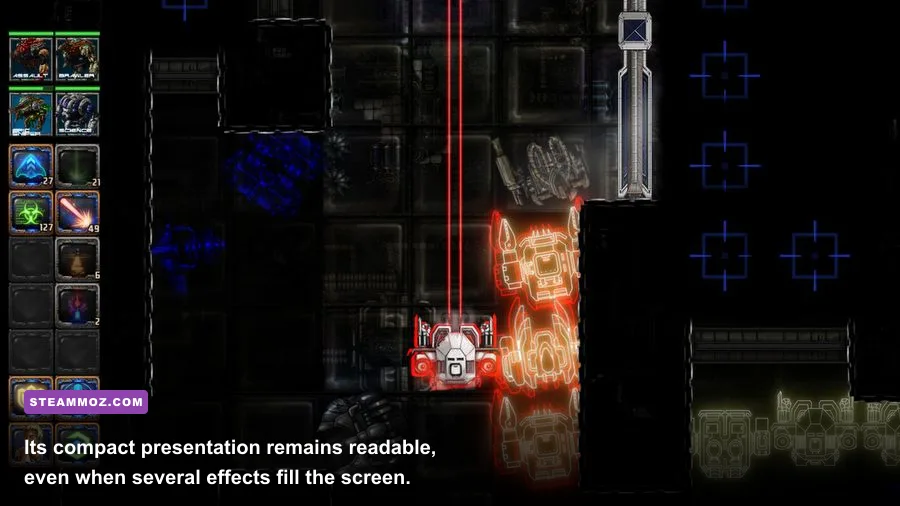
Yes—but with a very specific audience in mind. Bionic Dues is worth playing in 2026 if you enjoy old-school PC strategy games where menus, equipment comparisons, and tactical positioning are the main attraction. Its mechanics remain distinctive, and the four-mech structure gives every mission a satisfying puzzle to solve.
It’s less convincing if you want modern presentation, elaborate character writing, or cinematic mech battles. The interface can feel dated, the visual effects are modest, and the game doesn’t explain every interaction as clearly as a newer strategy RPG. You’ll need patience while learning which equipment combinations actually work. The real-time combat can also become hectic when several enemies converge, even though pausing helps.
| Player Type | 2026 Verdict | Why |
|---|---|---|
| Loot-focused RPG fan | Strong buy | Constant equipment decisions and meaningful squad specialization |
| Turn-based tactics fan | Worth trying | Pause-driven combat rewards planning, though it isn’t strictly turn-based |
| Mech action fan | Maybe | There’s no direct piloting or cinematic real-time destruction |
| Modern graphics enthusiast | Low priority | The presentation and interface show their 2013 origins |
It also remains easy to run on current hardware. Bionic Dues is a lightweight PC title rather than a game that needs graphics tweaking. You can find its current platform details on the official Steam page, while Arcen Games’ website provides background on the studio and its catalog. If you’re comparing it with other low-spec strategy games, our Dungeons 3 PC specs guide is a useful companion read.
My final verdict is a 7.5/10. Bionic Dues isn’t a forgotten masterpiece, and its rough edges are impossible to ignore in 2026. But the combination of four-mech squad management, flexible equipment roles, procedural mission pressure, and readable tactical problems still gives it a personality most mech games never develop. Buy it on sale, expect a learning curve, and judge it by the quality of its systems rather than its age. If you like turning a pile of imperfect parts into a machine that barely survives one more mission, it’s absolutely still worth the download.