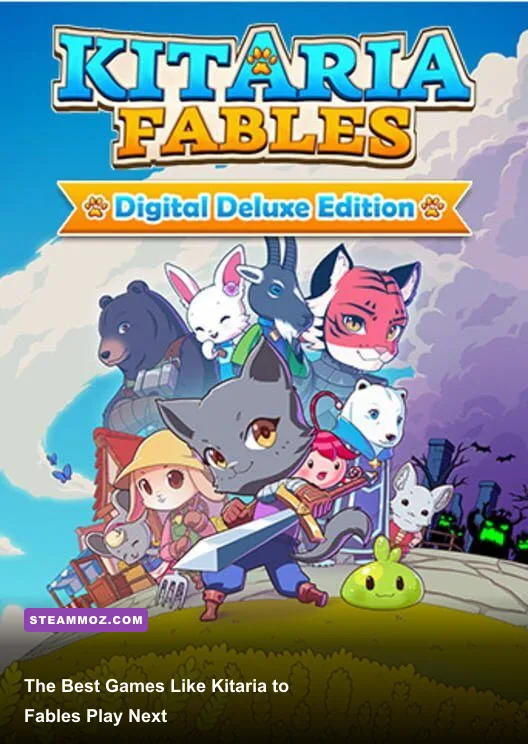
If Kitaria Fables' mix of cute animal characters, crop growing, crafting, and real-time monster fighting hooked you, start with Rune Factory 4 Special. It has the closest balance of farming, dungeon combat, equipment crafting, romance, and long-term progression. Stardew Valley is the better pure farming game, while Sun Haven is the strongest pick for fantasy co-op. For a more modern 3D adventure, My Time at Sandrock is the obvious next step.
Kitaria Fables is unusual because it never forces you to choose between a relaxing morning in the fields and a dangerous afternoon in the wild. You can plant turnips, gather materials, upgrade gear, then head out with a sword, bow, or magic spell before returning to Paw Village. The combat is lighter than a dedicated action RPG, but that blend gives the game its identity.
The recommendations below are ranked around that exact appeal. I looked at five things: how meaningful the farming loop feels, whether combat happens in real time, how much equipment progression exists, how lively the world is, and whether the game still feels good after the opening hours. If you want a second opinion on compact games with strong systems, Steamoz's Dungeons review is also worth a look.
The 2026 ranking at a glance
Not every game here copies Kitaria Fables' camera, animal cast, or low-pressure tone. The point is to find the same satisfying rhythm: gather resources, improve your home or character, then return to the field with better tools. That is why Rune Factory 4 Special sits above games that may look more similar at first glance.
| Rank | Game | Best Match For | Combat | Farming Depth |
|---|---|---|---|---|
| S-Tier | Rune Factory 4 Special | The closest all-round replacement | Real-time melee and magic | Excellent |
| S-Tier | Stardew Valley | Long-term farming and discovery | Real-time mines combat | Exceptional |
| A-Tier | Sun Haven | Fantasy farming with co-op | Real-time weapons and spells | Very strong |
| A-Tier | My Time at Sandrock | Crafting, quests, and 3D exploration | Real-time melee | Strong workshop focus |
| B-Tier | Snacko | Cat characters and island building | Light exploration danger | Strong construction focus |

🎮 Kitaria Fables
Looking to experience this game? Grab your digital key directly on our store for $4.99.
View on Steammoz Store →S-Tier: Rune Factory 4 Special is the closest match
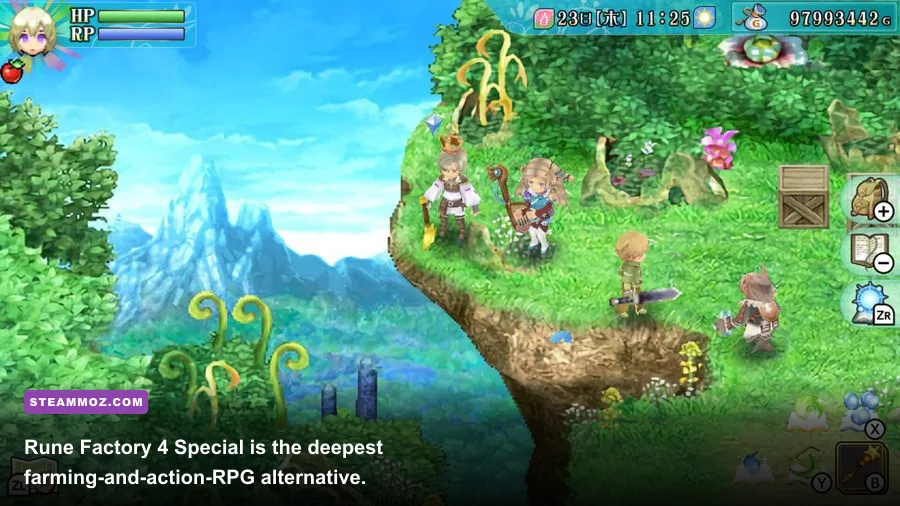
Rune Factory 4 Special understands the fantasy behind Kitaria Fables better than almost anything else: your farm is not an isolated minigame. It directly supports your adventure. Crops become ingredients, ingredients become food, and food keeps you alive during dungeon pushes where every healing item matters.
You play as the amnesiac protagonist who becomes involved in Selphia's royal duties. The story is more dramatic and character-heavy than Kitaria's gentle village tale, but the structure is familiar. Grow crops at Selphia's Farm, tame monsters, craft weapons, accept requests, and explore areas such as Yokmir Forest, Water Ruins, and Leon Karnak.
The combat has much more bite. You can use short swords, long swords, dual blades, spears, axes, hammers, fists, staves, and elemental magic. Each weapon family changes your rhythm. Dual blades reward aggressive close-range strings; spears give you safer reach; staves let you combine elemental spells with status effects. Bosses also punish button mashing more reliably than Kitaria's early enemies.
Why it ranks above the rest
Its progression is unusually interconnected. Forging is not just a shopping replacement: you can inherit effects, add materials, and improve weapons around a particular playstyle. A fire-resistant accessory matters in a fire-heavy area, while a high-quality recipe can turn a difficult dungeon into a manageable resource run. The game also includes marriage candidates and a large request board, giving the village genuine momentum.
| System | Specific Example | Why Kitaria Players Will Care | Learning Curve |
|---|---|---|---|
| Farming | Selphia Farm and seasonal crops | Supplies food, ingredients, and income | Low |
| Combat | Dual Blades, Spears, Staves | Real-time builds feel distinct | Medium |
| Crafting | Forge, Pharmacy, Cooking | Gear upgrades are more meaningful | Medium |
| Exploration | Yokmir Forest, Water Ruins, Leon Karnak | Biomes have different hazards and enemies | Medium |
| Social play | Requests, festivals, marriage | Villagers remain useful outside quests | Low |
There are caveats. The opening hours are slower, the menus feel dated, and the first combat encounters don't explain every system elegantly. Stick with it until the request board, monster barn, and crafting options open up. If Kitaria's simplistic combat was your favorite part, Rune Factory 4 Special may initially feel busy. If you wanted Kitaria to have deeper systems, this is the answer.
Check the official Rune Factory 4 Special Steam page for current platform and edition details.
S-Tier: Stardew Valley still owns the farming throne
Stardew Valley is less colorful in its combat presentation, but it remains the most complete recommendation for anyone who loved Kitaria's daily loop. The game begins with a neglected farm in Pelican Town, yet its scope expands into fishing, cooking, relationships, mining, community restoration, and late-game island exploration.
The key difference is pace. Kitaria often sends you toward a clear story objective. Stardew Valley lets you create your own priorities. On Spring 5, you might water parsnips, fish at the mountain lake, visit the Blacksmith, and spend the afternoon in the Mines. By Year 2, you may be optimizing quality sprinklers, building kegs, completing the Community Center, or preparing for Skull Cavern.
Combat is simple but strategically sharper than its first impression suggests. The Galaxy Sword, Iridium Band, and food buffs form a reliable late-game setup, while the mines teach you to manage stamina, health, bombs, and ladder luck. In Skull Cavern, a Serpent can cross the screen quickly, so positioning and staircases matter more than raw weapon damage.
Best progression route for new players
Upgrade your watering can before a rainy forecast, then prioritize a backpack expansion and a stable source of food. Build a Coop or Barn when your crop income is reliable rather than rushing livestock. In the Mines, save gems for gifts or sell duplicate minerals, but don't donate the first copy of every artifact without checking whether the Museum needs it.
For Kitaria fans, the most important tip is to treat the Mines as your adventure zone. Farming finances the run, cooking sustains it, and ore upgrades your tools. That same loop is why Stardew Valley has survived so many imitators. It respects short sessions but rewards planning across an entire in-game year.
The combat won't satisfy players looking for flashy skill rotations. There are no elaborate spell trees or weapon combos comparable to a full action RPG. Still, the timing around slimes, bats, serpents, and armored enemies gives the mine runs a clean, readable tension. The official Stardew Valley site remains the best source for current release information and creator updates.
A-Tier: Sun Haven is fantasy farming with real co-op energy
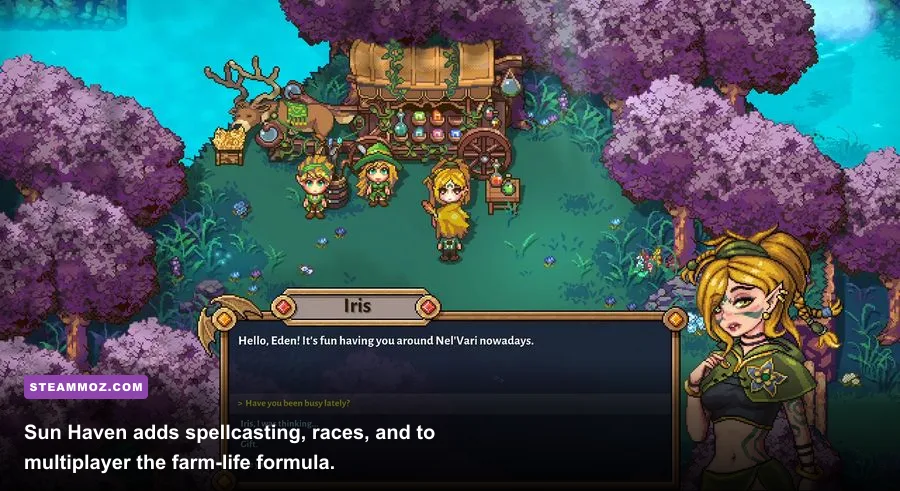
Sun Haven is the pick for players who want Kitaria Fables' fantasy flavor turned up to eleven. Your farm sits beside a magical town, and the world expands into distinct regions including the elven settlement of Nel'Vari and the monster-focused Withergate. You can choose from fantasy races such as humans, elves, demons, angels, and more, then build a character around weapons, spells, farming, or a hybrid approach.
Its skill structure is particularly welcoming. Farming, exploration, combat, fishing, mining, and other activities award their own experience, which unlocks perks in separate skill trees. That means regular play steadily improves the character without requiring you to grind a single activity. If you spend a morning fishing and an evening clearing mines, both parts of the day contribute to progression.
Combat includes swords, crossbows, and magic, and the game supports multiplayer farming. The action is not as tightly tuned as Rune Factory 4 Special, but the ability to build a farm with friends changes the entire pace. One player can grow crops while another mines or handles a quest, then everyone reunites for town events.
| Player Type | Recommended Focus | Useful Early Direction | Main Warning |
|---|---|---|---|
| Solo farmer | Farming and mana economy | Invest in crop perks and spell utility | Too many activities can dilute priorities |
| Melee adventurer | Combat and exploration | Carry healing food before dungeon runs | Rushing equipment can drain farm income |
| Magic hybrid | Mana, spells, and farming | Use ranged attacks to control groups | Mana management matters in longer fights |
| Co-op group | Divide farming, mining, and quests | Assign daily jobs before leaving town | Shared objectives require coordination |
Sun Haven's main weakness is uneven polish. Dialogue, balance, and interface friction can occasionally remind you that this is a broad indie sandbox rather than a tightly controlled console RPG. The upside is sheer content. There are multiple towns, romance routes, seasonal events, and enough crafting to keep a long-running save busy.
A-Tier: My Time at Sandrock makes crafting the adventure
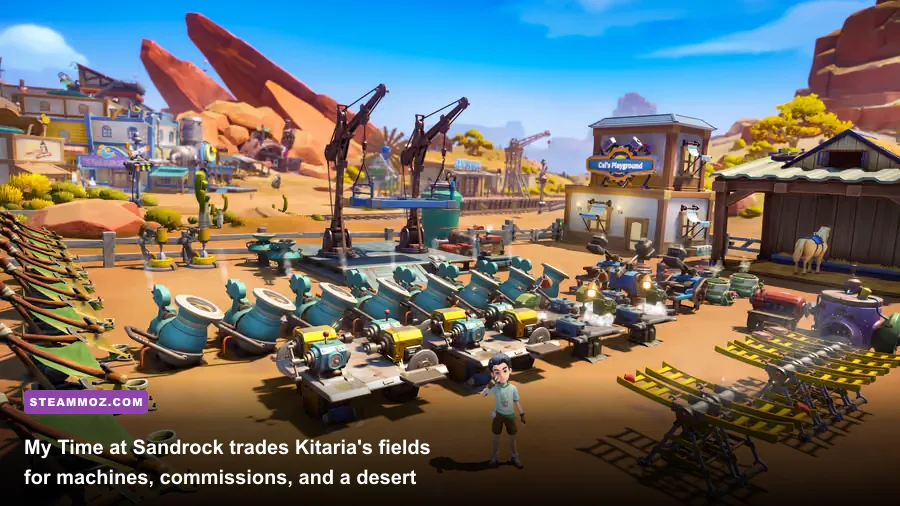
My Time at Sandrock is not a direct Kitaria clone, but it captures the same feeling of improving a home while becoming useful to a community. Instead of planting a traditional farm beside Paw Village, you inherit a workshop in a struggling desert town. Your main tools are machines, blueprints, commissions, and a stamina bar that forces you to plan each working day.
The workshop is the star. You gather stone, wood, ores, and relic materials, then turn them into processors, grinders, furnaces, and construction components. A commission might require copper wire, bronze plates, or a complete machine, so the real puzzle is setting up production before the deadline. It feels closer to Kitaria's resource-and-crafting loop than a conventional farming simulator does.
Combat is third-person and more direct. Weapons include swords, spears, daggers, and hammers, while skill and equipment upgrades make later ruins substantially more manageable. Ruins also provide a satisfying reason to keep improving the workshop: the materials found below ground feed the machines that unlock better tools and town projects.
The desert setting creates a different survival rhythm. Water and stamina are more important than in Kitaria, especially early in the game when every action competes for the same limited energy. Keep a supply of water, repair machines before leaving town, and accept commissions that use materials already in your storage. Chasing a high-paying request with no production setup is how an efficient morning becomes a wasted day.
Sandrock also has stronger character writing and larger story set pieces than Kitaria Fables. If your favorite moments were helping a town grow, this is arguably the best recommendation on the list. If you specifically want constant field combat and quick equipment drops, its workshop management may feel like an interruption rather than the point.
For more performance-focused PC advice, Steamoz's guide to PC specs and settings shows the kind of optimization checklist worth applying to demanding 3D games.
B-Tier: Snacko is the cozy cat-game wildcard
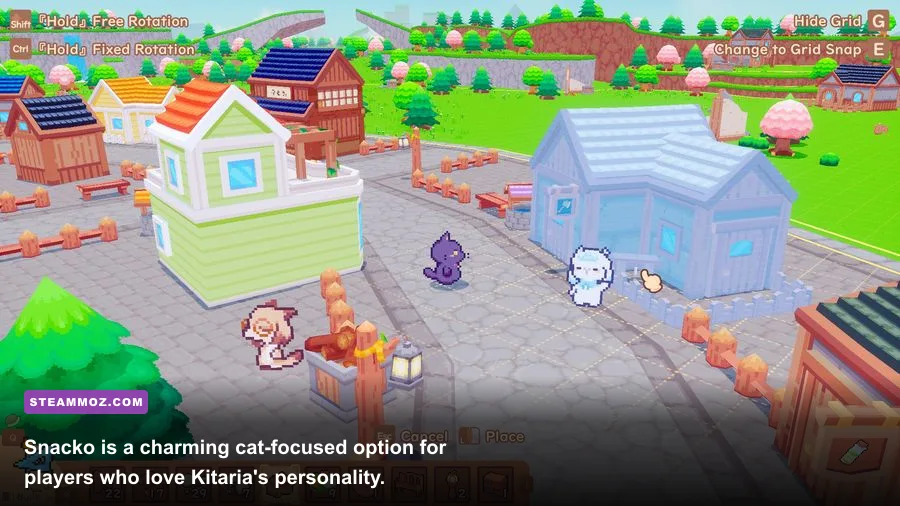
Snacko deserves a place here because it shares Kitaria Fables' most obvious charm: cats are the heroes, and the world is built around restoring a damaged community. You play as Momo, a cat who arrives on an island and begins rebuilding it through farming, gathering, crafting, decorating, and exploration.
The strongest overlap is emotional rather than mechanical. Snacko is about turning an empty place into somewhere worth living. You gather materials, construct buildings, customize spaces, and meet characters whose stories unfold as the island improves. The camera and construction tools make the home-building side more central than Kitaria's farm plots.
Don't choose Snacko expecting Rune Factory-level boss encounters. Its danger and exploration are lighter, and the progression is more focused on collecting resources and expanding the settlement than mastering a weapon type. That makes it a better recommendation for players who loved Kitaria's animals and village atmosphere but found its combat merely functional.
Which game should you play first?
Choose Rune Factory 4 Special if combat, crafting, and romance all matter. Choose Stardew Valley if you want the most rewarding long-term farm and don't need a fantasy action focus. Pick Sun Haven for magical systems and multiplayer. Go with My Time at Sandrock when workshop automation, story quests, and 3D exploration sound better than crop rows. Select Snacko if the cat cast and settlement restoration are the main reason Kitaria Fables clicked.
| If You Loved This Kitaria Feature | Play This First | Why |
|---|---|---|
| Real-time combat and gear upgrades | Rune Factory 4 Special | Its weapon families and crafting are much deeper |
| Growing crops for daily income | Stardew Valley | The seasonal farm economy is unmatched |
| Fantasy villages and magic | Sun Haven | Multiple races, towns, spells, and co-op |
| Gathering materials for town projects | My Time at Sandrock | Machines turn resources into meaningful progression |
| Cute cats and rebuilding a home | Snacko | Its island restoration loop is the closest tonal match |
The best Kitaria-style progression habits
Whichever game you choose, the best way to enjoy this genre is to protect the loop instead of rushing the story. Start each day with a short plan: one maintenance task, one resource target, and one adventure objective. Water or automate crops first, restock healing items second, then spend the remaining time exploring. That prevents the common mistake of reaching a dungeon with half your stamina and no food.
Always keep a small reserve of basic materials. In Kitaria Fables, ore, wood, and monster drops can disappear quickly when several upgrades unlock at once. The same principle applies to Stardew Valley's copper and iron, Sun Haven's crafting components, and Sandrock's machine parts. Selling everything for immediate cash feels good for one day and painful for the next three.
Upgrade tools that remove repeated friction before chasing luxury equipment. A faster axe, larger backpack, better watering tool, or reliable area-of-effect attack saves time across dozens of sessions. Then specialize. A character who tries to maximize every weapon and every profession at once usually ends up weaker than a build with one clear job.
Finally, don't judge these games by their first five hours. Kitaria Fables is at its best once crafting, farming, and exploration start feeding one another. Rune Factory 4 Special takes even longer to reveal its full toolset, while Stardew Valley's biggest payoffs arrive after the first season. Give each game enough time to establish its economy before deciding whether the slower pace is a flaw.
For players still comparing cozy games with stronger exploration systems, Steamoz's guides to Freedom Wars Remastered and Indoorlands performance settings offer useful next reads, even though both take their formulas in different directions.
Bottom line: Rune Factory 4 Special is the game to buy when you want Kitaria Fables with deeper combat and crafting. Stardew Valley is the safer recommendation for a farm you can revisit for hundreds of hours. Sun Haven is the best multiplayer fantasy option, My Time at Sandrock is the best 3D crafting adventure, and Snacko is the most charming cat-centered follow-up. In 2026, all five still prove that farming is at its best when it gives your next adventure a reason to exist.