
To win more often in Fibbage XL, stop treating it like ordinary trivia: write lies that match the prompt’s wording, choose answers by authorial style rather than confidence alone, and watch how each player behaves across rounds. The game rewards a sharp read of people just as much as a strong memory. These 10 tips cover the fundamentals new players need, from creating believable fake answers to surviving the final score swing.
Fibbage XL is a bluffing party game from Jackbox Games for 2–8 players, with an audience that can join and vote in supported setups. Every round presents a strange trivia prompt with one missing fact. Players invent answers, the game mixes those lies with the real answer, and everyone votes for what they believe is true. You earn points for finding the truth and for tricking other players into selecting your lie.
That scoring structure changes the entire strategy. A technically correct answer is only half the job. The best player is also trying to predict what the room will believe, how a particular friend writes, and whether a weird detail feels too ridiculous to be genuine.
1. Learn What Fibbage XL Actually Rewards
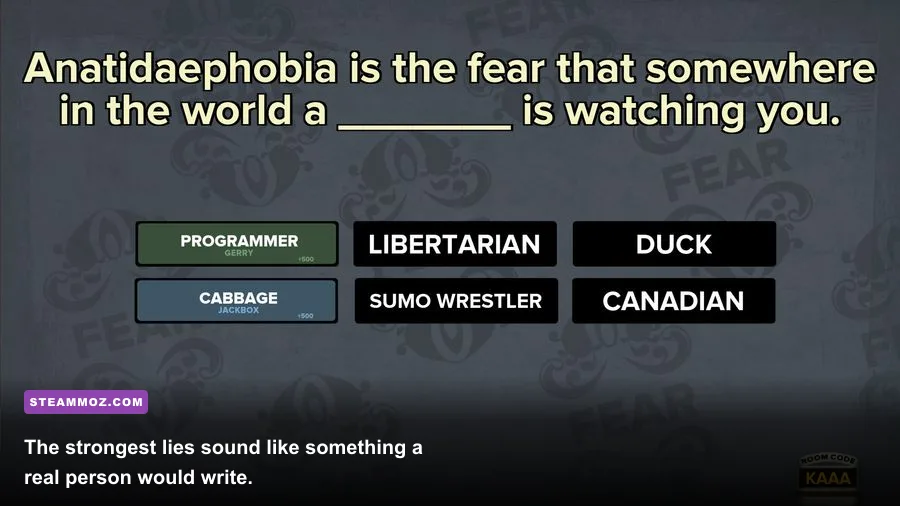
Before chasing clever jokes, understand the two ways to score. A correct pick gives you points, while a successful lie gives points whenever another player selects it. In practical terms, Fibbage XL has two parallel objectives: solve the question and manufacture an answer that looks more authentic than the truth.
The game’s prompts often involve celebrities, historical incidents, unusual laws, bizarre products, or obscure locations. You usually won’t know the answer immediately. That’s fine. Fibbage isn’t asking you to produce a perfect fact from memory; it’s asking you to build a credible possibility inside a very narrow sentence.
| Round Decision | What You Gain | Best New-Player Approach | Common Mistake |
|---|---|---|---|
| Find the truth | Reliable points | Eliminate answers that sound too polished or too broad | Choosing the funniest answer instead of the most factual |
| Submit a lie | Points for every player fooled | Match the prompt’s grammar and level of detail | Writing an obvious punchline |
| Read the room | Better odds on uncertain questions | Track each player’s vocabulary and joke habits | Assuming a friend always lies in the same style |
| Use the audience | Extra social evidence | Notice whether crowd voting follows a loud player | Treating audience behavior as guaranteed truth |
There’s also a crucial psychological layer: players tend to overvalue answers that contain vivid, unnecessary details. A lie mentioning a specific year, town, or person can feel researched even when it’s invented. Use that instinct when writing, but don’t overload your answer. One believable detail is stronger than three suspicious ones.
If you’re introducing the game to a group that hasn’t played Jackbox before, the official Fibbage XL Steam page explains the basic setup and player count. Also make sure everyone understands that phones are used as controllers, not as a source of outside research.

🎮 Fibbage XL
Looking to experience this game? Grab your digital key directly on our store for $4.99.
View on Steammoz Store →2. Write Lies That Sound Like Facts
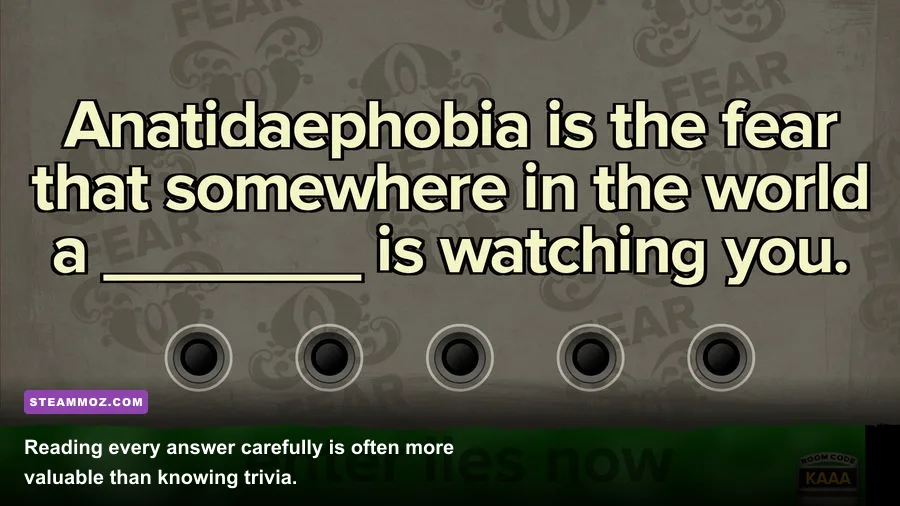
Your first lie will probably be too funny. That’s the most common new-player error. A joke may get a laugh, but if everyone knows it’s a joke, it earns nothing. Your goal is a sentence that makes players pause and think, “That sounds oddly plausible.”
Mirror the sentence structure
Look at the prompt’s grammar before typing. If it says, “The rarest flavor of ___ is…,” your answer should be a noun phrase. If it asks why a town banned something, write a short explanation rather than a random object. Matching the grammatical shape makes your lie disappear into the answer list.
Use one anchor detail
A strong lie often has a single anchor: a believable surname, a regional food, a dated event, or a mundane explanation. Imagine the difference between “because it was annoying” and “because the church bells disrupted radio broadcasts.” The second answer feels researched because it supplies a concrete reason, but it still leaves enough uncertainty for someone to choose it.
Keep the register consistent
Fibbage prompts have a voice. Some are formal and historical; others are silly, conversational, or built around wordplay. Match that voice. A serious prompt doesn’t need a goofy answer unless the wording invites it. Likewise, a deliberately absurd prompt can make a dry, bureaucratic answer look surprisingly real.
Before submitting, ask three quick questions: Does this answer fit the blank? Does it sound like a fact someone could have learned? Would I choose it if I saw it among six options? If the answer to the third question is no, rewrite it.
Don’t copy another player’s apparent style too closely. If everyone at the table knows you always use fake locations, they’ll begin rejecting anything that resembles your signature. Vary your approach between factual-sounding lies, understated jokes, and answers built around a single unusual detail.
That same discipline appears in other deduction-heavy games. Steamoz’s Hacknet beginner tips are about following small clues instead of guessing wildly, and Fibbage rewards a similar habit: every word should serve the illusion.
3. Detect the Truth by Its Awkwardness
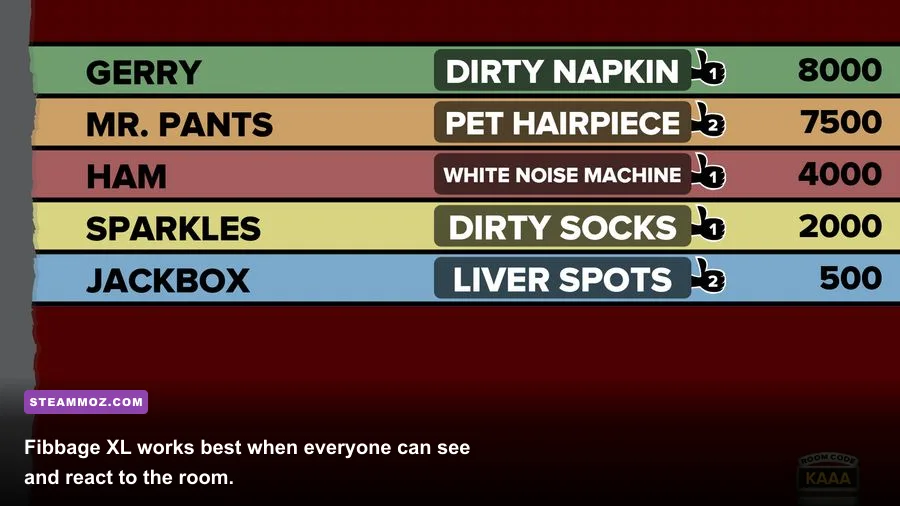
The real answer in Fibbage XL often looks less elegant than the lies. That’s deliberate. Player-created answers tend to be clean, short, and shaped to fit the prompt. The official fact may contain an oddly specific name, a clumsy phrase, or a detail nobody would invent naturally.
When you don’t know the answer, scan for the option with the least obvious “writer.” Lies usually have a human fingerprint: a punchline, a favorite phrase, a suspiciously perfect rhythm, or an attempt to sound clever. The truth can feel strangely flat because it wasn’t designed to fool you.
Use the elimination ladder
First, remove answers that violate the sentence’s grammar. Next, remove anything that is too broad to be useful. Then inspect the remaining options for factual texture. A real answer may include an unfamiliar proper noun or a precise measurement, while a lie often hides behind a generic phrase such as “a local tradition” or “a famous scientist.”
Pay attention to duplicate concepts. If two answers are essentially the same, one may be a player trying to make the other seem less trustworthy. It can also signal that the group is converging on the same obvious guess. Don’t automatically choose the more detailed version; sometimes the short answer is genuine and the longer one is camouflage.
| Answer Signal | Usually Suggests | How to Handle It |
|---|---|---|
| Perfectly shaped joke | Player-written lie | Enjoy it, but don’t vote for it unless the prompt supports humor |
| Odd proper noun | Possible real-world detail | Keep it in consideration instead of rejecting it for sounding strange |
| Overexplained answer | Player compensating for a weak lie | Compare it with shorter answers using the prompt’s exact wording |
| Plain, boring phrase | Potential truth | Check whether it fits the grammar and subject precisely |
Never assume the truth is always the most specific answer. Fibbage’s facts vary wildly in style, and a concise answer can be correct. The reliable skill is not spotting one universal truth pattern; it’s separating answers that feel authored from answers that feel extracted from a reference source.
4. Read Each Player’s Writing Fingerprint
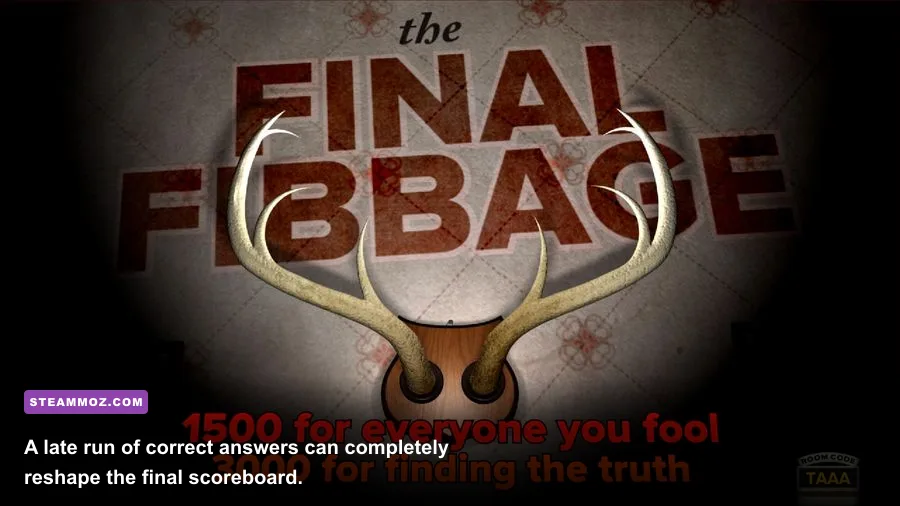
Every regular group develops tells. One player writes tiny, dry answers. Another adds fake historical context. Someone else uses the same two jokes until the entire room recognizes them. Track those habits, because Fibbage is partly a trivia game and partly a social deduction game.
Start with vocabulary. Does a player use formal words such as “allegedly” and “subsequently,” or do they write in short conversational fragments? Do they capitalize names correctly? Do they favor numbers, locations, food, or bodily humor? These details can identify a lie before you even evaluate whether it sounds factual.
Then track risk tolerance. A cautious player may submit a lie that is almost indistinguishable from the truth. A confident comedian may submit something outrageous and hope the room rewards the joke. Neither style is automatically better, but knowing who uses which approach changes your voting odds.
Don’t overfit after one round
A single answer isn’t enough to establish a tell. Players deliberately change styles, especially after noticing that the room has decoded them. Look for repeated behavior across at least two or three rounds. If somebody suddenly submits a polished historical answer after several jokes, that change itself becomes information.
Names can also be clues. If a prompt asks for a person and one answer uses a name that resembles a player’s own name or a local in-joke, it may be bait. But don’t reject it automatically. A player who knows the group expects an in-joke may use one precisely because it feels too obvious to be fake.
Most importantly, don’t let friendship override evidence. Familiar players are easier to read, but that familiarity can produce tunnel vision. If your favorite friend writes a brilliant lie, you may vote for it because you want it to be true. Separate “this sounds like them” from “this fits the prompt better than the alternatives.”
For groups that enjoy hidden information and clue interpretation, our Filament secrets guide covers a different kind of observation-heavy play. Fibbage’s clues are social rather than environmental, but the same principle applies: small patterns become powerful when you track them consistently.
5. Use the Room Without Letting It Control You
Fibbage XL is at its best when everyone talks, reacts, and accidentally reveals what they believe. A sharp gasp, a laugh that arrives too quickly, or someone asking “Who wrote that?” can expose more than the answer list. Listen to the room, but remember that players can perform reactions to manipulate you.
Watch the first reaction
Natural surprise usually happens immediately. A player who sees their lie on screen may laugh, complain, or defend it before anyone asks. That reaction is useful, but it isn’t proof. Skilled players know that pretending to hate their own answer can make it look safer, while loudly praising a lie can encourage someone else to select it.
Separate confidence from knowledge
Some players speak with certainty because they know the fact. Others speak with certainty because they want the room to follow them. Ask yourself whether the player gave a reason or merely announced a choice. “I remember this from a documentary” is stronger evidence than “That’s definitely it,” though even documentary memories can be wrong.
Audience behavior is similarly useful but imperfect. If an audience is present, its voting can reveal a broad group instinct. However, crowds often follow the funniest answer or the most confident voice. Treat audience votes as one additional clue, not as a hidden answer key.
Physical setup matters more than new players expect. Keep phones below the television line so nobody can see a neighbor’s choice. Make sure everyone can read the complete answer list, especially names and numbers. If the room is loud, appoint one person to repeat the prompt exactly; a misheard date or place can ruin an otherwise smart deduction.
6. Don’t Submit the First Lie You Think Of
The first idea is usually the obvious idea, and obvious ideas are dangerous. Another player may independently submit the same answer, creating confusion and reducing your control over the bluff. Take a few seconds to generate alternatives before committing.
Try this three-step method. First, write the direct answer that comes to mind. Second, make a version that sounds more factual by adding one specific detail. Third, make a restrained version that removes the joke. Compare all three and choose the one that best matches the prompt’s tone.
Suppose the prompt asks why an unusual town rule exists. “Because tourists were loud” is generic. “Because tourists kept interrupting a weekly sheep auction” has an anchor detail. “Because of complaints from visitors” is too vague. The middle answer has the strongest Fibbage shape because it sounds like a fact someone could verify.
Speed still matters. You don’t want to spend so long polishing that your answer feels unnatural or you run out of submission time. The goal isn’t literary perfection; it’s plausibility. A clean eight-word lie usually beats a desperate paragraph.
7. Vary Your Bluffing Style Across the Game
A successful lie changes the expectations of the room, but repeating the same trick makes you predictable. Alternate between three broad styles: the dry fact, the plausible explanation, and the joke that hides inside formal wording.
The dry fact works best for prompts about names, dates, products, and locations. The plausible explanation is ideal for “why” questions. The disguised joke can be devastating when the prompt is serious and the answer sounds just respectable enough to pass. Use humor sparingly; when every answer from you is funny, players will stop treating any of them as real.
Also vary answer length. Short lies are hard to identify because they don’t reveal much personality. Longer lies provide texture but expose more of your writing habits. If the room has started spotting your elaborate explanations, submit something plain in the next round and let someone else attract suspicion.
8. Think About the Scoreboard, Not Just the Round
Fibbage XL rewards immediate choices, but the scoreboard should influence your risk. If you’re far behind, a safe truth pick may not be enough to catch the leader. Look for a lie that can attract multiple votes, especially when the prompt is obscure and the room is uncertain.
If you’re leading, don’t become passive. Choosing the truth remains important, but avoid unnecessary experiments with obviously funny answers. A single successful bluff from a trailing player can create a large swing if several people select it. Your best defense is disciplined voting and careful reading of the strongest alternatives.
| Your Position | Voting Priority | Lie-Writing Priority | Risk Level |
|---|---|---|---|
| Comfortable lead | Choose the most evidence-backed truth | Use subtle, low-profile lies | Low |
| Middle of the pack | Balance factual fit with player tells | Target one or two predictable voters | Medium |
| Far behind | Take calculated chances on obscure prompts | Write a memorable but believable answer | High |
| Near the final round | Prioritize the player ahead of you | Exploit their known voting habits | Situational |
Don’t obsess over exact point arithmetic during a fast round. Fibbage’s scoring can change quickly depending on how many players choose each lie. Instead, use the scoreboard to identify your immediate target: the person one successful bluff or correct answer could realistically overtake.
9. Make the Final Round a Reset
The final round is where panic creates bad decisions. Players often assume the leader is unbeatable, then rush their lie or select the funniest answer without analyzing it. Treat the final prompt as a fresh puzzle with higher emotional stakes, not as a foregone conclusion.
Read every option twice. The first pass catches grammar and obvious jokes. The second pass looks for the awkward specificity that often marks the truth. If the prompt contains a person, place, or number, compare how naturally each answer completes the sentence rather than judging the answer in isolation.
When writing the final lie, avoid desperation. A huge gag may earn a laugh but rarely fools a room that has spent the entire game learning your style. A modest answer with one concrete detail is more likely to collect votes. If you’re leading, write something that doesn’t resemble your usual signature and force the room to solve the prompt without an easy author clue.
10. Build a Better Fibbage XL Session
Good strategy can’t fix a bad setup. Fibbage XL works best with a group that can see the screen, submit answers privately, and hear the prompt clearly. Connect the host device to a television or monitor, keep the room bright enough for phones, and make sure everyone joins the same room before starting.
For first-time players, begin with a relaxed round rather than explaining every possible bluffing theory. Let the game teach its rhythm: prompt, lie submission, answer reveal, voting, scoring. After the first round, explain why a plain answer can be stronger than a joke. New players improve quickly once they understand that they’re trying to fool people, not simply entertain them.
House rules can make repeat sessions better. Ban outside searches if your group is tempted to look up facts. Rotate the host device so one person doesn’t control every technical decision. If a player has a connection problem, pause before starting another round rather than letting them miss a submission and distort the answer pool.
Jackbox’s official Fibbage XL page is the best place to confirm supported features, while the Jackbox support center covers common room, device, and connection issues. You can also check the official Jackbox Games site for accessibility and platform information before hosting a larger group.
Finally, remember that Fibbage XL gets better when the table develops history. The first session teaches the rules. The second reveals everyone’s habits. By the third, a player’s favorite fake town, suspicious punctuation, or habit of defending a lie becomes part of the metagame. That’s where the real fun begins.
If you enjoy party games that reward observation, take a look at Steamoz’s Dungeons review for another game built around reading systems and anticipating choices. And if your group wants more couch-friendly games after Fibbage, our Freedom Wars Remastered beginner tips offer a very different kind of cooperative challenge.
The short version is simple: write like a fact, vote like a detective, and pay attention to the people behind the answers. Fibbage XL doesn’t demand encyclopedic knowledge from new players. It demands restraint, pattern recognition, and the confidence to choose the boring answer when the room is falling for a brilliant lie.