The best beginner build for Clair Obscur: Expedition 33 is a flexible Gustave, Maelle, and Lune setup built around Break damage, elemental Stains, and counterattacks. Keep Gustave as your reliable physical opener, use Lune to heal and prime weaknesses, then let Maelle convert those openings into explosive damage. Spend early Points on health and agility instead of chasing a glass-cannon setup, and prioritize weapon scaling, Pictos, and Lumina that support your preferred damage type.
That approach works because Expedition 33 is not a conventional turn-based RPG where a high attack stat solves every encounter. Its real combat engine is active defense: dodging, jumping, parrying, and shooting enemy weak points in real time. A supposedly perfect build still collapses if you ignore telegraphs, while a modestly equipped party can dismantle dangerous enemies once you understand their rhythm. The official Steam listing makes the timing-based combat clear, but the details below are what make the opening hours click.

🎮 Get Clair Obscur: Expedition 33
Ready to dive in? Grab your copy today for just $39.99.
Check OfferThe Best Starting Party and Its Job

Gustave, Maelle, and Lune form the most forgiving early-game team. Gustave gives you a sturdy front-line attacker, Maelle introduces stance-based burst damage, and Lune covers healing, elemental setup, and status pressure. You can eventually build every character in several directions, but this trio teaches nearly every important system without demanding perfect execution.
| Character | Early Role | Priority Skills | Why Beginners Want Them |
|---|---|---|---|
| Gustave | Physical opener and Break damage | Marking Shot, Powerful, Overcharge | Simple turns, strong ranged weak-point access, dependable Battery payoff |
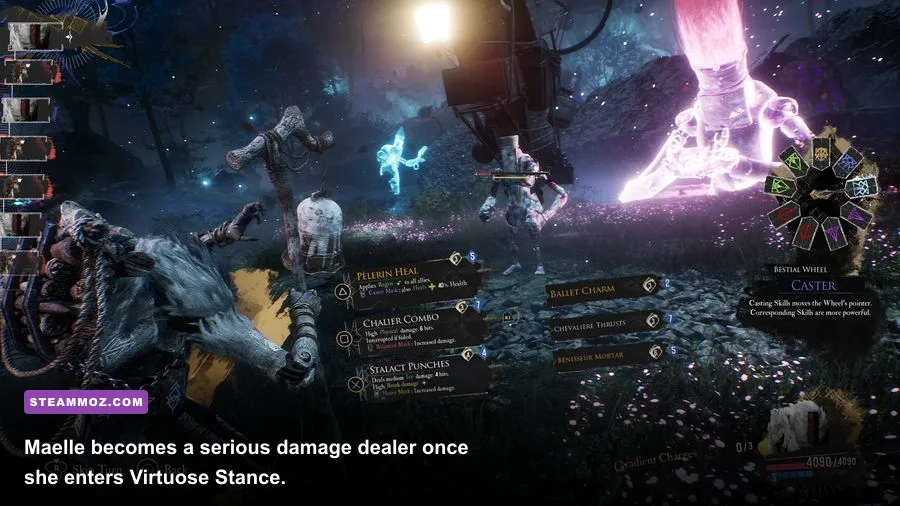
| Maelle | Stance-based finisher | Swift Stride, Offensive Switch, Fleuret Fury | Excellent damage once she reaches Virtuose Stance |
| Lune | Healer and elemental setup | Healing Light, Ice Lance, Thunderfall | Stains provide healing, damage, and flexible weakness coverage |
Gustave should usually act first. His basic attacks and Marking Shot help create a clean target for the party, while Overcharge is the payoff for building his Battery. Don't fire Overcharge randomly just because it is available. Save it for an enemy whose Break bar is close to empty or a boss turn where you need to remove a dangerous target quickly.
Maelle is the party's most important damage lesson. Her Offensive Switch changes her stance, and her damage output depends heavily on the stance she occupies. Swift Stride helps her move toward Virtuose Stance, while Fleuret Fury gives her a strong way to capitalize on that state. She can feel merely average during the first few fights; that's intentional. Maelle becomes dramatically better when you stop treating her as a generic swordswoman and start planning her turns around stance changes.
Lune is more technical, but she prevents the build from becoming fragile. Her elemental skills create Stains, and later skills consume or exploit those Stains for upgraded effects. Healing Light is your safety valve. Ice Lance and Thunderfall give you early elemental coverage, while Terraquake becomes valuable when you need Earth damage and a larger area attack. Lune's turns should be planned two actions ahead rather than spent on the biggest available spell.
🎮 Clair Obscur: Expedition 33
Looking to experience this game? Grab your digital key directly on our store for $39.99.
View on Steammoz Store →Stat Points and Weapon Scaling Priorities
For a first playthrough, use this stat order: Agility first, Vitality second, Luck or Might third, with the final choice depending on the weapon currently equipped. Agility improves how often a character gets to act, which means more chances to build AP, apply effects, heal, or punish a Break window. Vitality is not glamorous, but surviving one additional boss hit is worth more than a small damage increase when you are still learning parry timing.
Don't blindly put every point into Might. Weapons in Expedition 33 display scaling grades for attributes, and those grades should decide your offensive investment. If a weapon has stronger Agility scaling than Might scaling, Agility can give you both more turns and better damage. Check the weapon details screen whenever you replace equipment instead of assuming the newest weapon is automatically better.
| Character | First Priority | Second Priority | Third Priority | Early Reason |
|---|---|---|---|---|
| Gustave | Agility | Vitality | Might based on weapon scaling | More turns build Battery and create safer Overcharge windows |
| Maelle | Agility | Might | Vitality | Speed helps her reach and exploit stronger stances |
| Lune | Agility | Vitality | Luck or Might based on scaling | More turns mean more Stains, healing, and elemental coverage |
Use Gustave's Lanceram as a dependable opening weapon, then compare replacements by their scaling grade and passive effect rather than damage alone. Maelle's starting weapon is perfectly serviceable while you learn her stance system. Lune's elemental weapons should be judged by the spell plan you are using: a weapon that improves your preferred element can outperform a higher-level alternative with poor scaling.
Weapon upgrades are expensive enough that spreading materials across every option is a mistake. Upgrade one weapon per active character first. If you regularly swap party members, keep a second weapon serviceable, but don't turn your inventory into a museum of half-upgraded equipment. The same resource-discipline advice applies to other RPGs; our Atomic Heart beginner build guide covers a similar early-game trap.
The Opening Combat Rotation That Actually Works

Start normal encounters with Gustave's Marking Shot when an enemy has a visible weak point or when you want the party to focus fire. Follow with Lune, using the elemental skill that matches the target's weakness or creates the Stain you need. Maelle then takes the payoff turn: use Swift Stride or Offensive Switch to reach a stronger stance, attack the marked target, and save Fleuret Fury for a turn where its stance requirement is favorable.
Against an ordinary enemy, the rhythm looks like this:
- Read the target. Identify its weakness, attack pattern, and whether it can be safely shot.
- Open with Gustave. Mark the target or build Battery with basic attacks if the mark would be wasted.
- Prime with Lune. Apply the correct element or use Healing Light if the party has taken chip damage.
- Prepare Maelle. Change stance rather than spending her strongest attack into a poor multiplier.
- Break and burst. Use Overcharge or Fleuret Fury when the Break bar is nearly depleted, not several turns beforehand.
AP management is the quiet skill behind this rotation. Basic attacks are not filler; they generate the resources that let your stronger skills happen. If everyone spends AP on the first turn, the party often reaches the important Break window empty. Use one strong action, one basic action, or a defensive turn when necessary. That small amount of patience makes boss fights far less chaotic.
For bosses, don't treat Break as the only objective. A boss with a nearly empty Break bar may still have a lethal attack queued. If you cannot finish the bar before that attack lands, defend and learn the telegraph instead. Our guide to making smarter first-campaign decisions applies here too: resource timing beats flashy damage.
Parries, Dodges, Jumps, and Weak-Point Shots

The strongest beginner upgrade is not a Pictos. It is learning the difference between a dodge, jump, and parry. Dodging is the safest answer to most attacks, jumping clears low sweeps and can avoid certain ground effects, while parrying demands the tightest timing but produces the biggest reward. A successful parry can prevent damage, build momentum, and create an immediate counterattack opportunity.
Watch the enemy's animation, not the damage number or the sound effect. Many attacks have a deceptive wind-up followed by a fast impact. Start by dodging until you can recognize the final motion, then practice parrying a single attack in each encounter. Don't try to parry every hit in a multi-hit sequence immediately. Surviving the first swing and dodging the rest is a better learning strategy than losing a character while chasing a perfect counter.
Enemy projectiles and marked weak points are where Gustave earns his place. Use the aiming prompt during the enemy's recovery animation, not while the attack is still moving toward you. A shot can interrupt, damage a weak point, or contribute to a Break plan, but tunnel vision is dangerous. If the active character is about to be hit, defend first and shoot second.
Jumping also deserves more attention than it gets. Some attacks that look like ordinary horizontal swings are designed to catch a dodge but miss a jump. Conversely, a vertical strike may punish a jump. Expedition 33 wants you to identify attack families, so use the first attempt at a new enemy as reconnaissance. Once you know the pattern, the encounter becomes a timing puzzle rather than a stat check.
Pictos, Lumina, and Beginner-Friendly Synergies
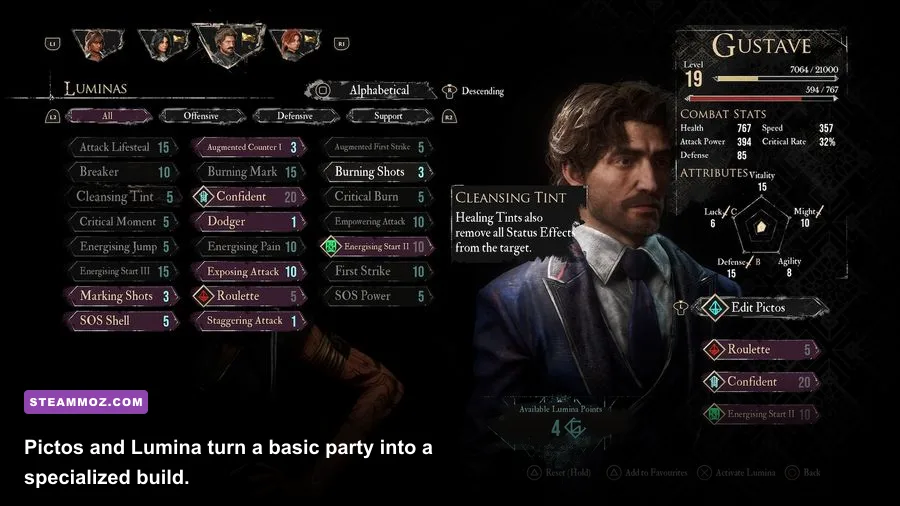
Pictos are equipment effects that can later be converted into Lumina, letting you keep useful passive abilities without wearing the original Pictos. Early on, don't chase a complicated meta setup. Equip effects that improve survivability, AP flow, Break damage, or your first-turn consistency. A passive that works every fight is more valuable than one that requires a perfect condition you rarely meet.
Gustave benefits from effects that improve damage against marked targets, reward Break contribution, or help him generate resources reliably. Maelle wants passives that enhance damage after a stance change, reward high health, or improve her critical output once she has reached Virtuose Stance. Lune should prioritize AP generation, healing efficiency, and elemental damage that matches her most-used skills.
| Build Layer | Gustave | Maelle | Lune |
|---|---|---|---|
| Core passive | Mark, Battery, or Break support | Stance-change or burst support | AP, healing, or elemental support |
| Defensive passive | Damage reduction or health | Health or counterattack safety | Health, dodge help, or emergency healing |
| Best early habit | Save Overcharge for a real window | Plan stance before attacking | Build Stains with purpose |
Once a Pictos has been worn for enough battles to unlock its Lumina effect, test it on the character who gets the most value from it. You don't need to hoard every Lumina point. A modest passive spread across all three active characters is usually stronger than loading one hero with five effects while the rest of the party has nothing.
Exploration helps this build more than grinding. Check side paths, interact with unusual objects, and revisit areas when the party gains new traversal options. Hidden rewards often include better Pictos or weapons that solve a weakness in your current setup. If you enjoy that style of discovery, Steamoz's hidden-location guide for Enshrouded has the same treasure-hunting mindset.
How to Progress Beyond the Starting Build
This beginner setup should carry you through the opening regions, but don't mistake it for a permanent restriction. Expedition 33 lets you reshape characters as your weapon collection and skill list expand. The moment Maelle has a reliable way to enter Virtuose Stance, you can shift more points toward damage. When Lune gains enough elemental options to cover common weaknesses, you can reduce defensive investment and build a more aggressive rotation.
Gustave's role may also evolve. He is excellent for teaching the basics, but later party members can specialize more heavily in support, damage, or Break control. Keep Gustave if you like the straightforward Battery loop; replace him when another character better supports the weaknesses and enemy patterns in a region. There is no shame in changing the party before a boss. The best team is the one that answers the encounter's mechanics.
Before every major fight, perform a quick checklist:
- Equip weapons with the best attribute scaling for the stats you actually invested in.
- Make sure at least one character can heal or recover from a bad defensive sequence.
- Carry elemental coverage instead of stacking three characters around the same damage type.
- Use Pictos and Lumina to fix a real problem, such as poor AP generation or low survivability.
- Practice the boss's first attack before committing to a full damage rotation.
If the game runs poorly on PC, stabilize performance before judging your timing. Uneven frame pacing can make parries feel inconsistent even when your input is correct. Lower demanding options such as shadows, effects, and volumetric quality first, then keep image quality high enough to read enemy animations. Steamoz's performance settings guide for Ankora: Lost Days explains the same visual-priority approach, while our Hunt: Showdown low-FPS fixes can help if broader PC problems are involved.
The short version is simple: let Gustave create order, let Lune create opportunity, and let Maelle cash it in. Invest in Agility and survivability early, respect weapon scaling, and practice one defensive mechanic at a time. Once you stop throwing every skill at the first available target, Clair Obscur: Expedition 33 stops feeling punishing and starts feeling wonderfully deliberate. For patch information and development updates, keep an eye on the official Expedition 33 website, Sandfall Interactive, and the game's official Steam news feed.