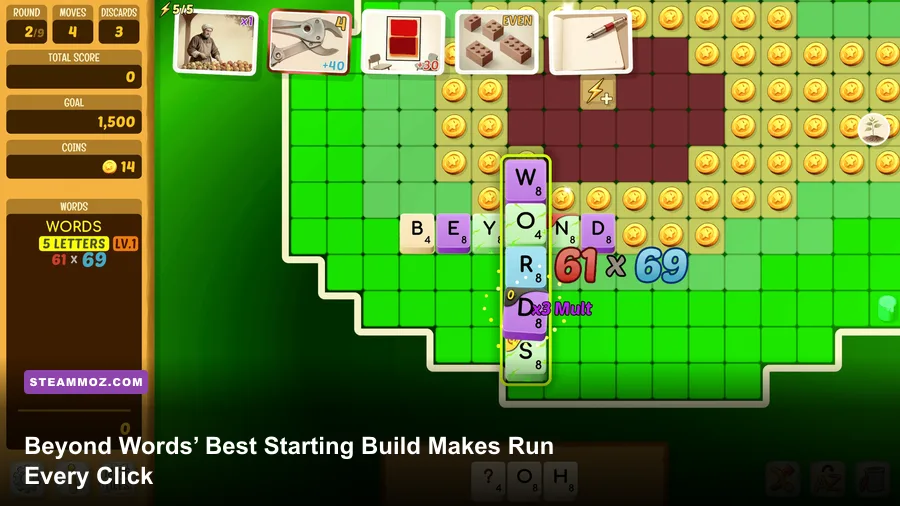
The best beginner build in Beyond Words is a consistency-first chain build: prioritize vowel access, short-word damage bonuses, Wildcard generation, and one defensive reset effect before investing in high-risk multiplier upgrades. It will not produce the biggest screenshot-worthy score on turn three, but it gives you playable turns far more often, which is what carries a new run through the first elite encounter and into the opening boss.
Beyond Words looks approachable because its basic loop is familiar: make words, deal damage, choose upgrades, and push farther. The trap is assuming that the longest word is automatically the strongest move. It usually isn't. A seven-letter chain that leaves your next rack unusable can be worse than a four-letter word that triggers your damage bonus, preserves a Wildcard, and keeps your defensive option available.
The beginner build at a glance
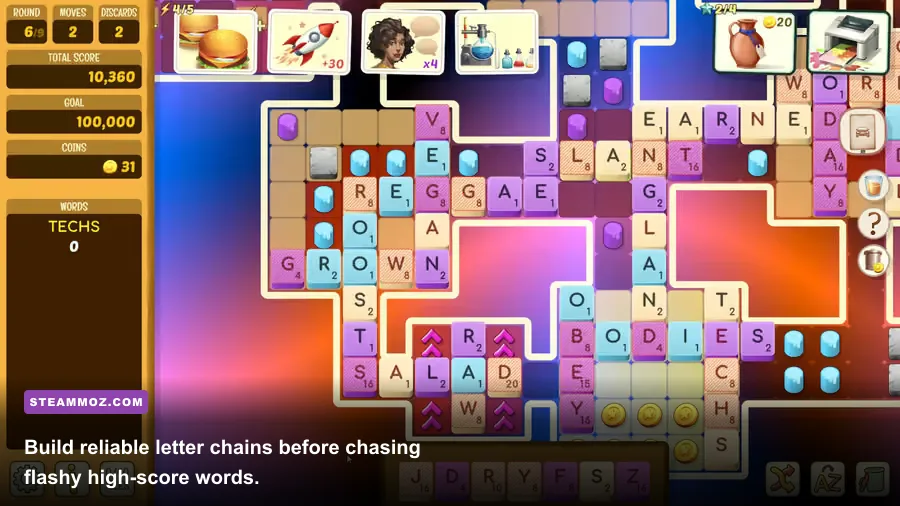
This guide focuses on the game's early word-combat economy rather than a late-run gimmick. Your first priority is to make ordinary turns productive. That means taking upgrades that improve the bottom of your performance range: more usable vowels, better access to Wildcards, and reliable bonuses for completing short chains.
| Build Element | Early Priority | Why It Matters | Beginner Target |
|---|---|---|---|
| Letter access | High | Prevents dead turns and awkward racks | Vowel or Wildcard improvement first |
| Damage | High | Short chains become dependable attacks | Four- and five-letter word bonuses |
| Defense | Medium-high | Stops one bad draw from ending a run | One shield or damage-reduction effect |
| Multipliers | Medium | Strong only after consistency is solved | One multiplier by the first elite |
| Rerolls | Medium | Converts unusable letters into playable turns | One reliable reset tool |
Think of the build as three layers. Your letter engine creates opportunities, your short-chain bonuses turn those opportunities into damage, and your defensive tool covers the turns where the board refuses to cooperate. Don't spend the first several upgrade choices on score multipliers alone. A multiplier attached to an impossible word is worth exactly zero.

🎮 Beyond Words
Looking to experience this game? Grab your digital key directly on our store for $11.24.
View on Steammoz Store →Choose consistency before spectacular scores
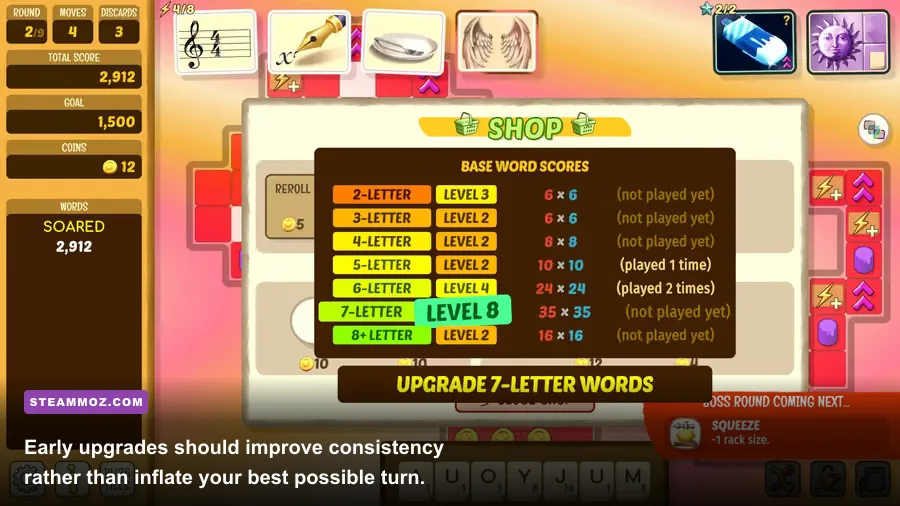
On the first upgrade screen, take the option that improves access to common letters or gives you a dependable Wildcard. In practical terms, this means upgrades that make vowels appear more often, replace a spent letter, or convert one awkward tile into a flexible tile. The precise name can vary between builds and updates, but the function is what matters: your opening hand should have a playable route without requiring a perfect seven-letter solution.
The strongest early pattern is a four-letter word followed by a five-letter word on the next turn. That rhythm keeps your damage moving while allowing you to save a rare letter or Wildcard for an emergency. Long chains are still useful, especially when an enemy is one clean hit from defeat, but they shouldn't be the foundation of your build.
Recommended first five picks
- Vowel access or Wildcard generation: take whichever option directly improves your next several hands.
- Short-word damage: favor bonuses that trigger at four or five letters instead of effects requiring a full-length chain.
- One defensive reset: choose a shield, damage reduction, or board refresh that you can activate when a rack collapses.
- Chain stability: pick an upgrade that preserves a letter, extends a combo, or reduces the cost of changing your current word.
- One multiplier: only now add a score or damage multiplier, because your engine can reliably trigger it.
This order also makes the build easier to pilot. You won't need to memorize a complicated trigger sequence, and you won't have to throw away a good defensive turn simply because your damage card demanded a longer word.
Stat priorities and upgrade decisions
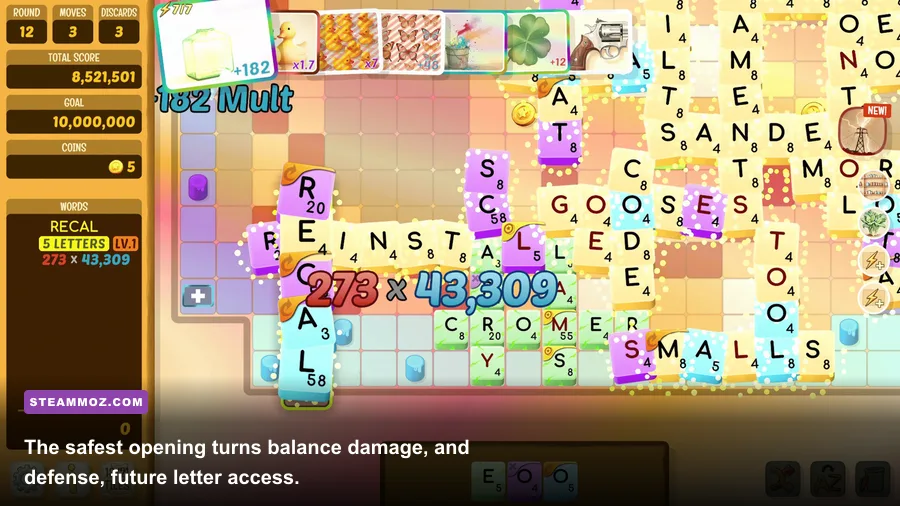
Beyond Words rewards a slightly different stat hierarchy from a conventional action RPG. Raw damage is visible, but letter quality and action reliability decide whether that damage appears at all. Rank upgrades by how often they improve a normal turn, not by how impressive their maximum value looks in the selection menu.
| Priority | Upgrade Type | Best Timing | What to Avoid |
|---|---|---|---|
| S-Tier | Wildcard, vowel, or letter replacement access | First two upgrades | Effects that require a rare letter every turn |
| S-Tier | Four- or five-letter damage bonus | Before the first elite | Bonuses tied only to maximum-length words |
| A-Tier | Board refresh, reroll, or defensive reset | Early or mid-act | Saving every reset until it is too late |
| A-Tier | Combo preservation | After your first damage bonus | Stacking combo effects without defense |
| B-Tier | Large score multiplier | After consistency is established | Taking it as the first upgrade |
There are two easy mistakes here. The first is overvaluing a bonus that triggers only on long words. The second is collecting several different reroll effects without any actual damage improvement. Rerolls are valuable because they help you reach a winning turn; they don't win the encounter by themselves. After you have one reliable reset, return to damage or chain stability.
If the game offers a choice between a modest permanent bonus and a dramatic temporary effect, take the permanent option during the opening stretch. Temporary boosts become excellent later, when your normal word already activates several bonuses. Early on, they tend to disguise a weak foundation.
The combat rotation that keeps runs alive
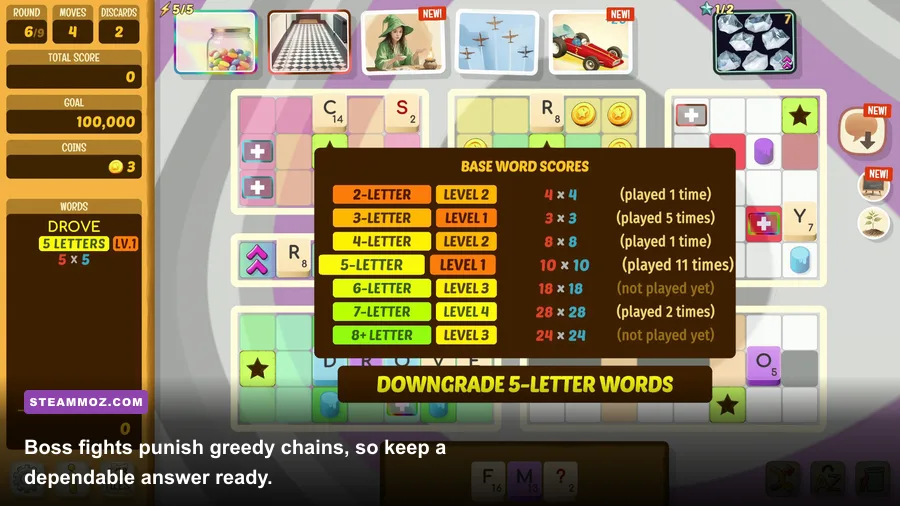
Your default rotation is simple: identify the safest scoring word, check the enemy's incoming damage, then decide whether the turn is for damage, defense, or setup. Don't begin by hunting for the highest possible score. Begin by asking whether the current rack supports a word that activates your most reliable bonus.
- Scan for a four-letter trigger. This is your baseline attack. Use it when the enemy is not threatening a lethal hit and the word activates your short-chain bonus.
- Check the next-turn risk. If the enemy telegraph shows a heavy attack or status effect, preserve a Wildcard or use your defensive reset rather than spending everything on damage.
- Extend only when the reward is real. Add letters for a longer chain when it crosses a meaningful damage threshold or finishes the enemy. Don't extend merely to inflate the score.
- Protect your engine pieces. Rare letters, Wildcards, and refresh tools are resources. Spend them when they prevent damage or secure a kill, not because the current turn feels untidy.
- Finish cleanly. If an enemy can be defeated with a short word, take the kill. A stylish chain that leaves the opponent alive often costs more health than it earns.
The most important timing lesson is to use defense before the incoming attack lands, not after your health has already fallen into danger range. A reset that prevents a bad rack from becoming a full enemy combo is worth more than one extra attack in a safe encounter.
How to handle elites and the first boss
Elite encounters are where a greedy beginner build usually breaks. Elites tend to punish repeated short turns with scaling pressure, while boss encounters make poor letter management especially painful. Your answer is not to abandon the consistency build; it's to change the way you spend its resources.
| Encounter | Main Danger | Best Response | Resource Rule |
|---|---|---|---|
| Standard enemy | Wasteful overbuilding | Use the shortest bonus-triggering word | Save Wildcards when safe |
| Elite enemy | Damage scaling and bad follow-up draws | Use a strong word early, then stabilize | Spend one reset before your rack becomes dead |
| First boss | Large telegraphed hit or disruption effect | Defend through the warning, attack after it resolves | Enter with at least one Wildcard or reset |
| Low-health finish | Taking unnecessary damage for a bigger score | Use the guaranteed lethal word | Ignore multiplier greed |
Against an elite, open with your best reliable damage turn rather than waiting for a perfect chain. The goal is to shorten the number of enemy turns, but not at the cost of exhausting every flexible resource. If the elite telegraphs a heavy attack, use the defensive option even if you could technically deal damage. Surviving with a smaller health buffer is better than entering the next room with no reset tool.
For the first boss, watch the warning pattern rather than the apparent health race. When a large attack is telegraphed, treat that turn as a defense check. Build a modest chain if it also gives protection, or refresh the board if your current letters cannot meet the requirement. Once the dangerous attack has passed, spend your saved Wildcard on the strongest clean word available. This alternating rhythm—stabilize, punish, stabilize—beats trying to force a giant chain every round.
Common beginner traps to avoid
Chasing the longest word: length is useful only when it produces a meaningful breakpoint. A safe four-letter trigger is often the correct move.
Taking every multiplier: multipliers need a reliable engine. Until you can consistently make playable words, letter access is the higher-value upgrade.
Holding resets forever: a reset that remains unused while you take avoidable damage is not being managed well. Spend it when it turns a failed turn into a safe one.
Ignoring the next hand: Beyond Words is not only about the current score. Consider what letters remain, what flexible tools are available, and whether your next turn has a realistic attack.
Overfitting to one perfect run: if a build works only when the opening rack contains ideal letters, it isn't a beginner build. Test upgrades by how often they rescue ordinary turns.
Final build plan for a first successful run
Start with vowel access or a Wildcard effect. Follow with a four- or five-letter damage bonus, then take one defensive reset. Add chain preservation next, and select your first serious multiplier only after those pieces are online. During combat, use short words as your default attack, save flexible letters for danger turns, and extend chains only when the extra length secures a kill or a valuable breakpoint.
This setup won't always top the score screen, and that's exactly why it works. It gives beginners a forgiving route through awkward letter draws, teaches the game's real tempo, and leaves enough room to pivot into a stronger specialized build later. For more route-planning ideas, compare it with our beginner build breakdown for Dungeons 2 and our guide to efficient early progression in Empires of the Undergrowth.
Before changing anything, check the latest Beyond Words Steam listing for patch notes and version details. You can also review the game's official Steam community discussions when an update changes letter weighting or upgrade behavior. If performance gets in the way of reading the board, our settings guide for Dragonkin has useful general lessons about frame pacing, while the ELEX PC fixes guide covers practical troubleshooting.
Master the opening turns, and Beyond Words stops feeling like a lottery. You’re not waiting for the perfect rack—you’re building enough control that almost any rack gives you a useful answer.