
Yes, Dropsy is worth playing in 2026—especially if you want a short, strange, genuinely tender adventure instead of another game built around combat, loot, or endless progression. Tendershoot's 2015 point-and-click game is rough around the edges, occasionally opaque, and unapologetically weird, but its hug mechanic, expressive pixel art, and unexpectedly moving story still feel distinctive. Play it for the atmosphere and character work, not for polished puzzle design or modern convenience features.
That distinction matters. Dropsy isn't a conventional horror game, although it uses disturbing imagery. It isn't a traditional comedy, either, despite the clown protagonist and constant visual absurdity. It's a largely wordless adventure about a misunderstood character trying to help people who are frightened of him. In 2026, that premise remains more memorable than most narrative games released this year.
The PC version is also easy to run, inexpensive during frequent Steam sales, and compact enough to finish without turning into a second job. You can check the official Steam page for Dropsy for current pricing, platform details, and user reviews. My verdict is a cautious recommendation: buy it if you enjoy experimental adventure games, but skip it if you need crystal-clear objectives and frictionless puzzle feedback.
What makes Dropsy different from other adventure games?
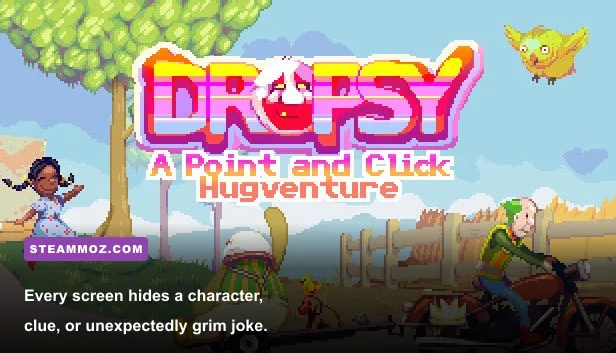
Dropsy replaces dialogue-heavy investigation with visual communication. The protagonist is a large, bald clown with a permanent smile, and most people initially read that smile as threatening. You don't persuade them through a dialogue tree. Instead, you explore, collect useful objects, solve environmental problems, and gradually earn a character's trust. Once that trust is established, Dropsy can offer a hug.
That hug is not a cosmetic animation. It is the game's emotional progression system. A character who rejects Dropsy early in the story may later become part of his growing circle of friends. The mechanic gives ordinary errands a clear purpose: you're not simply opening a locked door or delivering an item; you're helping somebody reach a point where they can see Dropsy as a person.
There is no conventional combat system, no experience level, no weapon inventory, and no branching skill tree. That absence is deliberate. The game's challenges come from observation, timing, item combinations, and understanding what each person wants. If you arrived after playing something like Enter the Gungeon, the lack of shooting and progression numbers may feel startling. Here, progress is measured in opened paths, solved problems, and new hugs.
| System | What Dropsy uses | How it affects play |
|---|---|---|
| Combat | None | Threats are solved through exploration and item use. |
| Dialogue | Mostly visual symbols and reactions | You read intent from icons, animations, and context. |
| Progression | New locations, items, and trusted characters | Every solution expands your social and physical access. |
| Primary goal | Help people and share hugs | Emotional payoff replaces conventional rewards. |

🎮 Dropsy
Looking to experience this game? Grab your digital key directly on our store for $0.99.
View on Steammoz Store →How good is Dropsy's story in 2026?
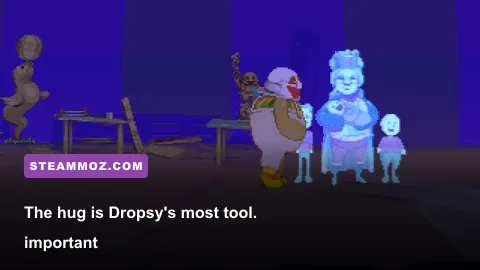
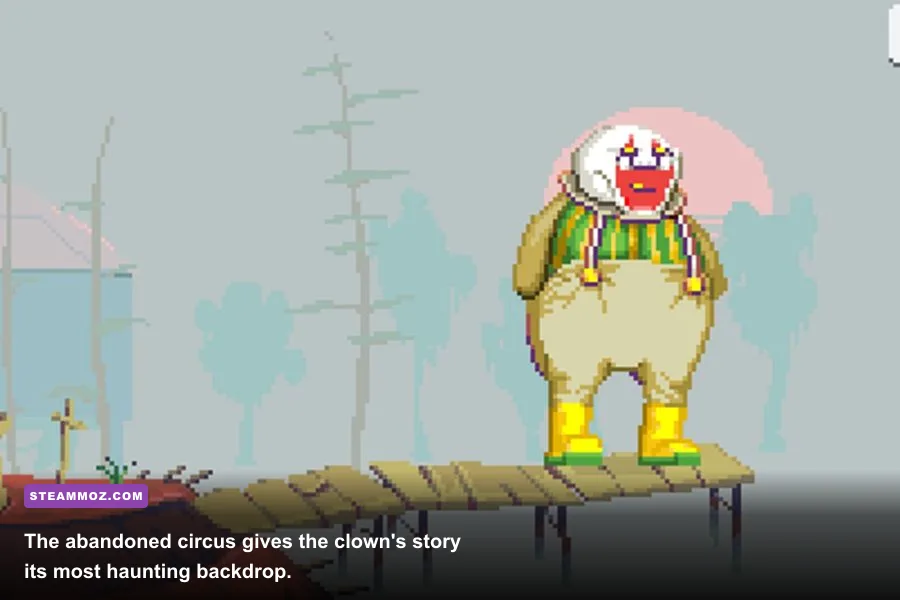
Dropsy's story works because it trusts images to carry ideas that another game would explain in paragraphs. The clown's oversized body, fixed grin, and colorful clothes make him look like a threat before he does anything wrong. The world responds to that appearance, and the contrast between public fear and Dropsy's actual behavior drives the narrative.
The setup begins with Dropsy living around a failing circus and dealing with the consequences of a fire that damaged his family and reputation. The exact details are revealed through exploration rather than a cinematic exposition dump. You piece together relationships, local resentment, rumors, and the circus's history by visiting places such as the town, the forest, the cemetery, the swamp, and the circus grounds.
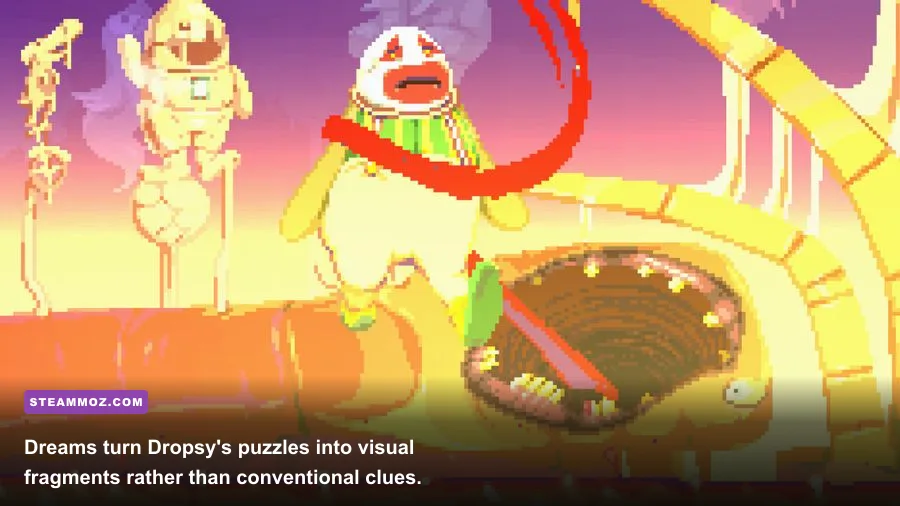
This structure can be surprisingly effective. A silent character should be difficult to write, but Dropsy communicates through hugs, facial reactions, dreams, and the objects he carries. The dream sequences are particularly important because they show how he interprets people and events. Their warped color palettes and symbolic imagery add a layer of psychological horror without turning the game into a jump-scare machine.
Not every story beat lands equally well. Some scenes lean into grotesque humor so hard that the emotional rhythm wobbles. A few characters feel more like punchlines than fully developed people, and the absence of spoken dialogue can make serious moments less precise than intended. Still, the central arc—an outcast trying to prove that kindness is real—has enough heart to carry the entire adventure.
For comparison, Dropsy is closer to an illustrated fable than a modern cinematic adventure. If you liked the time-loop storytelling and emotional oddness of In Stars and Time, you'll recognize the appeal of repetition, visual clues, and characters who communicate indirectly. Dropsy is less mechanically ambitious, but its emotional hook is just as clear.
Are Dropsy's puzzles clever or frustrating?
The honest answer is both. Dropsy has satisfying puzzles, but it also has several moments where the intended solution is so obscure that you'll start clicking everything out of desperation. The game uses a traditional point-and-click structure: move between screens, inspect objects, collect items, and use those items on characters or environmental obstacles.
The strongest puzzles are grounded in character motivation. If someone needs food, medicine, transportation, or a way out of danger, the solution usually makes sense once you've identified the problem. The best moments come when two seemingly unrelated locations connect through an object you found earlier. Dropsy's visual language also helps: characters often display a thought bubble or reaction that points toward the next useful step.
The weak spots involve item logic. Dropsy can carry objects that appear important but have limited use, while other solutions require revisiting an earlier screen after a small change. Because the game offers little written direction, you need to remember who reacted to what. A notebook or screenshot folder helps more than it should.
A practical way to avoid getting stuck
Start every play session by checking the map and revisiting characters who showed a clear need. Inspect every new object before using an item. If a person rejects you, don't assume the interaction is finished; that rejection may be a clue about a missing task. Also watch for environmental changes after completing a major favor. Dropsy often advances quietly, without a loud quest-complete notification.
| Puzzle type | Typical clue | Best approach | Frustration level |
|---|---|---|---|
| Character request | Thought bubble or repeated reaction | Trace the request through nearby locations | Low |
| Item combination | Object description and visual resemblance | Test items on matching environmental details | Medium |
| World-state puzzle | A screen changes after a favor | Revisit earlier areas after major progress | Medium |
| Symbolic dream puzzle | Images rather than explicit instructions | Focus on relationships and repeated symbols | High |
There is no shame in using a guide for one stubborn sequence. Unlike a deduction game, Dropsy sometimes asks you to guess the designer's item logic rather than derive a solution from complete information. The important thing is to avoid spoiling every character interaction; the emotional payoff depends on discovering those connections yourself.
How long does Dropsy take to finish?
A first playthrough usually takes around six to ten hours, depending on how quickly you understand the puzzle language and whether you chase optional interactions. That length is one of Dropsy's strengths in 2026. It has enough room to build a memorable world without padding the experience with repetitive combat encounters or collectible clutter.
Completion time varies because some content is easy to miss. Optional characters, environmental jokes, and extra dream material reward players who revisit areas instead of moving in a straight line. The game doesn't constantly push you forward, so thorough exploration matters. If you rush from objective to objective, you'll understand the plot but miss much of the personality.
The progression curve is gentle at first. Early tasks teach you to read visual reactions and notice usable objects. The middle section opens several regions and becomes less predictable. Near the end, the game expects you to connect clues across locations, and that is where many players either become fully invested or reach for a walkthrough.
| Play style | Estimated time | What you'll see | Who it's for |
|---|---|---|---|
| Story-focused | 5–7 hours | Main locations and essential character tasks | Players who want the central narrative |
| Exploratory | 8–10 hours | Optional reactions, side characters, and dream details | Players who inspect every screen |
| Completion-minded | 10+ hours | Missable interactions and achievement cleanup | Adventure-game completionists |
That makes Dropsy a good weekend game, especially if you're tired of 40-hour open worlds. It also means the full-price value depends on your tolerance for experimentation. On sale, the recommendation becomes much easier.
Does Dropsy still look and sound good?
The pixel art remains the game's biggest visual success. Dropsy's world is bright, chunky, and deliberately ugly in places, with saturated colors that make its darker imagery hit harder. The clown's silhouette is instantly recognizable, while background characters have enough visual exaggeration to communicate personality without dialogue.
The art direction also creates a useful tension. A cheerful palette can hide a rotten tree, a suspicious basement, or a character whose smile doesn't mean what it seems to mean. The cemetery and circus areas use this contrast especially well. Dropsy can look like a children's cartoon one moment and a nightmare illustration the next.
The soundtrack supports that mood with playful melodies, uneasy ambience, and sharp shifts between warmth and discomfort. Sound is not as expansive as in a big-budget adventure, but it gives the world texture. The audio design knows when to leave space, which matters in a game where visual reactions replace conventional conversation.
Technically, don't expect modern accessibility polish. Pixel scaling and presentation are part of the game's identity, but some interface elements feel dated on high-resolution displays. Before buying, check the publisher's official Dropsy listing and current Steam discussion posts for platform-specific information. The game is lightweight, though, and it doesn't need a gaming PC.
| Presentation factor | 2026 verdict | What to expect |
|---|---|---|
| Pixel art | Excellent | Distinctive silhouettes and expressive environmental detail |
| Animation | Good with rough edges | Strong character reactions, limited fluidity |
| Soundtrack | Very good | Playful, eerie, and effective without dominating scenes |
| Display polish | Functional | Older presentation choices may require patience |
How does Dropsy run on modern PCs?
Dropsy is one of the easiest PC games to run in this article's recommendation category. Its 2D pixel-art presentation places almost no meaningful demand on a current CPU or GPU. There are no ray-tracing options, shader-heavy weather effects, texture-quality tiers, or frame-generation settings to tune. You can install it on a modest laptop and expect smooth play unless another application or compatibility layer causes trouble.
For the cleanest experience, use the native resolution that looks sharpest on your display, disable unnecessary scaling filters if the pixel art appears blurry, and cap the frame rate if your system produces inconsistent pacing. These are comfort tweaks, not performance requirements. Dropsy's challenge is understanding its puzzles, not keeping a stable 144 frames per second.
| Hardware profile | Expected result | Recommended setup |
|---|---|---|
| Modern desktop GPU | Well above 60 FPS | Native display resolution and integer-style pixel scaling |
| Integrated graphics laptop | 60 FPS in normal play | Close background apps if windowed performance stutters |
| Older Windows laptop | Playable with occasional compatibility quirks | Try fullscreen and a frame cap |
| Steam Deck | Lightweight and suitable for handheld play | Use a comfortable text scale and controller layout |
If you're troubleshooting a different demanding PC game, Steamoz's guides to Dungeon Rushers PC settings and Grow: Song of the Evertree performance cover the kind of graphics tuning Dropsy simply doesn't require. That simplicity is a real advantage when you want an adventure you can launch instantly.
Who should play Dropsy in 2026?
Play Dropsy if you like point-and-click adventures that make you work for their emotional payoff. It is a strong fit for fans of visual storytelling, oddball indie games, pixel art, and narratives about characters who exist outside society's comfort zone. The game also suits players who prefer nonviolent problem-solving. You won't be managing weapons, armor, or stat scaling; you'll be managing attention.
It's particularly good for a shared playthrough. One person can handle the mouse while another tracks character clues and suggests item uses. The visual reactions make it easy to discuss what a character might want, even when the game refuses to spell it out. That kind of couch puzzling is increasingly rare.
Skip it if you need explicit quest markers, voice acting, fast travel, or puzzles that always follow strict real-world logic. Dropsy can be cryptic, and its interface occasionally feels like a relic from an earlier adventure-game era. Players looking for a mechanically deep RPG should look elsewhere; even a guide like Steamoz's Disciples: Liberation weapon rankings is built around a level of combat detail that Dropsy intentionally avoids.
| Player type | Recommendation | Why |
|---|---|---|
| Point-and-click fan | Buy | Strong visual clues, memorable locations, and unusual puzzle structure |
| Story-first player | Buy on sale or at full price | The emotional arc is more valuable than the mechanics |
| Completionist | Buy with a guide nearby | Optional interactions and obscure solutions can slow you down |
| Action-focused player | Skip or sample first | No combat, builds, upgrades, or conventional challenge loop |
| Horror fan | Try it | Disturbing imagery and melancholy atmosphere without constant scares |
Final verdict: is Dropsy worth playing in 2026?
Dropsy is worth playing in 2026 because it still has a personality that cannot be reduced to a genre label. The puzzles are uneven, the silent storytelling occasionally leaves too much unsaid, and the presentation shows its age. But the core idea—using hugs as a hard-earned form of communication—is so specific and sincere that the game remains easy to remember years later.
Give it six to ten hours, approach its weirdness with patience, and resist looking up every answer immediately. The reward isn't a new weapon, a stat boost, or a spectacular boss fight. It's watching a character who looks frightening make the world around him a little gentler. That is a small ambition, but Dropsy commits to it completely.
Steamoz rating: 8/10. Dropsy is a heartfelt, visually striking adventure with frustrating puzzle logic. Buy it if you want something unusual, humane, and compact; wait for a sale if opaque point-and-click design usually tests your patience.
For more unusual 2026 recommendations, see our Eternal Destiny review, and check the developer's official site for more from Tendershoot.