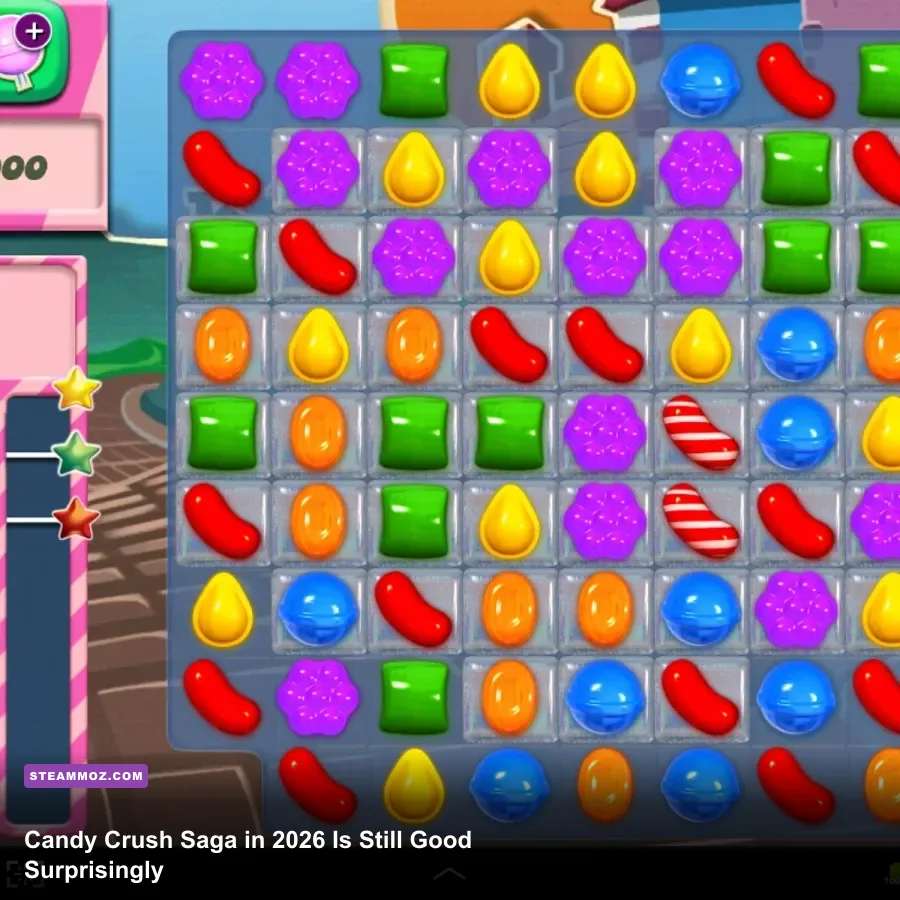
Yes, Candy Crush Saga is still worth playing in 2026—but only if you treat it as a bite-sized puzzle game rather than a fair, endlessly generous free-to-play experience. The matching is as sharp as ever, the level variety is far deeper than its candy-coated image suggests, and a five-minute session can still become a genuinely satisfying little victory. The catch is familiar: lives, boosters, timed events, and increasingly aggressive purchase prompts can turn a relaxing game into a patience test.
That tension is the real story of Candy Crush Saga today. King’s classic match-three game has survived because its basic loop remains almost perfectly readable: swap two candies, make three or more in a row, create a special candy, and watch the board explode. Nearly anyone can understand it in seconds. Mastering the board, however, takes deliberate planning, probability management, and a willingness to restart instead of throwing gold bars at a bad position.
Why Candy Crush Saga Still Feels So Good
The rules are simple, but the board is not
Candy Crush Saga’s strongest design decision is that every level gives you a compact problem with a clear objective. You might need to score a target, clear jelly, drop ingredients to the bottom, collect orders, or remove layered blockers before a move limit expires. There is almost never any confusion about what success looks like. The tension comes from deciding which move creates the most useful future board.
The six standard candy colors—red, orange, yellow, green, blue, and purple—form the foundation. Matching four candies creates a Striped Candy; a horizontal match produces a horizontally striped piece, while a vertical match produces a vertically striped one. Matching five in a straight line creates a Color Bomb, the familiar chocolate ball covered in sprinkles. A T or L shape creates a Wrapped Candy, which detonates twice and affects a 3x3 area around its position.
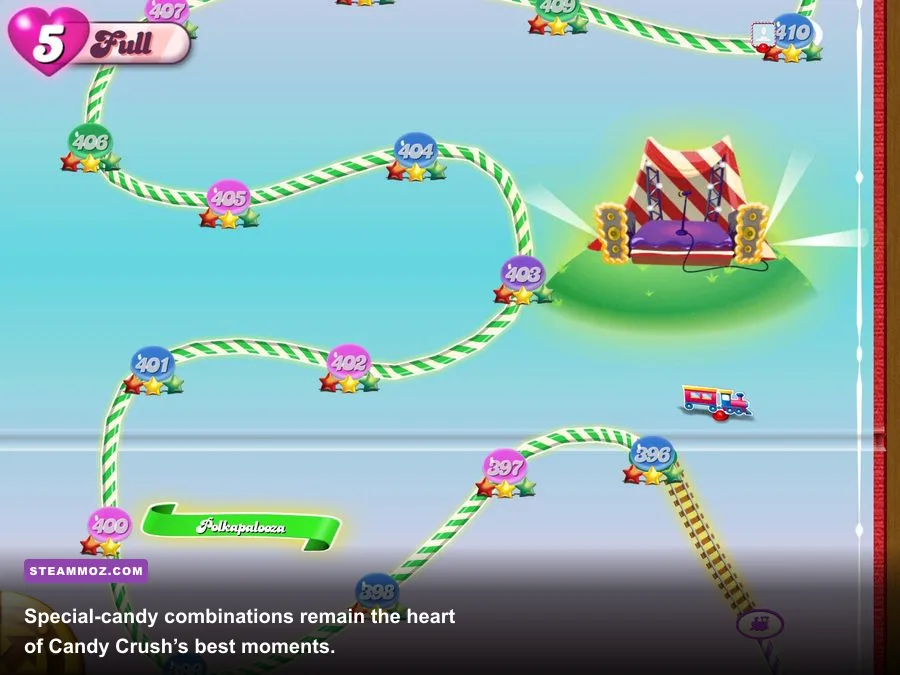
The real fireworks happen when you combine special candies. A Striped Candy plus a Wrapped Candy fires three rows and three columns. A Striped Candy plus a Color Bomb turns candies of the striped candy’s color into striped candies and activates them. The Color Bomb plus Color Bomb combination clears the entire board, while a Color Bomb plus a regular candy removes every candy of that color. These aren’t cosmetic effects; they’re the difference between scraping through a level and solving it with ten moves left.
The best move is usually not the biggest match
New players naturally chase four- and five-candy matches. Experienced players look for board control. A three-candy match that opens the bottom of a blocked board can be much stronger than an isolated Wrapped Candy at the top. Clearing blockers near the sides matters because cascades are less likely to reach awkward corners. On ingredient levels, you should inspect the exits first and avoid wasting moves on candies that cannot influence the drop path.
That makes Candy Crush surprisingly replayable. The rules never change, but board geometry, move limits, blockers, and objectives keep asking different questions. It is closer to a sequence of tiny tactical puzzles than to mindless swiping, especially once chocolate, licorice, candy fences, layered frosting, and teleporters start interfering with your plans.
| Special Candy | How You Create It | Best Use | Main Limitation |
|---|---|---|---|
| Striped Candy | Match four in a row | Clearing a full row or column | Its direction may not line up with the objective |
| Wrapped Candy | Make an L or T shape | Destroying clustered blockers | Its blast radius is local |
| Color Bomb | Match five in a straight line | Removing a troublesome color or combining with a special | Hard to create reliably on cramped boards |
| Color Bomb + Striped | Swap both special candies | Large-scale board clearing | Can waste useful colors if triggered too early |
| Color Bomb + Wrapped | Swap both special candies | Turning one color into powerful area damage | Less predictable than a carefully saved special |

🎮 RUSH
Looking to experience this game? Grab your digital key directly on our store for $4.99.
View on Steammoz Store →How the Progression Holds Up After All These Years
The early game is still excellent
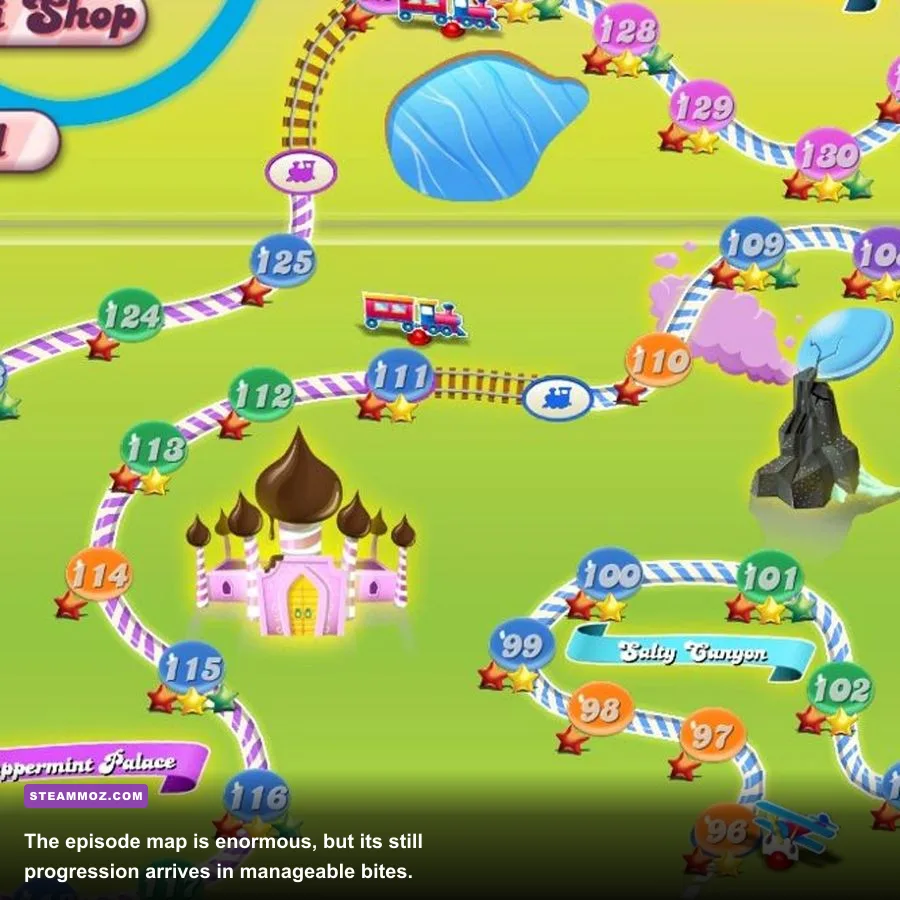
The first portion of Candy Crush Saga remains the most polished onboarding sequence in the genre. Early levels introduce the vocabulary gradually: basic matches first, then striped candies, wrapped candies, Color Bombs, chocolate, licorice, and new objectives. You learn by playing rather than reading a wall of instructions. The game also makes early wins feel generous, with frequent cascades and enough space to understand why a move worked.
That accessibility is useful even if you have not touched the game since the 2010s. You can return, play a handful of levels, and immediately understand the rhythm again. The official Candy Crush Saga page still presents the game as a quick-play experience, and that description remains accurate. It works on a commute, during a queue, or when you have ten minutes before bed.
Later levels are more demanding, but not always more elegant
The enormous episode map gives Candy Crush a remarkable sense of scale. Newer stretches add unusual board layouts, split spaces, conveyor belts, candy cannons, order requirements, and blockers that force you to rethink normal match-making. That variety is why the game has lasted so long. You aren’t simply repeating the same open square hundreds of times.
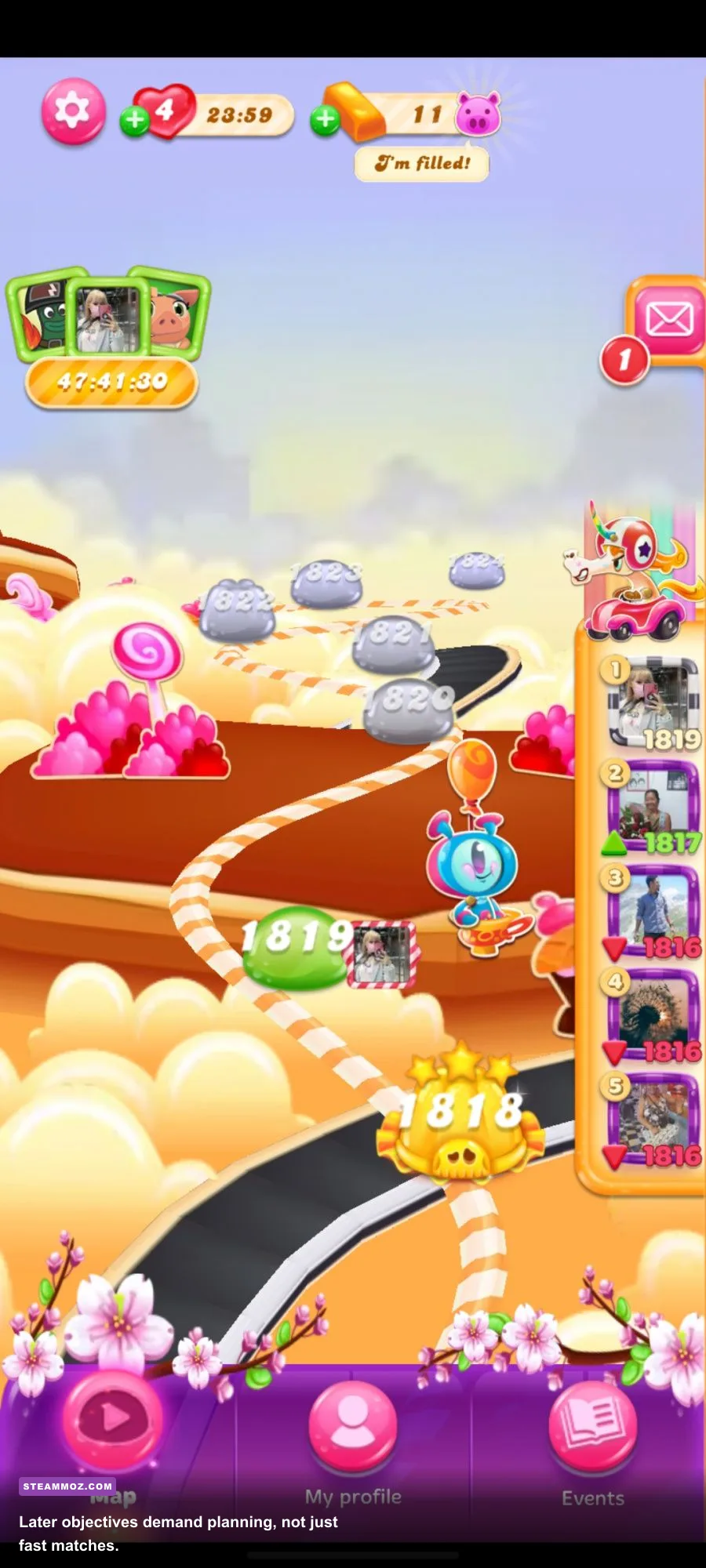
Still, the difficulty curve can feel uneven. Some levels are satisfying because they ask you to build a Color Bomb or engineer a chain reaction. Others feel difficult because the opening board is restrictive, the target is luck-dependent, or a blocker combination leaves too few meaningful moves. That distinction matters. A hard puzzle makes you want to try again; a board that depends on a fortunate opening can make the game feel like it is selling you relief.
The modern game also layers ongoing events and alternative modes over the core map. These can add useful variety, but they sometimes make the interface feel busy. If you only want classic levels, you may need to ignore several competing offers, event meters, and limited-time challenges before getting to the board.
| Progression Stage | What You Learn | Typical Challenge | My Verdict |
|---|---|---|---|
| Early episodes | Basic matches and special candies | Learning objectives and cascades | Excellent onboarding |
| Middle episodes | Blockers, chocolate, licorice, and tighter move limits | Creating space before chasing the target | Often the sweet spot |
| Advanced episodes | Complex layouts, conveyors, spawners, and layered objectives | Planning several moves ahead | Inventive but inconsistent |
| Endless live-service map | Regularly added levels and events | Maintaining patience through bad boards | Huge value for dedicated players |
Is Candy Crush Saga Fair Without Spending Money?

Free-to-play does not mean friction-free
You can play Candy Crush Saga without spending money. That has always been true, and it remains the most important reason the game continues to attract such a wide audience. You receive five lives, lose one when a level fails, and normally wait for lives to refill. The game also provides occasional free boosters, daily rewards, event prizes, and opportunities to earn gold bars through play.
However, the free route asks you to accept downtime. A difficult level can consume all five lives quickly, after which the game encourages you to wait or use resources. Boosters such as the Lollipop Hammer, which removes one candy or blocker, and the Free Switch, which swaps two candies without consuming a normal move, can rescue a board. Saving them for genuinely nasty positions is crucial because using them on a level you might have won naturally is poor value.
Gold bars are more important than ordinary boosters because they can buy extra moves or other advantages. The problem is that extra moves can blur the line between solving a puzzle and paying to erase a mistake. My advice is simple: never spend gold bars automatically after a failed attempt. Look at the board. If one or two moves would clearly finish the objective, the choice is understandable. If you need a miracle chain, save the currency and try again later.
Timed events and reward tracks can improve the free experience, but they also create pressure to return on a schedule. That is where Candy Crush can become less relaxing in 2026 than it feels during its best levels. Notifications, event timers, and purchase prompts are not difficult to understand, but they are designed to keep the game in your attention.
The healthiest way to play
Turn off notifications, refuse to chase every event, and set a session limit before starting. Treat boosters as tools for specific objectives, not as an expectation. If a level is clearly producing poor boards, stop after a few attempts. The game’s lives system works much better when you walk away voluntarily instead of feeling trapped by the timer.
Players who dislike recurring monetization should know what they’re signing up for. The core puzzle is free, but the surrounding economy is always visible. If you want a single-purchase match-three game with no lives or offers, Candy Crush Saga may irritate you even when the actual level design is excellent.
What to Know Before Playing on Android, iPhone, or Windows
Performance is rarely the deciding factor
Candy Crush Saga is not a demanding game by modern standards. It runs comfortably on a wide range of phones and Windows devices, and the board is visually clear even on smaller screens. You don’t need a gaming phone, a high-refresh-rate display, or a dedicated graphics card to enjoy it. The main performance concerns are battery drain, background activity, and whether your device has enough free storage for updates and cached content.
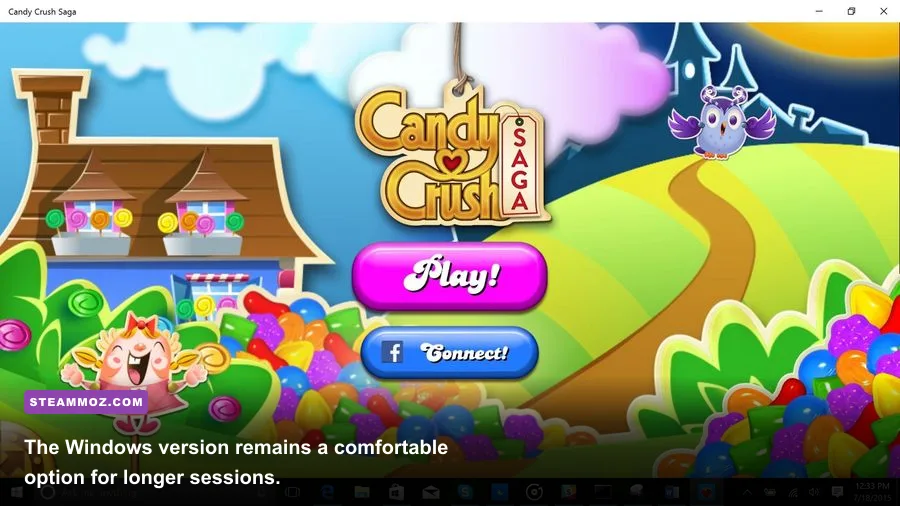
The Android version is easy to pick up and play, while the iPhone and iPad versions benefit from responsive touch controls and clean scaling. Windows is useful if you prefer a larger screen or want to play without holding a phone. Before installing, check the current requirements on the official Google Play listing or the official App Store listing, since supported operating systems and download sizes can change.
Cloud progression is convenient, but always connect the game to the correct King, Google, Apple, or Microsoft account before switching devices. If you play as a guest and then uninstall, your progress may not be recoverable. This is a boring warning, but losing a long run through the episode map is far more painful than any hard level.
| Platform | Best For | Strength | Potential Annoyance |
|---|---|---|---|
| Android | Flexible phone and tablet play | Broad device support and easy access | Performance and battery vary widely |
| iPhone/iPad | Consistent touch experience | Responsive controls and strong screen scaling | Older devices may need operating-system updates |
| Windows | Larger-screen sessions | Comfortable viewing and familiar desktop access | Less convenient for quick mobile play |
If you regularly troubleshoot PC games, our guides on stopping crashes and rescuing FPS or tuning settings for higher FPS cover more demanding software. Candy Crush generally needs none of that specialist work; keeping the app updated and your account synced is usually enough.
Smart Strategies for Beating Difficult Levels
Start with the objective, not the first match
Before moving anything, identify what actually ends the level. On jelly boards, prioritize moves that reach covered squares, especially isolated corners. On ingredient levels, inspect where cherries or hazelnuts enter and where they must exit. On order levels, check whether the order requires a specific candy, blocker, or combination. A flashy match that does not advance the objective is often wasted momentum.
Work from the bottom when the board is open. Matches near the bottom create new candies above them, increasing the chance of cascades and unexpected specials. There are exceptions: if a chocolate square or candy bomb is about to spread or expire, deal with it immediately. You should also clear blockers that restrict the board’s width before spending moves on isolated targets.
Use boosters with a plan
The Lollipop Hammer is best saved for a single blocker, candy bomb, or final jelly square that cannot be reached naturally. The Color Bomb is strongest when you can combine it with another special candy or remove a color that appears frequently across the board. A Coconut Wheel, when available in supported levels, can create striped candies and open a lane; don’t trigger it simply because it is glowing. The value comes from where its path lands.
Starting boosters deserve the same caution. A pre-level Color Bomb can produce a powerful opening, but it can also remove the color you needed to build a larger combination. On highly constrained boards, a Free Switch may be more valuable than a larger-looking booster because it lets you preserve a nearly completed special-candy setup.
Know when to quit a bad attempt
There is no prize for forcing a hopeless board. If the opening layout offers no path toward the objective, restart early when the game allows it. If a level requires four specific orders and none appear after several moves, don’t burn every booster trying to manufacture luck. Lives refill over time, and a fresh attempt can produce a much more workable arrangement.
This is also where Candy Crush’s famous difficulty becomes manageable. You’re not trying to win every board with perfect skill; you’re learning to recognize when the board is offering a winning line. Save resources for that moment, then capitalize hard with a Color Bomb, a Wrapped-and-Striped combination, or a carefully positioned vertical blast.
The Verdict: Worth Playing, With One Big Asterisk
Candy Crush Saga is still worth playing in 2026 because its central puzzle loop has aged extraordinarily well. The controls are immediate, the objectives are readable, the special-candy system creates real tactical decisions, and the huge level library offers more content than most players will ever finish. It remains one of the best games for short sessions, casual competition, and that dangerous moment when you say you’ll play one more level.
It is less compelling if you hate waiting, dislike recurring monetization, or want every challenge to be solved purely through skill. Some late-game boards lean too heavily on luck, and the event-heavy interface can make a simple puzzle feel like a storefront with a game attached. You’ll have a better time by disabling notifications, ignoring pressure to buy, and accepting that some levels are best revisited later.
My honest recommendation is to install it, play without spending money for a week, and see whether the rhythm works for you. Focus on the main map, learn the special-candy combinations, and treat boosters as limited tools rather than shortcuts. If the five-life system becomes annoying, stop before frustration turns the game into a chore.
For puzzle fans, Candy Crush Saga remains a remarkably effective piece of game design hiding beneath layers of live-service clutter. For everyone else, it is still worth trying—but only on your terms. If you want more progression-focused gaming advice, Steamoz’s fast-leveling guide and hidden-rewards guide offer very different ways to spend your next gaming session.