
Most players assume Tripledot Studios designed Woodoku Free as nothing more than a relaxing, low-stakes hybrid of classic Sudoku and retro block-dropping puzzles. They treat it like a simple commuter distraction, drop polyomino shapes onto the 9x9 grid, and casually collect their daily stars. But if you look beneath its minimalist timber aesthetic, the game hides surprisingly elaborate mechanics: off-path Journey Mode nodes, dynamic pentatonic sound scales, screen-clearing cosmetic fanfares, and hidden map tap interactions that casual solvers walk right past. Unlocking these secrets requires treating the game less like a passive time-killer and more like a tactical grid optimizer where multiplier management, tile counting, and map exploration dictate what secrets reveal themselves.
Unlocking Woodoku's Hidden Journey Nodes and Secret Star Paths

Journey Mode is where Woodoku's developers hid their most intricate structural content. At first glance, the Journey map looks like a linear string of progressive stages across themed zones like Mystic Forest, Sunken Valley, and Celestial Grove. However, standard linear progression only scratches the surface. If you meet strict scoring conditions on designated gateway stages, hidden branch paths diverge from the main trail, leading to secret trial shrines that award exclusive gem bundles and rare decorative profile emblems.
To expose these hidden branches, you cannot simply scrape by with a standard stage-completion clear. You have to trigger a "Perfectionist Clear" on designated milestone nodes (usually stage 5, 10, 15, and 20 within each 25-stage island). A Perfectionist Clear requires finishing the level's point objective while maintaining an unbroken 3x combo streak on the final move. When executed properly, the stage marker on the world map doesn't just turn gold; it sprouts a glowing root or vine that cuts across the map terrain, unlocking an off-road challenge node. Hunting these divergent paths rewards you much like uncovering hidden reward routes in complex adventure maps, proving that even mobile puzzle grids reward inquisitive players.
| Journey Chapter | Gateway Node | Secret Unlock Condition | Hidden Milestone Reward |
|---|---|---|---|
| Mystic Forest | Stage 10 | 4x Combo finish with over 650 surplus points | Elder Oak Node (150 Gems + Vintage Tile Skin) |
| Sunken Valley | Stage 15 | Simultaneous Box + Line clear on turn limit | Sunken Vault (250 Gems + Coral Badge) |
| Autumn Highlands | Stage 20 | Clear board with zero remaining 3x3 square blocks | Maple Cavern (300 Gems + Amber Glow Effect) |
| Celestial Grove | Stage 25 | Finish stage with 5 consecutive turn clears | Starlight Obelisk (Exclusive Constellation Border) |
Missing these requirements doesn't lock you out permanently, but the game deliberately conceals the trigger conditions. If you beat a level without hitting the combo threshold, the map simply shows a completed dot and pushes you down the standard road. You have to actively replay these milestone levels, study your piece queue, and prioritize massive board clears over cautious survival to crack open the map's hidden geometry.

🎮 Journey
Looking to experience this game? Grab your digital key directly on our store for $14.99.
View on Steammoz Store →Audio Easter Eggs: The Pentatonic Scale and Perfectionist Fanfares
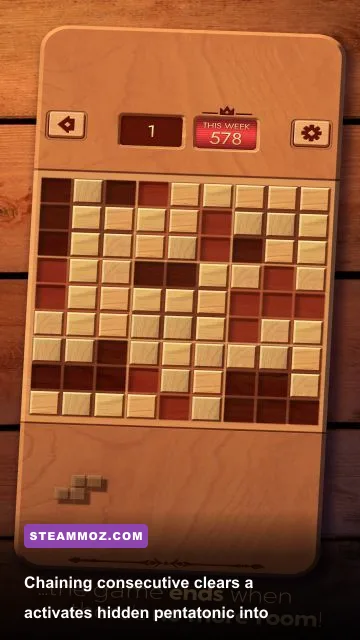
Play Woodoku on mute and you miss half the game's sensory personality. The sound design is not a collection of static, pre-rendered wooden clacks. The audio engine is programmed around a dynamic pentatonic pitch curve that actively responds to the speed and efficiency of your clearing chains. When you drop your first clearing tile—whether it wipes a horizontal 9-block line, a vertical strip, or one of the nine 3x3 sub-grids—the game plays a mellow root note (typically middle C in the default audio bank).
If your next placed tile clears another line or box without an empty placement turn in between, the engine steps up through the pentatonic scale: D, E, G, and A. If you manage to sustain this chain all the way to a sixth consecutive clear, the game bypasses the standard audio loop and plays a bright, marimba-style octave arpeggio that sounds like wind chimes echoing through an empty timber hall. This isn't just cosmetic polish; it is a hidden auditory feedback loop intended to notify advanced players that their score multiplier has hit its maximum 5x cap without requiring them to glance away from the grid.
Mobile players on modern iOS and Android devices who download the official release via the Woodoku on the App Store or the Google Play Store will notice this audio Easter egg pairs directly with a subtle haptic rhythm. The haptic motor switches from standard short taptic thumps into a rhythmic triple-pulse flutter when the octave arpeggio fires. Fine-tuning your touch timing for high-frequency chains feels just as satisfying as optimizing responsive puzzle performance on a dedicated gaming rig.
The Elusive Full-Board Wipe and the Golden Leaf Animation

Ask a hundred Woodoku players if they have ever cleared all 81 tiles off the board at once, and ninety-nine will tell you it's impossible. Because the game constantly feeds you asymmetrical polyomino shapes—including awkward 5-block L-shapes, bulky 3x3 solid blocks, and 4-block T-shapes—your board is almost always cluttered with foundational "anchors." But clearing the board to an immaculate 0-tile state is not only possible, it triggers one of the best visual Easter eggs in mobile puzzle gaming.
Executing a Full Board Wipe requires precise mathematical staging. You must construct a geometric cross-matrix where two opposing 9-tile lines and an overlapping 3x3 corner box share a single keystone block. When you slide that final piece into place, all intersecting sections collapse simultaneously. When the final tile dissolves, the standard wooden frame flashes with a subtle white halo, the game drops its standard UI elements for two seconds, and a cascading burst of golden autumn leaves swirls across the entire screen accompanied by a resonant church-bell gong.
The developer never mentions this event in tutorials or achievement lists. It exists purely as an elite secret for master tacticians who can manipulate the game's piece-generation RNG. Much like mapping out hidden secrets and unique loot pools in secret locations and hidden collectibles, achieving a 100% board wipe requires disciplined spatial foresight and deliberate refusal to take easy single-line bailouts.
Seasonal Map Secrets and Interactive UI Taps

Casual puzzle interfaces usually treat the world map as a passive backdrop, but Woodoku's seasonal updates contain surprisingly tactile UI Easter eggs. During limited-time seasonal runs like the Cherry Blossom Festival, Winter Frost, or Desert Oasis, the developers tuck interactive triggers directly into the map screen art. Tapping specific background elements in the correct order unlocks temporary particle effects and unlocks hidden token caches.
On the Autumn Vale event map, for example, tapping the sleepy wooden owl perched on the branch near Stage 12 five consecutive times causes the bird to wake up, shake its feathers, and drop a cluster of 50 bonus event acorns directly into your bank. Similarly, clicking the weathered stone compass in the bottom-left corner of the nautical maps three times quickly flips the game's global visual profile into a secret "Midnight Pine" color scheme—a high-contrast, deep-slate wood palette that isn't accessible anywhere inside the standard settings menu.
| Map Landmark | Interaction Requirement | Triggered Easter Egg | Effect Duration |
|---|---|---|---|
| Sleeping Forest Owl | Tap 5 times in rapid succession | Owl animation + 50 Event Acorns | Instant reward (Once per event) |
| Sunken Compass Rose | Triple-tap within 1.5 seconds | Unlocks "Midnight Pine" Dark Palette | Persists until app reboot |
| Waterfall Mill Wheel | Swipe finger clockwise 3 rotations | Water spray particle burst + audio ripple | Cosmetic (Unlimited uses) |
| Zen Garden Stone Lantern | Tap-and-hold for 3 seconds | Spawns Sakura Blossom trail on placed tiles | Active for current game session |
These playful aesthetic secrets show a team that cares about rewarding curious hands. Instead of stuffing every bonus into a microtransaction window, discovering these easter eggs feels like cracking a secret code in a vintage 90s puzzle cartridge.
High-Tier Combo Routing to Reliably Farm Secret Milestone Rewards

If you want to regularly unlock secret Journey branches and trigger the game's rare combo audio flourishes, relying on luck will get you stuck on Stage 15 forever. The piece-generation algorithm evaluates your open board state and purposefully spawns pieces engineered to exploit your narrowest gaps. If you leave isolated single-cell holes, the game will starve you of 1x1 dots while flooding your hand with bulky 5-tile corners. Dominating the board requires understanding structured quadrant play.
Elite solvers rely on the "Pocket Preservation" strategy. Divide the 9x9 board into four outer 4x4 corners and keep the central 3x3 square as a dead-zone buffer. Never drop heavy pieces in the exact center of the board unless doing so immediately triggers a multi-line wipe. By keeping the center relatively empty, you preserve an escape hatch for unpredictable 3x3 blocks while building dense, combustible line networks around the perimeter. Managing your resources this way mirrors the tactical pacing found in strategic resource farming guides, where proactive territory control always trumps reactive scrambling.
Furthermore, monitor the three pieces in your selection tray before placing a single tile. The game rolls pieces in sets of three; the algorithm will never replenish your tray until all three shapes are locked onto the board. If your tray holds a 5-block straight line, a 2x2 square, and an L-piece, calculate where all three will sit before dropping the first one. That mental pre-visualization is what separates casual swipers from high-score savants who chain 10-move clears and unlock every concealed secret Woodoku has to offer. Treat every move like an investment in board longevity, and the game's hidden systems will open up right before your eyes.