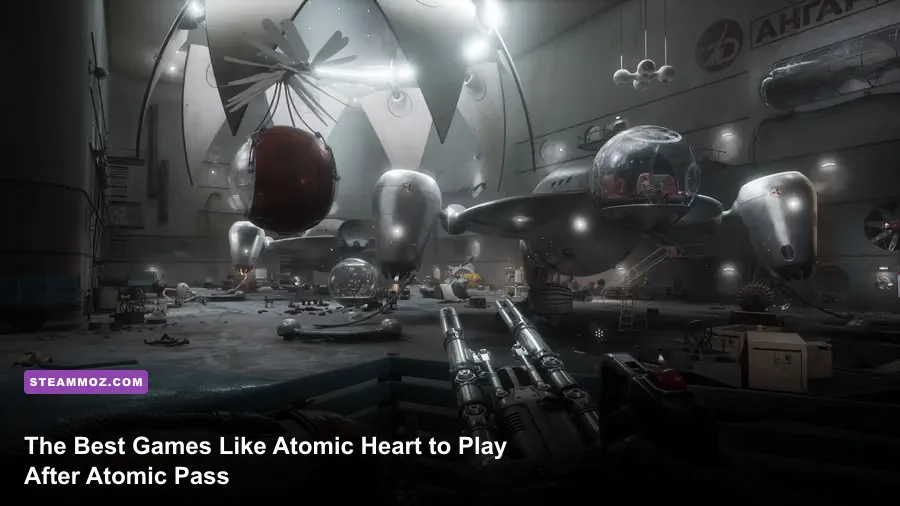
If Atomic Heart: Atomic Pass left you craving more Soviet-flavored weirdness, environmental puzzles, punchy first-person combat, and stories about technology escaping human control, start with Prey (2017) and BioShock Infinite. Prey is the best overall match for exploration and problem-solving, while BioShock Infinite comes closest to Atomic Heart's spectacular alternate-history mood. Metro Exodus, System Shock Remake, and Control round out the essential 2026 playlist, each targeting a different part of Mundfish's formula.
The Atomic Pass bundles Atomic Heart's major expansions—Annihilation Instinct, Trapped in Limbo, and Enchantment Under the Sea, with the final planned chapter completing the wider story—so this isn't a list for someone who has only finished the opening hours. It's aimed at players who have already used the Swede, upgraded Mass Telekinesis, fought through Facility 3826, and want another game with enough mechanical bite to fill that gap.
For context, check the official Atomic Heart Steam page for the current edition and DLC lineup. Then use the comparison below to pick the right follow-up instead of blindly buying the most familiar name.

The closest Atomic Heart alternatives ranked

Atomic Heart sits between a linear action game and an immersive sim. You can blast through encounters with the Kalash or Fat Boy, freeze targets with Frostbite, trap groups using Mass Telekinesis, or spend resources on the Polymeric Shield and melee upgrades. Its strongest moments come when the game lets those systems overlap: lift a crowd, electrify a vulnerable machine, then finish the survivor with the Zvezdochka.
That combination matters more than the Soviet setting when choosing a substitute. Prey matches the improvisation. BioShock Infinite matches the cinematic momentum. Metro Exodus matches the hostile-world tension. System Shock matches the locked doors and layered level design. Control matches the supernatural combat. Wolfenstein: The New Order is the pick if you mainly want fast, confident gunplay with an alternate-history edge.
| Game | Best Atomic Heart connection | Combat feel | How long to expect |
|---|---|---|---|
| Prey (2017) | Exploration, powers, environmental problem-solving | Deliberate and tactical | 16–25 hours |
| BioShock Infinite | Alternate history, spectacle, narrative pacing | Fast arena shooting | 11–15 hours |
| Metro Exodus | Russian sci-fi atmosphere and survival | Weighty, resource-driven | 15–25 hours |
| System Shock Remake | Labs, puzzles, hostile machinery | Old-school and demanding | 15–20 hours |
| Control | Telekinesis, paranormal fiction, build variety | Aggressive ability-based action | 12–20 hours |
| Wolfenstein: The New Order | Retro-futurist dystopia and weapon variety | Brutal, mobile gunplay | 11–16 hours |
🎮 Atomic Heart - Atomic Pass
Looking to experience this game? Grab your digital key directly on our store for $27.99.
View on Steammoz Store →Prey is the smartest replacement for Atomic Heart

Prey is the S-Tier recommendation because it understands the appeal of a beautiful facility filled with malfunctioning technology. Talos I is less colorful than Facility 3826, but its spaces connect with far more purpose. A locked security office can be reached through a vent, opened with a keycode found in an email, bypassed using the Hacking skill, or entered after you transform into a coffee mug with Mimic Matter.
You play Morgan Yu, and the first hours establish the game's signature trick: almost anything can be a Typhon Mimic. That means a chair, medkit, turret, or loose object deserves a second glance. The GLOO Cannon is the star tool. It freezes enemies, creates temporary platforms, seals fires, and lets you reach alternate routes. Follow a GLOO burst with the Wrench for a quiet takedown, or use Psychoshock to shut down a Typhon's abilities before switching to the Q-Beam.
Prey's neuromod system is also more consequential than Atomic Heart's upgrade trees. Human abilities such as Hacking 4, Leverage 3, and Repair 3 open practical routes, while Typhon powers unlock stronger tools at the cost of making station security more suspicious of you. The Recycler Charge is another deliciously dangerous option: it pulls nearby objects and enemies into a singularity, then converts the remains into crafting material.
The trade-off is pacing. Prey begins with weak weapons, limited suit space, and enemies that punish careless movement. Don't spend every spare part immediately. Upgrade the Suit Modification tree early, keep a spare GLOO charge, and search crew quarters for fabrication plans before crafting ammunition. If Atomic Heart's dodges and axe combos are your favorite part, Prey will feel slower. If the thrill is finding your own solution, nothing else here comes closer.
Arkane's official Prey website remains the best source for the game's setting and core systems.
BioShock Infinite nails the strange alternate-history mood
BioShock Infinite is the best choice for players who loved Atomic Heart's larger-than-life art direction, dark jokes, and constant stream of impossible machinery. Columbia's floating city is built around the same contrast: polished propaganda on the surface, violence and social rot underneath. Booker DeWitt's trip through the city is more linear, but its pacing is far tighter than Atomic Heart's uneven middle act.
The key mechanical difference is the Sky-Line. Booker can jump onto rails, change direction, and attack from moving platforms, turning arenas into vertical shooting galleries. Combine that mobility with Vigors and you get a surprisingly expressive combat loop. Possession hijacks human enemies or machines, Shock Jockey stuns groups and enables environmental electricity puzzles, and Undertow pushes or pulls targets into position.
Elizabeth is not just a story companion. She throws ammunition, salts, health, and gear into the fight, which lets you spend resources aggressively instead of hoarding every bullet. The most reliable early setup is Possession for machines, Shock Jockey for clustered enemies, and a shotgun for close-range finishers. Later, Return to Sender provides a defensive shield and a way to throw enemy projectiles back at their owners.
Infinite does not offer Atomic Heart's weapon crafting, open-ended routes, or deep environmental interaction. Its gear system is also limited to four active pieces, so experimentation is narrower. What it does deliver is a memorable 10-to-15-hour campaign with stronger character writing and cleaner encounter escalation. Pick it when you want the cinematic side of Atomic Heart, not a second Facility 3826.
For another weapon-focused recommendation, Steamoz's guide to Far Cry 3: Blood Dragon weapon rankings explores a similarly neon-soaked retro-futurist flavor.
Metro Exodus and System Shock cover the darker extremes
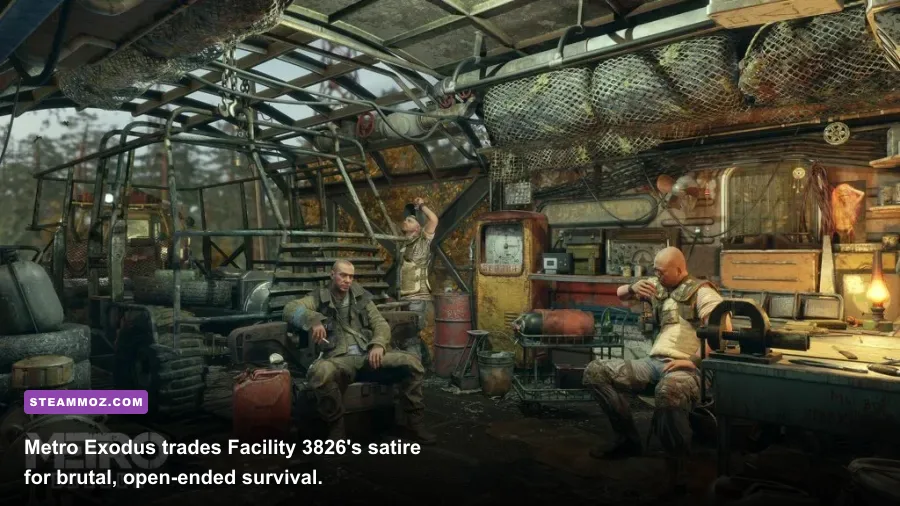
Metro Exodus is the A-Tier pick for atmosphere. Artyom leaves the Moscow Metro aboard the Aurora, moving through the Volga, Caspian, Taiga, and Dead City. Unlike Atomic Heart's manic satire, Metro is grim and patient. Its world asks you to clean weapons, check filters, conserve ammunition, and decide whether a loud firefight is worth the consequences.
The Volga is the best place to see the overlap. The level gives you a broad region, but its abandoned buildings and cult settlements still funnel you through carefully authored encounters. The Tihar pneumatic rifle is quiet and reusable, the Kalash handles general combat, and the Shambler is the panic button when mutants get close. Keep weapons clean: Metro's accuracy and reload behavior degrade as dirt builds up, especially in waterlogged or dusty areas.
Metro also rewards restraint. Knock out human enemies when possible, use throwing knives on isolated guards, and save incendiary ammunition for armored mutants. Your choices affect character outcomes and the condition of the crew, so the best run isn't always the one with the highest body count. If you want a game that feels Russian, bleak, and physically grounded after Atomic Heart, choose Exodus.
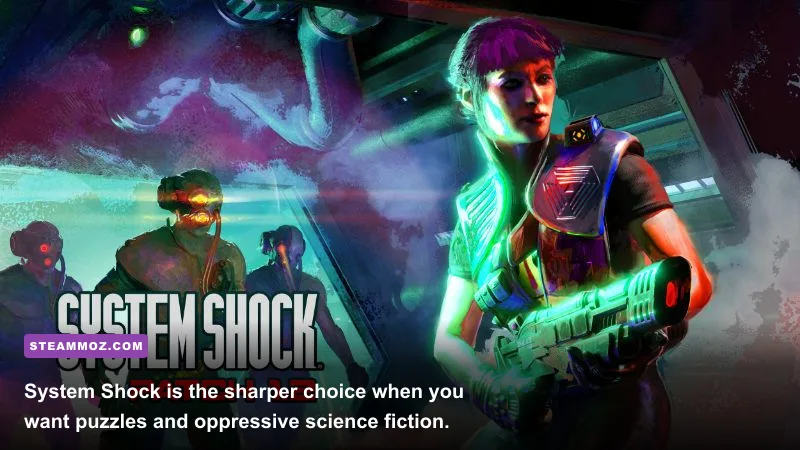
System Shock Remake takes the opposite route. Citadel Station is compact, hostile, and maze-like, with SHODAN turning every corridor into a test of memory. You will decode audio logs, reroute power, destroy cyberspace nodes, and manage inventory space while fighting mutants, security robots, and turrets.
The Lead Pipe is deliberately useful early, but the Magpulse is the clever answer to robotic enemies. EMP grenades and electrical weapons can disable machines that would otherwise consume precious ammunition. The remake's cyberspace sections are divisive, yet they reinforce the feeling that Citadel Station is one connected system rather than a string of combat rooms.
| Game | Recommended first build | Resource priority | Biggest warning |
|---|---|---|---|
| Prey | Hacking 2, Suit Modification, Repair 2 | GLOO, medkits, spare parts | Mimics can hide in ordinary objects |
| Metro Exodus | Stealth, weapon cleaning, armor upgrades | Filters, chemicals, rifle ammunition | Dirty guns lose reliability |
| System Shock Remake | Security access, inventory upgrades, energy weapons | Health patches, batteries, EMP tools | Map every route and save often |
| BioShock Infinite | Possession, Shock Jockey, shotgun gear | Salts and sniper or shotgun ammunition | Sky-Line arenas punish stationary play |
System Shock is harder to recommend broadly, but it is arguably the purest ancestor of Atomic Heart's puzzle-box facilities. Start on Normal if you want the intended pressure. Easy mode reduces friction without removing the station's route planning.
Steamoz also covers PC fixes for ELEX, useful if you enjoy demanding RPG systems but need to stabilize an older gaming rig before starting another long sci-fi adventure.
Control is the power fantasy Atomic Heart nearly becomes
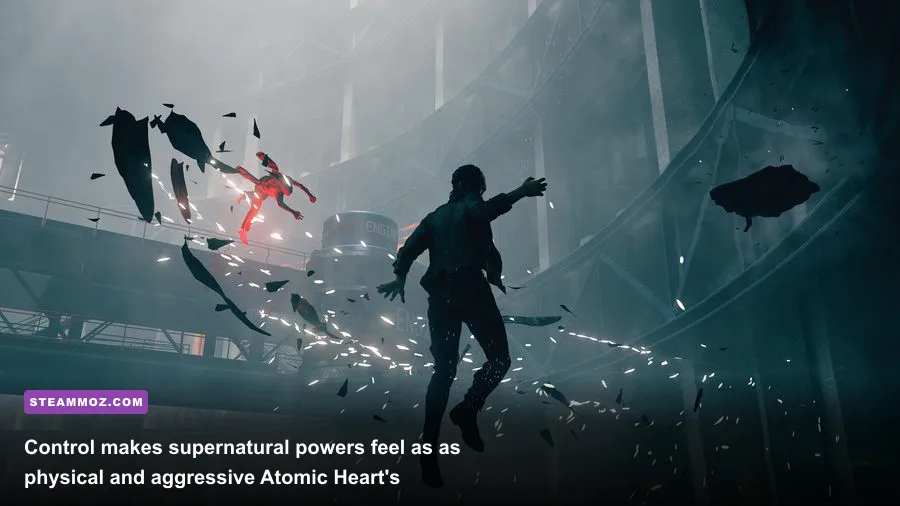
Control Ultimate Edition earns S-Tier status for combat alone. Jesse Faden's Service Weapon can switch between forms, while Launch lets her rip concrete, office furniture, and enemy debris from the Oldest House and throw it like a missile. The result is close to Atomic Heart's Polymer powers, but faster and more physical.
Unlock Launch during the early mission “Unknown Caller,” then prioritize its damage and energy-cost upgrades. Evade keeps Jesse alive against Hiss, Shield buys time in open rooms, and Seize turns weakened enemies into temporary allies. A strong general rotation is Launch, Service Weapon damage while energy regenerates, Evade through incoming fire, then Seize a low-health target. Against armored enemies, throw environmental objects first; bullets are less efficient until the armor breaks.
Control's best locations—Central Executive, Maintenance, the Research Sector, and the Ashtray Maze—feel deliberately unreal without losing spatial logic. The Oldest House changes as Jesse gains clearance levels, and side missions introduce bosses such as esse and Former that test movement rather than simple damage output. The main weakness is repetition: Hiss encounters can blur together, and the story expects you to enjoy cryptic documents and bureaucratic paranormal lore.
On PC, Control is also the most demanding recommendation here. Ray-traced reflections and transparent surfaces can punish mid-range GPUs, especially during Launch-heavy fights. Use DirectX 12 for ray tracing, but disable it for a stable high-refresh experience. A 60-fps target is more valuable than reflections when projectiles, debris, and particle effects fill the room.
| Setting | Recommended value | FPS impact | Visual note |
|---|---|---|---|
| Ray tracing | Off for 60 fps; Medium for high-end GPUs | Very high | Reflections and transparent surfaces improve |
| Volumetric lighting | Medium | Medium | Preserves atmosphere with a useful performance gain |
| Shadow resolution | Medium or High | Medium | High is sharper but rarely transformative in combat |
| Texture resolution | High if VRAM allows | Low to medium | Biggest benefit comes from 8GB or more VRAM |
| MSAA | Off with TAA enabled | Medium to high | Avoids paying twice for edge smoothing |
Remedy's official Control page has the current edition details. If you want more performance tuning before jumping into another graphics-heavy game, Steamoz's Far Cry 6 GOTY settings guide is a useful companion read.
Choose your next game by the Atomic Heart feature you miss
There isn't one perfect replacement because Atomic Heart is unusually broad. It borrows the facility design of immersive sims, the rhythm of modern shooters, the visual language of BioShock, and the upgrade loop of an action RPG. Your favorite part should decide the purchase.
Choose Prey if you want to poke at every room, combine powers, and discover routes the level designer never announces. Choose BioShock Infinite if you want a brisk, story-first campaign with lavish set pieces and an alternate-history setting. Choose Metro Exodus if the Russian atmosphere, weapon maintenance, and grim survival mattered more than Atomic Heart's jokes.
Pick System Shock Remake for dense maps, audio logs, keycards, and old-school pressure. Pick Control if Mass Telekinesis and Polymeric Shield were the abilities you never stopped using. Finally, choose Wolfenstein: The New Order when you simply want to shoot through an alternate Nazi timeline with excellent weapons, strong character work, and almost no inventory friction.
My personal 2026 order is Prey first, Control second, Metro Exodus third, System Shock Remake fourth, and BioShock Infinite fifth. Prey has the best mechanical overlap; Control supplies the most satisfying power fantasy; Metro delivers the strongest world texture. None copies Atomic Heart, and that's the point. Together, they show why the Atomic Pass works best as a gateway into a whole lineage of strange, hostile, machine-haunted shooters.
Before you install, glance at Steamoz's Everspace 2 hidden-rewards guide if exploration and secret hunting are your favorite habits, or the PC specs breakdown for Fatal Fury: City of the Wolves if you're comparing your system against newer releases. The short version remains simple: start with Prey, keep Control ready for pure combat, and save Metro Exodus for the night you want the wasteland to feel genuinely dangerous.