
If what you loved about Far Cry Primal Standard Edition was stalking prey, crafting from every kill, taming dangerous animals, and winning fights with a club or bow instead of an assault rifle, start with Horizon Zero Dawn Remastered. It has the closest hunt-study-exploit loop, while Ancestors: The Humankind Odyssey, Conan Exiles, ARK: Survival Ascended, and Kingdom Come: Deliverance II cover the survival, settlement, prehistoric, and grounded-combat sides of Ubisoft's 2016 experiment.
Far Cry Primal remains an unusual open-world game because its limitations are the point. Takkar has no minimap full of gun shops, no assault rifle safety net, and no vehicle to erase the terrain. A Stone Shard, a Hunter's Club, a Longbow, and the Owl are enough to turn Oros into a readable tactical playground. The best alternatives below preserve at least one part of that formula rather than merely offering another map with collectibles.
For reference, the official Far Cry Primal Steam page lists the Standard Edition as the core game, while Ubisoft's official Primal page remains useful for checking the original setting and features.
The best Far Cry Primal alternatives ranked

The table below ranks these games by the parts of Primal that actually matter: hunting pressure, tactile crafting, animal interaction, combat readability, and how much freedom the world gives you to make your own stories.
| Game | Tier | Closest Primal strength | Best for |
|---|---|---|---|
| Horizon Zero Dawn Remastered | S-Tier | Tracking, weak-point hunting, bow combat | A polished single-player adventure |
| Ancestors: The Humankind Odyssey | A-Tier | Prehistoric exploration and survival | Players who want discovery over missions |
| Conan Exiles | A-Tier | Crafting, clans, bases, brutal melee | Long-term sandbox survival |
| ARK: Survival Ascended | A-Tier | Predators, taming, resource progression | Dinosaurs and multiplayer systems |
| Kingdom Come: Deliverance II | B-Tier | Hunting, grounded weapons, immersion | Historical role-playing |
| Green Hell | B-Tier | Survival crafting and environmental danger | Hardcore survivalists |
My S-Tier pick is Horizon because it recreates Primal's best combat idea: observe the animal, identify the vulnerable component, and prepare before attacking. It doesn't reproduce Oros' tribal atmosphere, but its encounters have more mechanical depth. Conan and ARK rank just below because their progression is broader and more demanding; they are excellent replacements if you want to build a life rather than finish a 15-hour story.

🎮 Far Cry Primal Standard Edition
Looking to experience this game? Grab your digital key directly on our store for $7.49.
View on Steammoz Store →Horizon Zero Dawn Remastered is the closest combat match
Aloy's Focus fills the same practical role as Takkar's Owl, though with a science-fiction twist. Scan a machine and you can see components, elemental weaknesses, and patrol behavior. A Watcher may look like a basic target, but a Thunderjaw is a moving weapons platform: tear off its Disc Launchers, avoid the tail sweep, and use Tearblast Arrows to strip armor before committing to damage.
The key difference is that Horizon's weapons have defined combat jobs. The Hunter Bow is your reliable damage tool, the Sharpshot Bow rewards deliberate weak-point shots, and the Ropecaster pins large machines long enough to set up a critical strike. The Tripcaster creates the same satisfying preparation window as Primal's traps, except it lets you shape an entire arena before the fight starts.
Why it works for Primal players
Both games make reconnaissance valuable. In Primal, sending the Owl above an outpost marks enemies and lets you drop a Berserk Shard or fire at an alarm. In Horizon, the Focus exposes machine routes and components. That loop prevents combat from becoming mindless melee: information is the first weapon.
Horizon also has a cleaner difficulty curve. On Very Hard, enemy damage rises sharply and resources become more important, but the underlying tells remain readable. A Sawtooth lowers its head before charging; a Ravager exposes its cannon after the armor plate is removed. Don't mash light attacks. Slide, roll through the lunge, and spend the few seconds after a stagger on a component rather than the machine's large health bar.
| Horizon tool | Function | Primal comparison | Advanced use |
|---|---|---|---|
| Hunter Bow | Fast general damage | Longbow | Use elemental arrows to trigger status buildup |
| Sharpshot Bow | High-impact precision shots | Double-shot Longbow | Target cannons and exposed power cells |
| Ropecaster | Restrains machines | Animal control and traps | Pin heavy targets before a critical strike |
| Tripcaster | Places shock or fire wires | Primal traps | Build a corridor before an outpost assault |
Read our Desperados III review if stealth planning is the part of Primal you miss most. Horizon is less about synchronized takedowns, but it rewards the same patience.
Ancestors is Primal without the Ubisoft safety net
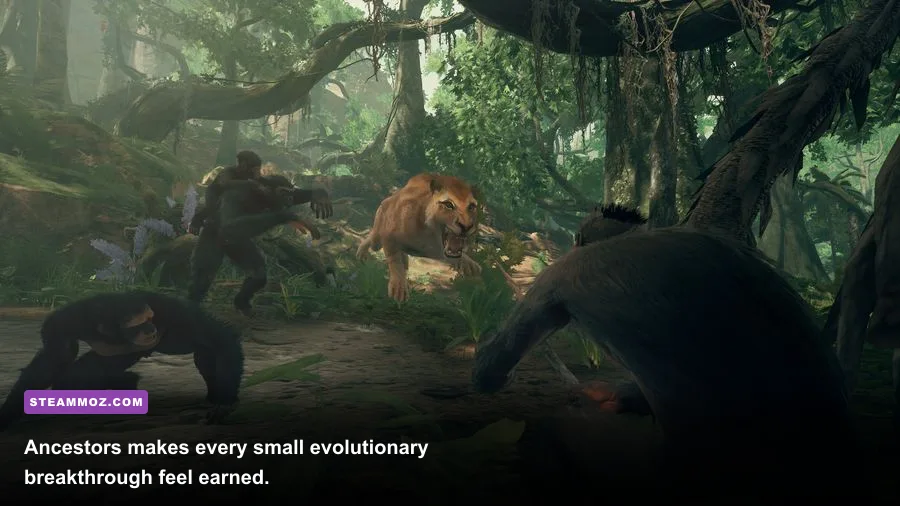
Ancestors: The Humankind Odyssey is the boldest recommendation here and the one most likely to frustrate you. You play an evolving hominid clan rather than a named warrior, beginning around 10 million years ago. There are no traditional quest markers, weapon tiers, or convenient tutorial pop-ups explaining every danger. You use intelligence, senses, and repetition to learn how to survive.
The first hours are about building a mental map. Identify plants, inspect branches, sharpen sticks, and listen for predators. A saber-toothed cat encounter isn't a scripted set piece; it is a risk calculation. Hold a sharpened stick, face the threat, and react to the audio cue when the animal commits. Panic, run blindly, or fail to orient your counter and your hominid can die. That harshness gives every successful expedition more weight than a normal side quest.
Ancestors' progression runs through neuronal skills. Discovering actions such as changing grip, dodging, or using both hands expands the clan's capabilities, while neuronal energy limits how much knowledge you can lock in before a generation change. You aren't spending points on a standard Combat tree like Primal's skills. You're teaching an entire species to manipulate its environment.
The game also handles failure differently. A dead individual hurts, but the clan can continue through reproduction and generation advancement. This creates a fascinating progression curve: early mistakes are costly, yet not always run-ending. Keep multiple adults alive, establish sleeping spots, and avoid taking every child on a dangerous trek just because the new area looks tempting.
Choose Ancestors if you want the feeling of being genuinely under-equipped. Choose Horizon if you want the same hunting tension with clearer objectives and more forgiving checkpoints. For another Steamoz progression-focused read, these Din's Curse survival tips explain a similarly punishing approach to protecting a fragile world.
Conan Exiles is the best crafting-heavy replacement
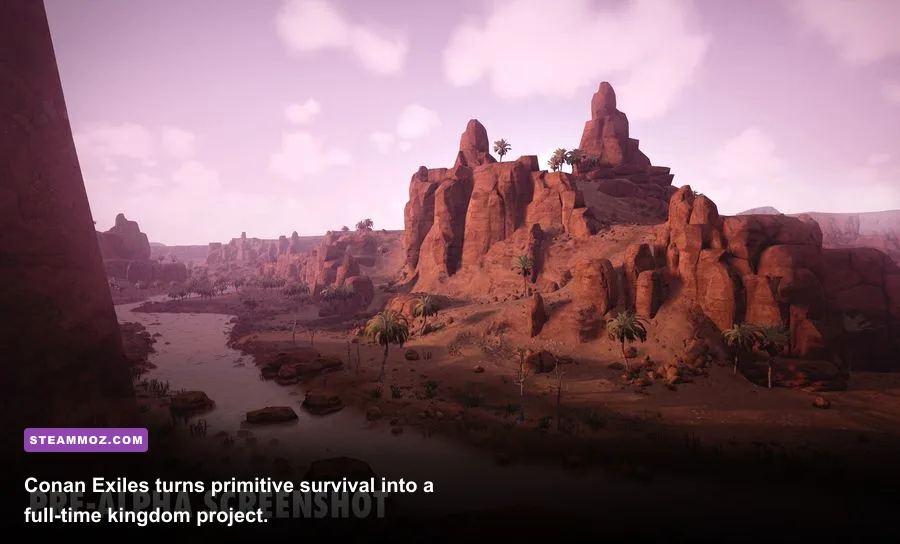
Conan Exiles takes Far Cry Primal's stone-age material loop and stretches it into a survival sandbox. You begin with nothing in the Exiled Lands, punch together basic tools, gather plant fiber, and eventually move from a rough shelter to a fortified compound with crafting stations, defensive walls, and captured thralls.
The early progression is easy to understand but has real priorities. Unlock a Stone Pick and Stone Hatchet first, then build a Campfire, Bedroll, and Carpenter's Bench. Once iron becomes available, upgrade quickly: iron tools harvest faster and make the jump toward steel possible. The game rewards a base near water and multiple resource routes, but don't build directly beside a high-level world boss or a frequently used NPC camp. You want access, not constant repairs.
Combat is heavier than Primal's quick club swings. Light and heavy attacks vary by weapon, stamina controls your ability to dodge, and armor weight affects mobility. A reliable early setup is a shield with a one-handed weapon for learning enemy timings, followed by a two-handed axe when you understand spacing. Human enemies telegraph overhead attacks clearly, but hyenas and large monsters punish greedy combos with fast lunges.
| Progression stage | Priority unlock | Why it matters | Common mistake |
|---|---|---|---|
| First hour | Stone tools, Bedroll, Campfire | Secures food, respawn, and basic gathering | Wandering far without a respawn point |
| Early base | Carpenter's Bench, Furnace | Opens stronger tools and construction | Spending all materials on decoration |
| Iron phase | Iron weapons and heavy armor | Raises damage and survivability | Ignoring stamina while wearing heavy gear |
| Thrall phase | Wheel of Pain and combat thralls | Improves defense and expedition power | Sending an untrained thrall into a boss fight |
The biggest warning is that Conan isn't a guided Far Cry campaign. Server settings, wipes, PvP rules, and mods can radically change the experience. For solo players, adjust harvest rates only if the material treadmill stops being fun; reducing the grind is better than turning every resource trip into busywork. The official Conan Exiles site explains the current game structure and editions.
ARK and Green Hell deliver harsher survival

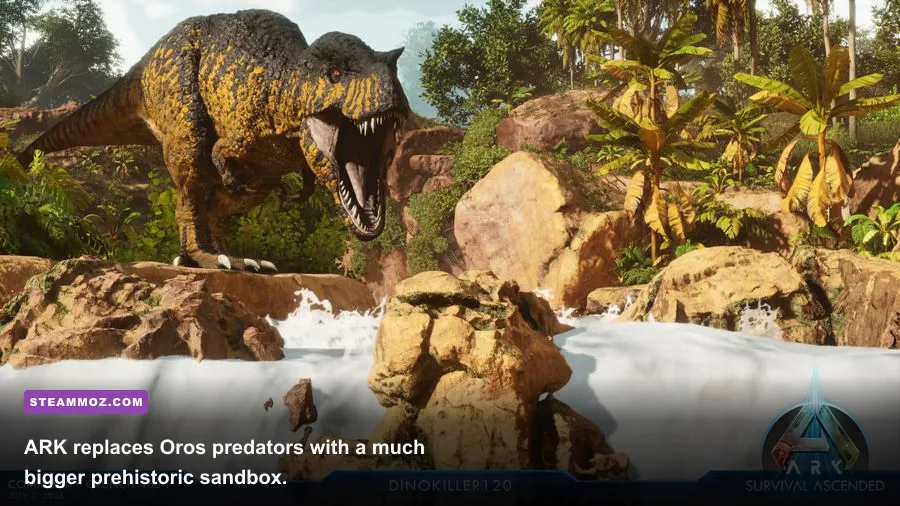
ARK: Survival Ascended is the obvious choice if the animal-taming side of Far Cry Primal was your favorite feature. Instead of a sabretooth companion or owl, you can build a food chain of creatures: a Parasaur for early scouting, a Trike for berry gathering and protection, and eventually predators such as Rexes for boss preparation. The scale is dramatically larger, though, and the systems are much more spreadsheet-heavy.
Taming has clear risk management. Herbivores are generally knocked unconscious and fed the correct food, while torpor must remain high without killing the creature. Narcoberries or Narcotic maintain torpor, but a bad food supply or an exposed taming pen can waste an hour. Build a simple trap before attempting valuable creatures, keep a spare bed nearby, and never assume a quiet beach is safe after dark.
Green Hell is less about conquering a map and more about not becoming sick in the rainforest. Its weapon roster is primitive, but its survival model is unusually granular. Inspect wounds, remove leeches, watch nutrition categories, and avoid drinking unsafe water until you have the tools to treat it. A scratch can become an infection, and a dirty bandage can make your original mistake worse.
ARK is the better long-term sandbox; Green Hell is the better short, tense survival challenge. Both are less cinematic than Primal and much less forgiving. If you prefer games that explain fewer systems and demand more attention, check Steamoz's progression guide for Decay: The Mare for another example of resource-conscious play.
Kingdom Come: Deliverance II makes hunting feel grounded
Kingdom Come: Deliverance II isn't prehistoric, but it understands why Primal's world feels convincing. Henry's survival depends on preparation, regional knowledge, and equipment rather than a magical skill reset. Hunting in forests, cooking meat, maintaining weapons, and managing stamina all connect to the broader role-playing system.
Its combat is deliberately awkward until you learn it. Attacks come from directional positions, blocks must be timed, and a perfect defense can create a Master Strike opportunity. Don't treat every opponent like a Far Cry outpost guard. Against multiple enemies, reposition constantly, keep one fighter between you and the others, and use terrain to prevent a surround. A well-placed longsword strike is powerful, but exhaustion makes every follow-up slower and less reliable.
The bow has no crosshair by default, which makes the first successful hunt feel wonderfully physical. Practice on rabbits and low-risk targets, keep your distance, and don't sprint immediately after firing. Noise, visibility, and your character's condition matter more than a simple damage number. That makes this the best recommendation for players who loved the immersion of Oros but want a deeper role-playing campaign.
It also has the strongest character-driven storytelling in this list, though it offers less freedom than Conan or ARK. You won't build a tribe or tame an entire ecosystem. You will, however, get a carefully authored medieval world where food, sleep, clothing, reputation, and weapon condition affect how each day plays.
Which game should you play first in 2026?
The answer depends on which Primal system you want to preserve. Pick Horizon Zero Dawn Remastered for the closest hunt-and-weak-point combat, Ancestors for raw prehistoric discovery, Conan Exiles for base building and clans, ARK: Survival Ascended for taming and multiplayer progression, Green Hell for serious survival pressure, and Kingdom Come: Deliverance II for immersive hunting and grounded melee.
| If you miss this in Primal | Play this first | Difficulty profile | Best session type |
|---|---|---|---|
| Owl scouting and animal weak points | Horizon Zero Dawn Remastered | Accessible with high skill ceiling | Focused solo campaign |
| Feeling vulnerable in nature | Ancestors | Opaque and punishing | Exploratory sessions |
| Crafting, shelters, and tribal growth | Conan Exiles | Scalable sandbox difficulty | Long solo or co-op runs |
| Animal companions and taming | ARK: Survival Ascended | Grindy and system-heavy | Persistent multiplayer |
| Environmental survival | Green Hell | Hardcore and demanding | Short challenge campaigns |
| Hunting and realistic combat | Kingdom Come: Deliverance II | Deliberate and skill-based | Story-led role-playing |
My personal 2026 order is Horizon first, Conan second, then Ancestors. Horizon delivers the cleanest mechanical substitute without asking you to learn an entire server economy. Conan follows if you want to spend dozens of hours turning a camp into a fortress. Ancestors is the wildcard: rougher, stranger, and far more memorable when its systems click.
Whatever you choose, don't expect a direct clone. Far Cry Primal's magic was the combination of a focused campaign, a readable open world, and tools that made every kill useful. These games split that magic into different directions. The trick is deciding whether your favorite memory is stalking a mammoth, rescuing a captured Wenja, crafting a better club, or simply surviving the night. Start there, and the right successor becomes obvious.
For more RPG and strategy recommendations, Steamoz's Dungeon Siege retrospective and Disciples: Liberation review are worth adding to your reading list.