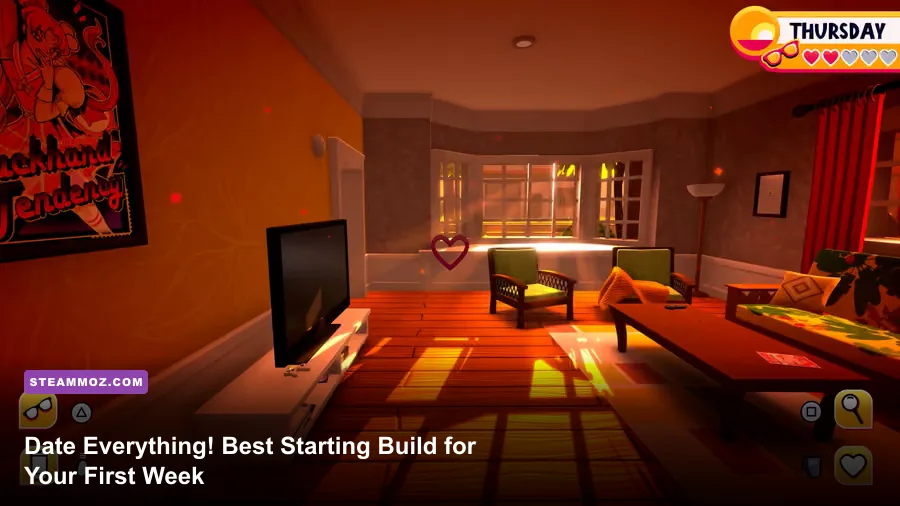
The best Date Everything! starting build is a low-commitment exploration build: scan every room with the Dateviators, meet objects in small groups, prioritize neutral dialogue choices, and save before every route-defining conversation. There are no conventional stats, weapons, skill trees, or gear upgrades to distribute. Your real build is a route plan built around the game’s three relationship outcomes: Date, Friend, and Hate.
That distinction matters. Players arriving from a traditional RPG often waste their first run looking for a charm stat, an energy meter, or an optimal equipment setup. Date Everything! is closer to a branching visual novel wrapped around a searchable house. The Dateviators unlock the people hiding inside everyday objects, while your dialogue decisions determine whether those objects become romantic partners, friends, enemies, or some wonderfully strange combination of the three.
This beginner build is designed to reveal as much content as possible without accidentally locking you out of characters. It also gives you a clean foundation for later completionist runs. You can find the game on the official Steam page, while the official Date Everything! website has the broader character and campaign details.
The Best Beginner Build Is Exploration First

Your first priority should be discovery, not romance. The house contains more than 100 dateable characters, and many of them are attached to objects you would normally ignore. The obvious targets are furniture and appliances, but the game’s joke works best when you inspect the things that look like background decoration. If you only chase the first attractive personality you meet, you’ll miss the game’s best surprises.
What to prioritize during the opening sweep
- Use the Dateviators on every visible object. Do a slow room-by-room sweep rather than interacting randomly. The device is your map, scanner, and progression key.
- Meet characters without immediately choosing a strong stance. Early conversations often establish tone before a later choice determines the relationship path.
- Keep a handwritten route log. Note the object, personality, preferred tone, and the decision that changed the relationship. The cast is large enough that memory becomes a genuine liability.
- Keep several rotating saves. Use one save at the start of each in-game day, one before a major conversation, and one after a successful route decision.
The strongest opening pattern is simple: scan, talk, record, then move on. You’re not trying to finish a character’s arc immediately. You’re building information. That makes this route much safer than selecting every flirtatious option and hoping the game rewards commitment.
| Build Element | Beginner Recommendation | Why It Works | Common Mistake |
|---|---|---|---|
| Primary focus | Exploration | Reveals the widest selection of dateable objects | Rushing toward one character |
| Dialogue tone | Neutral and curious | Preserves flexibility while you learn personalities | Choosing extreme flirt or hostility immediately |
| Progress tracking | Room-by-room notes | Prevents missed objects and repeated conversations | Trusting memory across a large cast |
| Save strategy | Rotating manual saves | Makes route testing painless | Relying on a single autosave |
| First-run goal | Discover and sample routes | Creates a strong base for later endings | Trying to complete every ending at once |

🎮 Date Everything!
Looking to experience this game? Grab your digital key directly on our store for $10.19.
View on Steammoz Store →How Date, Friend, and Hate Routes Actually Work
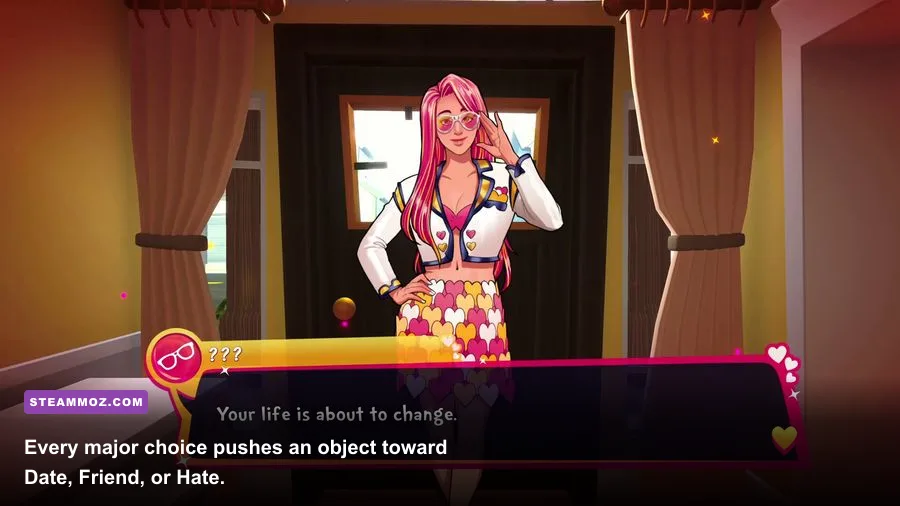
Date Everything! gives your choices more weight than a simple affection meter. The three headline outcomes are Date, Friend, and Hate, and they represent different ways of understanding a character. Romance is only one answer. A friendship route can reveal jokes, backstory, and character beats that a romantic approach never sees, while Hate routes are often deliberately theatrical rather than simple failure states.
For a first run, treat those routes as deliberate experiments. Start with the Date path for one or two characters whose personalities immediately appeal to you, but keep your wider choices measured. You’ll learn how the game telegraphs intent: some characters respond to confidence, others to sincerity, patience, humor, or direct disagreement. There isn’t a universal dialogue stat that lets you brute-force every conversation.
The route-neutral dialogue rule
When you don’t know what a character wants, pick the response that acknowledges what they just said. Don’t make the conversation about your own goal, and don’t select a joke simply because it looks like the most dramatic option. This isn’t a guaranteed solution for every scene, but it is the most reliable way to avoid turning an exploratory conversation into an accidental Hate route.
Once you identify a character’s personality, specialize. If a character is defensive, pushy flirting can read as disrespect rather than confidence. If a character is openly theatrical, a timid response may fail to match their energy. Read the wording, not just the icon or emotional color of the choice.
| Route | Best First-Run Approach | Choice Pattern | When to Use It |
|---|---|---|---|
| S-Tier: Date | Reserve for characters you understand | Warm, attentive, personality-matched responses | When you want a focused romance ending |
| S-Tier: Friend | Use as the default safe route | Supportive, curious, non-romantic choices | When you want more character context |
| A-Tier: Hate | Test from a backup save | Contrarian, dismissive, or deliberately hostile responses | For alternate endings and completion runs |
The key beginner insight is that Friend is not the consolation prize. It’s often the best first route because it lets you understand a character before you replay the conversation with a romantic angle. If you’re collecting endings, the Friend route also gives you a useful baseline for spotting which decisions actually matter.
Exact First-Run Priorities for Every Room
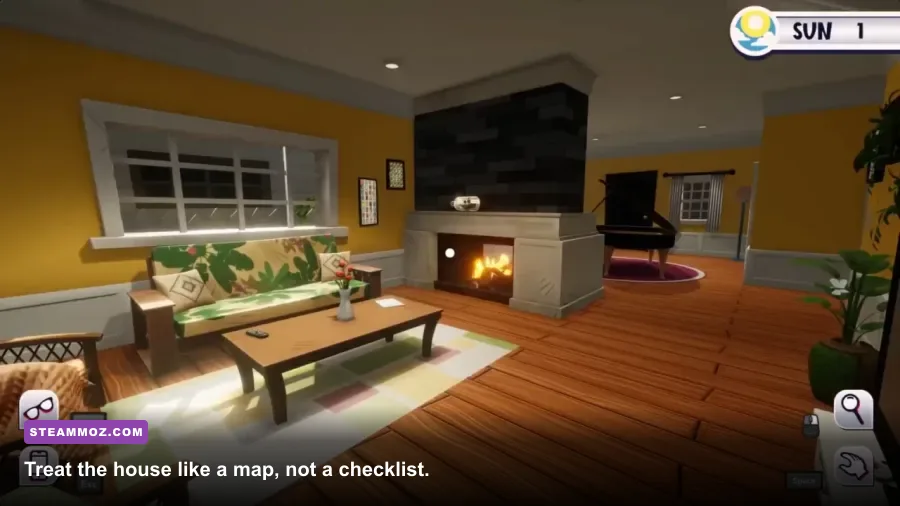
Think of the house as a sequence of investigation zones. Don’t clear a room by clicking only the obvious furniture. Sweep low surfaces, corners, appliances, doors, containers, and decorative objects. Date Everything! gets much funnier when you let the Dateviators expose the objects you would never consider conversation partners in another game.
Recommended exploration order
- Start with the room where your character appears. Learn the Dateviators interface and test how scanning identifies a character.
- Clear the main living space. Larger furniture and visible interactive objects make this the easiest place to learn the game’s rhythm.
- Move through utility areas. Appliances often have stronger, more specific personalities, so these conversations teach you how varied the cast can be.
- Check transition spaces. Doors, hallways, windows, and other structural objects are easy to overlook because they look like navigation props.
- Return after major story progress. A previously quiet object may become relevant later, and revisiting familiar rooms costs less than assuming you found everything.
Don’t burn your entire first day trying to force one conversation to its ending. The better rhythm is two or three meaningful interactions followed by another scan. You want a broad sample of personalities before you start spending your best choices on a route.
Make notes using three columns: object name, personality clues, and route result. Add a fourth column for the exact dialogue choice that caused a visible shift. That last detail is crucial when you replay. Knowing that a character prefers kindness is useful; knowing the precise scene where a teasing response changed the route is much better.
Why curiosity beats optimization
There’s no combat encounter where you need to save stamina for a boss, and there’s no equipment economy demanding that you spend currency on the perfect accessory. Your scarce resources are attention and save slots. Spend them on discovery. A route that looks inefficient can reveal a character connection or joke that makes the next playthrough dramatically easier to navigate.
If you enjoy methodical discovery in games, the same mindset applies to hidden-object progression in Everspace 2’s secret locations, although Date Everything! replaces loot hunting with dialogue and personality clues.
Dialogue Choices and the No-Stat Build
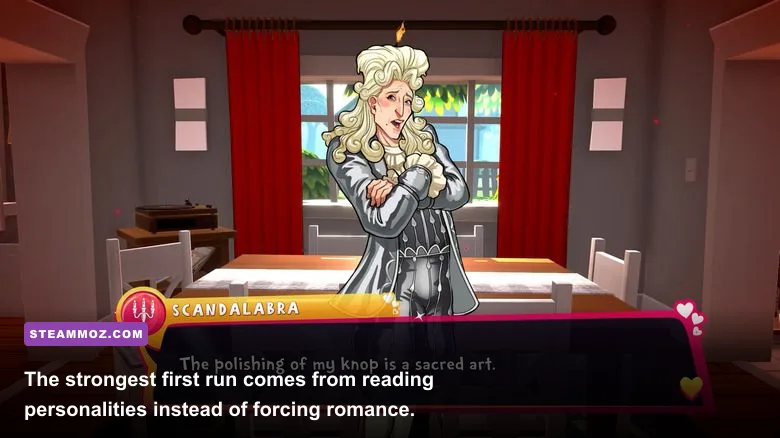
There are no strength, intelligence, charm, or fitness points for you to allocate in Date Everything! That’s the most important build information in this guide. Your character does not become stronger through grinding, and you cannot fix a bad conversation by returning with better gear. The progression system is knowledge-based: you improve by learning what each character values and by remembering which choices lead where.
Use a three-layer decision process
Layer one is literal reading. Identify what the character is asking or revealing. If they are describing a fear, respond to the fear before trying to be funny. If they are showing off, acknowledge the performance before challenging it.
Layer two is personality matching. Decide whether the character seems to want reassurance, debate, attention, independence, or a joke. Matching their conversational energy usually performs better than selecting the answer that sounds most romantic to you.
Layer three is route intent. Once you know whether you want Date, Friend, or Hate, choose responses that consistently support that goal. A single playful line may be harmless early, but repeated mixed signals can create an ending you didn’t plan.
Save before a conversation that introduces a new emotional subject, not only before an obvious final choice. Branching games often hide their most important decision in the middle of a scene. If a character suddenly asks what you think of them, what they want, or whether you understand them, that’s your warning to create a manual save.
For a first playthrough, avoid reloading every time a response feels imperfect. Let a few mistakes stand. You’ll learn more about the route logic by seeing the consequences than by constantly searching for an invisible perfect score. Reload only when you accidentally trigger a route you’re actively trying to avoid or when you want to record a branch for later.
The Best Route Rotation for Beginners
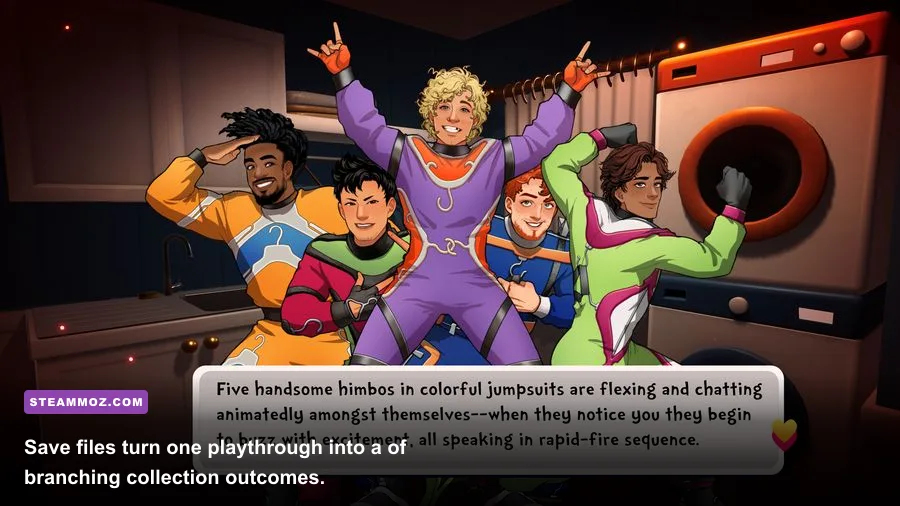
Trying to romance every dateable object immediately sounds tempting, but it produces a messy first run. Use a rotation that teaches you the systems without turning the campaign into spreadsheet maintenance.
Run one: discovery and two focused Dates
Choose two characters you genuinely like and pursue them with care. Keep everyone else on neutral or Friend-leaning choices. This gives you enough romantic content to understand the Date route while preserving a broad pool of characters for experimentation.
Run two: Friend sweep
Return to your day-one saves and aim for Friend outcomes with characters you previously ignored. Because you already know their personalities, you can move faster and pay attention to new dialogue rather than rediscovering the house layout.
Run three: Hate and alternate endings
Only after you have a stable save archive should you deliberately pursue Hate routes. These branches can require intentionally abrasive answers, and testing them from your main save risks disrupting a route you still want to finish. Use a duplicate save and keep your successful Date and Friend outcomes untouched.
| Playthrough | Main Objective | Route Mix | Save Requirement |
|---|---|---|---|
| First | Learn the house and cast | Two Date routes, neutral exploration elsewhere | Daily save plus pre-conversation saves |
| Second | Expand character knowledge | Friend routes across missed objects | Keep first-run endings intact |
| Third | Test alternate outcomes | Hate routes and branch experiments | Duplicate branch saves |
| Completion | Collect remaining endings | Targeted route cleanup | Maintain a route spreadsheet or notes |
This rotation is much less stressful than chasing a perfect all-characters run from the beginning. It also makes the game’s replay value clearer. You’re not simply repeating conversations; you’re changing the meaning of those conversations after learning who each object really is.
For comparison, the idea of a route-specific beginner build also shows up in our guide to Dungeons 2’s beginner build, but Date Everything! rewards restraint instead of power stacking.
Save Management, Accessibility, and Common Traps
Your save system is effectively your respec tool. Since there are no stats to reset, a pre-choice save lets you test a branch, record the outcome, and return to your preferred route. Keep at least three separate files: a daily checkpoint, a current character checkpoint, and a completed-ending archive.
Traps that ruin first runs
- Assuming every object is a romance target. The game’s premise supports friendship and conflict too. A Date outcome is not automatically the most satisfying result.
- Skipping repeat visits. New context can make an earlier object worth revisiting. Treat unexplored rooms as unfinished until you’ve checked them again after story progress.
- Choosing the funniest answer every time. Humor is part of the game, but a joke can be supportive, flirtatious, cruel, or simply wrong for the person speaking.
- Overwriting your only successful save. Don’t let one experiment destroy an ending you worked for.
- Looking for a hidden stat guide. There is no conventional charm build. Guides promising a universal numerical answer are solving the wrong game.
For the cleanest experience, use the display and text options that make long dialogue comfortable rather than chasing performance tweaks that don’t affect route outcomes. Date Everything! is a dialogue-heavy game, so readable text, clear audio, and an input method you can use comfortably matter more than shaving a few milliseconds from an already lightweight scene.
If your broader library includes older PC games that need technical cleanup, Steamoz has separate guides for ELEX crash and FPS fixes and Harvey’s New Eyes PC requirements. Those are useful troubleshooting references, but Date Everything! itself is primarily a route-management challenge.
Your First-Week Build Checklist
Before you start, remember the central rule: the best Date Everything! beginner build is flexible. You are building a relationship map, not a combat character. Scan broadly, make conservative choices until you understand a personality, and protect your saves before emotional turning points.
- Activate the Dateviators and sweep every accessible room.
- Record each discovered object and the personality clues it gives you.
- Pick two characters for focused Date routes.
- Keep new conversations neutral until you understand their tone.
- Use Friend choices when you want information without romantic commitment.
- Create a manual save before any major confession, argument, or identity reveal.
- Return to earlier rooms after story progress and scan overlooked objects.
- Archive completed endings before testing a different route.
- Use later playthroughs for systematic Friend and Hate-route cleanup.
That plan gives beginners the best balance of story, discovery, and replay value. More importantly, it respects what makes Date Everything! unusual. The household objects aren’t loot, quest markers, or stat bonuses waiting to be optimized. They’re characters with their own boundaries and bizarre little dramas. Approach them like people, keep your route notes honest, and your first week will reveal far more than a rushed romance sweep ever could.
For official updates and support, check the Date Everything! Steam community hub and the Sassy Chap Games developer site. If you want another choice-heavy game where the fun comes from understanding a strange cast, our Dungeons 3 beginner tips offer a very different kind of planning challenge.