Yes, Gone Home is still worth playing in 2026—provided you want a tightly focused, atmospheric story rather than combat, puzzles, or a traditional adventure game. Fullbright's 2013 debut lasts roughly two hours, runs effortlessly on modern PCs, and tells a remarkably human coming-of-age story through rooms, letters, cassette tapes, and the things a family leaves behind. Its mystery is less about solving a crime than understanding the people who lived in the house.
That distinction matters. If you approach Gone Home expecting a horror game because of its stormy opening, dark corridors, and empty family home, you may feel misled. If you approach it as an interactive short story about Katie Greenbriar returning home on June 7, 1995, it remains one of the cleanest examples of environmental storytelling in games. It is short, occasionally obvious, and mechanically simple—but its restraint still lands.
What Gone Home actually is
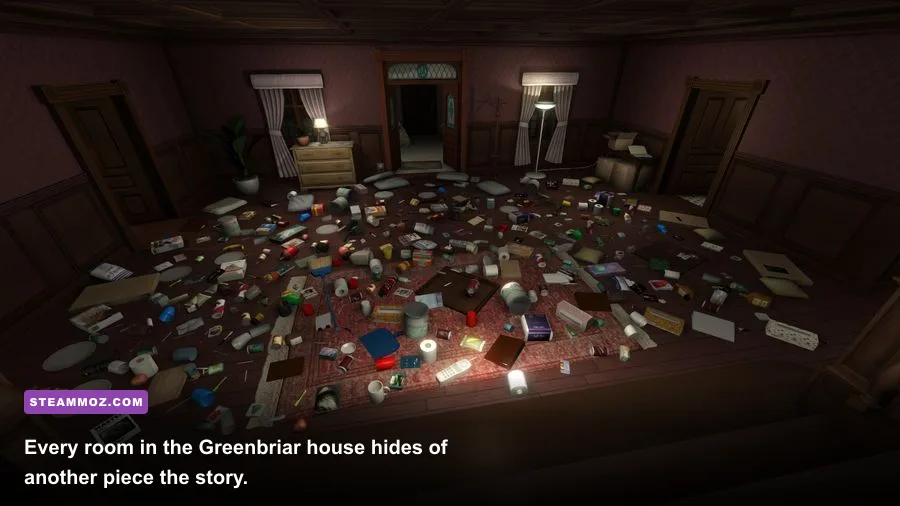
You play Kaitlin “Katie” Greenbriar, a college student who comes home after traveling abroad. Her family has moved into a large old house in Oregon, but nobody is there to greet her. A note on the front door from Katie's younger sister, Samantha, asks her not to investigate. Naturally, the entire game is built around investigating.
There is no inventory screen, combat system, dialogue wheel, skill tree, or conventional quest log. You walk through the house, open drawers, inspect photographs, read notes, listen to audio diaries, and unlock new rooms with keys or discoveries. The first-person camera is deliberately grounded: Katie cannot jump, sprint, or manipulate every object in a physics-sandbox fashion. The design keeps your attention on context rather than busywork.
The house is the real protagonist. The foyer, kitchen, attic, basement, bedrooms, office, and hidden passages are arranged as a chain of emotional evidence. A packed box says something different from a school flyer. A missing cassette case matters because of where it sits. A family argument becomes more painful when you notice the ordinary room around it: a half-finished meal, a stack of mail, or a teenager's posters covering the walls.
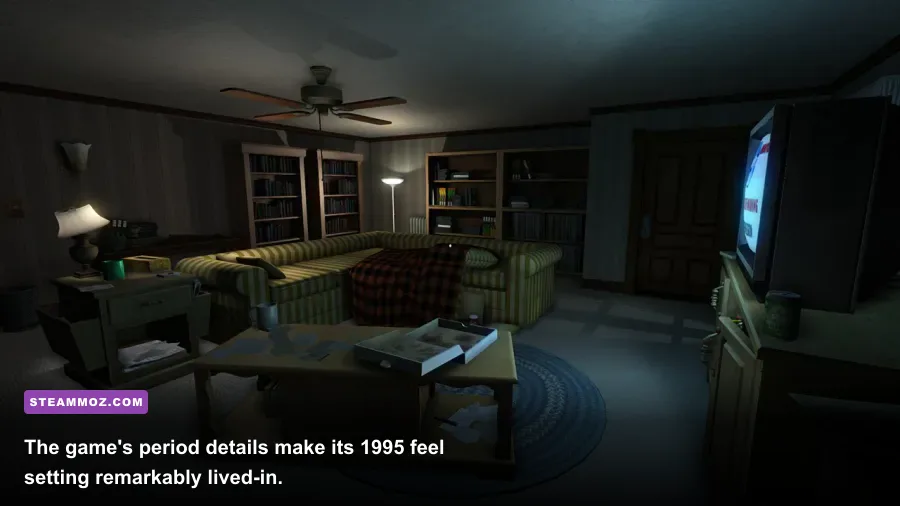
Gone Home's premise also benefits from its 1995 setting. There are no smartphones, text messages, GPS markers, or instant search engines to flatten the mystery. Communication happens through handwritten notes, landline calls, answering-machine recordings, zines, and mix tapes. The period detail isn't just decorative nostalgia; it creates believable gaps in knowledge that the player has to bridge.
The story approach still feels unusual
Sam's narration guides much of the experience, but the player reconstructs her life from physical traces. Her relationship with Lonnie, school pressure, family expectations, and the fear of being misunderstood emerge gradually. The writing is direct and emotionally accessible, sometimes almost too direct, but the strongest moments come from what the game lets you infer before the narration confirms it.
The 2013 release also deserves credit for putting a queer teenage romance at the center of a mainstream indie game without treating it as a twist or a tragedy. Gone Home's emotional question isn't whether Sam's identity is acceptable. It's whether the people around her will understand her as a whole person. That perspective remains meaningful in 2026, and it is one reason the game's cultural footprint outlasts its modest mechanics.

🎮 Gone Home
Looking to experience this game? Grab your digital key directly on our store for $5.24.
View on Steammoz Store →How the exploration and progression work
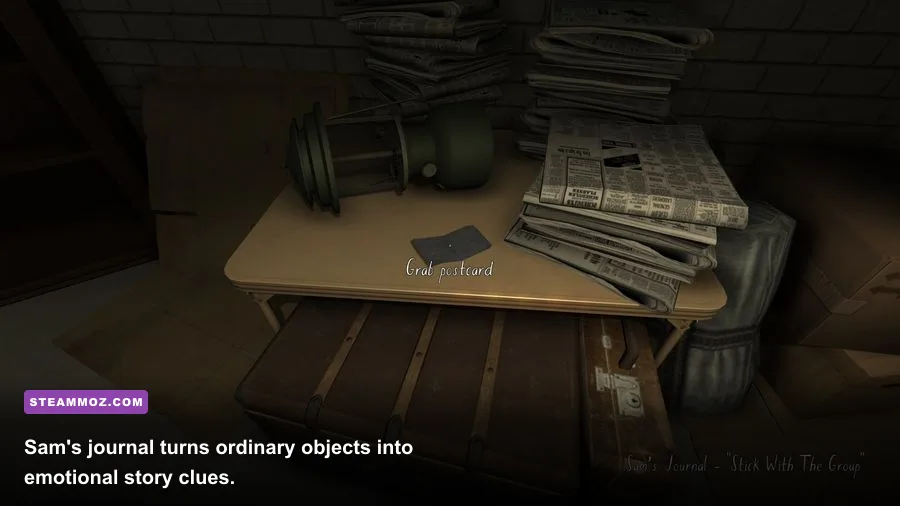
Gone Home has no conventional progression curve. You don't gain power; you gain context. The main loop is simple: enter a space, inspect its readable objects, follow a clue to another space, and gradually unlock the structure of the house. The green lightning-bolt icon appears when an object can be examined, while doors and containers provide the basic physical rhythm of exploration.
The game does offer a subtle sequence, even though it rarely announces it. Katie starts near the front entrance, then moves through the ground floor, bedrooms, the basement, and finally the attic. Keys and discoveries open routes, but the best progression is informational. Finding a locker combination, a hidden switch, or a personal letter changes the meaning of rooms you have already visited.
| Progression Element | What You Do | Why It Matters | Player Advice |
|---|---|---|---|
| House exploration | Open doors, drawers, cabinets, and boxes | Reveals family history and current events | Search rooms methodically before moving on |
| Readable objects | Inspect notes, photos, flyers, and labels | Provides context without exposition dumps | Rotate objects and check both sides when possible |
| Audio diaries | Listen to Sam's narrated entries | Connects discoveries into an emotional timeline | Let each recording finish before rushing ahead |
| Keys and switches | Unlock restricted rooms and passages | Controls physical access through the house | Revisit earlier areas after major discoveries |
| Optional details | Read magazines, inspect toys, and examine clutter | Builds the 1995 atmosphere and family identity | Take your time; optional objects are the game's texture |
For a first playthrough, resist the urge to use a walkthrough. The game is compact enough that getting briefly lost is part of the intended mood. Look for visual continuity: labels, colors, photographs, and handwritten references often point toward the next relevant location. You don't need to inspect every object to finish, but the incidental clutter is where the house feels most authentic.
There is also a “Story Mode” option in the PC version that removes some locked-door progression and lets you explore more freely. It is useful if you are replaying the game, showing it to someone else, or focusing on environmental details. For a first run, the standard structure is better because locked spaces create anticipation without turning the game into a frustrating puzzle box.
Completion time varies with reading speed and curiosity. A focused run can finish in around 90 minutes, while a careful first playthrough usually lands near two hours. That is not a flaw by itself, but it does affect value. Gone Home is closer to an interactive novella than a 20-hour adventure, so its success depends on the quality of those two hours rather than the size of its content map.
Performance, controls, and playing Gone Home in 2026
On current Windows hardware, Gone Home is exceptionally easy to run. Its Unreal Engine 3 presentation is modest by modern standards, and the game does not demand a powerful GPU, fast storage, or high-end processor. Loading is quick on an SSD, input latency is negligible, and a stable 60 frames per second is realistic even on integrated graphics from several hardware generations ago.
The PC version is still the strongest choice if you want mouse precision, flexible display options, and the quickest load times. A controller works well for relaxed exploration, but the mouse makes it slightly faster to inspect objects and turn through cramped rooms. The game is not mechanically demanding enough for the choice to affect difficulty.
| Setting or Hardware Profile | Recommended Value | Expected Impact | Visual or Practical Note |
|---|---|---|---|
| Resolution | Native monitor resolution | Very low performance cost | Improves text and object readability |
| Texture quality | Maximum | Minimal impact on modern GPUs | Keeps posters, labels, and clutter sharper |
| Dynamic shadows | High or maximum | Small GPU impact | Preserves the house's subdued lighting |
| Ambient occlusion | Enabled if available | Minor performance cost | Adds depth beneath furniture and in corners |
| V-sync | On for 60 Hz displays | May add slight input delay | Prevents distracting tearing during slow pans |
| Frame-rate cap | 60 FPS | Stabilizes presentation | More than 60 FPS adds little to this experience |
Don't expect a modern remaster's lighting or material quality. Some textures look soft, certain objects have simple collision, and the character animation is dated. Those rough edges are most visible when you inspect the environment closely. Still, they rarely interfere with the story because the house is designed around readable shapes and meaningful placement rather than photorealism.
Audio remains more important than resolution. Use headphones if you can. Rain against the windows, electrical hum, footsteps, door sounds, and the cassette recordings create the game's tension. The soundtrack is sparse, and that sparseness makes every environmental noise feel deliberate. This is not a game to play while watching another screen.
If you regularly troubleshoot demanding PC games, our guides to fixing crashes and low FPS and solving poor PC performance cover broader Windows issues. You almost certainly won't need that level of work for Gone Home, but compatibility layers, overlays, and unusual ultrawide setups can still cause occasional quirks.
What still works—and what feels dated
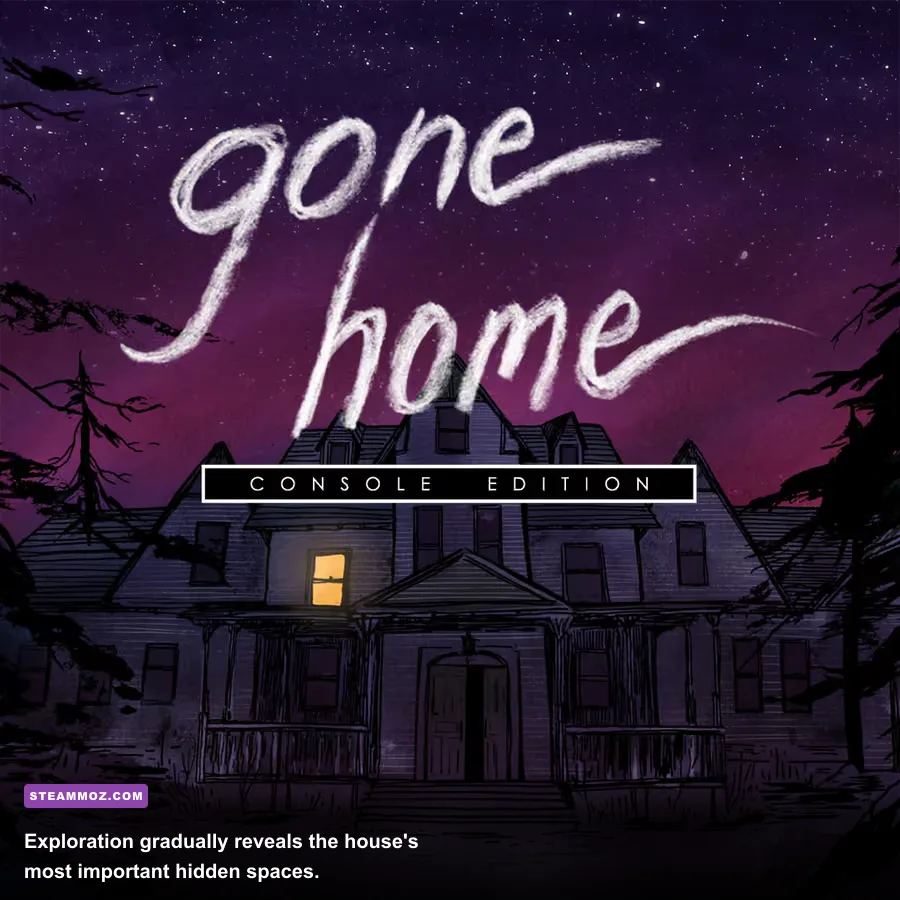
The environmental storytelling is the clear winner. Gone Home understands that a bedroom can communicate character faster than a paragraph of dialogue. Sam's belongings are not random collectibles; they show her interests, anxieties, friendships, and changing sense of self. The arrangement of the Greenbriar home also tells you about the parents' priorities and the family's uneven relationship with the property.
The sound design remains excellent. A cassette starting in a dark room can feel more intimate than a cutscene because you are the one who found it. The voice performance in Sam's recordings carries the emotional center, while the restrained presentation avoids turning every revelation into a cinematic event.
The game also respects the player's pace. You can sprint through the central narrative or spend time reading every piece of ephemera. It doesn't punish curiosity, and it doesn't bury key story beats behind a punishing puzzle. In 2026, that accessibility makes it a strong recommendation for new players who want to understand why narrative-focused games became such a major part of the indie scene.
But the simplicity can feel limiting. Walking speed is slow, the interaction prompt can be finicky around clutter, and there are stretches where you are simply moving from one room to another. If you need combat, systemic simulation, branching dialogue, or a demanding puzzle layer, there is very little here to satisfy that appetite.
The mystery framing is another potential weakness. Marketing and the opening setup can suggest supernatural horror, but Gone Home ultimately pursues a grounded family drama. That bait-and-switch works if you appreciate atmosphere for its own sake; it disappoints if you bought the game expecting ghosts or escalating scares. The darkest moments are emotional and contextual, not hostile encounters.
| Element | 2026 Verdict | Strength | Where It Shows Its Age |
|---|---|---|---|
| Story and themes | Still powerful | Specific, empathetic, and focused | Some narration is quite explicit |
| Environmental detail | Excellent | Objects carry character and history | Older textures look soft up close |
| Exploration | Effective but basic | Low friction and easy to understand | Slow movement and limited interaction |
| Atmosphere | Still memorable | Rain, darkness, audio, and period detail | Not a genuine horror experience |
| Replay value | Limited | Second runs reveal missed context | Little changes after the first completion |
If you enjoy games that tell stories through spaces, Gone Home pairs naturally with more experimental narrative adventures. It has less mechanical ambition than a conventional exploration game, but that narrow focus is the point. Our coverage of GRIS's ability-driven design and Dropsy's object-focused storytelling offers useful contrast: both show how games can create momentum without relying on traditional combat progression.
Is Gone Home worth playing in 2026?
For most players interested in narrative games, yes. Gone Home remains worth playing because its central idea has not aged: spaces remember people. The dated graphics are easy to overlook, the short runtime is appropriate to the story, and the absence of combat gives the writing room to breathe. It is especially easy to recommend to players who are curious about walking simulators, environmental storytelling, queer game history, or indie games that prioritize empathy over challenge.
It is not worth buying blindly if you measure value by hours, replayability, or mechanical depth. A first playthrough is brief, and much of its impact depends on how willing you are to read, listen, and notice. This is a game for a quiet evening, not a long-term progression hobby. Consider it an interactive film with more agency than a movie and less mechanical variety than an adventure game.
Its best qualities are also why it continues to divide players. Some will find the lack of puzzles frustratingly passive. Others will find the directness emotionally honest. Some will admire the ordinary subject matter; others will want a larger mystery. Neither reaction is wrong. Gone Home is deliberately small, and its success depends on whether that intimacy matches what you want from games.
Before buying, check the official Steam page for the current PC edition, pricing, platform support, and player reviews. You can also read the developer's background through Fullbright's official site and explore the game's original information at the official Gone Home website. Just remember that the Steam page and storefront description cannot prepare you for every story beat, so avoid spoilers if you want the intended experience.
Final verdict: Gone Home is a 8/10 narrative experience in 2026. Its controls and visuals are plainly from another era, but its atmosphere, sound design, representation, and environmental writing remain sharp. Play it with headphones, take your time, and don't expect a horror game. If you can accept a two-hour interactive story built from household details, Sam's journey is still absolutely worth taking.
For more perspective on focused indie experiences, Steamoz's review of Hop Step Sing! Hop☆Summer 2nd also looks at how short-form games earn their time and attention. Gone Home makes the same argument in a quieter voice: a game doesn't need a huge map or a hundred-hour campaign to leave a lasting impression.