
Hop Step Sing! VR Live HopSummer 2nd is worth playing in 2026 only if you want a compact anime concert experience, not a full rhythm game. Its charming performers, close-up staging, and novelty of watching a virtual live show from inside VR still work, but the package is short, mechanically light, and difficult to recommend at full price to anyone expecting replayable scoring, branching content, or a substantial story. Treat it as an interactive music video with VR presence, and the value proposition makes sense.
That distinction matters more now than it did at launch. The VR catalogue has expanded with deeper rhythm games, social concert spaces, and technically ambitious showcases. HopSummer 2nd cannot compete with those on content volume. What it can still do is deliver an unusually intimate anime performance featuring the Hop Step Sing! cast, with the camera positioned close enough to make the idols feel like they're performing specifically for you. That's the hook, and nearly every strength and weakness flows from it.
What HopSummer 2nd Actually Is
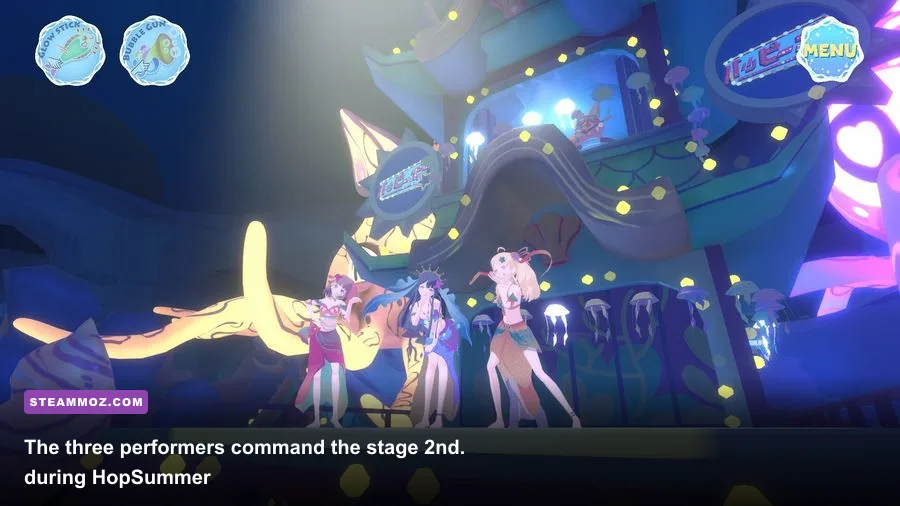
HopSummer 2nd is a standalone VR live-performance title in the Hop Step Sing! multimedia project. It isn't structured like Beat Saber, Hatsune Miku VR, or a conventional rhythm campaign. You aren't building a character, clearing a song chart, or unlocking a long progression ladder. Instead, you enter a staged concert presentation and watch the performers from a first-person viewpoint.
The appeal is best understood as presence. You occupy a virtual audience position while the animated idols perform around you. The production uses camera placement, lighting, choreography, and audience-facing gestures to create the illusion of attending a small live show. The cast's expressions and movements do more work than any conventional game system. If you've ever enjoyed anime concert footage but wished you could sit on the stage rather than watch through a flat screen, this is the fantasy HopSummer 2nd is selling.
The title also benefits from being self-contained. You don't need to grind through an earlier game to reach the concert, and the basic premise is easy to grasp immediately. Newcomers can jump in without learning a complicated interface. Fans who already know the Steam listing and the wider project will get more from the character-focused presentation, but prior knowledge isn't essential to understanding what happens on stage.

🎮 Hop Step Sing! VR Live HopSummer 2nd
Looking to experience this game? Grab your digital key directly on our store for $14.99.
View on Steammoz Store →Performance, Characters, and the Front-Row Illusion

The strongest part of the review is the performance itself. Hop Step Sing!'s appeal rests on its trio of virtual idols: Niina, Shikimi, and Mikasa. Their personalities are communicated through introductions, gestures, vocal delivery, and the way each performer occupies the stage. The presentation isn't trying to simulate a realistic human concert; it leans into bright anime aesthetics, clean character silhouettes, and theatrical movement.
That works particularly well in VR because scale changes the emotional texture of familiar animation. On a monitor, an idol waving toward the camera is simply a directed shot. Inside a headset, that same gesture lands differently when the character is standing a few virtual metres away and looking directly toward your position. The effect isn't photorealistic, but it is immediate. You notice small details in staging that a conventional music video would rush past.
Lighting is used as the main tool for spectacle. Colour changes separate verses from chorus sections, while the stage composition keeps the performers readable even when the background becomes busy. The result is more polished than the modest scope suggests. Still, expectations need to stay realistic. Facial animation is not at the level of modern high-budget VR productions, and some movements can look repetitive once you've watched the performance more than a few times.
HopSummer 2nd is also more convincing when you sit or stand still and let the show come to you. Moving around too aggressively can expose the limits of the staging and make the scene feel like a fixed video wrapped around a camera. The best viewing position is usually one that keeps the entire stage visible while allowing you to focus on whichever performer has the current vocal or choreography spotlight.
| Element | What It Delivers | 2026 Verdict |
|---|---|---|
| Character presentation | Readable anime personalities and direct audience-facing gestures | Still charming |
| Stage direction | Colourful lighting, choreographed formations, concert-style camera placement | Effective but limited |
| Animation quality | Clean virtual idol performance with occasional repetition | Aged acceptably |
| Audience immersion | Close first-person viewpoint and strong sense of physical presence | Main reason to play |
Is There Enough Gameplay to Keep You Coming Back?
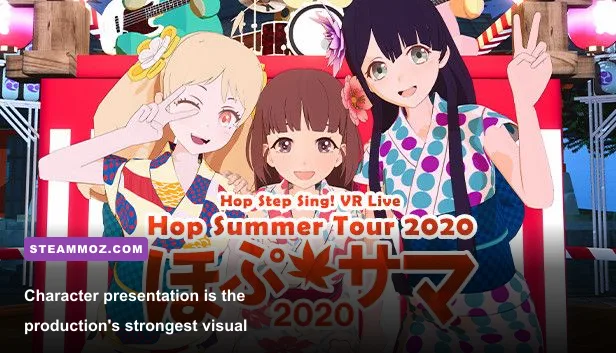
This is where the recommendation becomes complicated. HopSummer 2nd has interactive VR elements, but it isn't a demanding rhythm title. The experience asks you to participate in the performance rather than master a dense note chart. Depending on your expectations, that can feel refreshingly relaxed or surprisingly thin.
There are no meaningful weapon builds, character statistics, combat rotations, or loot systems here. There isn't an RPG-style progression curve hiding behind the concert, either. The core loop is presentation-first: enter the live show, engage with its audience-facing moments, appreciate the choreography, and revisit the performance if you want to inspect the staging or spend more time with the characters.
That structure makes the first session the most important one. A player looking for challenge may finish and immediately ask what comes next. A fan interested in virtual idol performances may happily replay favourite sections, compare viewpoints, and return for the atmosphere. The replay value is therefore personal rather than systemic. It comes from affection and presence, not from new unlocks or improved scores.
For context, players wanting a game with stronger mechanical depth should look toward something built around repeatable play. Steamoz's coverage of other games like Absolute Drift is obviously aimed at a different audience, but it illustrates the key distinction: those games create long-term value through mastery. HopSummer 2nd creates value through a curated performance.
| Player Type | Likely Experience | Replay Value | Recommendation |
|---|---|---|---|
| Anime concert fan | Feels like a private front-row performance | Moderate to high | Buy on sale or at a fan-friendly price |
| Rhythm-game specialist | Too little scoring depth and challenge | Low | Try only with modest expectations |
| VR newcomer | Simple, accessible introduction to seated VR viewing | Moderate | Good short-form showcase |
| Completionist | Limited systems and a compact content package | Low | Wait for a discount |
Comfort, Controls, and PC VR Performance
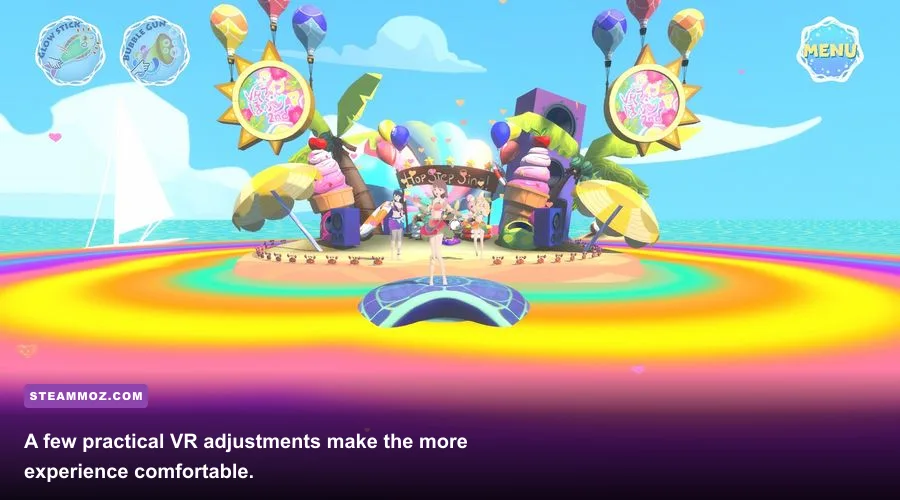
HopSummer 2nd is naturally more comfortable than a room-scale action game because the experience keeps your attention on a staged performance rather than forcing constant movement. A seated setup is a sensible starting point, especially if you are sensitive to artificial camera motion. The show itself does not demand the rapid turning, dodging, or locomotion that causes problems in more aggressive VR titles.
Even so, comfort isn't automatic. Long sessions with a heavy headset can become tiring, and close-up virtual performers may feel intense for players who aren't used to VR scale. Take the headset off if the scene begins to feel uncomfortable; there is no reward for pushing through nausea. A stable play area, properly adjusted headset fit, and controllers placed where they won't collide with a desk are more important here than chasing visual settings.
On PC, the game is best approached as a low-complexity VR presentation rather than a benchmark. The practical priorities are stable frame pacing and a clear image. If your headset software offers resolution scaling, start at its default value and only increase it if the experience remains smooth. Dropping resolution slightly is preferable to accepting stutters during choreography, because broken frame timing damages immersion more than softer edges do.
| Setting or Hardware Choice | Recommended Profile | Performance Impact | Visual Result |
|---|---|---|---|
| Headset resolution | Native or default SteamVR scale | Low to moderate | Best balance of clarity and stability |
| Supersampling | Use only after confirming a stable frame rate | Moderate to high | Sharper character edges, heavier GPU load |
| Refresh rate | Choose the highest stable headset mode | Moderate | Smoother motion during choreography |
| Background applications | Close overlays and unnecessary GPU-heavy software | Low but useful | Fewer frame-time spikes |
The title's relatively focused scope also means it is a better fit for mid-range gaming PCs than visually extravagant VR releases, but don't confuse that with a universal hardware guarantee. Check the current Steam store information for the latest operating-system and headset requirements before buying. SteamVR itself, headset drivers, and the game can all change over time, so an old forum post is not a reliable substitute for the live listing.
What Still Feels Dated in 2026
The biggest problem is content density. HopSummer 2nd asks you to pay for a short, highly specific experience, and that equation becomes harder to defend as the VR market matures. A single concert can be memorable, but it doesn't automatically become a great game. Once the novelty of standing inside the performance fades, the lack of deeper systems becomes impossible to ignore.
The presentation can also reveal its age in places. Animation loops are more noticeable on repeat viewings, environmental detail is functional rather than lavish, and the stage behaves more like a carefully authored set than a genuinely reactive venue. None of these issues ruin the show, but they prevent it from feeling like a definitive virtual concert in 2026.
There is also a narrow audience problem. Players who don't already enjoy anime idol culture may struggle to connect with the material because the production assumes that the performers and their style are the attraction. The game doesn't offer a robust narrative campaign to convert sceptics. It gives you the concert and trusts the concert to sell itself.
That isn't necessarily a design failure. Short VR experiences often work best when they have one clear purpose. The question is whether that purpose matches your library. If you want broad replayability, compare it with a deeper VR purchase before spending full price. If your collection already includes action-heavy titles, HopSummer 2nd can serve as a pleasant change of pace—much like the compact creative experiences discussed in Steamoz's Glitchhikers starting guide, although the two games pursue very different kinds of immersion.
Final Verdict: Buy It for the Performance
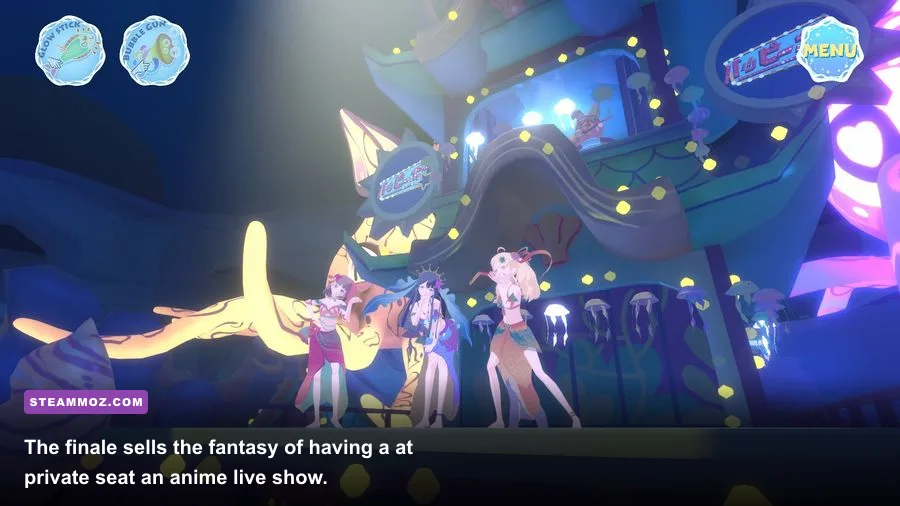
Hop Step Sing! VR Live HopSummer 2nd earns a cautious recommendation in 2026. It remains a sweet, approachable VR concert with appealing character work and a surprisingly effective front-row perspective. The central illusion—being physically present for an anime idol performance—still lands when the lighting, choreography, and direct gestures align.
But this is not a hidden rhythm masterpiece, and it shouldn't be judged as one. There are no elaborate song charts to perfect, no meaningful progression system, and no large campaign waiting after the credits. Its value is concentrated in the quality of the show itself. Fans should consider it a compact companion piece; newcomers should buy only when the price reflects the limited scope.
| Category | Score | Reason |
|---|---|---|
| VR immersion | 8/10 | Close staging creates a convincing private-concert feeling |
| Visual presentation | 7/10 | Colourful and readable, though animation shows its age |
| Interactive depth | 5/10 | Participation is light and lacks a substantial progression loop |
| Replay value | 5/10 | Depends heavily on your attachment to the performers |
| 2026 value | 6/10 | Worthwhile for fans, difficult to justify as a full-price game |
My advice is simple: buy HopSummer 2nd if the idea of sitting inside a polished anime concert genuinely excites you. Use a comfortable seated setup, prioritise stable frame pacing over aggressive supersampling, and go in expecting a showcase rather than a traditional game. If you need dozens of hours, demanding rhythm mechanics, or a story-driven VR adventure, spend your money elsewhere.
For more hardware and performance reading, Steamoz's guides to PC crashes and low FPS fixes and VR-adjacent PC performance troubleshooting are useful reminders that smooth delivery matters as much as visual ambition. HopSummer 2nd doesn't need to be bigger to be enjoyable. It just needs to find the players who want exactly this kind of brief, charming virtual live show.
Before purchasing, check the official Hop Step Sing! website for project information and the developer's current announcements. In the right headset, at the right price, HopSummer 2nd is still worth playing in 2026—just don't mistake a lovely concert ticket for a complete rhythm game.