
If you miss Borderlands 2 VR’s mix of physical aiming, absurd guns, character skills, and loot-driven progression, start with Fallout 4 VR for the biggest world, Into the Radius for the best weapon handling, and Gunfire Reborn for the most satisfying build experimentation. Arizona Sunshine 2, Robo Recall, and Borderlands 3 complete the shortlist, but each scratches a different part of the Pandora itch.
That distinction matters in 2026. Borderlands 2 VR still has a wonderfully unusual identity: it is a full campaign shooter adapted for PlayStation VR, with the original Vault Hunters, BAMF skill trees, Badass Rank bonuses, and a ridiculous number of procedurally generated guns. It also has rough edges that modern VR players feel immediately, including PlayStation Move limitations, dated enemy animation, and no native PC VR release. The games below are not cheap copies. They are the best replacements depending on whether you want loot, scale, co-op, tactical handling, or pure motion-controlled chaos.

S-Tier replacements for Borderlands 2 VR
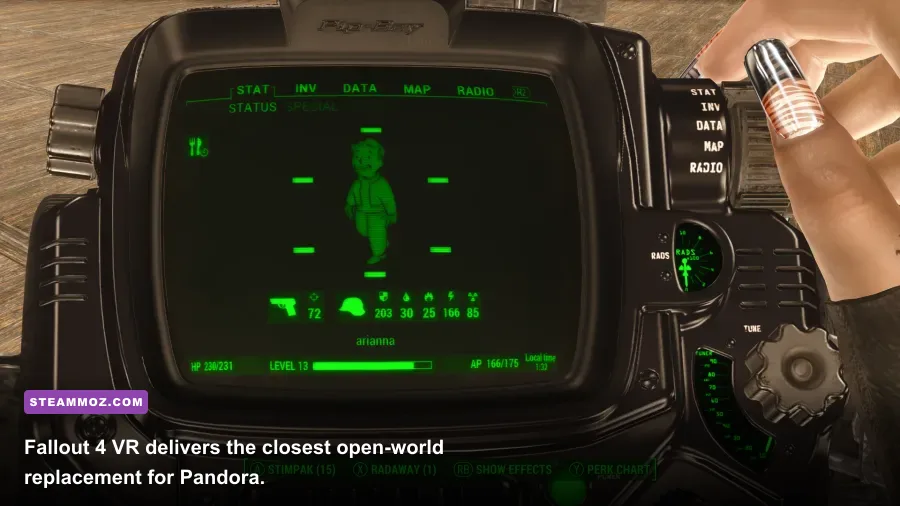
Fallout 4 VR is the obvious S-Tier choice if what you loved was wandering through a huge world while constantly discovering new weapons. Bethesda’s version includes the complete Commonwealth campaign and the familiar SPECIAL system. Strength, Perception, Endurance, Charisma, Intelligence, Agility, and Luck all remain central, while perks such as Rifleman, Gunslinger, Commando, and Armorer let you shape a build rather than simply chase higher item level.
The important caveat is that Fallout 4 VR is a 2017 PC release, not a polished modern VR remaster. With SteamVR’s default settings, you may see inconsistent frame pacing in Boston, especially around downtown cells and dense settlements. A steady 90 frames per second is much more valuable than maximum shadow quality because reprojection during close-range firefights can make aiming feel muddy. The community’s Fallout 4 VR Essentials mod list is practically part of the ownership experience, although you should install mods selectively and test one change at a time.
Its progression curve is slower than Borderlands 2 VR’s. You will not collect a new gun every few seconds, but the trade-off is meaningful exploration. A combat rifle with a .308 receiver, a scoped hunting rifle, or a modded laser rifle can remain useful for hours because receiver, barrel, stock, sight, and magazine choices change how the weapon behaves. Fallout 4 VR wins on world scale and role-playing; Borderlands wins on loot velocity and enemy spectacle.
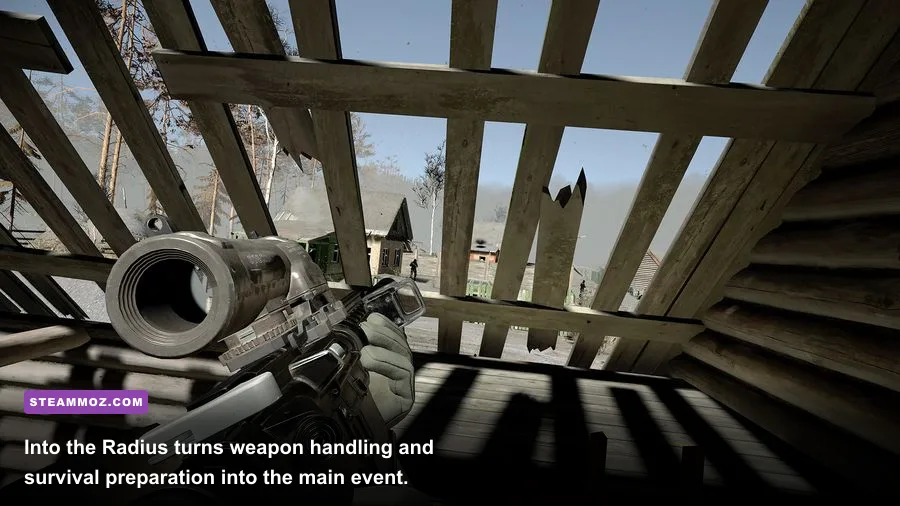
Into the Radius earns the other S-Tier slot, although it is a very different beast. Its Pechorsk Exclusion Zone is divided into dangerous areas rather than Borderlands-style linear missions. You manually clean magazines, insert rounds, attach suppressors, repair weapons, and organize your backpack before leaving the safe zone. A damaged AKM is not merely a lower-stat drop; it can jam at the worst possible time.
The game’s combat has excellent tension because enemies telegraph danger without turning every encounter into a bullet sponge. Fractures shimmer and lunge, Mimics fire from cover, and Seekers punish careless movement. Bring spare magazines, a headlamp, healing injectors, and enough ammunition to return safely. Unlike Borderlands, the winning strategy is often disengagement. A quiet route through a field can be stronger than a louder, better weapon.
| Game | Borderlands-like strength | Progression model | Best platform |
|---|---|---|---|
| Fallout 4 VR | Open-world shooting and character builds | SPECIAL perks and weapon crafting | PC VR |
| Into the Radius | Hands-on guns and expedition tension | Gear condition and mission rewards | PC VR, Quest |
| Gunfire Reborn | Weapons, skills, and replayable builds | Roguelite runs and permanent upgrades | PC, console, VR options vary |
| Arizona Sunshine 2 | Co-op shooting and physical weapons | Campaign unlocks and scenario progression | PC VR, PS VR2, Quest |

🎮 Borderlands 2 VR
Looking to experience this game? Grab your digital key directly on our store for $12.49.
View on Steammoz Store →Gunfire Reborn is the best loot-build substitute
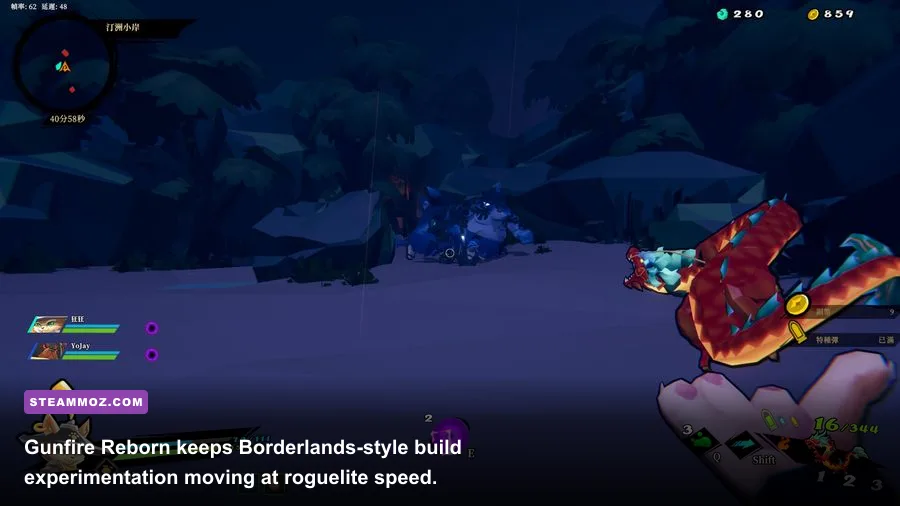
Gunfire Reborn is not a conventional full-motion VR shooter, and that is precisely why it works so well as a Borderlands alternative. It is a first-person roguelite built around weapons, elemental interactions, scrolls, ascensions, and short runs. The Crown Prince begins with an elemental grenade that applies Decay, then combines it with an electric or fire weapon to trigger Fusion effects. Decay plus Shock creates Miasma; Decay plus Burn creates Explosion; Shock plus Burn creates Manipulation.
Those combinations are the game’s equivalent of Borderlands skill synergy. Crown Prince’s Energy Orb can freeze enemies and set up critical hits, while ascensions such as Elemental Maestro and Occult Scrolls turn a respectable weapon into the centerpiece of a run. The Warlord’s Armor scroll rewards shield-heavy play, while Rich’s Privileges improves weapon quality and skill damage. You are not just asking whether a gun has higher damage. You are asking whether it supports your current status-effect engine.
Other heroes change the rhythm completely. Ao Bai can dual-wield and leans into explosive or sustained gunfire. Qing Yan converts armor into an aggressive melee resource through Cleave and Leap. Lei Luo rewards precise sniper shots with chain lightning and Fatal Current. That variety gives Gunfire Reborn more replayable build depth than many traditional loot shooters, even though individual runs are much shorter.
The weakness is tactile. You are managing a crosshair and conventional controls, not physically grabbing a shotgun from your chest rig. If your favorite Borderlands 2 VR moment was reloading under pressure or physically lining up a pistol, this will feel less immersive. If it was discovering a broken combination and melting a boss with elemental damage, Gunfire Reborn is arguably the sharper game.
| Build target | Recommended hero | Core interaction | Priority weapon type |
|---|---|---|---|
| Elemental chain damage | Crown Prince | Decay into Miasma or Explosion | Elemental rifle or corrosive weapon |
| Dual-wield burst | Ao Bai | Two weapons with complementary effects | Launcher plus automatic weapon |
| Close-range aggression | Qing Yan | Armor recovery through Leap and Cleave | Shotgun or melee weapon |
| Precision boss damage | Lei Luo | Fatal Current and critical hits | Sniper rifle |
Arizona Sunshine 2 is the co-op pick
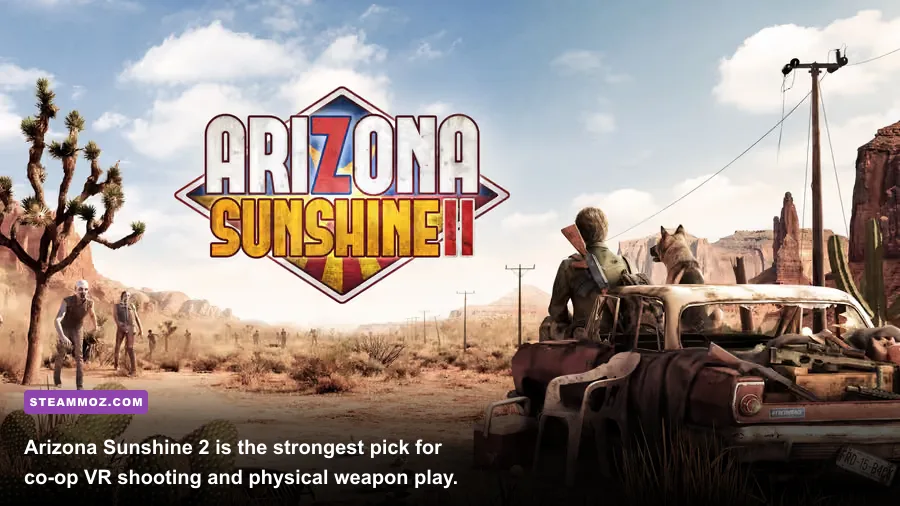
If you played Borderlands 2 VR because shooting is more fun with a friend, Arizona Sunshine 2 should be near the top of your 2026 list. Vertigo Games built its campaign around two-player co-op, and every weapon feels designed for hands rather than an inventory menu. You can rack a shotgun, pull a magazine, use a sidearm one-handed, and physically interact with the environment while your partner covers an angle.
The dog Buddy is more than a cosmetic companion. You can direct him toward targets, use him to create space, and rely on his presence to make quiet exploration feel less empty. That changes how you approach the campaign’s zombie encounters. Instead of sprinting through every room, you can send Buddy forward, identify threats, then conserve ammunition by using controlled headshots. A pistol is efficient against isolated walkers; a shotgun is a panic button when a group collapses on your position.
Arizona Sunshine 2 does not have Borderlands’ randomized loot ladder or class-based skill trees. Its progression is campaign-based, with new scenarios and equipment opportunities rather than a constant rain of rarity colors. That keeps the action readable in VR, where searching through a huge inventory while zombies advance would be frustrating. The trade-off is replay value: once you know a chapter’s ambushes, the surprise fades faster than it does in a procedural loot shooter.
For comfort, use snap turning if smooth rotation causes discomfort, and begin with a moderate smooth-movement speed. The game’s close-quarters rooms can produce rapid camera motion when you backpedal from a horde. On PC VR, prioritize stable frame timing over ultra-quality shadows. In co-op, voice communication is not optional; call out reloads, special infected, and the direction of a flanking group before the room turns into a scramble.
Robo Recall is the pure-action alternative
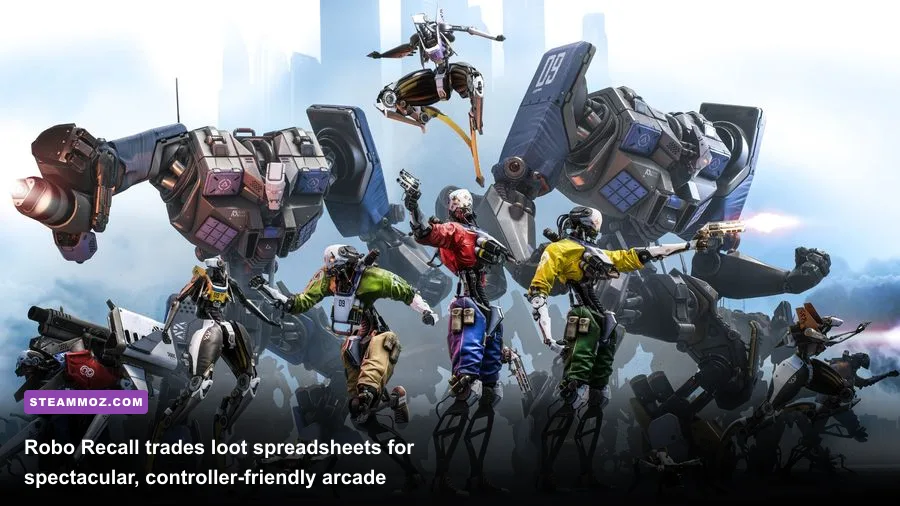
Robo Recall belongs in this list for a different reason: it captures the joyful physicality of Borderlands 2 VR without pretending to be an RPG. Developed by Epic Games, it is a compact arcade shooter where you teleport through futuristic arenas, grab robots, tear them apart, and throw their bodies back into the fight. The campaign is shorter and more structured than Borderlands, but its moment-to-moment gunplay remains one of VR’s cleanest.
The weapon loop is built around four guns, each held in a corresponding holster. You can dual-wield pistols for controlled fire, grab a shotgun for close-range destruction, or use the assault rifle when enemies spread across an arena. The signature trick is not simply shooting. You can catch incoming projectiles, rip weapons from robots, and use environmental objects as improvised missiles. A good run feels like a choreographed action scene because the game rewards fast decisions rather than careful inventory management.
Its scoring system also gives it a reason to survive beyond the first campaign clear. Headshots, multi-kills, damage avoidance, and stylish takedowns feed the arcade loop. Players who enjoyed Borderlands 2 VR’s constant combat but skipped side quests for the next firefight will probably prefer Robo Recall’s focus. Players looking for loot rarities, grenades with wildly different modifiers, and a build that evolves over ten hours should choose Gunfire Reborn or Fallout 4 VR instead.
Robo Recall is also one of the safest technical recommendations here. Its arena structure keeps draw distances controlled, and the stylized visuals remain readable at a high refresh rate. That makes it a particularly good choice for older PC VR systems or newcomers who want responsive aiming before committing to a 30-hour virtual reality RPG.
| Setting or priority | Recommended value | Performance impact | Visual result |
|---|---|---|---|
| Headset refresh rate | 90Hz if stable | High GPU and CPU demand | Smoother aiming and less discomfort |
| SteamVR resolution | 100% baseline | Medium to high GPU demand | Sharper sights without unnecessary supersampling |
| Dynamic shadows | Medium | Medium demand in busy scenes | Good depth with fewer frame-time spikes |
| Texture quality | High if VRAM allows | Low to medium demand | Clearer weapons and enemy details |
Borderlands 3 and the games that miss the mark
Borderlands 3 is the strongest non-VR recommendation because it preserves the franchise’s core formula better than anything else: four playable Vault Hunters, class action skills, manufacturers with distinct weapon behavior, and a campaign built around a huge volume of guns. Moze’s Iron Bear supports explosive builds, FL4K’s Fade Away enables critical-hit bursts, Amara’s Phasegrasp locks down targets, and Zane’s Digi-Clone creates a second source of pressure. The skill trees are deeper and more flexible than Borderlands 2’s original setups.
Its gunplay is also faster. Sliding, mantling, alternate firing modes, and manufacturer gimmicks make combat more mobile than the older game. A Maliwan weapon needs a charge before firing but rewards elemental matching; Jakobs guns return critical-hit damage through ricochets; Tediore reloads turn discarded magazines into temporary weapons. That is exactly the kind of mechanical variety Borderlands 2 VR fans usually want.
But Borderlands 3 does not replace VR immersion. You lose physical reloading, room-scale aiming, and the strange thrill of seeing Pandora at headset scale. Treat it as the choice for the loot and class systems, not as a substitute for motion controls. It also has a more uneven story and a brighter, busier visual style than Borderlands 2, though its endgame build variety is excellent.
My final ranking is straightforward. S-Tier goes to Fallout 4 VR and Into the Radius because both offer the strongest sense of presence and meaningful long-term progression. A-Tier includes Gunfire Reborn, Arizona Sunshine 2, and Robo Recall: each nails one major part of the Borderlands 2 VR fantasy, but none covers every angle. B-Tier belongs to Borderlands 3 as a non-VR fallback and to games such as The Outer Worlds, which has entertaining loot and dialogue but no native VR version and much less satisfying shooting.
| Tier | Game | Why it ranks here | Biggest compromise |
|---|---|---|---|
| S-Tier | Fallout 4 VR | Open world, crafting, perks, and exploration | Needs performance tuning and mods |
| S-Tier | Into the Radius | Best physical weapons and survival tension | Less loot variety and no co-op campaign |
| A-Tier | Gunfire Reborn | Excellent elemental builds and replayable runs | Not a fully physical VR shooter |
| A-Tier | Arizona Sunshine 2 | Best co-op weapon handling | Limited randomized progression |
| A-Tier | Robo Recall | Most polished arcade VR gunplay | Shorter campaign and no RPG structure |
| B-Tier | Borderlands 3 | Best flat-screen loot and class systems | No native VR mode |
Before buying, check the official Fallout 4 VR Steam page, the Into the Radius Steam listing, and the official Gunfire Reborn page for headset and platform details. You can also compare wider PC performance advice with Steamoz’s Deadfall Adventures PC specs guide and frame-rate tuning tips in Dragonkin settings that make every frame count. For more RPG progression reading, see our Dungeon Siege review and Death Howl leveling guide.
The short version is this: choose Fallout 4 VR when you want Pandora-sized exploration, Into the Radius when every reload should matter, and Gunfire Reborn when the build is more important than the body presence. Arizona Sunshine 2 is the co-op answer, while Robo Recall is the instant-action answer. None completely recreates Borderlands 2 VR, but together they show why its blend of loot, skills, and physical shooting still feels unusually hard to replace in 2026.