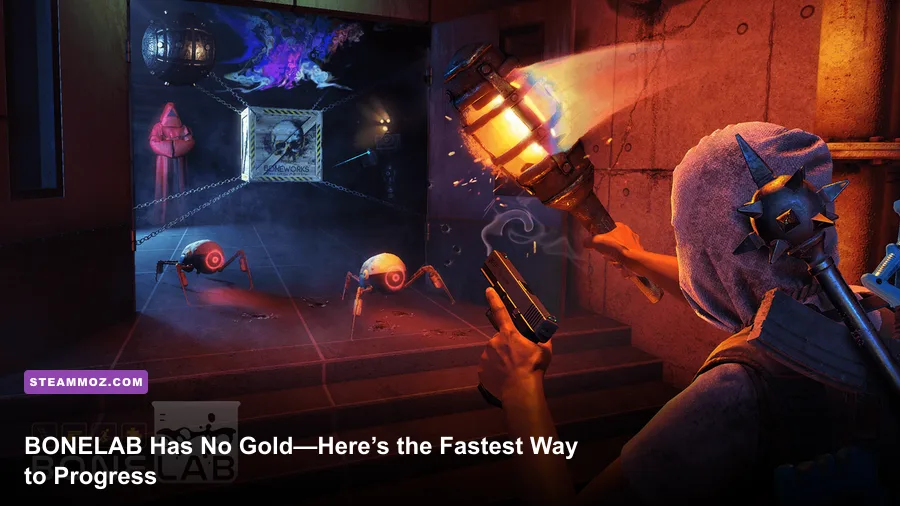
BONELAB doesn’t have character levels, gold, or an XP bar, so traditional farming routes do not exist. The fastest way to progress is to clear the campaign until the Main Hub opens up, collect capsules and key items along the route, unlock avatars through the Body Mall, and use the hub’s activities to earn progression-related unlocks. If a guide promises a gold exploit, it’s describing a different game—or confusing BONELAB with BONEWORKS mods.
That distinction matters because BONELAB’s progression is deliberately physical. You find objects in the world, carry them, throw them into collection points, solve environmental puzzles, and open new activities. There’s no enemy loop that pays coins and no stat screen where grinding strength from 10 to 20 suddenly makes you stronger. Your real power comes from understanding the avatars, exploiting physics safely, and learning which unlocks are worth detouring for.

What “leveling and gold farming” actually means in BONELAB
BONELAB uses a campaign-and-unlock structure rather than an RPG economy. You begin in the Void, reach the Main Hub, and gradually activate different doors and activities. The campaign chapters introduce weapons, movement ideas, avatar abilities, and new environments. Capsules scattered through levels unlock items, avatars, and sandbox content, but they aren’t spendable gold. Once collected, they function more like permanent rewards.
The most important early objective is opening the hub’s progression path. Don’t waste your first sessions hunting every hidden object before you understand the route. Complete the early campaign objectives, learn how the hub connects to the six primary campaign levels, then return for cleanup. This avoids a common time sink: crawling through a dark corner with an underpowered avatar only to discover the collectible requires a tool or movement option introduced later.
| Progression Element | What It Does | Best Farming Approach | What It Is Not |
|---|---|---|---|
| Campaign completion | Opens story routes and activities | Push forward through required objectives | An XP-granting level system |
| Capsules | Unlock avatars, weapons, props, and content | Collect during first pass, then sweep missed areas | Spendable currency |
| Avatars | Change body weight, speed, height, and handling | Unlock the Body Mall roster | Classes with conventional skill trees |
| Ammo and weapons | Support combat and experimentation | Search rooms and use weapons conservatively | Gold purchased from vendors |
| Sandbox items | Expand replay and experimentation options | Return to completed stages for missed capsules | Gear with RPG rarity tiers |
For official details, check the BONELAB Steam page and the developer’s BONELAB page. They make the game’s sandbox focus clear: this is a physics-driven VR action game, not a currency treadmill.
🎮 BONELAB
Looking to experience this game? Grab your digital key directly on our store for $31.99.
View on Steammoz Store →The fastest BONELAB progression route for a new player
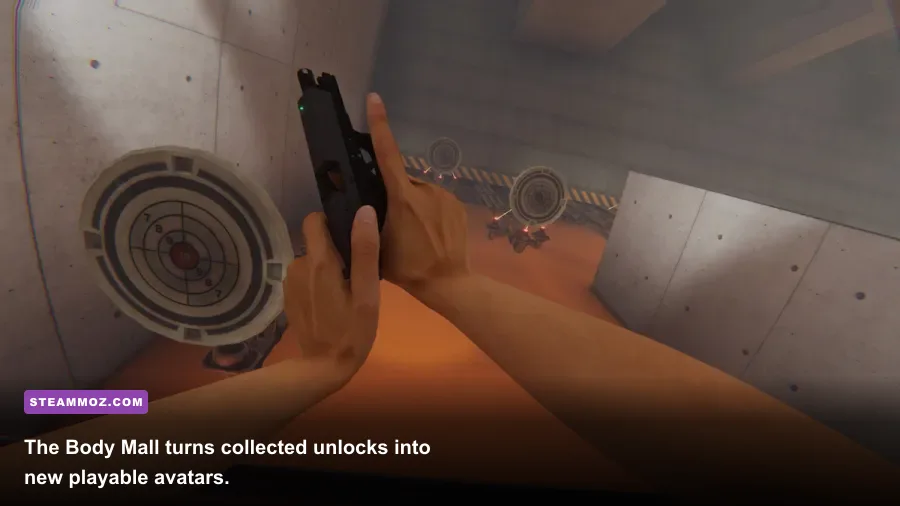
Your first run should prioritize forward momentum and safe experimentation. Start by learning the interaction basics in the Void. Grab objects with both hands, test holsters, and get comfortable climbing before you chase optional rooms. In VR, fumbling with a weapon during a fight costs more time than simply avoiding a bad encounter, so the tutorial space is worth treating as a movement drill rather than something to rush through.
Step 1: Reach the Main Hub
Follow the opening sequence until you arrive at the Main Hub. This is your central staging area. Look for active doors, obvious control points, and the transport mechanisms that connect the campaign’s major routes. If a door appears inactive, don’t assume you need gold; BONELAB usually wants campaign progress, a specific interaction, or a completed activity.
Step 2: Clear required objectives before detouring
During the first pass through a level, grab visible weapons and capsules, but don’t spend ten minutes forcing a route that seems physically impossible. BONELAB loves environmental misdirection. A high ledge may be intended for a later avatar, while a blocked path may open after you power a machine or finish a nearby encounter. Mark the location mentally and return after the level becomes replayable.
Step 3: Collect the obvious capsules
Search rooftops, side rooms, maintenance corridors, behind large props, and above normal eye level. VR games punish players who only scan the floor. Physically tilt your head upward, check behind doors, and inspect platforms from multiple angles. If the capsule is visible but unreachable, try a lighter or taller avatar later rather than throwing yourself into a risky climbing attempt.
Step 4: Revisit with the right avatar
Avatar choice is BONELAB’s closest equivalent to a build system. Heavy bodies can push through physical resistance and hit harder, while smaller or lighter bodies are better for narrow routes and quick movement. The nimble options are useful for platforming; heavier options are more forgiving when a melee encounter turns chaotic. Swap bodies from the Body Mall instead of trying to force every challenge with the default frame.
This is where a careful route beats a fake “gold farm.” You’re not repeating a five-minute mission for coins. You’re reducing backtracking by combining story progress, capsule collection, and avatar testing in the same run.
Capsule hunting without wasting hours
Capsules are the closest thing BONELAB has to a collectible economy, and they’re worth treating systematically. Don’t rely on random wandering. Divide each level into zones: entry area, combat space, vertical route, puzzle room, and exit corridor. Before leaving a zone, check three layers—floor level, reachable platforms, and overhead structures. This simple pattern catches far more collectibles than a frantic room-by-room search.
Use landmarks instead of vague memory
Take mental notes using strong visual landmarks: a yellow machine, a broken bridge, a large sign, a minecart track, or a distinctive doorway. BONELAB’s spaces can look similar when you’re wearing a headset, especially after a long session. A landmark-based route lets you return directly to a missed side room rather than replaying an entire chapter blindly.
Check physics props
Some secrets are hidden behind movable objects, on shelves, or inside spaces that only become obvious after you manipulate the environment. Use your gravity-style interaction tools and both hands. If a stack of crates looks deliberately placed, move it. If a door is slightly ajar, pull it fully open. The game frequently rewards curiosity, but it rarely rewards repeatedly smashing the same object with a crowbar.
| Search Zone | What to Inspect | Useful Avatar Trait | Common Mistake |
|---|---|---|---|
| Upper platforms | Ledges, beams, rooftops, hanging structures | Height or mobility | Only searching at eye level |
| Industrial rooms | Crates, shelves, machines, vents | Strength and reach | Ignoring movable props |
| Combat arenas | Side entrances, balconies, corners | Speed for quick scouting | Leaving immediately after waves end |
| Puzzle routes | Behind switches, under platforms, alternate doors | Balanced handling | Assuming the main path is the only path |
| Exit corridors | Rooms behind the final objective and dead ends | Any, depending on access | Rushing to the level transition |
For broader collectible habits, our Dragonkin hidden rewards guide covers the same useful principle: map a route by landmarks, not by hope. The game-specific mechanics differ, but the anti-backtracking logic transfers perfectly.
Avatar choices that make progression faster
There are no skill points to distribute, but avatars dramatically change how quickly you can solve problems. A heavy avatar is excellent when you need to shove, carry, or survive close-range punishment. A tall avatar helps with reach and climbing angles. Smaller, faster bodies are better for evasive movement and tight spaces. The trick is to stop treating one avatar as your permanent main.
Use a mobile body for exploration, a heavy body for physical obstacles, and a balanced body for mixed combat. Switching before a challenge is faster than dying three times because your current frame cannot reach a ledge or safely absorb a hit. Remember that reach, mass, and acceleration affect your real-world VR actions; this isn’t merely a cosmetic selection screen.
| Avatar Profile | Strength | Weakness | Best Use |
|---|---|---|---|
| Light and agile | Fast movement and easier platforming | Less forgiving in melee | Capsule routes and evasive combat |
| Tall and rangy | Reach, climbing angles, overhead access | Can feel awkward in cramped rooms | Vertical exploration and interactables |
| Heavy and powerful | Momentum, impact, physical pushing | Slower repositioning | Brutes, barriers, and close combat |
| Balanced frame | Reliable handling across situations | No extreme advantage | First clears and unfamiliar levels |
Don’t confuse physical strength with invulnerability. Enemies can still stagger you, knock weapons away, or create dangerous pileups. Keep your off-hand free when possible, maintain room-scale awareness, and avoid swinging heavy props near furniture or your play boundary. BONELAB’s best “stat upgrade” is often better spacing.
Best combat activities for efficient practice

If by farming you mean building skill quickly, the hub activities are much more useful than replaying campaign fights at random. Street Puncher is ideal for learning melee timing, target prioritization, and how much distance you need before committing to a swing. Arena-style encounters are better for testing weapon handling, crowd control, and movement under pressure.
Use physics before ammunition
Ammo is limited during many campaign sections, while the environment is packed with improvised tools. Pipes, bats, knives, heavy objects, and thrown props can conserve firearms for armored or distant threats. A clean two-handed melee strike is often safer than trying to reload while an enemy is inside your personal space.
Control the room’s geometry
Never let multiple enemies surround you if you can help it. Move through doorways, around large props, and toward narrow approaches that limit attack angles. BONELAB enemies may look ragdoll-heavy, but their collisions can still stun-lock you when several bodies reach you at once. Backpedal only when you can see the floor; tripping over a prop is a real danger, not a meme.
| Situation | Best Response | Why It Works | Risk to Avoid |
|---|---|---|---|
| Single melee enemy | Keep range, parry or strike the limb, then reposition | Prevents close grappling | Standing still after the hit |
| Several enemies | Use doorways and funnel the group | Reduces attack angles | Fighting in open space |
| Armored target | Use firearms or heavy impact tools | Improves damage consistency | Wasting light melee swings |
| Low ammunition | Search the room and switch to physics weapons | Preserves critical shots | Reloading in grappling range |
| Unclear arena objective | Inspect switches, doors, and nearby props | Objectives are often physical | Assuming enemies are endless |
Players coming from traditional shooters may also benefit from our FPS-first performance guide. BONELAB is VR, so stable frame pacing matters even more than visual sharpness. A stutter during a grab or swing can ruin an otherwise perfect attempt.
Performance settings that protect your farming runs
There’s no benefit to chasing collectibles at maximum visual quality if the headset is struggling. BONELAB’s physics-heavy scenes can punish unstable performance, especially when several enemies, weapons, and loose props occupy the same room. Prioritize a consistent refresh rate, then increase resolution only when the game remains comfortable.
PC VR recommendations
Start with the headset’s native refresh target and test a busy arena rather than an empty corridor. Lower shadow quality and effects before cutting resolution aggressively; clear visual edges matter when you’re searching for capsules. If you use SteamVR, watch frame timing during combat and object-heavy sandbox scenes. A profile that feels smooth in the Main Hub may still buckle in a crowded activity.
Standalone Quest considerations
On standalone hardware, keep your play space clear and expect the most demanding moments around enemy groups and physics clutter. Avoid leaving unnecessary props scattered around a sandbox session if you’re trying to evaluate combat performance. Restarting a messy scene can produce a cleaner test than repeatedly adding objects until the headset struggles.
| Setting or Habit | Recommended Starting Point | Performance Impact | Visual Trade-Off |
|---|---|---|---|
| Refresh rate | Use a stable headset target | High importance for comfort | May require lower rendering load |
| Shadow quality | Medium before raising other options | Moderate to high in busy rooms | Less dynamic shadow detail |
| Effects quality | Medium for combat-heavy runs | Moderate during explosions and clutter | Reduced effect density |
| Resolution | Increase only after stable frame timing | High on PC VR GPUs | Lower clarity when reduced |
| Sandbox clutter | Delete unused props between tests | Can improve consistency | Less persistent experimentation |
For PC troubleshooting, the official BONELAB Steam Discussions are more useful than generic fix lists because headset, runtime, and mod setups vary wildly. You can also compare the way we approach performance in Dragonkin’s frame-focused settings guide.
What not to farm, and how to finish efficiently
Don’t farm random enemies expecting currency, replay an arena expecting XP, or install an unverified “gold mod” and assume it represents the base game. BONELAB’s official progression is about content access and collectibles. Mods can add currencies, weapons, maps, or custom systems, but those are separate from the vanilla game and may break after updates or conflict with other mods.
A clean completion route looks like this: finish the opening campaign path, activate the Main Hub’s available routes, collect obvious capsules during every first clear, unlock and test the avatar roster, then replay levels for vertical and gated secrets. Keep a short note of missed rooms. When you return, choose the avatar that solves the specific obstacle instead of defaulting to the one you enjoy most in combat.
That approach is faster, safer, and more honest than calling BONELAB a gold-farming game. If you enjoy this style of practical progression planning, our fast leveling and gold farming guide for Empires of the Undergrowth covers a game that genuinely has an economy. BONELAB is different: your reward is a bigger toolbox, better routes, and the ability to turn nearly any room into a physics playground.
Bottom line: there is no vanilla BONELAB gold exploit because there is no vanilla gold system. Push the campaign, collect capsules, swap avatars intelligently, and use the Main Hub activities to sharpen your combat. Once you stop searching for an imaginary currency loop, BONELAB’s progression becomes much clearer—and a lot more fun.