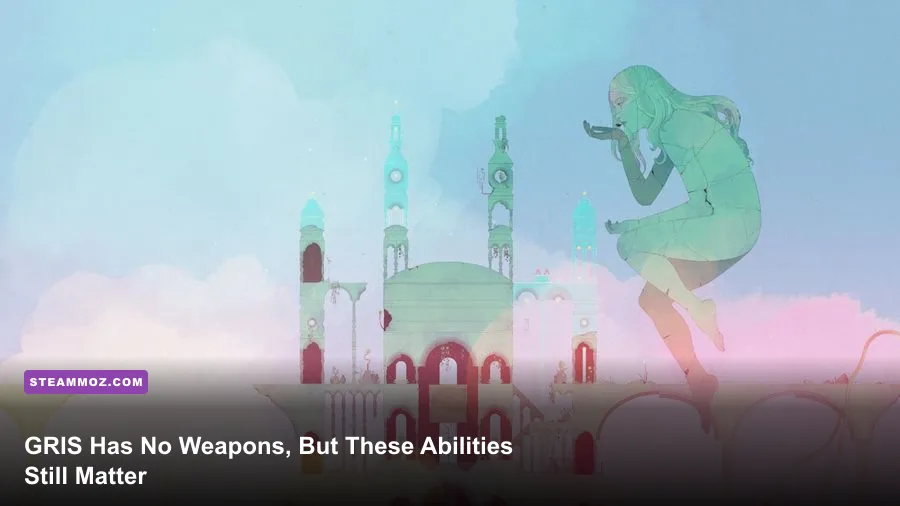
GRIS does not have weapons, armor, equipment slots, damage stats, or a conventional tier list. Its closest equivalent is an ability ranking: the double jump and air dash are the most valuable movement tools, stone form is the best puzzle utility, and swimming is the most situational. Mementos add optional exploration goals, while the dress changes visually and mechanically as the journey progresses. Treating GRIS like an action RPG will send you looking for gear that simply isn't there.
That distinction matters for anyone searching for a GRIS weapon tier list and best equipment ranking. Nomada Studio built GRIS as a narrative platformer about movement, spaces, color, and recovery. There are no enemies with health bars, no weapon upgrades, no character statistics, and no inventory screen to optimize. The challenge comes from reading the environment and understanding what each new ability lets you do.
This ranking focuses on the tools that actually exist in the game. It covers every major movement ability, the dress forms connected to progression, Mementos, and the optional collectibles that can make exploration more satisfying without changing your power level.
If you want the official product details first, the GRIS Steam page confirms the game's platforming and exploration focus. You can also see the studio's broader work through the official Nomada Studio website.
GRIS Ability Tier List At A Glance
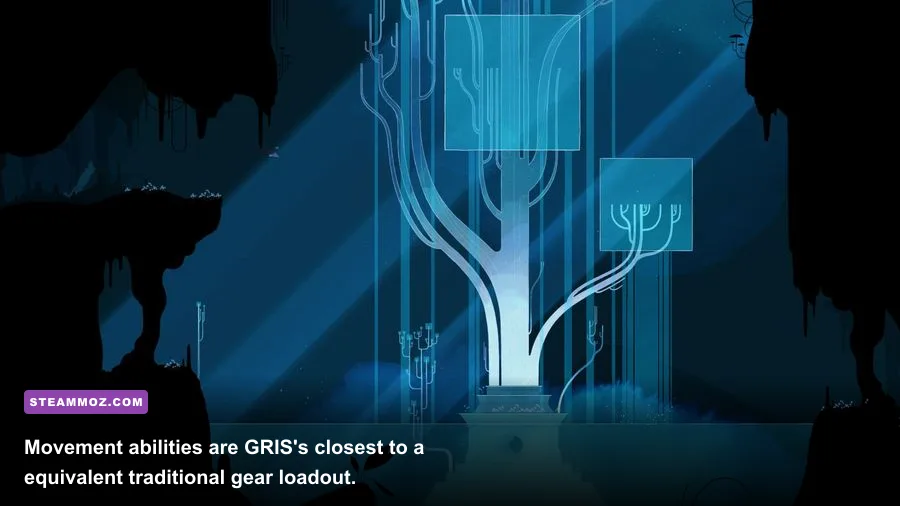
The ranking below measures usefulness across platforming, exploration, puzzle solving, and late-game traversal. “S-Tier” doesn't mean the ability deals more damage; there is no damage system. It means the tool either expands the map dramatically or solves problems that would otherwise be impossible.
| Tool or Ability | Tier | What It Does | Best Use |
|---|---|---|---|
| Double Jump | S-Tier | Provides a second jump in midair | Vertical traversal, recovery, hidden paths |
| Air Dash | S-Tier | Moves GRIS horizontally through the air | Long gaps, precision jumps, late-game routes |
| Stone Form | A-Tier | Turns GRIS into a heavy block | Pressure puzzles, weighted switches, falling hazards |
| Swimming | A-Tier | Allows underwater movement | Exploration and submerged platforming |
| Basic Jump | B-Tier | Core vertical movement | Early traversal and ordinary platforming |
| Song | B-Tier | Interacts with specific environmental elements | Activating plants and progressing puzzles |
| Mementos | C-Tier | Optional collectibles with no stat bonuses | Completion, secrets, and visual rewards |
The important caveat is that GRIS has no bad unlocks. Swimming is lower than the double jump only because it applies to fewer situations, not because it is poorly designed. Each ability arrives when the world is ready to support it, and the game rarely asks you to use a tool before teaching its purpose.

🎮 GRIS
Looking to experience this game? Grab your digital key directly on our store for $2.99.
View on Steammoz Store →S-Tier: Double Jump And Air Dash
Double jump
The double jump is the most useful ability in GRIS because it immediately changes how you approach almost every room. Before unlocking it, a ledge is a hard boundary. Afterward, the same ledge becomes a question: can you reach it with one jump, reserve the second jump for correction, and still land safely?
That extra jump is more than a height increase. It is a recovery tool. GRIS's platforming often uses soft silhouettes, low-contrast backgrounds, and moving structures that can make distance difficult to judge. The double jump gives you a second chance after a slightly late input. Experienced players should avoid spending it automatically. Hold the first jump until the apex of your initial arc, then use the second jump when you can see the landing zone clearly.
The ability is especially strong around collapsing platforms and rotating structures. Jump once to gain height, watch the platform's movement, then trigger the second jump only after the target lines up. That rhythm is safer than tapping both jumps immediately, which creates a tall but inflexible trajectory.
Air dash
The air dash is the other S-Tier tool. It provides horizontal reach and makes long gaps far less intimidating. Where the double jump fixes vertical mistakes, the dash fixes distance mistakes. Used together, they form GRIS's most powerful traversal combination.
A reliable sequence is jump, wait until the character begins to fall, then air dash toward the target. Dashing at the start of a jump can waste the ability before you know where the platform will move. Dashing late preserves the option to use your second jump for a final correction. The exact timing depends on the obstacle, but the principle is consistent: don't burn both recovery tools before the landing is visible.
The dash also helps with momentum-based sections. Some routes look impossible if you treat each platform as a stop-start landing point. Instead, use the first platform to set up the next jump, carry your movement through the arc, and dash only when the gap demands it. GRIS is gentle, but it still rewards clean movement.
A-Tier: Stone Form And Swimming
Stone form
Stone form is one of GRIS's cleverest abilities because it isn't mainly about reaching higher platforms. It changes your relationship with gravity. Once transformed, GRIS becomes a heavy stone block that can drop through fragile surfaces, activate pressure mechanisms, and resist certain environmental forces.
Its best use is puzzle reading. If you see a suspicious platform below a safe ledge, ask whether the game wants you to become heavy rather than jump farther. Stone form can also stabilize situations where normal movement would send you sliding or drifting. The form's weight is the point, so don't treat it as a cosmetic transformation.
The downside is flexibility. While in stone form, you give up the delicate control of normal movement. You can't use it as a universal defensive mode, and it won't solve a gap that requires horizontal precision. It belongs in A-Tier because its puzzle value is excellent, but its usefulness depends heavily on the room's layout.
Swimming
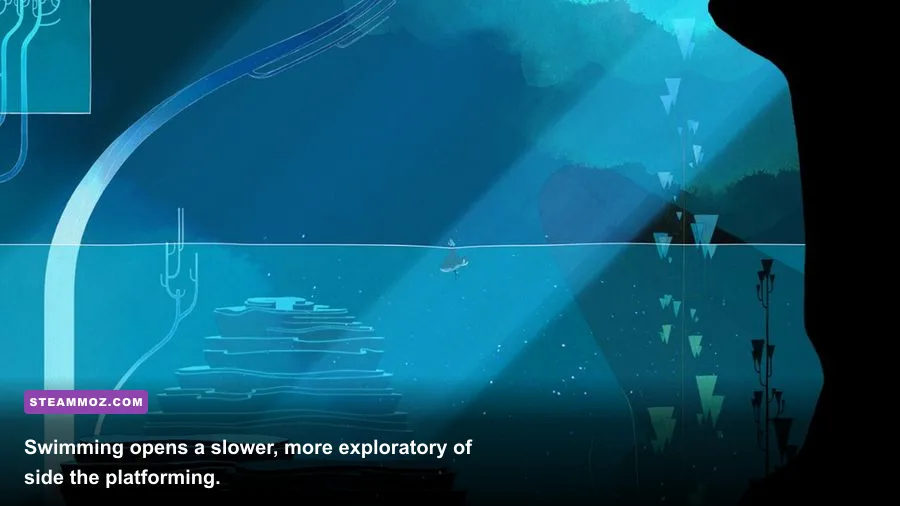
Swimming opens GRIS's underwater spaces and changes the tempo of exploration. The movement is slower and more spacious than standard platforming, giving you time to search for routes, collectibles, and visual details. It is not a speedrunner's favorite tool, but it is one of the game's most important world-expansion abilities.
When swimming, plan your route before committing to a narrow opening. Underwater areas often use vertical space, so scan above and below instead of moving only toward the most obvious doorway. If you're collecting Mementos, the slower pace is useful: hidden routes are easier to notice when you stop treating the section like a race.
Swimming ranks below the double jump and dash because it doesn't improve every part of the game. On its own, it won't help you cross a land-based gap or correct a jump. In the areas designed around it, however, it is indispensable.
B-Tier: Basic Jump And The Song
Basic jump
The basic jump sounds too ordinary to rank, but GRIS's entire movement language is built around it. It has a clean arc, readable momentum, and enough control to make early areas feel inviting without becoming automatic. Before the advanced abilities arrive, the jump teaches you to judge distance, identify safe ground, and use the environment's shapes as visual instructions.
Don't rush past that early lesson. Later rooms still depend on the same jump, only with more demanding combinations. Players who mash inputs tend to struggle when the game introduces moving platforms because they stop watching the arc. Tap deliberately, watch the character's position relative to the target, and remember that a calm correction is usually better than a panicked sequence of inputs.
The song
GRIS's song is not a weapon or a combat skill. It is an environmental interaction tool used to awaken or affect specific elements in the world. Its ranking is lower because it doesn't provide broad movement advantages, but it is essential whenever the environment clearly reacts to your voice.
Use the song when a plant, object, or structure looks unusually prominent and the game has already established that sound matters. The visual language is generally direct, so you shouldn't need to test every background decoration. GRIS wants you to notice the invitation, not solve an invisible logic puzzle.
The song also reinforces the game's central design idea: progress is often about reconnecting with a part of the world rather than defeating something. That makes it narratively important even when its mechanical impact is narrower than the movement abilities.
Best Dress Forms And Progression Ranking
GRIS's dress changes as abilities are gained, but these forms aren't separate armor sets. They don't have defense values, elemental resistance, durability, or upgrade paths. The dress is a visual expression of progression and, in specific moments, a practical shape tied to the current ability.
| Progression Element | Ranking | Mechanical Value | Why It Matters |
|---|---|---|---|
| Double-jump progression | S-Tier | Expands vertical reach and recovery | Useful across nearly every later zone |
| Air-dash progression | S-Tier | Expands horizontal reach | Combines with jumping for demanding routes |
| Stone-form progression | A-Tier | Enables weight-based puzzles | Changes how you interpret platforms and hazards |
| Swimming progression | A-Tier | Unlocks underwater regions | Reveals alternate routes and secrets |
| Color restoration | S-Tier narrative value | Changes the world's atmosphere | Connects exploration to GRIS's emotional arc |
Color restoration deserves a special mention. It isn't equipment, but it functions like a progression system because each major environmental shift changes what the world communicates. The early gray spaces gradually give way to stronger color identities, including the red, green, and blue areas. Those changes are not just visual rewards; they help distinguish the kind of movement and puzzle language you should expect.
For a detailed game-to-game comparison, our coverage of games like Absolute Drift is useful if what you really want is another stylish, movement-focused experience. GRIS itself stays deliberately light on conventional progression systems.
Mementos And Collectibles Ranked For Completionists
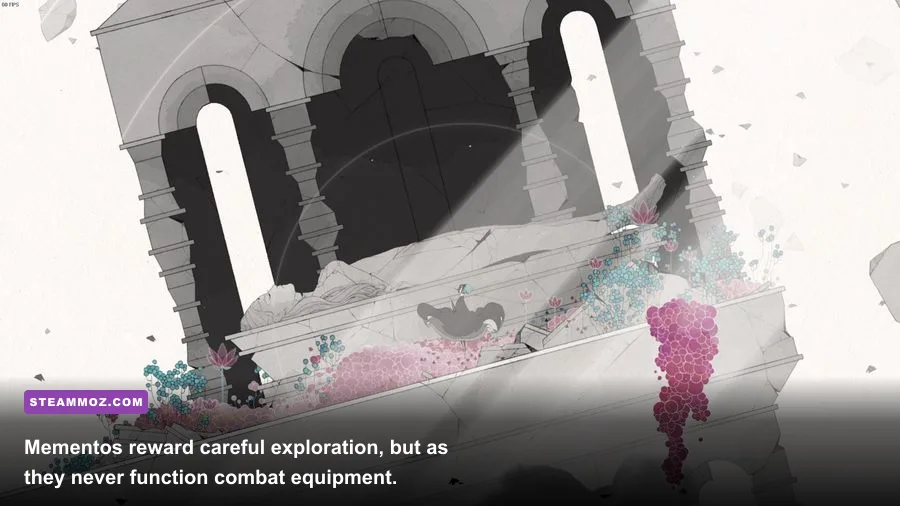
Mementos are the closest thing GRIS has to equipment, but calling them gear creates the wrong expectation. They don't increase jump height, improve dash distance, unlock passive bonuses, or make any encounter easier. Their value is completion, discovery, and the small visual payoff attached to collecting them.
For a first playthrough, rank them below every movement ability. If a Memento requires an awkward detour that would break your understanding of the current route, keep moving and return later when your expanded toolkit makes the path obvious. GRIS is designed so that revisiting a space with a new ability can turn a mysterious ledge into a clear invitation.
For a completionist run, Mementos become S-Tier targets because they give the world a reason to be examined rather than merely crossed. Look for unusual negative space, isolated platforms, suspiciously tall vertical shafts, and routes that seem to lead away from the story path. The game frequently rewards curiosity without placing a giant collectible marker on the screen.
Don't confuse Mementos with the game's story progression. Missing one won't lock you out of an ability or produce a weaker ending. That makes them ideal optional objectives for a second run, especially if your first playthrough focused on absorbing the soundtrack and visual direction.
How To Use The Best Ability Combinations
The strongest “build” in GRIS is a movement sequence, not a loadout. You generally want to preserve options until the landing becomes clear. A good default sequence is:
- Start with a normal jump. Establish your height and observe the target's movement.
- Use the double jump late. This gives you more vertical correction and avoids wasting the recovery tool.
- Air dash during descent. Save horizontal movement for when the gap is fully readable.
- Switch to stone form only for weight problems. Don't activate it simply because the icon or prompt is available.
- Enter water slowly. Search the full space before committing to the most obvious exit.
That approach works because GRIS's hazards are usually telegraphed rather than aggressive. There are no conventional bosses demanding damage rotations, no enemy attacks to parry, and no weapon cooldowns to manage. The pressure comes from committing too early or failing to notice the intended interaction.
If the game feels difficult, the answer is rarely “find better equipment.” Check whether you're using the wrong movement order. A failed jump with the double jump and dash already spent is often a planning error, not a reflex problem. Reset your position, watch the platform cycle, and try again with one tool held in reserve.
Performance Settings For A Clean GRIS Playthrough
GRIS is not a demanding modern action game, and performance tuning won't change its fictional weapon rankings because there are no weapons to simulate. Still, a stable frame rate helps with visual timing, especially in sections involving moving platforms and long air arcs.
| Setting | Recommended Value | Performance Impact | Visual Note |
|---|---|---|---|
| Resolution | Native display resolution | Medium to high | Preserves the watercolor artwork |
| Frame rate | Stable 60 FPS or display maximum | Low on modern PCs | Makes movement timing feel consistent |
| V-Sync | On if tearing appears | Very low | Useful during slow pans and scrolling scenes |
| Fullscreen mode | Fullscreen or borderless | Low | Choose based on desktop convenience |
| Resolution scale | 100 percent | Medium | Lower only if your hardware struggles |
GRIS's hand-painted presentation benefits from native resolution, so lowering image quality should be a last resort. If you're playing on a low-powered laptop, reduce resolution before chasing tiny visual settings. The official Steam listing provides the current platform information, while the Devolver Digital GRIS page highlights the game's visual and musical identity.
For PC troubleshooting habits, our guide to fixing crashes and low FPS in Aliens: Fireteam Elite covers more demanding hardware scenarios, but the same basics apply here: update your graphics driver, close unnecessary overlays, and test fullscreen if borderless mode behaves poorly.
Final Verdict On The GRIS “Weapon” Tier List
GRIS has no weapon tier list because weapons were never part of its design. The meaningful ranking is clear: double jump and air dash sit in S-Tier, stone form and swimming belong in A-Tier, and the basic jump and song are dependable B-Tier tools. Mementos are optional C-Tier mechanically, but they become essential for players chasing a complete exploration run.
That absence of gear is a strength, not a missing feature. GRIS keeps your attention on movement, atmosphere, and the way a devastated world gradually becomes readable again. You don't spend time comparing attack power or farming currency. You learn the space, earn a new ability, and return with a different understanding of the same landscape.
Players who want traditional builds may prefer our Bang-On Balls Chronicles weapon tier list or the Darklands beginner build guide. GRIS offers something more focused: a small set of beautifully integrated abilities where every unlock changes the way you move through the world.