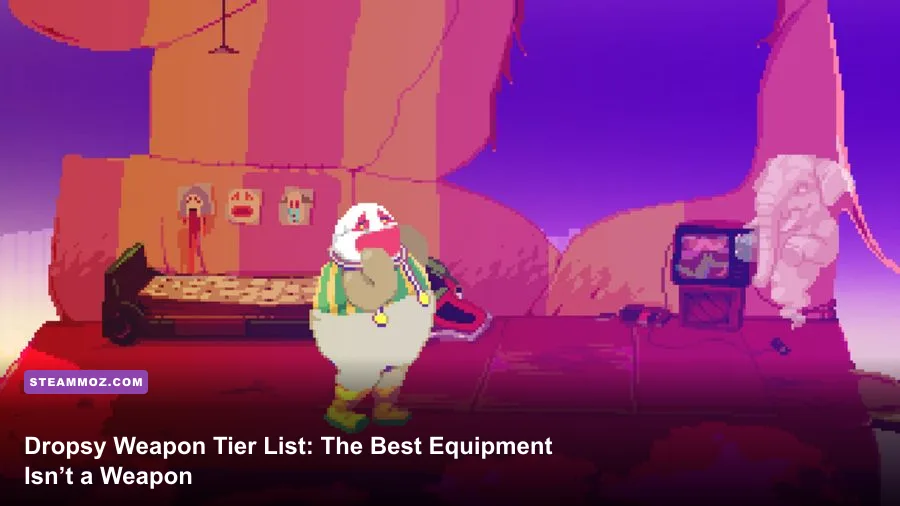
Dropsy has no weapons, armor, damage stats, or equipment tiers. That is the crucial answer behind this search: the game is a surreal point-and-click adventure about a misunderstood clown, and its real progression comes from collecting objects, understanding visual clues, opening new routes, and hugging people. Any supposed Dropsy weapon tier list that ranks swords, guns, or armor is mixing the game up with another title. The useful ranking is a priority list for Dropsy’s tools, interactions, and exploration habits.
That distinction isn’t a technicality. Dropsy never asks you to optimize attack power or build a combat loadout. There are no character levels, weapon rarities, skill trees, crafting benches, or boss damage phases. Instead, every item has a context: it may unlock a conversation, trigger a reaction, reveal a route, or complete one of the game’s oddball stories. The best “equipment” is therefore the object that solves the most immediate chain of problems, not the item with the biggest number.
This guide ranks those systems honestly, explains how progression actually works, and points out where players waste time. For the official store listing, check Dropsy on Steam. You can also compare the game’s design with our practical advice for Children of Silentown and Door Kickers, although Dropsy is deliberately far less combat-focused than either.
The Real Dropsy Tier List

Here’s the short version. S-Tier goes to observation, the hug interaction, and inventory objects that clearly connect one character or location to another. A-Tier includes revisiting areas at different times, checking every visual clue, and following animal-related interactions. B-Tier covers optional detours and experimentation with unrelated objects. None of these are weapons; they are the tools that actually move the game forward.
| Rank | System or “Equipment” | Why It Ranks Here | Best Use |
|---|---|---|---|
| S-Tier | Hugs and emotional reactions | They define Dropsy’s goal and frequently reveal progress | Interact with every receptive character |
| S-Tier | Key inventory objects | Objects create the game’s main puzzle chains | Use them where visual clues suggest a connection |
| S-Tier | Observation and visual language | There is no combat stat to rescue a missed clue | Study icons, expressions, scenery, and reactions |
| A-Tier | Map exploration | New screens and routes expose more interactions | Return to old locations after major discoveries |
| A-Tier | Animal interactions | Animals often provide useful reactions and optional context | Try interactions when a scene appears emotionally relevant |
| B-Tier | Optional detours | They may not unlock the critical path immediately | Use them for story, humor, and completion |
| C-Tier | Imaginary weapons and armor | They do not exist in Dropsy’s systems | Do not search for damage or defense upgrades |
The biggest mistake is treating the inventory like a role-playing-game loadout. An object is not stronger because it appears later, and it does not become obsolete because you found another item. Dropsy’s puzzles are mostly about relationships and cause-and-effect. If a character reacts to an object, remember that reaction. It may be the clue that makes a later scene readable.

🎮 Dropsy
Looking to experience this game? Grab your digital key directly on our store for $0.99.
View on Steammoz Store →Why Dropsy Has No Weapon Progression
Dropsy’s design rejects the usual adventure-game power curve. You play as Dropsy, a large, kind-hearted clown viewed with suspicion by much of the world around him. The central fantasy is not becoming dangerous; it is proving that empathy can cut through fear and misunderstanding. A shotgun, sword, or armor set would undermine that structure, so the game never creates a combat economy around them.
That means there are no attack values to compare, no stamina breakpoints, and no enemy telegraphs to memorize. You won’t find a “best early weapon,” an endgame legendary, or a stat-soft-cap route. The important numerical advice is effectively zero: there is no damage stat, defense stat, weapon durability value, or upgrade percentage to optimize.
This also explains why the game can feel unusually opaque if you arrive from an RPG. Progress is communicated through images, expressions, sound, and changes in the world rather than quest markers and item levels. A character’s reaction can matter more than a written objective. A strange object in the corner of a screen can be more valuable than a chest full of loot in another game.
For a useful comparison, our Cthulhu: The Cosmic Abyss starter build explains a game where point allocation genuinely matters. Dropsy is the opposite: there are no points to waste. Your advantage comes from remembering what the world has shown you.
Best Inventory Items and How to Rank Them

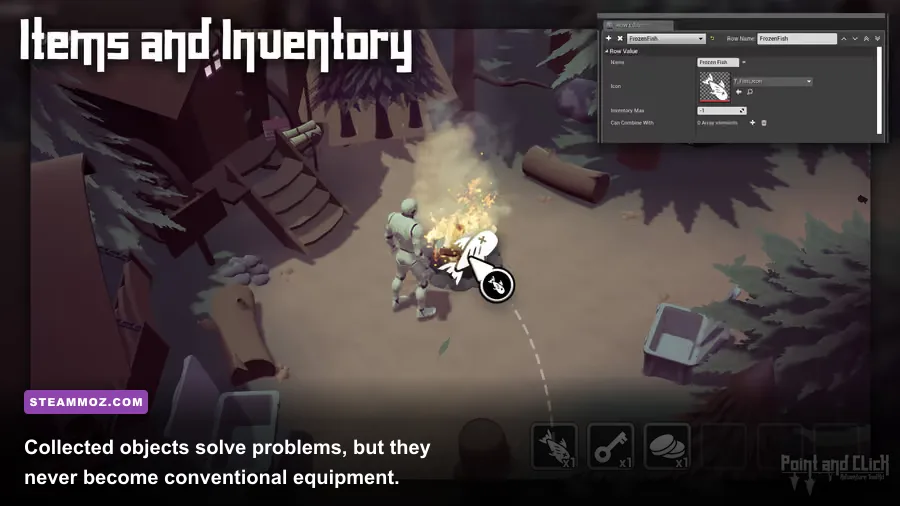
Inventory objects deserve the closest thing Dropsy has to an equipment ranking. The best items are not universally powerful; they are the ones that participate in multi-step chains. An object that makes one character react, points you toward another location, and changes what you can do later is effectively S-Tier. A funny object used once for an optional gag is useful, but it belongs lower.
S-Tier: Objects with a clear relationship chain
Prioritize anything that produces a strong response from a character, animal, or environmental scene. If the game presents a striking visual connection, assume it matters. Keep testing the item in nearby contexts before wandering across the entire map. Dropsy rewards local reasoning: the answer is often closer to the clue than players expect.
A-Tier: Route-opening objects
Objects that let you access a new screen or interact with a previously passive part of the environment are excellent, even if they do not immediately complete a storyline. New routes multiply your options. They also give you more context, which can make earlier puzzles easier to interpret.
B-Tier: One-off comedy and flavor items
These objects are still worth investigating because Dropsy’s humor and optional scenes are part of its appeal. They simply shouldn’t dominate your search when a main interaction is unresolved. If an item produces no reaction after a sensible number of attempts, put it aside and continue exploring.
| Item Priority | Typical Signal | Player Action | Common Mistake |
|---|---|---|---|
| S-Tier | Immediate character or scene reaction | Test nearby people, animals, and objects | Assuming the first reaction is the complete solution |
| S-Tier | Object visually matches a clue | Return to the matching location | Ignoring background details |
| A-Tier | New path or screen becomes available | Explore the entire new area | Leaving after checking only the first hotspot |
| B-Tier | Humorous or unusual one-off response | Record it mentally and move on | Grinding unrelated combinations |
| C-Tier | No response anywhere obvious | Revisit after another story beat | Assuming the item is bugged immediately |
There is no shame in keeping a small note of unresolved reactions. Write down the character, the location, and what changed. That is much more useful than searching for a nonexistent Dropsy equipment build. You can also use screenshots to preserve visual clues, especially if you play in short sessions.
The Best Exploration “Build” for Dropsy
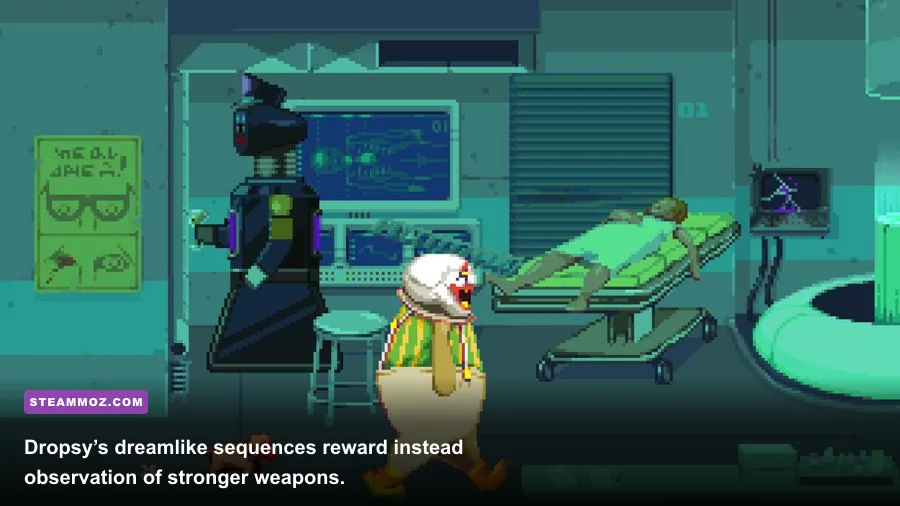
If you want a build recommendation, use this three-part setup: observe, interact, revisit. Start every new screen by scanning the whole composition before clicking. Look for people, animals, doors, unusual objects, blocked paths, and anything that contrasts with the background. Dropsy’s pixel art is busy by design, and the important clue may not be the brightest object.
Next, interact broadly but intelligently. Speak to characters more than once when the scene changes. Try the hug interaction whenever it is available, not because every attempt solves a puzzle, but because emotional responses are part of the game’s logic. A refusal, a smile, or a confused reaction can tell you what kind of obstacle you’re facing.
Finally, revisit. New information can turn an apparently decorative object into a meaningful one. If you have just obtained an item or learned something significant, return to locations that previously felt incomplete. This is the closest thing Dropsy has to a progression loop, and it works better than blindly clicking every inventory object on every person.
Players coming from action games often over-search for an optimal route. Don’t. Dropsy is more generous when you treat the map as a network of stories rather than a combat arena. If you hit a dead end, change the question from “What do I fight?” to “Who has not reacted yet?” That mental shift solves more problems than any hypothetical weapon could.
For contrast, our Clone Drone in the Danger Zone tips focus on enemy timing and defensive movement. Dropsy asks for the opposite skill set: patience, visual memory, and willingness to test an idea without expecting an immediate reward.
How to Avoid Getting Stuck

Most Dropsy roadblocks come from missing a reaction, not from lacking a powerful item. When progress stalls, use a fixed reset routine instead of random clicking. First, revisit every major area you have unlocked. Second, talk to each important character again. Third, check animals and unusual environmental objects. Fourth, review your inventory and look for an item whose visual theme matches a location or person.
Do not assume that a quiet response means failure. Some interactions are deliberately subtle, and the game may communicate progress through a changed expression, a new animation, or a newly accessible scene rather than a pop-up. Take a moment to watch what happens after an interaction instead of instantly opening the next screen.
It’s also worth separating main progression from optional content. Dropsy contains plenty of strange detours, and some are memorable precisely because they don’t behave like conventional quests. If you have spent several minutes testing an object with no meaningful response, mark it as optional or future content and pursue a different character thread.
Use outside help carefully. A walkthrough can reveal the answer, but it can also flatten the joy of discovering why the world works the way it does. If you need a hint, search for the specific location or character rather than “Dropsy all items.” The latter tends to encourage checklist play, which misses the emotional rhythm that makes the game special.
Final Ranking: What Matters Most
The final Dropsy weapon tier list is simple because the premise is simple: there are no weapons to rank. The top-tier equipment is observation, the hug interaction, meaningful inventory objects, and a willingness to revisit places after the story changes. Exploration and animal encounters sit just below them, while optional comedy items are valuable but rarely essential.
If you were searching for a combat build, there is nothing to grind and no loadout to perfect. If you were searching for the best way to progress, focus on reactions and relationships. Dropsy’s strongest tool is the ability to notice what other games train you to ignore: a facial expression, a visual echo, a blocked route, or a character who suddenly seems ready to listen.
That is why the game remains so distinctive. Its progression is not about making Dropsy stronger. It is about making the player more attentive. For more indie-game guidance, see our Decadent starting-build guide and DARIUSBURST beginner build; just remember that neither kind of build logic applies directly here. In Dropsy, empathy is the only real upgrade path.
For more background, visit the developer’s official Tendershoot website and the publisher’s Dropsy page at Devolver Digital. There’s no secret sword waiting at the end of the map—only another odd story, another character to understand, and possibly one more hug.